Mythology-first: what each tradition actually recorded
The standard failure mode in animal-symbolism writing is the mythology smoothie: take the wolf from Norse mythology, the wolf from Roman founding myth, the wolf from Anishinaabe tradition, blend them with Ted Andrews, and serve it as "wolf symbolism in mythology." The problem is that these wolves are doing completely different work in completely different cosmological systems, and blending them produces something accurate to none of them.
Greek and Roman mythology is the most richly documented animal-symbolism tradition in Western literature. Ovid's Metamorphoses (c. 8 CE) (15 books of divine transformations, most of them into animals) is the primary reference. Zeus/Jupiter transforms into a swan (to approach Leda), a bull (to abduct Europa), an eagle (to carry Ganymede to Olympus), a golden shower. Each transformation is theologically specific: the swan's beauty for seduction; the bull's power for abduction; the eagle's aerial authority for the seizure of the future cup-bearer of the gods. Aelian's On Animals (c. 200 CE) catalogs ancient beliefs about specific species, preserving animal lore that would otherwise be lost. These are not interchangeable; reading Ovid directly reveals how precise the mythological logic is.
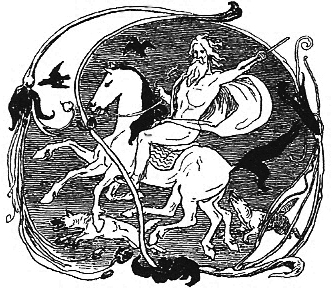
Norse mythology is the tradition with the most dense and documented human-animal relationships in the surviving European corpus. Odin's wolves Geri and Freki (loyal companions who eat Odin's share at the feast while Odin drinks only wine), his ravens Huginn and Muninn (Thought and Memory, his intelligence network), his horse Sleipnir (eight-legged, born of Loki in mare form, able to travel between worlds), and the serpent Níðhöggr (who gnaws the roots of Yggdrasil) are all specific beings with specific relationships to specific deities, not symbolic placeholders. Neil Price's The Viking Way (Oxbow, 2019) is the scholarly standard for the animal-magic dimension of Norse religion.
Celtic mythology is partially reconstructed: the Celts left no written mythology; what survives was recorded after Christianization, in Irish and Welsh manuscript traditions that preserve older oral material in varying degrees of transformation. The Irish Táin Bó Cúailnge (the great cattle raid of Cooley) is organized around the contest of two divine bulls; the war goddess Morrigan appears as a crow or raven. The Gundestrup Cauldron (c. 1st century BCE) shows Cernunnos surrounded by animals. Miranda Green's Animals in Celtic Life and Myth (Routledge, 2000) is the primary scholarly synthesis.
Hindu mythology produces the richest continuous literary record of animal symbolism in any living tradition. The divine vahanas (deity mounts) (Garuda for Vishnu, Nandi for Shiva, the peacock for Karttikeya, the owl for Lakshmi, the rat for Ganesha) are theological statements about the qualities each deity embodies, not decorative choices. The Ramayana's Hanuman (divine monkey general), the Mahabharata's nagas (divine serpents), and the Jataka tales' animal incarnations of the Bodhisattva add further layers. Each requires its own primary-source treatment; the Puranic literature is the main reference.
Egyptian mythology is the oldest tradition with continuous documentary evidence for specific animal-deity relationships. The Pyramid Texts (c. 2400–2300 BCE) are the oldest surviving religious corpus; they contain falcon (Horus), ibis (Thoth), jackal (Anubis), and cow (Hathor) associations that persisted through 3,000 years of Egyptian religion. Erik Hornung's Conceptions of God in Ancient Egypt (Cornell, 1982) is the scholarly standard for understanding the theological logic of Egyptian theriomorphic deities.
The familiar six, and where each one's meaning comes from
Most people arrive asking about the same handful of animals, and each carries a different traditional weight. The wolf runs through Anishinaabe teaching, the Norse sagas and Roman founding myth before it reaches Ted Andrews. The owl runs through Athena's coinage and Lakshmi's mount. The eagle runs through the Roman legion's standard and Hindu Garuda. The bear runs through Finno-Ugric bear feasts and the Ainu iyomante. The butterfly runs through the Greek psyche, and the raven through Odin's Huginn and Muninn. The deer, fox, lion and dolphin pages trace theirs the same way.
Mythology overview
Animal Symbolism in Mythology
One mythology at a time. No smoothie.
Animals carry specific meanings in specific mythologies, and the meanings rarely translate cleanly across traditions. Ovid's Metamorphoses, the Prose and Poetic Edda, the Táin Bó Cúailnge, the Ramayana, and the Pyramid Texts each treat animals differently. The entries below keep those mythologies separate.
Animals in this list
Wolf spirit animal meaning: loyalty, family and teaching. Traced from the modern pop-concept back through Ted Andrews's Animal Speak (1993) to Old Norse sagas, Anishinaabe doodem tradition, and the Roman foundation myth. Named-nation specific. No pan-tribal framing.
Raven spirit animal meaning: transformation, prophecy and intelligence. From the modern pop-concept back through Odin's Huginn and Muninn, the Morrígan in the Táin, the Haida and Tlingit Raven cycles, and Ted Andrews's 1993 synthesis. Named-nation specific.
Eagle spirit animal meaning: courage, freedom and leadership. Traced from the modern courage-freedom reading back through Ted Andrews's Animal Speak to Zeus's eagle in Homer, the Roman legionary aquila, the Vedic Garuda, the Mexica founding of Tenochtitlan, and Lakota eagle-feather protocol.
Snake spirit animal meaning: transformation, rebirth and healing. Traced from the modern transformation-and-rebirth reading back through Ted Andrews's Animal Speak to the serpent in Genesis 3, the Greek Asclepius rod, Indian Nāga and the Buddhist Mucalinda, and Mesoamerican Quetzalcóatl.
Owl spirit animal meaning: wisdom, intuition and insight. Traced from the modern wisdom-and-intuition reading back through Ted Andrews's Animal Speak to Athena's Little Owl on the Athenian tetradrachm, the Roman strix, Lakshmi's vahana uluka, and Japanese fukurō folklore.
Horse spirit animal meaning: freedom, power and speed. Traced from the modern freedom-and-power reading back through Ted Andrews's Animal Speak to the Vedic Aśvamedha, the Greek Pegasus, the Welsh Rhiannon of the Mabinogion, the Gallo-Roman Epona, and the Plains horse cultures that began with the 1680 Pueblo Revolt.
Lion spirit animal meaning: courage, sovereignty and leadership. Traced from the modern courage-and-royalty reading back through Ted Andrews's Animal Speak to Sumerian Inanna and her seven lions, the Egyptian Sekhmet, the Hebrew Bible's Samson and the Lion of Judah, and the Buddhist singha temple guardian.
Bear spirit animal meaning: strength, protection and solitude. Traced from the modern strength-protector reading back through Ted Andrews's Animal Speak to Finno-Ugric bear ceremonialism, the Ainu iyomante, the Greek Brauron arkteia, and Anglo-Saxon kenning tradition.
Dolphin spirit animal meaning: joy, play and intelligence. Traced from the modern joy-and-intelligence reading back through Ted Andrews's Animal Speak to the Homeric Hymn to Apollo at Delphi, Arion's rescue by a dolphin in Herodotus, the Minoan Knossos dolphin fresco, and the Amazonian boto encantado tradition.
Butterfly spirit animal meaning: transformation, rebirth and soul. From the modern pop-concept back to the Greek psyche, the Mexica goddess Itzpapalotl, the Zhuangzi butterfly dream, the Japanese chō, and Ted Andrews's 1993 synthesis.