Where awakening animals come from
The contemporary cluster of "awakening animals" — butterfly, phoenix, snake, eagle, dragonfly — is a modern synthesis that draws on several distinct primary traditions, each of which uses its central animal to make a specific philosophical or theological argument. Understanding the source traditions shows why these particular animals were chosen and what they actually claim.
The butterfly carries awakening associations through two independent sources that converged in Western consciousness. The first is the Greek psychē: the Greek word for "soul" and "butterfly" is identical, and ancient Greek funerary art regularly depicted the soul leaving the body as a butterfly or small winged figure. Apuleius's Metamorphoses (c. 150 CE) — which includes the Psyche-and-Eros myth as its central narrative — uses the butterfly-soul identification to structure a story about the soul's trials and final apotheosis.
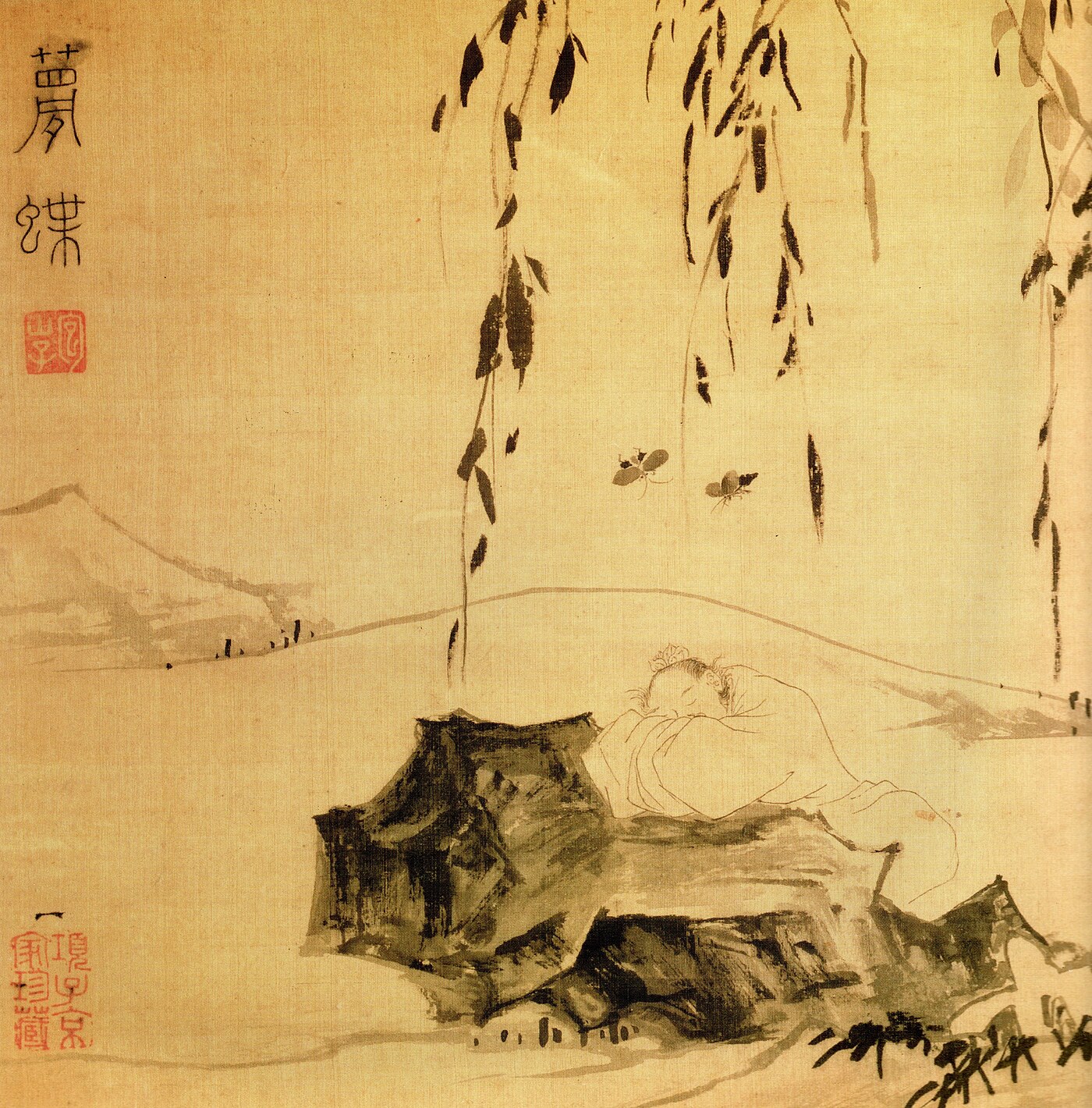
The second source is Zhuangzi's butterfly dream (Chapter 2 of the Zhuangzi, c. 4th century BCE): "Once upon a time, I, Chuang Tzu, dreamt I was a butterfly... Now I do not know whether I was then a man dreaming I was a butterfly, or whether I am now a butterfly dreaming I am a man." This is a specific philosophical argument about the nature of identity, consciousness, and the distinction between dreaming and waking states — the huahu (transformation) between butterfly and man as a parable about the permeability of apparently stable categories. It is not "butterflies = change" in a generic sense; it is a precise metaphysical proposition about whether there is a stable "self" that persists through transformation.
The phoenix carries awakening/resurrection associations through three independent traditions. The Egyptian Bennu — a heron associated with the primordial mound of creation and with the sun's daily renewal — appears in the Pyramid Texts (c. 2400–2300 BCE) as a symbol of the soul's renewal. Greek and Roman authors (Herodotus 2.73, Pliny the Elder Natural History 10.2) recorded the phoenix myth as an Egyptian tradition, adding the self-immolation narrative. The Chinese fenghuang is a distinct composite bird (not specifically associated with fire or self-renewal in Chinese tradition) that became conflated with the Western phoenix through later cross-cultural exchange. These are three different birds with three different theological functions.
The serpent in Kundalini tradition is the most specifically awakening-associated animal in any systematic spiritual framework. The Kundalini is described in tantric and Upanishadic literature as a coiled serpent at the base of the spine (the mūlādhāra chakra); spiritual awakening in this framework is precisely the serpent rising through the spinal chakras to the crown. The Sat-Chakra-Nirūpana (1577 CE) by Purnanda is the primary textual source; John Woodroffe's The Serpent Power (1919) is the most influential early Western translation and commentary. The Kundalini serpent is not a generic "transformation" symbol; it is a specific technical concept within a specific practice system.
The eagle enters awakening symbolism primarily through the solar-renewal tradition: as the sun's companion and highest-flying bird, the eagle appears in multiple traditions as the creature that looks directly at the sun — a metaphor for direct spiritual perception. In Isaiah 40:31 ("they shall mount up with wings like eagles") the image is specifically one of renewed strength after exhaustion. The dragonfly's awakening associations are primarily a modern Western synthesis; its biological metamorphosis (aquatic larva to aerial adult) supplies the transformation metaphor, with Ted Andrews contributing the major interpretive framework in Animal Speak (1993).
Thematic list
Animal Symbolism of Awakening
Metamorphosis, rising, and return — with sources.
The 'awakening' cluster builds on distinct primary traditions: the Greek psyche-as-butterfly and Zhuangzi's butterfly dream, the Egyptian Bennu (phoenix) in the Pyramid Texts, the Kundalini serpent in tantric Upanishadic literature (Sat-Chakra-Nirūpana, 1577), and the eagle in solar-renewal traditions. None is a direct match for the contemporary 'awakening' concept; each contributed to its construction through specific philosophical or theological arguments.
Animals in this list
Butterfly spirit animal meaning, from the modern pop-concept back to the Greek psyche, the Mexica goddess Itzpapalotl, the Zhuangzi butterfly dream, the Japanese chō, and Ted Andrews's 1993 synthesis.
Phoenix spirit animal meaning, traced from the modern resurrection reading back through Ted Andrews's Animal Speak to the Egyptian Bennu of the Pyramid Texts, Herodotus 2.73, Ovid's Metamorphoses 15.391–407, the Chinese fenghuang, and 1 Clement 25's early Christian appropriation.
Snake spirit animal meaning, traced from the modern transformation-and-rebirth reading back through Ted Andrews's Animal Speak to the serpent in Genesis 3, the Greek Asclepius rod, Indian Nāga and the Buddhist Mucalinda, and Mesoamerican Quetzalcóatl.
Eagle spirit animal meaning, traced from the modern courage-freedom reading back through Ted Andrews's Animal Speak to Zeus's eagle in Homer, the Roman legionary aquila, the Vedic Garuda, the Mexica founding of Tenochtitlan, and Lakota eagle-feather protocol.
Owl spirit animal meaning, traced from the modern wisdom-and-intuition reading back through Ted Andrews's Animal Speak to Athena's Little Owl on the Athenian tetradrachm, the Roman strix, Lakshmi's vahana uluka, and Japanese fukurō folklore.
Dragonfly spirit animal meaning, traced from the modern transformation-and-illusion reading back through Ted Andrews's Animal Speak to Japan's ancient name Akitsushima ('Island of Dragonflies') in the Nihon Shoki, samurai kabuto helmet crests, and the Zuni and Hopi Sikyátki dragonfly pottery motif.
Swan spirit animal meaning, traced from the modern grace-and-transformation reading back through Ted Andrews's Animal Speak to the Hindu hamsa of Saraswati and Brahma, the Greek Zeus-as-swan seduction of Leda, the Finnish Swan of Tuonela in the Kalevala, and the Irish Children of Lir.