Reference
Animal Symbolism
What animals have meant, in the traditions that recorded them.
Animal symbolism is not one tradition. What a wolf means in Old Norse sagas, in Anishinaabe teaching, in Roman foundation myth, and in Ted Andrews's Animal Speak (1993) are four different things. The A-Z dictionary below collects every animal spoke on this site; each entry names the tradition it draws on and cites the primary source rather than blending traditions into a generic reading.
Why traditions produce different readings for the same animal
The wolf is the clearest example. In Old Norse saga literature, the wolf appears in three distinct registers: as Odin's companions Geri and Freki (loyal, war-associated, divine); as Fenrir (the monstrous wolf who swallows the sun at Ragnarök, symbol of inevitable chaos); and as the úlfheðnar, the wolf-skin warriors who fought in wolf-fury. These three Norse wolves are not interchangeable with each other. They are also not interchangeable with the wolf in Anishinaabe oral tradition, where the wolf is the brother of Nanabozho and carries specific clan and teaching associations; or with the wolf in Roman founding myth (the she-wolf who suckled Romulus and Remus, a nourishing force rather than a destructive one); or with the wolf as Ted Andrews describes it in Animal Speak (loyalty, teaching, social structure). Collapsing all four into "the wolf means loyalty and instinct" produces something accurate to none of them.
This matters because people come to animal symbolism for genuine reasons: to understand a dream, to choose a meaningful tattoo, to work within a spiritual practice, to understand a text they're reading. Getting a vague pan-cultural answer defeats all of those purposes. Knowing which tradition you're drawing on (and reading what that tradition actually recorded) produces a much more useful result.
How to read the entries on this site
Each animal entry covers at minimum: the Mesopotamian/Near Eastern tradition (usually the oldest documented layer), the Greek and Roman treatment, one or more Indigenous traditions (named specifically by nation and scholar, never generalized as "many Native American tribes"), the Hindu or East Asian tradition where relevant, and the modern pop-spiritual synthesis derived from Ted Andrews. Where traditions agree (the owl as a messenger of death appears in enough unrelated cultures to be significant) that convergence is noted explicitly. Where traditions contradict, the contradiction is in the text.
The Andrews synthesis is named as such throughout. Animal Speak (Llewellyn, 1993) is the book behind most of what the internet calls "animal symbolism," and it is a genuine contribution, a synthesis that made older material accessible to a mass audience. But it blends sources without always naming them, which makes it difficult to use as a scholarly tool. The entries on this site go behind it: naming the Anishinaabe source Andrews drew on, the Norse source, the Egyptian source, and checking what those sources actually say versus what Andrews recorded.
The animals that carry the most cross-cultural weight
Some animals appear in enough unrelated traditions with enough consistency that the convergence itself is informative. The owl appears as a death messenger in ancient Greek, Aztec, Anishinaabe, and West African traditions without any plausible historical contact between those cultures: suggesting either that something about the owl's actual behavior (its nocturnal nature, its silent flight, its haunting call) generates similar symbolic responses, or that the association is deeply psychologically embedded in human pattern-recognition. The snake appears in both healing and destructive roles across Mesopotamian (Ningishzida), Greek (Asclepius), Hebrew (Numbers 21), and Hindu (nāga) traditions, a consistent ambivalence that reflects the snake's biological reality (venomous and medicinal simultaneously).
These convergences do not mean all traditions are saying the same thing. They mean the same animal generates consistent symbolic work across unrelated cultures, which is worth knowing as you read any specific tradition's treatment. The entries note these convergences where they are real and avoid manufacturing them where they are not.
A–Z by animal
Aardvark spirit animal meaning, traced to Dogon cosmogony in Marcel Griaule's Dieu d'Eau, San Bushmen narrative fragments, and the 1778 Dutch etymology (aard-vark, 'earth-pig') that gave the animal its English name.
Alligator and crocodile spirit animal meaning, traced from the modern primal-power reading back through Ted Andrews's Animal Speak to the Egyptian crocodile god Sobek of the Faiyum, the Mesoamerican Cipactli earth-crocodile in Sahagún, the Seminole alligator traditions documented by William Bartram, and Herodotus Book 2 on Egyptian crocodile-worship.
Anteater spirit animal meaning, with honest documentation of a thin pre-modern record. Aztec Florentine Codex references to honey-anteaters, Kayapó Brazilian Amazonian traditions, and the taxonomic history from Linnaeus forward.
Antelope spirit animal meaning, traced to San Bushmen eland-centered rock art documented by David Lewis-Williams, the Egyptian gazelle-goddess Anuket, and the Bamana/Dogon Chi Wara agricultural headdresses.
Armadillo spirit animal meaning, traced from the modern boundaries reading back to Jamie Sams and David Carson's Medicine Cards (1988), and set against the documented record: the Nahuatl turtle-rabbit in Sahagun's Florentine Codex, the Classic Maya armadillo, the Andean charango, identical quadruplets, and leprosy research.
Bat spirit animal meaning, traced from the modern rebirth-and-shadow reading back through Ted Andrews's Animal Speak to the Maya Camazotz in the Popol Vuh, the Chinese fú homophone pun, Aristotle's classification puzzle, and early-modern European witch-familiar folklore.
Bear spirit animal meaning, traced from the modern strength-protector reading back through Ted Andrews's Animal Speak to Finno-Ugric bear ceremonialism, the Ainu iyomante, the Greek Brauron arkteia, and Anglo-Saxon kenning tradition.
Beaver spirit animal meaning, traced from the modern industry-and-construction reading back through Ted Andrews's Animal Speak to the Anishinaabe Amik clan, the Cree and Innu beaver-people narratives, the 1975 Canadian national-emblem status, Pliny the Elder's famous self-amputation error, and the medieval Physiologus bestiary.
Bee spirit animal meaning, traced from the modern community-and-industry reading back through Ted Andrews's Animal Speak to the Egyptian bjt (bee of Lower Egypt), the Ephesian Artemis priestesses called Melissae, Virgil's Georgics Book 4, the Samson-and-honey episode in Judges 14, and Mellonia as Roman household goddess.
Betta fish spirit animal meaning. Honest treatment: no deep ancient tradition, but a documented Thai plakat fighting culture with Siamese royal patronage under King Rama III, and a genuine modern 'solo warrior' pop reading. Includes practical keeping resources.
Bison spirit animal meaning, traced from Ted Andrews's Animal Speak to the Lakota White Buffalo Calf Woman, the sacred pipe, and the 19th-century near-extinction that shaped the modern reading.
Black cat symbolism and superstition, checked against the sources: what the 1233 papal decretal Vox in Rama actually says, who started the claim that cat-killing worsened the Black Death, why England's most famous witch cat was white, and what shelter adoption data really shows.
Blue jay spirit animal meaning, traced honestly: a corvid found only in North America, so no ancient European or Asian tradition can be behind it. What the record does hold is a Cherokee feather charm in Mooney 1900, a Chinookan trickster who is a different bird, a Southern jaybird-and-devil belief, and Ted Andrews in 1993.
Bobcat spirit animal meaning, traced to Cherokee wildcat narratives in Mooney 1900, the Hopi Toho kachina, and related Southwestern and Southeastern Indigenous traditions.
Butterfly spirit animal meaning, from the modern pop-concept back to the Greek psyche, the Mexica goddess Itzpapalotl, the Zhuangzi butterfly dream, the Japanese chō, and Ted Andrews's 1993 synthesis.
Camel spirit animal meaning, traced to the pre-Islamic Bedouin poetry of Imru' al-Qais's Muʿallaqah, Qur'anic verses (88:17 and others), Silk Road commercial centrality, and the Bactrian-versus-dromedary biological split.
Cardinal spirit animal meaning, distinct from our cardinal-visiting-meaning page. Cherokee totsuhwa (daughter of the sun), 1672 English-language etymology from Catholic vestments, and the American memorial tradition.
Cat spirit animal meaning, traced from the modern independence-and-mystery reading back through Ted Andrews's Animal Speak to Egyptian Bastet and the Bubastis cult (Herodotus 2.59–60), Freyja's chariot-cats in Snorri's Prose Edda, and the Japanese maneki-neko tradition.
Cheetah spirit animal meaning, checked against the actual record: the Mughal coursing establishment documented by Abu'l-Fazl and Jahangir, the Eurasian hunting-cheetah trade, the Egyptian leopard-cheetah confusion, and why the modern speed-and-focus reading has no traceable source.
Chipmunk spirit animal meaning, traced to Haudenosaunee how-the-chipmunk-got-its-stripes narratives, Cherokee storytelling in Mooney 1900, and the North American woodland ecological context.
Cougar spirit animal meaning, traced from the modern power-and-decisiveness reading back through Ted Andrews's Animal Speak to the Cherokee night-vision story recorded by James Mooney, the contested puma plan of Inca Cusco, and the naming history that gave one cat over forty English names.
Coyote spirit animal meaning, traced from the modern trickster reading back through Ted Andrews's Animal Speak to specific Indigenous traditions: the Diné Ma'ii, the Great Basin Shoshone-Paiute creator-trickster, California Miwok and Maidu creation narratives, and Tsalagi (Cherokee) material recorded by James Mooney.
Crane spirit animal meaning, traced from the modern longevity-and-grace reading back through Ted Andrews's Animal Speak to the Chinese crane as mount of the xian immortals (Zhuangzi), the Japanese senbazuru thousand-cranes tradition and Sadako Sasaki (1955), the Greek Ibycus-and-the-cranes story in Plutarch, and Celtic crane-bag traditions.
Crocodile spirit animal meaning, cross-referenced to our alligator page and focused on the specifically crocodilian traditions: Egyptian Sobek at Kom Ombo, Hindu Ganga-makara, and Nigerian Òrìṣà contexts.
Crow spirit animal meaning, traced from the modern transformation-and-trickster reading back through Ted Andrews's Animal Speak to the Japanese three-legged Yatagarasu of the Kojiki, Apollo's burned crow in Ovid, the Rāmāyaṇa sage-crow Kakabhusundi, and the British magpie rhyme tradition.
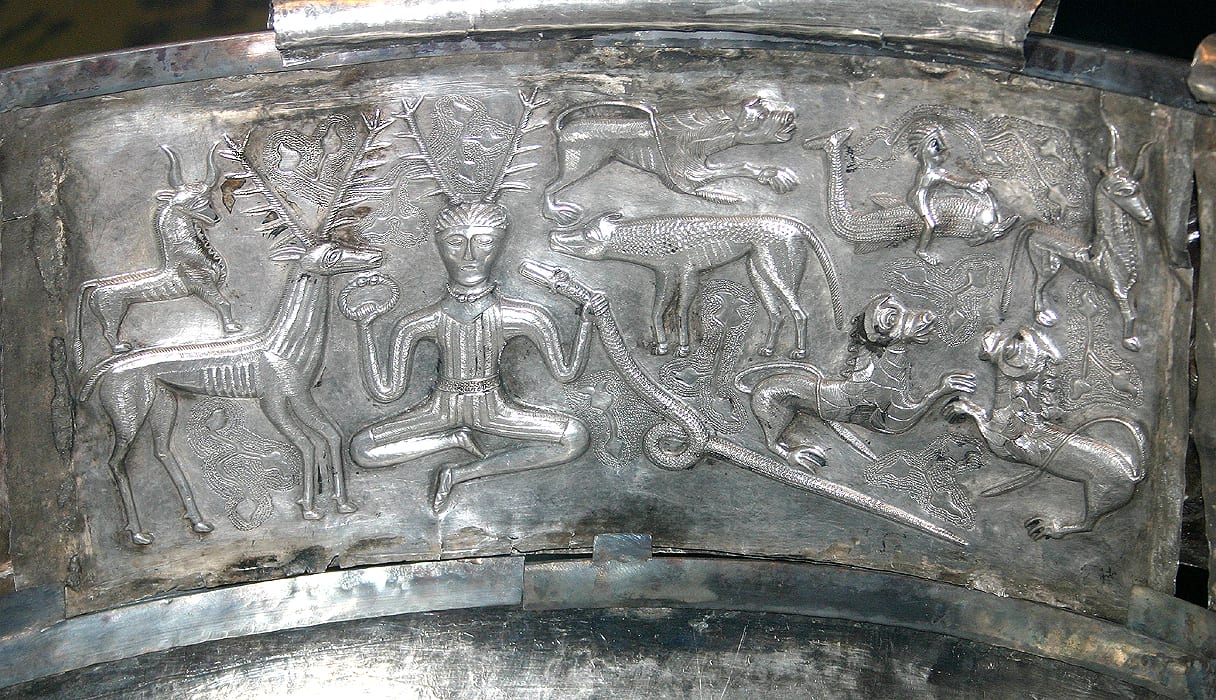
Deer spirit animal meaning, traced from the modern gentleness-and-grace reading back through Ted Andrews's Animal Speak to Artemis's sacred hinds, Celtic Cernunnos on the Gundestrup Cauldron, the deer of Japan's Kasuga shrine, and the Banyan Deer Jātaka.
Dog spirit animal meaning, traced from the modern loyalty-and-companionship reading back through Ted Andrews's Animal Speak to Egyptian Anubis, Greek Cerberus, the Homeric Argos at Odysseus's doorstep, and the Mexica Xolotl and xoloitzcuintli.
Dolphin spirit animal meaning, traced from the modern joy-and-intelligence reading back through Ted Andrews's Animal Speak to the Homeric Hymn to Apollo at Delphi, Arion's rescue by a dolphin in Herodotus, the Minoan Knossos dolphin fresco, and the Amazonian boto encantado tradition.
Dove spirit animal meaning, traced to the Genesis 8 Noah's flood narrative, Aphrodite-Venus iconography, the Christian Holy Spirit descending at Christ's baptism, Mesopotamian Ishtar attribution, and Picasso's 1949 peace-dove poster.
Dragon spirit animal meaning, traced from the modern power-and-wisdom reading back through Ted Andrews's Animal Speak to the Chinese long (龍), the Welsh Y Ddraig Goch, the Norse Fáfnir of the Völsunga saga, the Biblical Leviathan of Job 41, and the Revelation 12 dragon.
Dragonfly spirit animal meaning, traced from the modern transformation-and-illusion reading back through Ted Andrews's Animal Speak to Japan's ancient name Akitsushima ('Island of Dragonflies') in the Nihon Shoki, samurai kabuto helmet crests, and the Zuni and Hopi Sikyátki dragonfly pottery motif.
Eagle spirit animal meaning, traced from the modern courage-freedom reading back through Ted Andrews's Animal Speak to Zeus's eagle in Homer, the Roman legionary aquila, the Vedic Garuda, the Mexica founding of Tenochtitlan, and Lakota eagle-feather protocol.
Elephant spirit animal meaning, traced from the modern memory-and-wisdom reading back through Ted Andrews's Animal Speak to Hindu Ganesha and Airavata, the Buddhist white elephant of Queen Maya's dream, the Thai royal white elephant tradition, and African Bantu matrilineal totemism.
Elk spirit animal meaning, traced from the modern stamina-and-confidence reading back through Ted Andrews's Animal Speak to Lakota elk dreamers and the siyotanka courting flute, the Crow elk-tooth dress, and the Yurok elk-antler purses of Kroeber's 1925 Handbook of the Indians of California.
Falcon spirit animal meaning, distinguished from the hawk and traced from the modern focus-and-precision reading back through Ted Andrews's Animal Speak to the Egyptian Horus, Frederick II's 1240s De Arte Venandi cum Avibus, Arab-Bedouin falconry (UNESCO Intangible Heritage), and Mongol imperial hunting.
Flamingo spirit animal meaning, traced from the modern joy-and-balance reading back through Ted Andrews's Animal Speak to the Egyptian red-sun hieroglyph dshr, Roman imperial flamingo-tongue cuisine (Apicius, Suetonius on Vitellius), Andean Atacama flamingo reverence, and Caribbean Taíno featherwork.
Fox spirit animal meaning, traced from the modern cleverness-adaptability reading back through Ted Andrews's Animal Speak to Japanese kitsune and Inari shrine practice, Chinese húli jīng, the European Reynard tradition, and Aesop's fables.
Frog spirit animal meaning, traced from the modern transformation-and-cleansing reading back through Ted Andrews's Animal Speak to the Egyptian goddess Heqet, Aristophanes's 405 BCE comedy Frogs, the Chinese moon-toad Chán Chú in the Huainanzi, and the second plague of Egypt in Exodus 8.
Giraffe spirit animal meaning, traced from the modern farseeing-perspective reading back through Ted Andrews's Animal Speak to the Egyptian giraffe-hieroglyph sr, the 1414 Ming-dynasty episode in which a giraffe gifted by the Bengal Sultan was identified as a qilin, and the San Bushmen rain-dance tradition.
Goat spirit animal meaning traced to real sources: the Chinese zodiac word yang that refuses to say goat or sheep, the two goats of Leviticus 16 and Azazel, Thor's goats in the Prose Edda, and the 1856 drawing that gave the devil a goat's head.
Goose spirit animal meaning, traced to real sources: the geese of Juno who woke Manlius in Livy Book 5, the Egyptian Great Cackler and the Meidum geese, the documented origin of Mother Goose in Perrault 1697, and peer-reviewed work on pair bonds and V-formation that unusually supports the folk reading.
Groundhog spirit animal meaning, traced to Lenape (Delaware) traditions, the Pennsylvania Dutch Candlemas tradition that seeded Groundhog Day, and the 1887 Punxsutawney Phil origin.
Hawk spirit animal meaning, traced from the modern vision-and-messenger reading back through Ted Andrews's Animal Speak to the Egyptian Horus and Ra-Horakhty tradition, Roman and Etruscan augury, and Lakota hawk imagery documented by Frances Densmore.
Hedgehog spirit animal meaning, traced through Pliny's claim that hedgehogs carry apples home on their spines, the heraldic urcheon, Egyptian rebirth amulets, and the Archilochus fragment Isaiah Berlin made famous in 1953.
Horse spirit animal meaning, traced from the modern freedom-and-power reading back through Ted Andrews's Animal Speak to the Vedic Aśvamedha, the Greek Pegasus, the Welsh Rhiannon of the Mabinogion, the Gallo-Roman Epona, and the Plains horse cultures that began with the 1680 Pueblo Revolt.
Hummingbird spirit animal meaning, traced from the modern joy-and-lightness reading back through Ted Andrews's Animal Speak to the Aztec war-god Huitzilopochtli, the Nazca hummingbird geoglyph, the Taíno colibrí narrative, and early modern European encounters with the bird.
Jaguar spirit animal meaning, traced through the sixty-year scholarly argument over the Olmec were-jaguar, the Maya balam and the Popol Vuh, Andean feline imagery at Chavin, the Mexica ocelotl, and Ted Andrews's Animal Speak.
Kangaroo spirit animal meaning, traced to Aboriginal Australian Dreamtime narratives documented by T.G.H. Strehlow, W.E.H. Stanner, and contemporary Aboriginal scholars, plus James Cook's 1770 first European encounter and the 1908 Australian Coat of Arms.
Koala spirit animal meaning, traced to Dharug and Gweagal Dreaming narratives, David Collins's 1798 An Account of the English Colony in New South Wales, and the contemporary bushfire-and-conservation context following the 2019–20 Australian fires.
Ladybug spirit animal meaning, traced to medieval European Marian 'Our Lady's Beetle' etymology, Turkish uğur böceği (luck-beetle), the 'Ladybug, ladybug, fly away home' nursery rhyme, and broader agricultural-beneficial-insect folklore.
Leopard spirit animal meaning, traced from the modern stealth-and-power reading back through Ted Andrews's Animal Speak to the Egyptian sem priest's spotted garment, the Oba of Benin as leopard of the home, and the Greek word pardalis.
Lion spirit animal meaning, traced from the modern courage-and-royalty reading back through Ted Andrews's Animal Speak to Sumerian Inanna and her seven lions, the Egyptian Sekhmet, the Hebrew Bible's Samson and the Lion of Judah, and the Buddhist singha temple guardian.
Llama spirit animal meaning, traced from the modern steady-service reading back through Ted Andrews's Animal Speak to Incan white-llama sacrifice documented by Bernabé Cobo's 1653 Historia del Nuevo Mundo, Moche decapitator-priest iconography, and contemporary Aymara ch'alla libation ceremonies.
Monkey spirit animal meaning traced to real sources: Sun Wukong in a novel published anonymously in 1592, Hanuman in Valmiki's Ramayana, the Japanese wordplay behind the three wise monkeys at Nikko, Thoth in baboon form, and Churchill's 1944 order about the apes of Gibraltar.
Moose spirit animal meaning, traced from the modern self-esteem-and-groundedness reading back through Ted Andrews's Animal Speak to the Anishinaabe Mooz doodem, Mistassini Cree hunting religion, Wabanaki moose-calling craft, and the elk-head staffs of the Mesolithic Baltic.
Moth spirit animal meaning, traced to sources that exist: the death's-head hawkmoth named for the Fates and read as an omen in nineteenth-century Britain, the moth and candle of Attar's Conference of the Birds, the bogong moth harvested on GunaiKurnai Country, and a 2024 paper that overturns the moth-to-a-flame explanation.
Octopus spirit animal meaning, traced from the modern intelligence-and-adaptability reading back through Ted Andrews's Animal Speak to Minoan octopus pottery (c. 1500 BCE), the Ainu Akkorokamui, Hawaiian Kanaloa, and the Fijian octopus-god Rokobakaniceva who defeated the shark.
Otter spirit animal meaning, traced from the modern playfulness reading back through Ted Andrews's Animal Speak to the sacred otter of the Zoroastrian Avesta Vendidad 14, the Anishinaabe Nigig clan and the Midewiwin otter-skin medicine bag, the Scottish Hebridean otter-king folklore, and the Japanese kawauso yōkai.
Owl spirit animal meaning, traced from the modern wisdom-and-intuition reading back through Ted Andrews's Animal Speak to Athena's Little Owl on the Athenian tetradrachm, the Roman strix, Lakshmi's vahana uluka, and Japanese fukurō folklore.
Ox spirit animal meaning, traced to sources that exist: the ox as second animal of the Chinese zodiac, Laozi's departure west in Sima Qian's Shiji and the ox that is not in it, Kuoan Shiyuan's ten ox-herding pictures, the aurochs behind every domestic cow, and why the ox at the manger comes from Isaiah rather than Luke.
Panda spirit animal meaning: an unusually honest treatment. The giant panda is barely attested in classical Chinese religious and literary sources, was 'discovered' by the West via Armand David in 1869, and became a global symbol only after Mao's 1950s–70s panda diplomacy and the WWF's 1961 adoption of the image.
Peacock spirit animal meaning, traced from the modern beauty-and-pride reading back through Ted Andrews's Animal Speak to Kartikeya's mount in South Indian Tamil tradition, Hera-Juno's Argus-eyed peacock in Ovid's Metamorphoses, the Yazidi Tawûsê Melek, and Byzantine Christian resurrection iconography.
Pelican spirit animal meaning, traced from the modern self-sacrifice reading back through heraldry, Dante and Aquinas to the Physiologus of about the second century, and to the biological mistake underneath the whole tradition.
Penguin spirit animal meaning: an honest treatment. Penguins are a Southern Hemisphere family unknown to Old World ancient civilizations. Their spiritual-cultural tradition is almost entirely post-1520 (Magellan) and largely 20th-century. Māori kororā and Antarctic exploration literature are the main threads.
Phoenix spirit animal meaning, traced from the modern resurrection reading back through Ted Andrews's Animal Speak to the Egyptian Bennu of the Pyramid Texts, Herodotus 2.73, Ovid's Metamorphoses 15.391–407, the Chinese fenghuang, and 1 Clement 25's early Christian appropriation.
Pig spirit animal meaning traced to real sources: the twelfth branch of the Chinese zodiac, Zhu Bajie in Journey to the West, what Leviticus 11 and Deuteronomy 14 actually say and do not say, the Thesmophoria piglets, and the peer-reviewed record on pig cognition.
Praying mantis spirit animal meaning, traced from the modern stillness-and-patience reading back through Ted Andrews's Animal Speak to ǀKaggen of the ǀXam San, the Greek word for a prophet that gave the insect its name, and the Chinese martial art built on its strike.
Rabbit spirit animal meaning, traced from the modern fertility-and-timidity reading back through Ted Andrews's Animal Speak to the Mesoamerican Four Hundred Rabbits (Centzon Tōtōchtin), the Chinese moon-hare and Japanese Inaba hare, and the African-rooted Br'er Rabbit trickster.
Raccoon spirit animal meaning, traced from the modern curiosity-and-disguise reading back through Ted Andrews's Animal Speak to the Powhatan and Nahuatl hand-etymologies, a Cherokee trickster tale recorded by James Mooney, the Passamaquoddy and Penobscot Lox-as-raccoon material collected by Charles Godfrey Leland, and the Abenaki raccoon-trickster Azeban.
Ram spirit animal meaning, traced to sources that exist: the ram-headed sphinxes of Amun at Karnak and the two Egyptian sheep whose horns tell them apart, the Ur statuette Woolley named for Genesis 22 that is not a ram, Agni's mount in the Vedic fire cult, and the Mishnah's ruling on why a shofar cannot be a cow's.
Rat spirit animal meaning, traced to sources that exist: the 217 BCE bamboo daybook that pairs the rat with the first earthly branch, Ganesha's mouse and when it actually appears, the Karni Mata temple at Deshnoke, and the 2018 PNAS paper that argued the Black Death was not spread by rats.
Raven spirit animal meaning, from the modern pop-concept back through Odin's Huginn and Muninn, the Morrígan in the Táin, the Haida and Tlingit Raven cycles, and Ted Andrews's 1993 synthesis. Named-nation specific.
Rhinoceros spirit animal meaning, traced from the modern ancient-power reading back through Ted Andrews's Animal Speak to Albrecht Dürer's 1515 woodcut of a rhinoceros he never saw, the Chinese xiniu medicinal tradition documented in the Bencao Gangmu, and the contemporary conservation context that is arguably more significant than any pre-modern spiritual reading.
Rooster spirit animal meaning traced to real sources: the bird Parodars who wakes the world in Vendidad 18, the cock crow in the Gospel accounts of Peter's denial, the oldest surviving weathercock of about 820, and the Latin pun on gallus behind the French emblem.
Scorpion spirit animal meaning, traced from the modern defense-and-transformation reading back through Ted Andrews's Animal Speak to the Egyptian goddess Serqet, the scorpion-men of the Epic of Gilgamesh Tablet IX, the Orion-and-Scorpio star myth, and the Isis-and-seven-scorpions narrative.
Sea turtle spirit animal meaning, distinguished from the broader turtle page and focused on Pacific traditions: Hawaiian honu 'aumakua, the Japanese Urashima Tarō tale, and Māori whai and related Polynesian practices.
Seahorse spirit animal meaning, traced from the modern patience-and-male-pregnancy reading back through Ted Andrews's Animal Speak to Poseidon's hippocampus in Homer and Pausanias, the Pictish sea-horse stone carvings of 6th–9th century Scotland, the traditional Chinese medicine tradition, and contemporary conservation status.
Shark spirit animal meaning, traced from the modern ferocity-and-survival reading back through Ted Andrews's Animal Speak to the Hawaiian shark 'aumakua and Kāmohoaliʻi, the Fijian shark-god Dakuwaqa, the Solomon Islands shark-calling tradition, and Māori mako culture.
Snake spirit animal meaning, traced from the modern transformation-and-rebirth reading back through Ted Andrews's Animal Speak to the serpent in Genesis 3, the Greek Asclepius rod, Indian Nāga and the Buddhist Mucalinda, and Mesoamerican Quetzalcóatl.
Spider spirit animal meaning, traced from the modern creativity-and-weaving reading back through Ted Andrews's Animal Speak to the West African Anansi trickster cycle, Diné and Hopi Grandmother Spider, Ovid's Arachne, and the Japanese jorōgumo of Edo-era folklore.
Squirrel spirit animal meaning, traced from the modern preparation-and-thrift reading back through Ted Andrews's Animal Speak to Ratatoskr in the Norse Eddas and the ambivalent industry-and-greed squirrel of medieval European bestiaries.
Swan spirit animal meaning, traced from the modern grace-and-transformation reading back through Ted Andrews's Animal Speak to the Hindu hamsa of Saraswati and Brahma, the Greek Zeus-as-swan seduction of Leda, the Finnish Swan of Tuonela in the Kalevala, and the Irish Children of Lir.
Tiger spirit animal meaning, traced from the modern strength-and-courage reading back through Ted Andrews's Animal Speak to Durga's mount in the Devi Mahatmya, the Korean mountain-god sanshin, the Chinese Bai Hu (White Tiger) of the Four Symbols, and the Siberian Tungusic Amba.
Turtle spirit animal meaning, traced from the modern patience-and-longevity reading back through Ted Andrews's Animal Speak to the Haudenosaunee Turtle Island creation narrative, the Hindu Kurma avatar, the Chinese Black Tortoise Xuanwu, and the Hawaiian honu.
Unicorn spirit animal meaning, traced from the modern purity-and-magic reading back through Ted Andrews's Animal Speak to Ctesias of Cnidus's Indica (5th century BCE), Pliny the Elder, the Septuagint/KJV translation of Hebrew re'em as 'unicorn,' the Physiologus, and the Chinese qilin (usually confused with the unicorn in English).
Vulture spirit animal meaning, traced from the modern purification-and-rebirth reading back through Ted Andrews's Animal Speak to Egypt's Nekhbet and Mut, Zoroastrian dakhma excarnation, Tibetan sky burial (jhator), and the Aztec vulture day-sign Cozcacuauhtli.
Whale spirit animal meaning, traced from the modern wisdom-and-memory reading back through Ted Andrews's Animal Speak to the Book of Jonah, the Inuit Sedna narrative, the Māori Paikea (whale-rider) tradition, the Greek Ketos of Perseus and Andromeda, and Herman Melville's Moby-Dick.
Wolf spirit animal meaning, traced from the modern pop-concept back through Ted Andrews's Animal Speak (1993) to Old Norse sagas, Anishinaabe doodem tradition, and the Roman foundation myth. Named-nation specific. No pan-tribal framing.
Zebra spirit animal meaning, traced to San Bushmen rock art, Roman circus hippotigris exhibitions documented by Dio Cassius, and the 1883 extinction of the quagga subspecies, a conservation-context bookend to the living plains, mountain, and Grévy's zebras.