Animals in the Bible
The Dove in the Bible: Noah's Peace, the Holy Spirit, and the Offering of the Poor
The dove does three distinct theological jobs in the biblical text. And in Hosea 7:11 it does a fourth — as a figure of foolishness — that almost no one quotes.
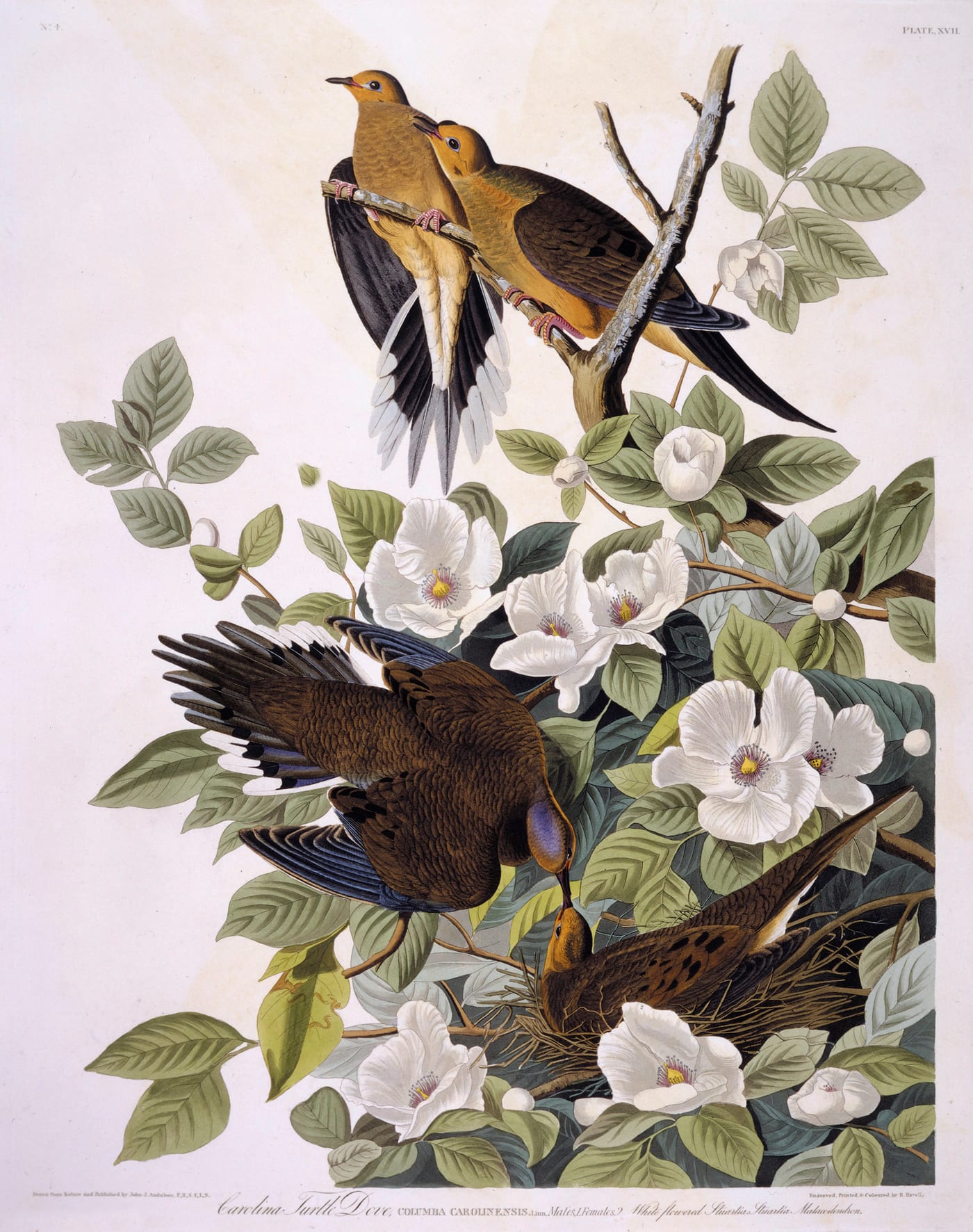
The biblical dove (Hebrew yonah; Greek peristerá) is the founding text for the Western peace-dove symbol. In Genesis 8:11, Noah's dove returns with a fresh olive leaf, signaling the end of the Flood. Song of Solomon addresses the beloved as 'my dove' (2:14; 5:2; 6:9) — a term of tenderness. All four Gospels record the Holy Spirit descending as a dove at Jesus's baptism. Leviticus 12:8 and Luke 2:24 place doves as the sacrifice of the poor, marking Jesus's family's economic status. Hosea 7:11 uses the dove as a figure of naive, directionless political behavior — a use that rarely makes it into popular treatments.
The dove is the biblical animal whose popular meaning is most accurately inherited from the primary text. Genesis 8:11 really does give the dove its peace-sign meaning, and Matthew 3:16 really does make it the Holy Spirit's form. But the full biblical dove tradition is larger than these two passages. Song of Solomon gives the dove to lovers. Leviticus gives it to the poor. And Hosea gives it to politicians who don't know what they're doing.
Genesis 8: the olive leaf and what it actually means
Noah releases the dove seven days after the raven's inconclusive flight (Genesis 8:7–8). The first release returns with nothing — the waters still cover the earth. The second, seven days later, returns with a fresh olive leaf (v. 11, BHS: ʿaleh-zayit taraf). The Hebrew taraf means "freshly plucked" or "torn off" — the leaf is live, not dried. Noah understands: the tree is above water, the world is recovering. The third release, seven days later, does not return at all (v. 12): the dove has found a place to land and stay.
The dove's return with the olive leaf is a sign that divine judgment has ended and the world is accessible again. "Peace" in the modern sense — international harmony — is a downstream inference. The original meaning is more specific: the waters of destruction have receded, life is possible again. Pablo Picasso's 1949 lithograph dove, used for the World Peace Congress poster, attached this imagery to Cold War politics. That use is legitimate, but it is historically two steps removed from Genesis 8's original meaning.
Song of Solomon: the dove as beloved
Song of Solomon uses "my dove" (yonati) as an intimate address for the female beloved in three passages: 2:14 ("O my dove, in the clefts of the rock"), 5:2 ("Open to me, my sister, my love, my dove, my perfect one"), and 6:9 ("My dove, my perfect one, is the only one"). The dove is a term of endearment, not a theological symbol. Its use is erotic and tender. The Song of Solomon's dove is as far from Noah's flood-recession signal as possible in register, which is theologically significant: the same canonical text holds the dove as eschatological new-beginning and as intimate love-name.
The Gospels: the Holy Spirit as dove
All four Gospels record the Spirit's descent at Jesus's baptism using dove imagery: Matthew 3:16 (hōsei peristerán — "like a dove"), Mark 1:10 (hōs peristerán), Luke 3:22 (sōmatikōi eidei hōs peristerán — "in bodily form like a dove"), John 1:32 (theaomai to pneuma katabaínon hōs peristerán — "I saw the Spirit descending like a dove"). The dove-baptism is the only event present in all four Gospels. Luke specifies "in bodily form" — the Spirit does not merely descend in a dove-like manner; it takes a physical form. This is the textual foundation for all subsequent Christian dove iconography, from the San Vitale mosaics (c. 547 CE) onward.
Leviticus and Luke: the dove of the poor
Leviticus 12:8 specifies the purification offering for women who cannot afford a lamb: two turtledoves or two young pigeons. Luke 2:24 records that Mary and Joseph brought this exact offering — "a pair of turtledoves, or two young pigeons" — at Jesus's presentation in the Temple. This is a socioeconomic marker embedded in the birth narrative: the Messiah's family is in the class for whom the cheap offering is the only option. Luke's Gospel consistently emphasizes Jesus's association with the poor; the dove-offering is one of its quietest and most precise documentary details.
Hosea: the foolish dove
Hosea 7:11 provides the least-quoted bird verse in the prophetic literature: "Ephraim is like a dove, silly and without sense, calling to Egypt, going to Assyria." The dove here is not peaceful; it is naive, fluttering between superpowers without comprehending its own danger. The prophet is criticizing Israel's foreign policy of playing Egypt and Assyria against each other — and the image he chooses is a bird known for its harmlessness, its disorientation, and its lack of tactical sense. The biblical text is not committed to the dove as a uniformly positive symbol.
Frequently asked
- What does the dove symbolize in the Bible?
- The biblical dove carries three distinct meanings. First, peace and new beginnings: Genesis 8:11, where Noah's dove returns with a fresh olive leaf, signaling the end of the Flood. Second, love and intimacy: Song of Solomon uses 'my dove' (yonah) as a term of endearment for the beloved. Third, the Holy Spirit: all four Gospels record the Spirit descending as a dove (peristerá) at Jesus's baptism. A fourth, lesser-noted use appears in Hosea 7:11, where 'Ephraim is like a dove, silly and without sense' — the dove as naive and vulnerable, not wise.
- Why did Jesus's family offer doves at the Temple?
- Leviticus 12:8 specifies that a woman who cannot afford a lamb for the purification offering may instead bring two turtledoves or two pigeons. Luke 2:24 records that Mary and Joseph brought 'a pair of turtledoves or two young pigeons' for Jesus's presentation in the Temple. This is a specific marker: the family was not wealthy enough to bring a lamb. The dove-offering is an economic detail with theological weight — it places Jesus's family in the class of the Levitical poor, consistent with the poverty themes in Luke's Gospel.
- Is the dove's peace meaning in the Bible really about peace?
- In Genesis 8, the dove's olive leaf means the Flood is over and God's judgment has ended. 'Peace' in the modern sense — harmony, absence of conflict — is a secondary inference. The primary meaning is that the world is accessible again, that death has receded. Pablo Picasso's 1949 white dove poster grafted the Genesis imagery onto Cold War international-peace iconography, which is why the dove-equals-peace equation feels universal in 2026. The Biblical original is more specific: the dove signals the end of a specific catastrophe.
Sources
- PRIMARYGenesis 8:8–12 (BHS) — Noah releases the dove; its return with a fresh olive leaf (v. 11) signals the recession of the Flood. The founding dove-as-peace text in the Western record.
- PRIMARYSong of Solomon 2:14; 5:2; 6:9 (BHS) — The beloved addressed as 'my dove' (yonah) — the Hebrew term of endearment. 'My dove, my perfect one' (6:9) is among the most tender uses of the dove-name in the Hebrew Bible.
- PRIMARYMatthew 3:16; Mark 1:10; Luke 3:22; John 1:32 (NA28) — All four Gospels record the Holy Spirit descending as a dove (peristerá) at Jesus's baptism. The only Gospel event witnessed in all four accounts.
- PRIMARYLeviticus 1:14; 5:7; 12:8 (BHS) — Doves and turtledoves as the acceptable sacrifice for those who cannot afford a lamb. The economic sliding-scale of the sacrifice system; Luke 2:24 records Mary and Joseph offering 'a pair of turtledoves' at Jesus's presentation — the offering of the poor.
- PRIMARYLuke 2:24 (NA28) — The presentation of the infant Jesus in the Temple; Mary and Joseph's dove-offering under Leviticus 12:8. The historical marker of Jesus's family's economic status.
- PRIMARYHosea 7:11 (BHS) — 'Ephraim is like a dove, silly and without sense, calling to Egypt, going to Assyria.' The dove as politically naive in the prophetic tradition — a negative use of the dove image.