Animals in the Bible
Fish in the Bible: Jonah's Three Days, the Feeding of the Five Thousand, 153 Resurrection Fish, and the Ichthys Symbol
A fish that swallows a prophet, a meal that feeds five thousand from almost nothing, a strange number of fish in a resurrection appearance, and a secret symbol that became Christianity's most recognized logo.
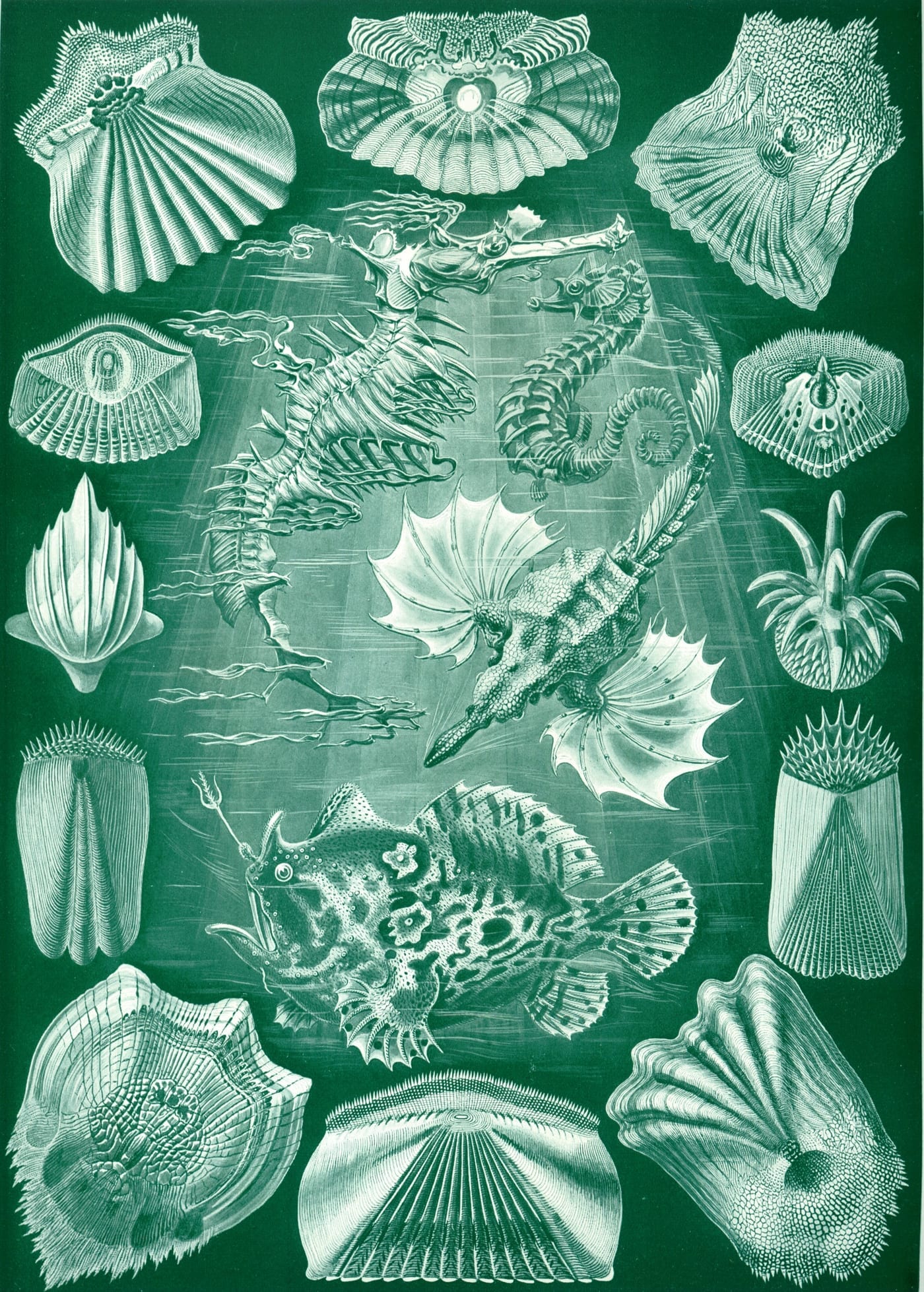
The fish in the biblical text carries multiple distinct theological functions. The dag gadol (great fish) of Jonah 1:17 swallows the prophet, contains him three days, and vomits him out — a pattern Jesus explicitly cites (Matthew 12:40) as a type of his burial and resurrection. The miraculous fish-multiplications (Matthew 14; John 6) connect the fish to eucharistic provision. John 21's 153 large fish in an unbroken net is a resurrection appearance that has generated centuries of numerological interpretation. The early Christian ichthys (ΙΧΘΥΣ) fish was a Greek acrostic: Iesous CHristos THeou HYios Soter.
Of all the animals in the Bible, the fish is the one with the most surprising post-biblical trajectory. The great fish of Jonah becomes the template for the Resurrection. A small fish supper for a few disciples becomes a eucharistic feast for five thousand. A post-resurrection breakfast on the shore features the risen Christ cooking fish over coals. And a simple two-curved-line drawing of a fish becomes, in the catacombs, the secret symbol of a persecuted religion. None of these outcomes are obvious from the fish's role in the Hebrew pastoral economy.
Jonah's fish: survival and typology
The Hebrew text of Jonah 1:17 says simply dag gadol — "a great fish." Neither species nor size is specified. The fish swallows Jonah when he is thrown overboard; Jonah's prayer is offered from the fish's belly (chapter 2). After three days and three nights, the fish vomits Jonah onto dry land. The fish is not a monster-figure or a punishment vehicle; it is a survival mechanism. Jonah was thrown into the sea to drown and is instead preserved alive in the fish's belly for three days.
Matthew 12:40 records Jesus using this episode as a self-referential sign: "For just as Jonah was three days and three nights in the belly of the great fish, so will the Son of Man be three days and three nights in the heart of the earth." The structural parallel is preservation through apparent death. Jonah goes into the deep and comes out alive; Jesus goes into death and comes out alive. The fish's belly is the womb of the resurrection typology.
The feeding of the five thousand: fish and bread
The feeding of the five thousand is the only miracle recorded in all four Gospels (Matthew 14:17–21; Mark 6:38–44; Luke 9:13–17; John 6:1–14). The available food is five loaves and two fish (five loaves and five fish in some readings). John 6 specifies opsária for the fish — small salted or pickled fish, a standard common food of the Galilean fishing economy. The eucharistic resonance in John 6 is developed extensively: verses 51–58 extend the feeding into a discourse on eating Jesus's flesh and blood. The fish disappears from the John 6 eucharistic interpretation; the bread takes center stage. The fish's role is historically grounded (it is the food of Galilean fishermen) but theologically preliminary.
John 21: the 153 fish
John 21:11 is one of the most precisely numbered miracle narratives in the Gospels: "Simon Peter went aboard and hauled the net ashore, full of large fish, 153 of them. And although there were so many, the net was not torn." The risen Jesus is on the shore; the disciples have been fishing all night without success; Jesus instructs them to cast on the right side; the net fills. The specific number 153 is unexplained in the text. Jerome's commentary on Ezekiel (c. 400 CE) notes that ancient Greek naturalists counted 153 species of sea fish, making the catch a symbol of universal completeness. Augustine proposed the arithmetic reading. Modern scholars propose various interpretations. None is definitive. John simply records the number, and the number's precision — not "about 150" but exactly 153 — signals that it is meaningful without explaining how.
The ichthys symbol
The ichthys (ΙΧΘΥΣ, "fish" in Greek) as a Christian symbol is documented in catacomb art from the 2nd century CE. Robin Jensen's Early Christian Art and Architecture (University of California Press, 2015) provides the archaeological evidence. The fish drawing — two arcs meeting at a point — worked as both a pictographic fish and an acrostic: Iesous CHristos THeou HYios Soter (Jesus Christ Son of God Savior). In contexts of Roman persecution, the symbol could be drawn quickly and recognized by other believers without explanation. Its survival as a popular Christian symbol into 21st-century culture (car emblems, jewelry) makes it one of the longest-lived animal-symbols in Western religious history.
Frequently asked
- What does the fish symbolize in the Bible?
- The fish in the Bible is primarily associated with miraculous divine provision (the feeding of the five thousand, Matthew 14 and John 6), resurrection typology (Jonah's three days in the fish, cited by Jesus in Matthew 12:40 as a sign of his burial and resurrection), and the vocational identity of Jesus's first disciples (four of the Twelve were commercial fishermen). The early Christian ichthys symbol (a fish drawn with two curved lines) was an acrostic — Iesous CHristos THeou HYios Soter (Jesus Christ Son of God Savior) in Greek — used as a secret identifier in persecution contexts.
- What is the Jonah fish and how does Jesus use it?
- The Hebrew text of Jonah 1:17 says dag gadol — 'a great fish.' It does not specify a species; the Septuagint renders it as ketos (great sea-creature). Matthew 12:40 has Jesus cite the Jonah episode directly as a typological sign: 'as Jonah was three days and three nights in the belly of the great fish, so will the Son of Man be three days and three nights in the heart of the earth.' The fish is the vehicle of Jonah's survival of what should have been death by drowning; Jesus uses this as the template for his own burial and resurrection.
- What is the significance of the 153 fish in John 21?
- John 21:11 records the disciples catching 153 large fish in a net that does not break, after the risen Jesus tells them where to cast from the shore. The number 153 has generated extensive commentary: Jerome (c. 400 CE) noted that Greek zoologists of his era counted 153 species of fish, making 153 a symbol of the totality of creation. Augustine proposed a numerical interpretation: the sum of 1+2+3...+17 = 153, and 17 = 10 (commandments) + 7 (gifts of the Spirit). Neither explanation is in the text; John 21 simply records the number without explanation.
- Why were so many of Jesus's disciples fishermen?
- The Sea of Galilee (Kinneret) was a commercial fishing center in first-century Judea. Peter, Andrew, James, and John — half of the inner circle — were fishermen. The fishing economy of the Galilee region was significant: archaeologists at Magdala have documented first-century fish-processing facilities. Jesus's ministry was centered in the fishing villages of the northwestern shore (Capernaum, Bethsaida). The fishing metaphor ('fishers of men,' Mark 1:17) was a natural vocational translation for an audience of commercial fishermen.
Sources
- PRIMARYJonah 1:17; 2:1–10 (BHS) — The great fish (dag gadol) that swallows Jonah; his prayer from the fish's belly; his vomiting out after three days. The fish as divine instrument of survival rather than judgment.
- PRIMARYMatthew 12:40 (NA28) — 'For just as Jonah was three days and three nights in the belly of the great fish, so will the Son of Man be three days and three nights in the heart of the earth.' Jesus's explicit typological use of the Jonah fish.
- PRIMARYMatthew 14:17–21; John 6:1–14 (NA28) — The feeding of the five thousand: five loaves and two fish. John 6 identifies the fish as opsária (small salted fish) — a specific common food. The eucharistic resonances in John 6.
- PRIMARYJohn 21:1–14 (NA28) — The post-resurrection fishing scene: 153 large fish caught after the risen Jesus instructs the disciples where to cast the net. The meal of bread and fish prepared by the risen Christ.
- PRIMARYLuke 5:1–11 (NA28) — The miraculous catch of fish: the breaking nets, Peter's 'I am a sinful man, O Lord,' the call to leave the boats. 'From now on you will be catching men.'
- PRIMARYMark 1:16–17 (NA28) — The call of the fishermen: Simon, Andrew, James, John — four of the Twelve are commercial fishermen called from their work.
- PEER-REVIEWEDRobin M. Jensen, Early Christian Art and Architecture — University of California Press, 2015. The ichthys fish symbol in early Christian catacomb art; the Greek acrostic ΙΧΘΥΣ (Jesus Christ Son of God Savior).