Animals in the Bible
The Lamb in the Bible: Passover, Isaiah's Servant, and the 29 Appearances in Revelation
The lamb does three distinct theological jobs across the biblical canon, and they all reinforce each other in ways that are carefully constructed rather than coincidental.
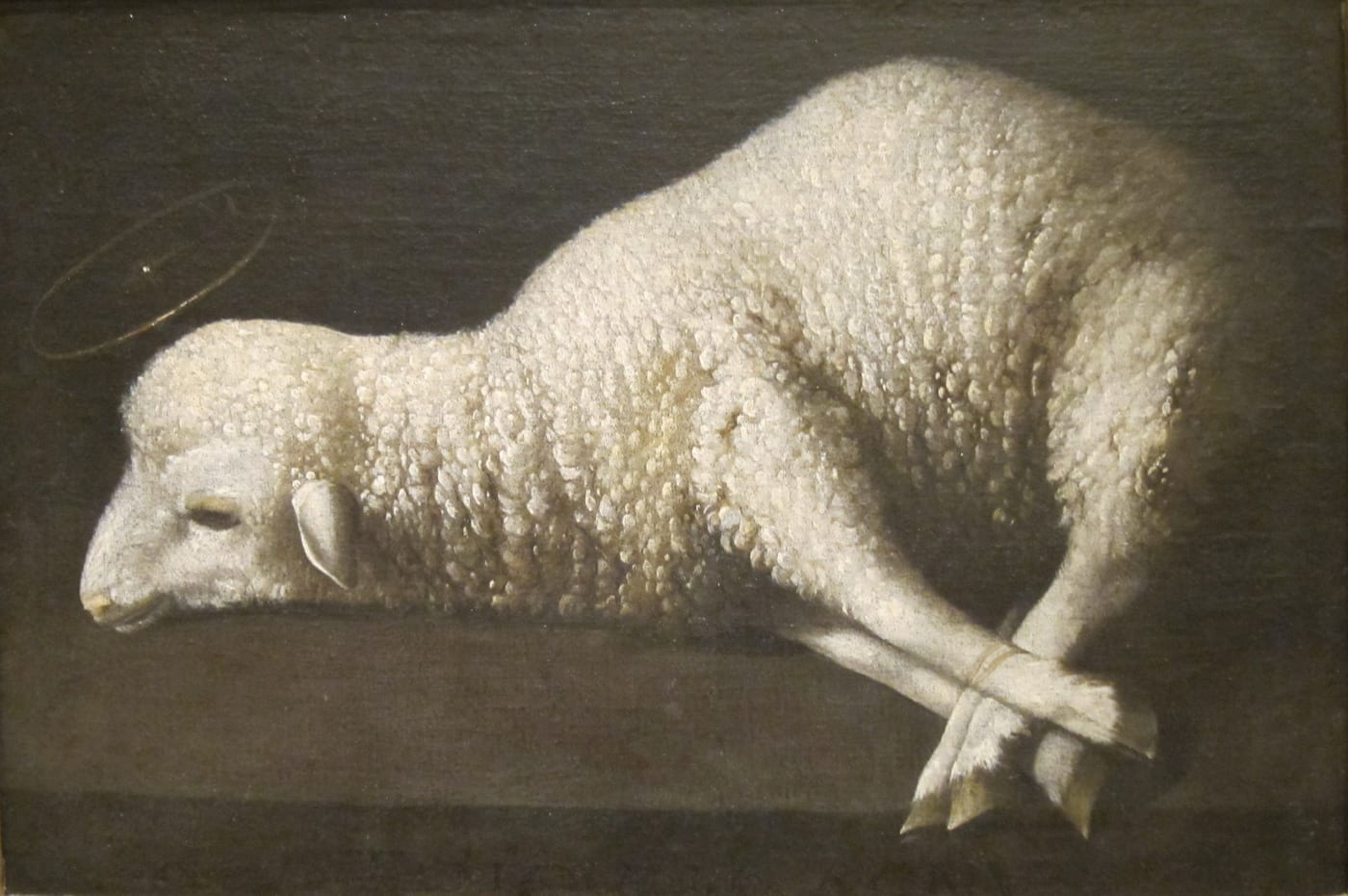
The lamb (Hebrew seh/kebes; Greek amnos/arnion) is the biblical animal with the most densely layered theology. Three distinct functions reinforce each other: the Levitical sacrificial lamb (Leviticus 1, 4), the Passover lamb whose blood protected Israelite firstborns (Exodus 12), and the Suffering Servant compared to a lamb in Isaiah 53:7. Paul identifies Jesus with the Passover lamb in 1 Corinthians 5:7. The Gospel of John times the crucifixion to Passover lamb-slaughtering hours. Revelation uses arnion (Lamb) 29 times as a primary Christ-title, describing the Lamb as bearing permanent marks of slaughter while standing in cosmic sovereignty.
The lamb is the biblical animal that has done the most theological work in the history of Christianity. The entire Christian theology of atonement runs through the lamb-tradition: from Abel's offering in Genesis 4:4 through the Passover of Exodus 12 through the Levitical sacrifice system through Isaiah 53's silent Servant through John the Baptist's declaration in John 1:29 through 29 appearances in Revelation. No other animal has been this consistently and deliberately threaded through a canonical tradition. Understanding that thread requires reading the texts in sequence rather than reaching for the symbol directly.
The sacrificial foundation: Leviticus and Exodus
The lamb's theological significance in the Hebrew Bible begins with its place in the sacrificial economy. Leviticus 1:10–13 establishes the lamb as an acceptable burnt-offering animal. Leviticus 4:32–35 establishes it as an acceptable sin-offering animal. These are legal texts, not symbolic ones; the lamb is appropriate for sacrifice because it is a domesticated animal of the correct size and category, without defect, representing real economic value. The act of sacrifice is costly, you are giving up a productive animal, and that cost is part of the theological logic.
But the founding lamb-text is Exodus 12. The Passover lamb is specified precisely: a year-old male without blemish, set apart on the 10th of Nisan, kept until the 14th, slaughtered at twilight. Its blood is applied to the doorposts and lintel of each household. The destroyer passes over the marked houses. The first-born of Egypt die; the Israelite firstborns live. The lamb's blood is apotropaic, it deflects death. Every subsequent biblical lamb-reference lives in the gravitational field of this text.
Isaiah 53: the Servant as lamb
Isaiah 53:7 is the text that transforms the sacrificial lamb into a figure of voluntary submission and suffering: "He was oppressed, and he was afflicted, yet he opened not his mouth; like a lamb that is led to the slaughter, and like a sheep that before its shearers is silent, so he opened not his mouth." The comparison establishes a new lamb-register: not a lamb killed because it is a legally appropriate offering, but a figure who does not resist being killed, whose silence and submission are morally meaningful. The passive suffering of the sacrificial animal becomes a model for a specific kind of human (or divine) endurance.
Isaiah 53 is the most-quoted Old Testament text in the New Testament after the Psalms. Philip in Acts 8:32–33 explains the passage to the Ethiopian eunuch by identifying the Servant with Jesus. Matthew, Luke, John, and Paul all draw on Isaiah 53's language. The lamb-comparison of Isaiah 53:7 functions as a key that unlocks the Passover lamb typology: if the Servant is a lamb, and the Servant is Jesus, and the Passover lamb protected Israelite firstborns from death, then Jesus's death functions as a cosmic Passover.
John 1:29: "the Lamb of God"
John the Baptist supplies the phrase that later usage flattens into a single title. Seeing Jesus, he declares: "Behold, the Lamb of God, who takes away the sin of the world" (John 1:29; repeated at 1:36). The Greek here is amnos, not Revelation's diminutive arnion, and the full phrase ho amnos tou theou has no precedent anywhere in the Hebrew Bible. John is coining it. That leaves an obvious question open: which lamb does he mean? Commentators have argued for the Passover lamb, for Isaiah's Suffering Servant, for the twice-daily Temple tamid-offering, and for an apocalyptic lamb-figure drawn from Jewish end-times literature. None of the four candidates cancels out the others, and most readings of the Gospel treat them as simultaneously active. John doesn't pick one lamb. He picks the word and lets every lamb-tradition that came before it pour in.
1 Corinthians 5:7 and the Passover-Passion typology
Paul writes 1 Corinthians around 54 CE, earlier than any of the Gospels. In 1 Corinthians 5:7 he states the typological equation directly: "Christ, our Passover lamb, has been sacrificed." This is the earliest New Testament text that formally identifies Jesus with the Passover lamb. The statement is incidental to Paul's main argument in the chapter (he is dealing with a case of sexual immorality in the Corinthian community), which suggests the identification was already established enough to be cited as common ground rather than argued for as a novelty.
Raymond Brown's The Death of the Messiah (Doubleday, 1994) documents John's Gospel timing the crucifixion to the afternoon of Nisan 14 (John 19:14, 31), the hours when Passover lambs were being slaughtered in the Temple. This is different from the Synoptic Gospels' timeline, in which the crucifixion follows a Passover meal already eaten. Brown treats the Johannine timing as a deliberate theological choice: John's Jesus dies at the hour of Passover slaughter, not after the Passover meal. The lamb typology shapes the narrative.
Revelation: the Lamb as cosmic sovereign
The book of Revelation uses arnion (a diminutive form meaning "little lamb") 29 times as the primary designation for Christ. The first appearance is Revelation 5:6: "between the throne and the four living creatures and among the elders I saw a Lamb standing, as though it had been slain, with seven horns and with seven eyes, which are the seven spirits of God sent out into all the earth." G.K. Beale's NIGTC commentary notes the paradox: the Lamb stands (alive) but bears the marks of slaughter (dead). The seven horns are the symbol of omnipotence; the seven eyes are omniscience. Perfect power and perfect knowledge belong to the slaughtered Lamb.
Revelation 7:17 completes the reversal: "For the Lamb in the midst of the throne will be their shepherd." The one who was slaughtered as a sacrificial lamb is now the shepherd who protects the flock. The sacrifice becomes the protector; the victim becomes the guardian. The title carries this weight through the rest of the book, too: the Lamb seals the 144,000 in Revelation 7, marches with the redeemed in Revelation 14, and hosts "the marriage supper of the Lamb" in Revelation 19:7–9. Twenty-nine uses is not a cameo. The biblical lamb tradition that began with Exodus 12's blood on doorposts ends in Revelation's New Jerusalem, where the Lamb is the lamp (21:23) and the temple (21:22) and the shepherd (7:17) simultaneously.
Sources
- PRIMARY Exodus 12:1–13 (BHS) . The Passover lamb: a year-old male without blemish, slaughtered at twilight, its blood applied to doorposts. The foundational lamb-sacrifice text.
- PRIMARY Leviticus 1:10–13; 4:32–35 (BHS) . The burnt offering and sin offering from the flock; the lamb as a standard sacrificial animal in the Levitical system.
- PRIMARY Isaiah 53:7 (BHS) . 'like a lamb that is led to the slaughter, and like a sheep that before its shearers is silent.' The Suffering Servant as lamb.
- PRIMARY John 1:29, 36 (NA28) . 'Behold, the Lamb of God, who takes away the sin of the world.' John the Baptist's identification of Jesus; the Greek amnos (lamb).
- PRIMARY Revelation 5:6, 12–13; 7:9–17; 21:22–27 (NA28) . The Lamb (arnion) as Christ's primary title in Revelation (29 occurrences). 5:6: the Lamb 'standing as though it had been slain.' 7:17: 'the Lamb in the midst of the throne will be their shepherd.'
- PRIMARY 1 Corinthians 5:7 (NA28) . 'Christ, our Passover lamb, has been sacrificed.' Paul's direct identification; the oldest New Testament statement of the Passover-Passion typology.
- PEER-REVIEWED Raymond Brown, The Death of the Messiah, vol. 2 . Doubleday, 1994. The Passover-timing of the crucifixion in John's Gospel and the Lamb typology.
- PEER-REVIEWED G.K. Beale, The Book of Revelation (NIGTC) . Eerdmans, 1999. The arnion (Lamb) in Revelation and the paradox of the slaughtered Lamb as cosmic sovereign.