The primary-source wisdom animals
Specific animals carry wisdom associations in specific traditions through specific documented relationships, not because wisdom is a universal quality that any impressive-looking animal automatically acquires. Each of the major wisdom animals is traceable to a particular cultural logic.
| Animal | Tradition | Where it is recorded | What it stands for there |
|---|---|---|---|
| Owl (little owl) | Greek | Aristophanes, Birds (414 BCE); Athenian tetradrachms | Athena's bird: learning and craft |
| Ravens Huginn and Muninn | Norse | Poetic Edda, Grímnismál 20 | Thought and memory, gathering what Odin needs to know |
| Ibis | Egyptian | Pyramid Texts (c. 2400–2300 BCE) | Thoth's scribal wisdom: writing, judgment, the measure of time |
| Elephant | Hindu | Ganesha Purana | Ganesha's learning and the removal of obstacles |
| Salmon | Irish | Macgnímartha Finn, Kuno Meyer's translation | A poet's knowledge: seeing what is hidden, then saying it in verse |
| Serpent | Biblical | Genesis 3:1; Matthew 10:16 | Practical shrewdness, with a warning attached |
| Spider (Anansi) | Akan | R. S. Rattray, Akan-Ashanti Folk-Tales (1930) | Owner of every story, bought from the sky-god Nyame |
| Crow and raven | Modern science | Corvid studies by Bernd Heinrich and John Marzluff | Tool use, planning and social memory, measured rather than imagined |
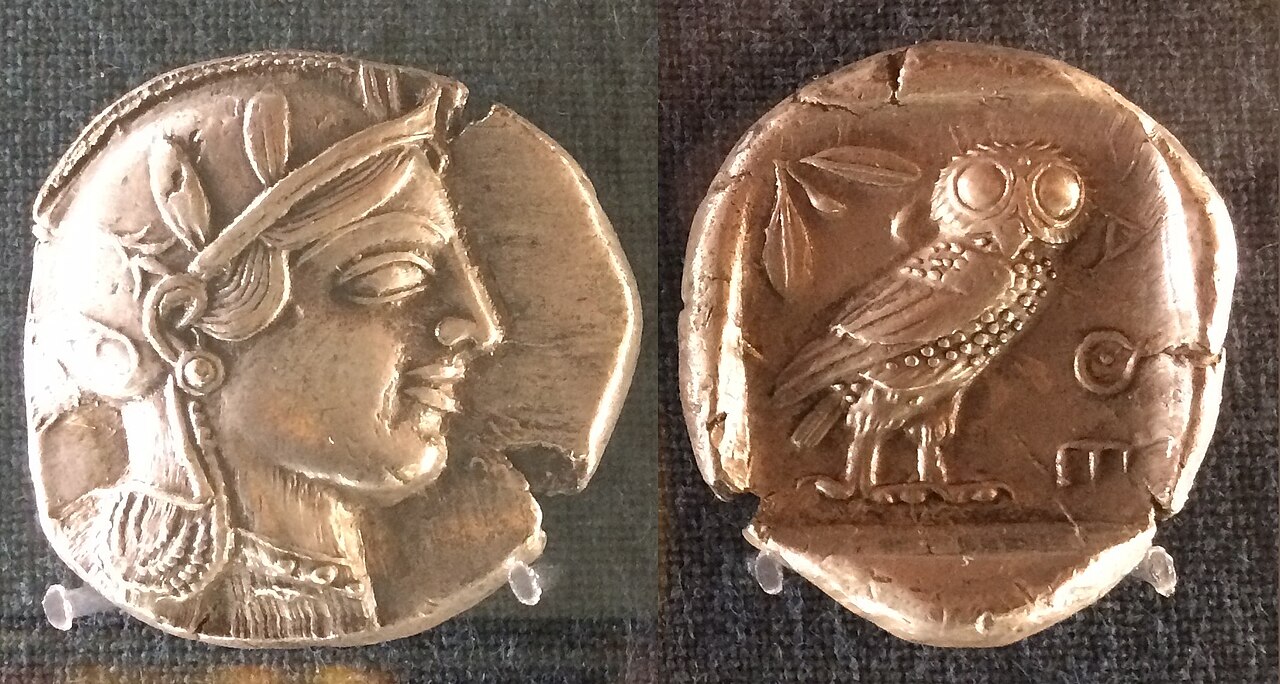
The owl of Athena is the oldest and most continuously documented wisdom-animal association in Western tradition. The Little Owl (Athene noctua) was the sacred animal of Athena, goddess of wisdom, craft, and warfare. Aristophanes's Birds (414 BCE) references the owl-of-Athena trope as already established and proverbial. Athenian silver tetradrachms carried the owl on the reverse by the 5th century BCE; these coins circulated across the Mediterranean as the dominant trade currency of the classical world, spreading the owl-wisdom-Athens association far beyond Attica. The phrase "an owl to Athens" (meaning bringing something to a place that already has it in abundance) appears in Aristophanes and is still used in Greek today.
Odin's ravens, Huginn and Muninn, carry a different kind of wisdom: surveillance, memory, and intelligence rather than philosophical knowledge. Grímnismál 20 in the Poetic Edda names them explicitly: Huginn is "Thought" and Muninn is "Memory." Each morning Odin sends them out across the nine worlds to gather information; each evening they return and report. The stanza reveals Odin's anxiety: he worries more about losing Muninn (Memory) than Huginn (Thought), which has been read as a Scandinavian meditation on the relative importance of memory versus active reasoning in the acquisition of wisdom. This is documented wisdom, not generic "raven = smart" association.
The ibis of Thoth carries the Egyptian version of scribal-and-divine wisdom. Thoth (ibis-headed god of writing, knowledge, magic, and the measurement of time) was the divine scribe who recorded the weighing of the heart at judgment and who wrote the decrees of the gods. The association of the ibis with wisdom runs through the Pyramid Texts (c. 2400–2300 BCE) and persists through the Greco-Roman period; Hermes Trismegistus, the syncretic Greek-Egyptian wisdom deity, is the Hellenistic inheritor of Thoth's portfolio.
Ganesha, the elephant-headed deity of Hindu tradition, is associated with wisdom, learning, and the removal of obstacles, the deity invoked at the beginning of undertakings. His elephant head carries specific philosophical weight: the elephant's memory, its patience, and its ability to navigate through obstacles are understood as material expressions of the divine wisdom Ganesha embodies. The Ganesha Purana is the primary textual source. Ganesha's elephant associations place the animal in a different register from the other wisdom animals: not a creature observed in nature and projected onto a deity, but a deity whose animal-composite nature is theologized directly.
The crow and raven also carry wisdom associations through their documented intelligence. Modern cognitive ethology (corvid studies by Bernd Heinrich, John Marzluff, and others) has established that crows and ravens demonstrate tool use, long-term planning, social memory, and theory of mind. The folk and mythological wisdom associations may encode genuine behavioral observations: the Ainu recognized the crow as a messenger of the gods partly because of observable corvid intelligence; the Norse Huginn-Muninn tradition may encode folk observation of raven behavior alongside theological symbolism.
The animal of knowledge and poetry: the Salmon of Knowledge
Ireland's wisdom animal comes to us through a story, not a god. In Macgnímartha Finn ("The Boyish Exploits of Finn" in Kuno Meyer's translation), the poet Finnéces has spent seven years on the Boyne "watching the salmon of Fec's Pool; for it had been prophesied of him that he would eat the salmon of Féc, when nothing would remain unknown to him." When the fish is finally caught, he sets the boy Demne to cook it and forbids him to taste it. The boy burns his thumb on the salmon and puts the thumb in his mouth. The knowledge goes to him instead. The poet asks his name, hears "Demne," and answers: "Finn is thy name, my lad, and to thee was the salmon given to be eaten, and verily thou art the Finn." (Earlier in the text the boy had already been called Finn, "the Fair.")
The text is specific about what that knowledge was for. Whenever Finn put his thumb in his mouth and chanted, "whatever he had been ignorant of would be revealed to him," and the next thing he learns is "the three things that constitute a poet." In this tradition the wise animal confers a poet's knowledge: seeing what is hidden, then putting it into verse. (Kuno Meyer's translation, Ériu 1, pp. 185 to 186.)
The serpent: wisdom with a warning attached
The Bible gives the serpent a double reputation, and both halves turn on cleverness. Genesis 3:1 introduces it as "more subtil than any beast of the field which the LORD God had made," and that subtlety is what leads Eve astray. In Matthew 10:16 the same quality is turned to good use: sending out the disciples "as sheep in the midst of wolves," Jesus tells them, "be ye therefore wise as serpents, and harmless as doves" (both King James Version). The serpent's wisdom here is practical shrewdness in a hostile world, and the verse pairs it with the dove's innocence to keep it from becoming cunning.
Which animal is the symbol of wisdom in many cultures?
The usual answer is the owl, and it holds for the line that runs from Athena through Athenian coinage into European art. It doesn't hold everywhere, even in the ancient Mediterranean. Writing in Rome in the first century CE, Pliny the Elder called the horned owl "especially funereal" and said it "is greatly abhorred in all auspices of a public nature," a "direful omen" when seen in a city (Natural History 10.16, Bostock and Riley translation). Pliny separates three night birds, the owlet, the horned owl and the screech owl, and it is the horned owl he calls funereal. Athena's bird was the little owl, Athene noctua, the one on the coin above. So Rome read a different owl as a death omen, and the word "owl" alone doesn't settle what a culture meant by it.
So the honest answer to "which animal symbolizes wisdom" is a question back: in which tradition? Greek: the owl. Norse: Odin's ravens. Egyptian: the ibis of Thoth. Irish: the salmon. Hindu: Ganesha's elephant. Biblical: the serpent, with a caveat (more in animals in the Bible). Each one is wise for a different reason, and the reasons are documented.
Thematic list
Animals That Symbolize Wisdom
From Athena's owl to Odin's ravens.
The strongest primary-source associations between specific animals and wisdom are the Greek owl of Athena (Aristophanes, Birds; Athenian tetradrachm coinage), Odin's ravens Huginn and Muninn (Poetic Edda, Grímnismál 20), the Egyptian ibis of Thoth (Pyramid Texts), and the elephant Ganesha in Hindu tradition (Ganesha Purana). The crow's intelligence is also documented in modern cognitive ethology.
Animals in this list
Owl spirit animal meaning: wisdom, intuition and insight. Traced from the modern wisdom-and-intuition reading back through Ted Andrews's Animal Speak to Athena's Little Owl on the Athenian tetradrachm, the Roman strix, Lakshmi's vahana uluka, and Japanese fukurō folklore.
Raven spirit animal meaning: transformation, prophecy and intelligence. From the modern pop-concept back through Odin's Huginn and Muninn, the Morrígan in the Táin, the Haida and Tlingit Raven cycles, and Ted Andrews's 1993 synthesis. Named-nation specific.
Crow spirit animal meaning: transformation, intelligence and magic. Traced from the modern transformation-and-trickster reading back through Ted Andrews's Animal Speak to the Japanese three-legged Yatagarasu of the Kojiki, Apollo's burned crow in Ovid, the Rāmāyaṇa sage-crow Kakabhusundi, and the British magpie rhyme tradition.
Elephant spirit animal meaning: memory, wisdom and strength. Traced from the modern memory-and-wisdom reading back through Ted Andrews's Animal Speak to Hindu Ganesha and Airavata, the Buddhist white elephant of Queen Maya's dream, the Thai royal white elephant tradition, and African Bantu matrilineal totemism.
Dolphin spirit animal meaning: joy, play and intelligence. Traced from the modern joy-and-intelligence reading back through Ted Andrews's Animal Speak to the Homeric Hymn to Apollo at Delphi, Arion's rescue by a dolphin in Herodotus, the Minoan Knossos dolphin fresco, and the Amazonian boto encantado tradition.
Fox spirit animal meaning: cunning, adaptability and intelligence. Traced from the modern cleverness-adaptability reading back through Ted Andrews's Animal Speak to Japanese kitsune and Inari shrine practice, Chinese húli jīng, the European Reynard tradition, and Aesop's fables.
Spider spirit animal meaning: creativity, patience and connection. Traced from the modern creativity-and-weaving reading back through Ted Andrews's Animal Speak to the West African Anansi trickster cycle, Diné and Hopi Grandmother Spider, Ovid's Arachne, and the Japanese jorōgumo of Edo-era folklore.
Turtle spirit animal meaning: patience, longevity and stability. Traced from the modern patience-and-longevity reading back through Ted Andrews's Animal Speak to the Haudenosaunee Turtle Island creation narrative, the Hindu Kurma avatar, the Chinese Black Tortoise Xuanwu, and the Hawaiian honu.