Spirit Animal
Beaver Spirit Animal
Beaver spirit animal meaning: industry, construction and family. Traced from the modern industry-and-construction reading back through Ted Andrews's Animal Speak to the Anishinaabe Amik clan, the Cree and Innu beaver-people narratives, the 1975 Canadian national-emblem status, Pliny the Elder's famous self-amputation error, and the medieval Physiologus bestiary.
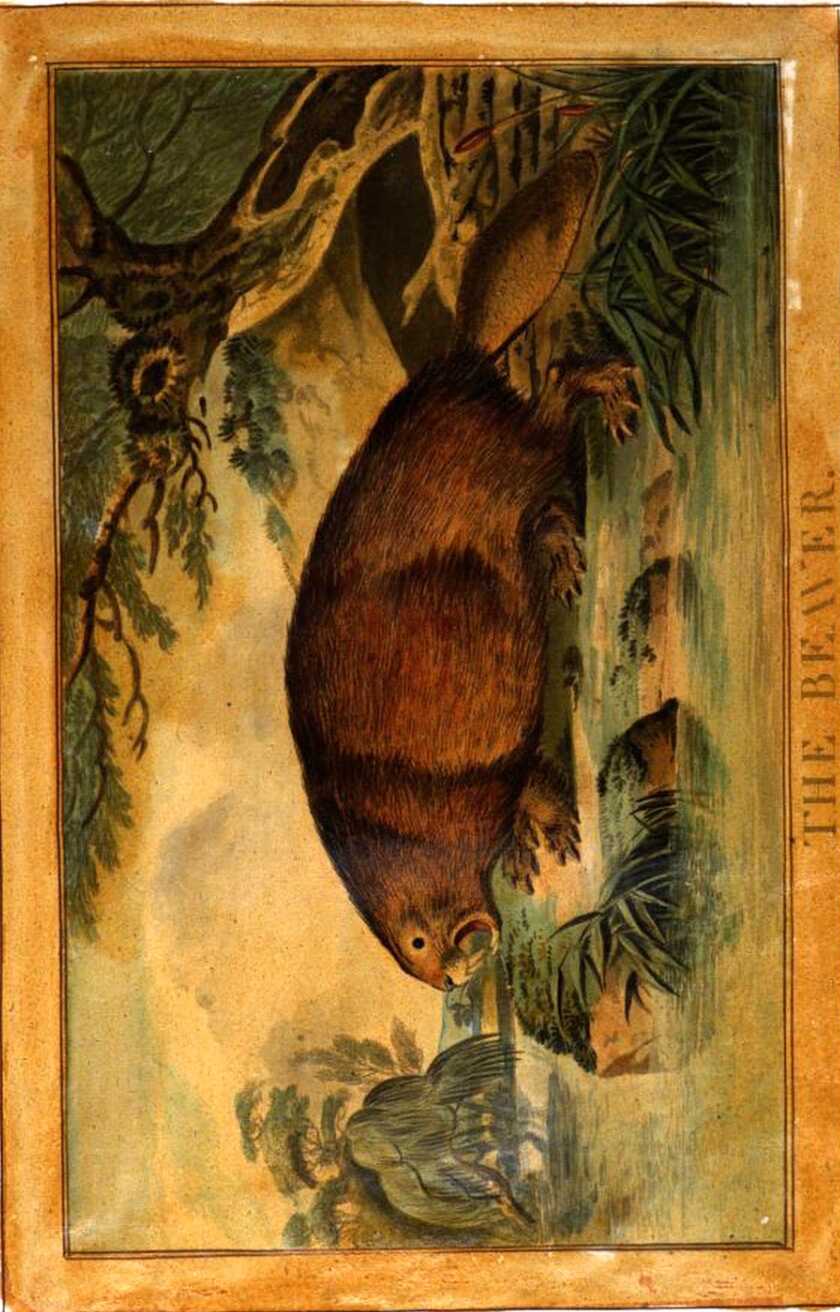
In modern American "spirit animal" usage, the beaver stands for industry, construction, the determined shaping of environment, and family cooperation. That reading comes through Ted Andrews's Animal Speak (Llewellyn, 1993) and the broader 'busy as a beaver' English-language idiom. The older traditions are specific. Anishinaabe Amik (beaver) is a doodem clan per William Warren 1885; Cree and Innu narratives in Frank Speck's 1935 Naskapi fieldwork document the beaver-people as cooperative kin. The beaver was chosen as the symbol on the Hudson's Bay Company coat of arms in 1678, appeared on the 1851 Three-Penny Beaver (Canada's first postage stamp), and received formal Canadian national-emblem status by Act of Parliament on March 24, 1975. Pliny's Natural History 8.47 preserves the famous (and biologically false) story that beavers bite off their own testicles when pursued; the Physiologus (2nd century CE) allegorized it.
There is an Anishinaabe doodem named Amik, recorded in William Warren’s 1885 History of the Ojibway People. There is a beaver on the Hudson’s Bay Company coat of arms granted in 1678. There is a beaver on Canada’s first postage stamp, issued in 1851 and designed by Sandford Fleming. And on March 24, 1975, the Parliament of Canada passed the National Symbol of Canada Act, formally designating the beaver the national animal of Canada. Not just an emblem. A statutory national animal.
That is a stack of real, specific, documentable beaver-tradition. Modern spirit-animal articles rarely reach any of it.
The four traditions, with specific dates
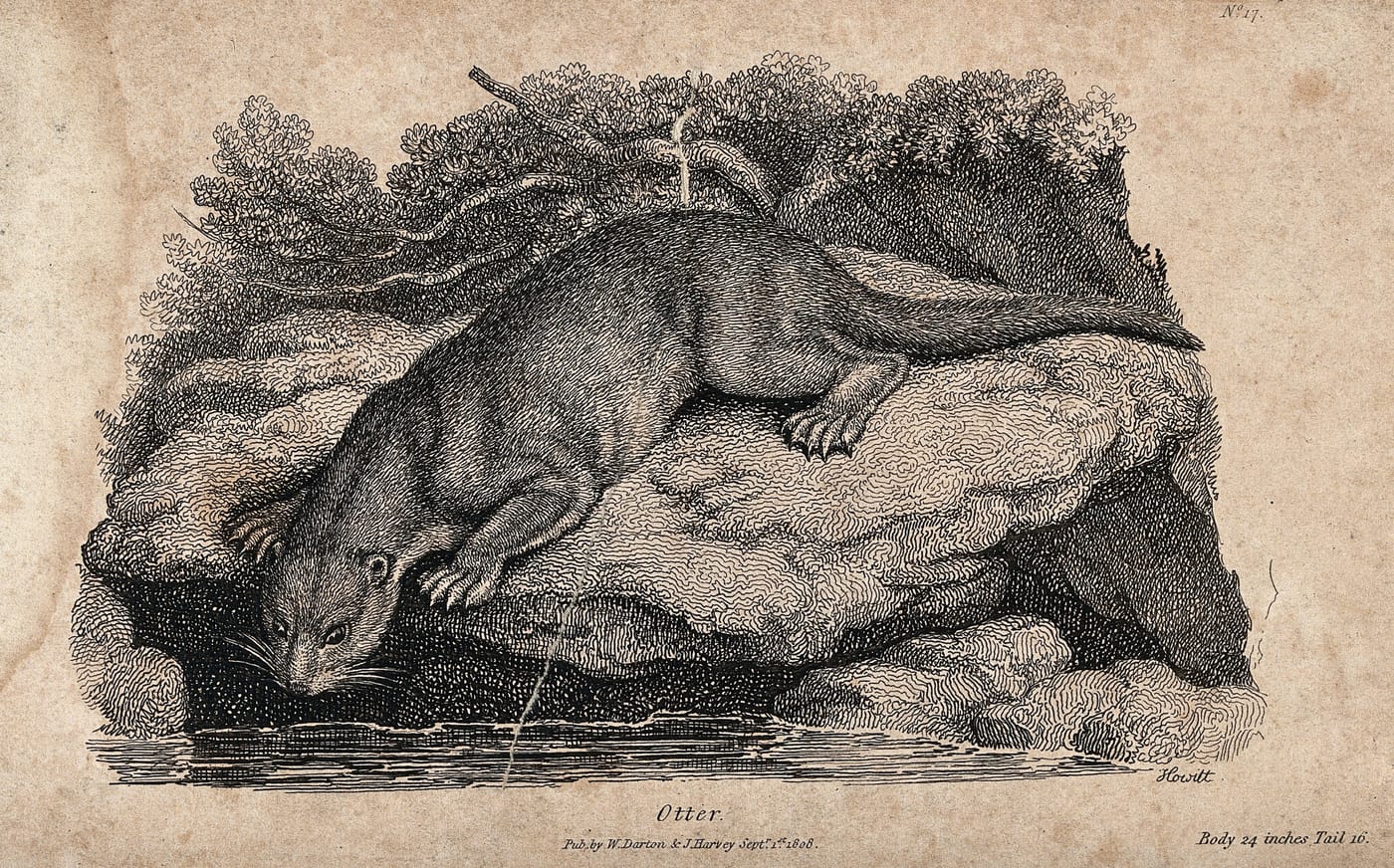
Amik, the Anishinaabe clan. One of the doodemag recorded by Warren 1885. Cross-reference our Anishinaabe doodem page for the clan-system context. Speck’s 1935 Naskapi fieldwork documented related Cree and Innu beaver-kin narratives. LaDuke’s All Our Relations (1999) is the contemporary Indigenous-authored treatment.
The Canadian national animal. 1678, Hudson’s Bay coat of arms. 1851, Three-Penny Beaver postage stamp. March 24, 1975, formal statutory national-animal designation. Williams’s The Company of Adventurers (Viking, 1983) is the standard Hudson’s Bay Company history.
Pliny’s self-amputation error. Natural History 8.47, c. 77 CE. Beavers allegedly bite off their own testicles when pursued, knowing hunters want the castoreum. Biologically false (the organs are separate). Almost certainly a folk-etymological error confusing Latin castor with castrare. The story was repeated by Aelian, allegorized by the medieval Physiologus, and finally debunked by Thomas Browne’s Pseudodoxia Epidemica in 1646.
The Physiologus beaver. 2nd-century Christian allegorical bestiary. The self-amputating beaver is read as a figure for the virtuous man renouncing temptation to save his life. This allegory traveled with the error for over a millennium, shaping European beaver imagery in ways that had nothing to do with actual beaver biology.

What the pop reading keeps
Andrews’s 1993 Animal Speak: industry, construction, family. The busy-as-a-beaver cluster. All real, all grounded in the animal’s actual dam-building behavior. But the Canadian national-emblem history, the Indigenous clan traditions, and the 1,500-year-old Pliny error are more interesting, and all of them are in the traditions sections above.
Across traditions
Anishinaabe and Cree (Amik, beaver-people)
Amik (beaver) is one of the Anishinaabe doodemag (clans) recorded in William W. Warren's History of the Ojibway People (1885) and subsequent Anishinaabe scholarship. See our Anishinaabe doodem page for the broader clan-system context. The beaver's significance is tied to the animal's role as the dominant shaper of northern-forest wetland landscapes; Anishinaabe territorial knowledge incorporates beaver pond-succession as a natural-history framework.
Cree and Innu (Naskapi) traditions, documented by Frank Speck in his 1935 Naskapi: The Savage Hunters of the Labrador Peninsula (University of Oklahoma Press), treat the beaver as a family of cooperative kin with specific ceremonial protocols around hunting. Contemporary Cree scholar Winona LaDuke's All Our Relations (South End Press, 1999) carries the tradition into modern Indigenous environmental writing.
- PRIMARY William W. Warren, History of the Ojibway People . Minnesota Historical Society, 1885.
- PRIMARY Frank G. Speck, Naskapi: The Savage Hunters of the Labrador Peninsula . University of Oklahoma Press, 1935.
- PRIMARY Winona LaDuke, All Our Relations . South End Press, 1999.
Canadian (Hudson's Bay Company through Act of Parliament 1975)
The beaver on the Hudson's Bay Company coat of arms, granted by the Royal College of Arms in 1678, reflects the central role of the beaver pelt in the North American fur trade that drove European-Indigenous commercial contact for more than two centuries. Canada's first postage stamp, the 1851 Three-Penny Beaver designed by Sandford Fleming, placed the animal on the nation's mail before Confederation.
The beaver received formal Canadian national-emblem status by Act of Parliament on March 24, 1975 (National Symbol of Canada Act, S.C. 1975, c. 29). The animal appears on the Canadian five-cent coin, on numerous provincial coats of arms, and in the logos of the Royal Canadian Mounted Police and various federal agencies. Mark Kurlansky's Salt: A World History (Walker, 2002) treats the fur-trade economic context; Glyndwr Williams's The Company of Adventurers (Viking, 1983) is the standard Hudson's Bay Company history.
- REFERENCE National Symbol of Canada Act, S.C. 1975, c. 29
- REFERENCE Hudson's Bay Company coat of arms (granted 1678)
- PEER-REVIEWED Glyndwr Williams, The Company of Adventurers . Viking, 1983.
Roman (Pliny's castoreum and self-amputation error)
Pliny the Elder's Natural History 8.47 records one of the most famous zoological errors in ancient natural history: the claim that beavers (castores), pursued by hunters, bite off their own testicles and throw them to the hunters, knowing that the beaver's castoreum (a real secretion of the castor sacs, used as medicine) is what the hunters want. The story is biologically false: the testicles and castor sacs are separate organs, and beavers cannot self-castrate.
The story is almost certainly a folk-etymological misreading of the Latin castor / Greek kastōr, associated with the word for "castrate." Nonetheless, the tale traveled through Aelian's On the Nature of Animals 6.34 and into the medieval bestiary tradition (the Physiologus allegorizes it as the virtuous man renouncing temptation) where it shaped European beaver imagery for over a millennium. The error was still being repeated into the 17th century despite Thomas Browne's 1646 Pseudodoxia Epidemica specifically debunking it.
- PRIMARY Pliny the Elder, Natural History 8.47 . Rackham trans., Loeb Classical Library.
- PRIMARY Aelian, On the Nature of Animals 6.34 . Scholfield trans., Loeb Classical Library.
- PRIMARY Physiologus, chapter on the beaver . Curley trans., University of Chicago Press, 2009.
- PRIMARY Thomas Browne, Pseudodoxia Epidemica (1646) . Robbins ed., Clarendon Press, 1981.
Ted Andrews (1993)
Andrews's 1993 beaver is the industry-construction-family figure, drawn from the animal's observable dam-building behavior, softened into personal-spirit keyword form. The Indigenous North American clan traditions are gestured at without specific nation naming. The Canadian national-emblem history is absent. Pliny's self-amputation error is not mentioned, which is a shame since it is one of the more interesting stories in ancient natural history.
- REFERENCE Ted Andrews, Animal Speak . Llewellyn, September 1993.
Working with the Beaver
If you want a regular practice rather than a one-time read, an oracle deck is the standard tool: you draw a card and sit with whatever animal comes up. Our ranked guide to spirit animal oracle decks compares the field.
Frequently asked
- What does a beaver symbolize spiritually?
- In modern pop usage, industry, construction, and family cooperation, the Andrews 1993 reading plus the 'busy as a beaver' English-language idiom. Older traditions are specific. Anishinaabe Amik is a doodem (clan) recorded by William Warren 1885. The beaver has been on the Hudson's Bay Company coat of arms since 1678, on Canada's first postage stamp since 1851, and has held formal Canadian national-emblem status by Act of Parliament since March 24, 1975. And Pliny the Elder's Natural History 8.47 preserves the biologically false but long-lived story of beavers biting off their own testicles when pursued.
- When did the beaver become Canada's national animal?
- By Act of Parliament on March 24, 1975 (National Symbol of Canada Act, S.C. 1975, c. 29). But the beaver had been a Canadian visual symbol for much longer: on the Hudson's Bay Company coat of arms since 1678, on the 1851 Three-Penny Beaver (Canada's first postage stamp, designed by Sandford Fleming), and on the Canadian five-cent coin since the late 19th century. The fur-trade economic importance of the beaver pelt through the 17th–19th centuries drove the symbolic prominence.
- Did Pliny really think beavers bit off their own testicles?
- Yes. Pliny the Elder's Natural History 8.47 (c. 77 CE) records the story that beavers pursued by hunters bite off their own testicles and throw them to the hunters, knowing that the beaver's castoreum (a real secretion from the castor sacs, used in ancient medicine and perfumery) is what the hunters want. The story is biologically false: the testicles and castor sacs are separate organs. The tale almost certainly comes from folk-etymology linking Latin castor (beaver) with castrare (to castrate). Aelian repeated it, the medieval Physiologus allegorized it, and Thomas Browne finally debunked it in 1646.
- What is Amik in Anishinaabe tradition?
- Amik is the Anishinaabe (Ojibwe) word for beaver and the name of one of the clan-doodem groups recorded in William Warren's 1885 History of the Ojibway People. See our Anishinaabe doodem page for the broader clan-system context. Amik's clan significance is tied to the beaver's role as the dominant shaper of northern-forest wetland landscapes, a natural-history fact that Anishinaabe territorial knowledge incorporates into pond-succession frameworks.
Sources
- PRIMARY William W. Warren, History of the Ojibway People . Minnesota Historical Society, 1885.
- PRIMARY Frank G. Speck, Naskapi: The Savage Hunters of the Labrador Peninsula . University of Oklahoma Press, 1935.
- PRIMARY Winona LaDuke, All Our Relations . South End Press, 1999.
- REFERENCE National Symbol of Canada Act, S.C. 1975, c. 29
- REFERENCE Hudson's Bay Company coat of arms (1678)
- PEER-REVIEWED Glyndwr Williams, The Company of Adventurers . Viking, 1983.
- PRIMARY Pliny the Elder, Natural History 8.47 . Loeb Classical Library.
- PRIMARY Aelian, On the Nature of Animals 6.34 . Loeb Classical Library.
- PRIMARY Physiologus (Curley trans., 2009)
- PRIMARY Thomas Browne, Pseudodoxia Epidemica . Robbins ed., Clarendon, 1981.
- REFERENCE Ted Andrews, Animal Speak . Llewellyn, September 1993.