Color symbolism, sourced
Black Feather Meaning: Raven Messengers, American Folk Omens, and the Modern Reversal
The black feather's folk-omen tradition runs toward warning and change. Its contemporary spiritual meaning runs toward protection and mystery. Both have sources.
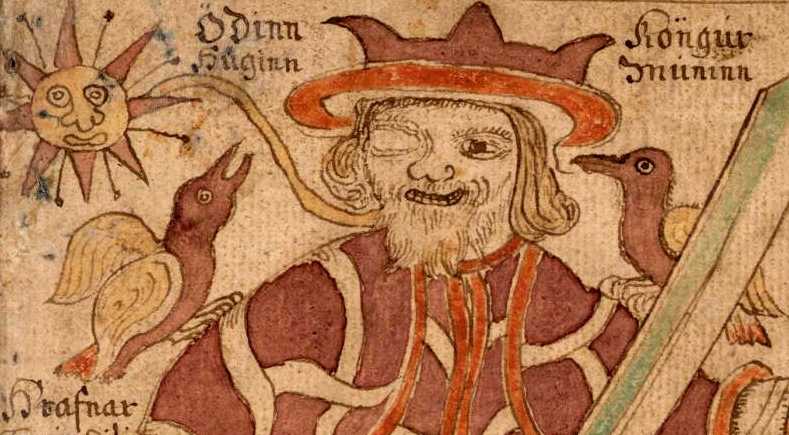
In Appalachian and Southern US folk tradition (Puckett 1926; Hand 1961–64; Randolph 1947), black feathers — as extensions of black-bird omen belief — clustered in the warning and change category. In Norse mythology (Prose Edda, Gylfaginning 38), Odin's black-feathered ravens Huginn and Muninn were intelligence-gatherers, not personal omens for mortals. The contemporary 'black feather = protection, magic, and mystical awareness' reading derives primarily from Ted Andrews's Animal Speak (1993) and the New Age revaluation of darkness as mystery rather than danger.
Black feathers are among the most commonly found feathers in North America — crows and starlings shed them constantly — which is probably why the tradition of reading them as signs is so widespread. The reading depends entirely on which tradition you consult. The folk-omen archive says warning or change. The Norse tradition says divine intelligence. The 1990s New Age synthesis says protection. These readings are not compatible, and knowing which one you're using changes the meaning completely.
Appalachian and Southern folk tradition
Puckett's 1926 folk-belief archive documents black-feather and black-bird omen traditions across the American South. The underlying logic is consistent: black equals death in the color-coding of that tradition (black cat, black crow, black butterfly, black feather all cluster together). A black feather found or encountered near the house was read in the same ominous register as other black-object omens. This reading is not universal across all Southern folk tradition, but it is the dominant valence in Puckett's documentation.
Vance Randolph's Ozark Superstitions (1947) documents black-feather omen entries with a similar valence in the Ozark region. Randolph notes that the specific meaning could range from general bad luck to specific death-warning depending on context, but the positive "protection" reading is not present in his archive.
The Frank C. Brown Collection (1961–64) adds Appalachian confirmation. Black feathers appear in the bird-omen section with a cluster of warning and change associations. The specific meaning of "finding a black feather means protection" does not appear in this archive.
Norse tradition: Huginn and Muninn's feathers
Snorri Sturluson's Prose Edda (c. 1220 CE, Gylfaginning 38) names Odin's two ravens: Huginn (Thought) and Muninn (Memory). These birds are black — ravens are always black. Their feathers, by association, carry the meaning of divine intelligence, the ability to travel between worlds, and the collection and transmission of knowledge. Odin worries more about Muninn than Huginn, the text says, which 13th-century Icelandic readers understood as a statement about memory's primacy.
The raven-feather-as-intelligence-symbol is specific to the Norse tradition. It does not translate into a personal protection or luck reading for an ordinary person who finds a feather; in the Prose Edda's framework, Huginn and Muninn serve Odin, not mortals. But the association of black raven feathers with divine knowledge and world-spanning perception is genuinely present in the primary sources, and it provides one legitimate traditional basis for reading a raven feather as something more than bad luck.
Edward Topsell and the bestiary lineage
Edward Topsell's The History of Four-Footed Beasts and Serpents and Fowls (1658) transmitted bestiary raven-lore into English print culture. The raven in the medieval bestiary tradition carried associations with prophetic ability and long life (the bird was believed to live three hundred years). A raven feather in this lineage was associated with foresight, not danger. The bestiary tradition is not a folk-omen tradition; it is a learned-culture tradition written for an educated audience. But it provides another pre-20th-century layer to the black-feather interpretive complex.
Pacific Northwest Indigenous traditions
In Haida and Tlingit tradition, the Raven is a trickster-creator, the being who stole the sun, moon, and stars and gave them to the world (Swanton's 1905 Bureau of American Ethnology fieldwork; Bringhurst's A Story as Sharp as a Knife, 1999). Raven feathers in these traditions carry trickster-creative associations — intelligence, boundary-crossing, the power to change the world through cleverness. This reading is tradition-specific; it belongs to Haida and Tlingit contexts, not as a universal "raven feather meaning."
Any treatment of "black feather = Raven medicine" that does not name the specific Pacific Northwest nation and cite specific primary sources is likely collapsing distinct traditions into a generic pan-Indigenous reading, which our cultural-position page addresses in detail.
The contemporary "protection and mystery" reading
Ted Andrews's Animal Speak (1993) treats black birds and their feathers as "magic, the occult, and the unseen" — a positive reframing of darkness as mystical depth rather than danger. His framework influenced virtually all subsequent American metaphysical writing on black feathers. By the 2000s, "black feather = magical protection, mystical awareness, and the ability to see what others cannot" was the dominant reading in American New Age culture, coexisting with — but not replacing — the older folk-omen tradition in rural communities.
The reversal follows the same pattern as the black butterfly's modern reframing: darkness moves from threatening to mysterious and then to protective. This is a specific cultural move with a specific origin in 1990s New Age metaphysics, not a recovery of an older tradition.
What you're actually finding
The most frequently found black feathers in North American environments are American crow primaries and secondaries (5–15 cm, glossy black), European starling feathers (smaller, with iridescent green-purple sheen in good light), and common grackle feathers. Raven feathers are found primarily in northern and western North America and are significantly larger than crow feathers — the primaries reach 25+ cm and have a distinctive wedge-shaped tail when the full tail is seen. Identification matters: a crow feather and a raven feather are not the same, and the primary sources that give raven feathers their most specific meaning (Norse, Pacific Northwest) are different from the sources that give crow feathers their meaning.
Frequently asked
- What does finding a black feather mean?
- In Appalachian and Southern US folk tradition (Puckett 1926; Hand 1961–64; Randolph 1947), a black feather was primarily associated with change, warning, or death — the same valence as black birds (crows, ravens) in those traditions. In Norse tradition, black raven feathers connect to Odin's Huginn and Muninn (Prose Edda, Gylfaginning 38) — powerful intelligence-messengers, not personal omens for ordinary mortals. The contemporary 'black feather = protection, magic, and mystical awareness' reading comes primarily from Ted Andrews's Animal Speak (1993) and the New Age revaluation of darkness as mystery rather than danger.
- Is a black feather a bad sign?
- In the folk-omen traditions that documented it first (Puckett 1926; Randolph 1947), black feathers, as extensions of black-bird omen-belief, clustered in the warning and change category rather than the good-luck category. Whether this means 'bad sign' depends on your tradition: a change warning could be neutral or even useful. The strong death-omen reading is more consistently associated with black birds near the house than with finding a dropped black feather, though the distinction is not always made explicitly in the archived traditions.
- What does a black raven feather mean specifically?
- Raven feathers have the most specific primary-source backing of any black feather. In Norse tradition, Odin's two ravens (Huginn and Muninn) were his information-gathering agents, making their feathers symbolic of divine intelligence and the ability to see across worlds (Prose Edda, Gylfaginning 38). In Pacific Northwest Indigenous traditions, the Raven as a trickster-creator (Haida and Tlingit material documented by Swanton 1905, Bringhurst 1999) gives raven feathers trickster-creative associations. These are specific traditions, not generalizable to any black corvid feather.
- What bird leaves black feathers?
- Common black-feathered species in North America: common raven (Corvus corax), American crow (Corvus brachyrhynchos), black vulture (Coragyps atratus), black-billed magpie (Pica hudsonia, black and white), European starling (Sturnus vulgaris, iridescent black-green), boat-tailed grackle (Quiscalus major), common grackle (Quiscalus quiscula). The most frequently found pure-black feathers in most North American environments are crow and starling feathers. Raven feathers are notably large (primary feathers can exceed 25cm) and are found primarily in northern and western ranges.
Sources
- PRIMARYSnorri Sturluson, Prose Edda (Gylfaginning 38) — Trans. Anthony Faulkes, Everyman, 1987. Huginn and Muninn — Odin's black-feathered raven messengers.
- PRIMARYWayland Hand (ed.), Popular Beliefs and Superstitions from North Carolina (Frank C. Brown Collection) — Duke University Press, vols. VI–VII, 1961–64. Black feather and black-bird omen entries in Appalachian tradition.
- PRIMARYNewbell Niles Puckett, Folk Beliefs of the Southern Negro — University of North Carolina Press, 1926. Black feather and black-bird omen traditions in Southern US folk-belief.
- PRIMARYVance Randolph, Ozark Superstitions — Columbia University Press, 1947. Black feather omen entries in Ozark folk tradition.
- PRIMARYEdward Topsell, The History of Four-Footed Beasts and Serpents (and Fowls) — E. Cotes, 1658. Raven feather material transmitted from the bestiary tradition to English print culture.
- REFERENCETed Andrews, Animal Speak — Llewellyn, September 1993. The primary vector for the contemporary 'black feather = protection, magic, mystery' reading.
- REFERENCECornell Lab of Ornithology, Common Raven (Corvus corax) species account