American folk-belief, sourced
What It Means When a Blue Jay Visits You: Folk Tradition vs. Contemporary Belief
Loud, bold, and impossible to ignore at the feeder. What the blue jay actually means across the traditions that recorded it.
The blue jay has no single unified 'visiting meaning' in pre-20th-century primary sources. In Appalachian folk tradition (Frank C. Brown Collection, 1961–64), it appears mainly as a boldness or weather sign. In Cherokee animal-council narratives (Mooney 1900), it is tsisquaya, a named participant in origin stories. In Southeastern Gullah-influenced trickster tales (Harris 1883), it carries a mischief-adjacent role. The contemporary 'blue jay as messenger' reading derives primarily from Ted Andrews's Animal Speak (1993). The more recent 'blue jay as sign from a deceased loved one' reading appears to be a late-20th-century extension of the cardinal-as-messenger belief.
The blue jay is the loudest, most conspicuous bird at most American feeders east of the Rockies. You do not overlook a blue jay. This makes it a natural candidate for folk attention, and it has accumulated meanings accordingly — though not always the ones currently circulating on social media.
What the Appalachian folk record says
Wayland Hand's edited Frank C. Brown Collection of North Carolina folklore (Duke University Press, 1961–64) is the most systematically compiled archive of Appalachian folk belief from the 19th and early 20th centuries. Blue jays appear in several bird-omen entries. The dominant reading is one of communications and weather: a blue jay calling or behaving unusually was often interpreted as a weather sign, a warning of approaching winter, or a sign of coming noisy events (consistent with the bird's behavioral reality). There is nothing in the collection specifically about the blue jay as a messenger from the dead or as a personal spiritual sign for the observer.
Puckett's 1926 Folk Beliefs of the Southern Negro documents similar material in the broader American South. The blue jay is not the owl (death-sign) or the crow (ambiguous omen) in this tradition; it occupies a secondary tier, characterized primarily by its noise and boldness rather than by a fixed omen-meaning.
Cherokee tradition: tsisquaya in the animal council
James Mooney's Myths of the Cherokee (Smithsonian Bureau of American Ethnology, 1900) is the foundational primary source for Cherokee animal lore. The blue jay appears in the Cherokee species-naming material and in the animal-council story tradition as tsisquaya. Animal-council narratives describe a primordial time when animals and birds held councils to decide matters affecting the world. The blue jay's role in these stories is a named participant — not a cosmic force and not a death sign. It is one bird among many, distinguished primarily by the characteristics that make it recognizable: noise, boldness, color.
Unlike the owl (tsgili/uguku), which carries strongly negative or ambiguous power in Cherokee tradition, the blue jay does not carry a charged valence in Mooney's record. Generalizing tsisquaya into a modern "spirit animal" message-figure would stretch the material beyond what it supports.
Trickster-adjacent: the Gullah and Southeastern folk tradition
Joel Chandler Harris's Nights with Uncle Remus (James R. Osgood, 1883) is a contentious document in American literary history — Harris, a white Georgia journalist, recorded Gullah and Southeastern African-American oral stories in dialect, raising questions of authorship and appropriation that scholars continue to debate. But as an early-20th-century archive of Southeastern folk narrative, it remains a primary source. Blue jays appear in the Brer-story universe in roles that share characteristics with trickster figures: mimicry, deception, confidence, and a certain indifference to being liked.
This reading is consistent with corvid behavior. Blue jays (Cyanocitta cristata) are corvids — family Corvidae, the same family as ravens and crows. They mimic other birds, including red-shouldered hawks. They cache food and use deceptive moves to hide caches from rivals. They are intelligent enough to recognize individual human faces (Cornell Lab research). The trickster reading is not arbitrary; it maps onto real behavioral characteristics.
John James Audubon and the naturalist record
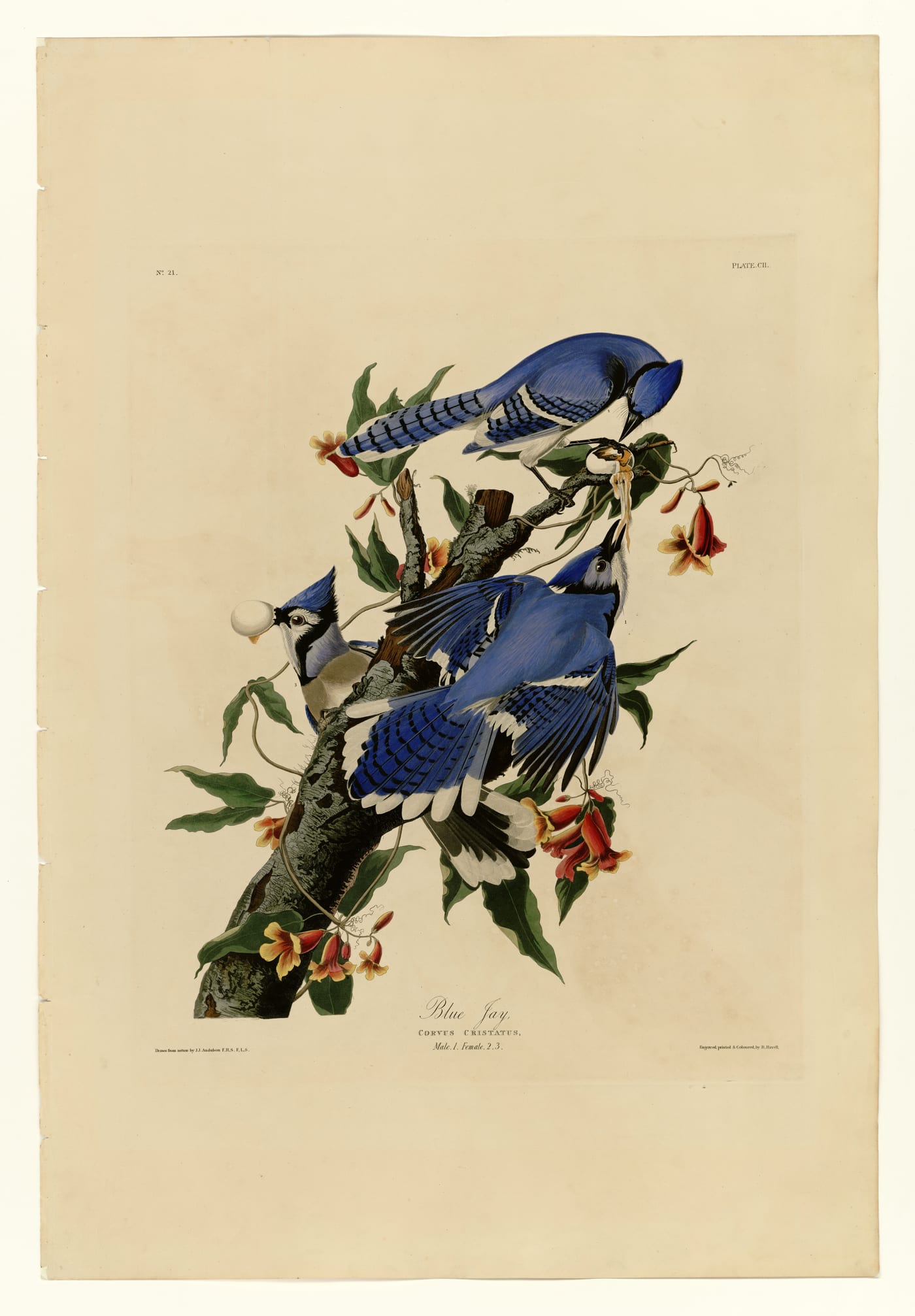
John James Audubon's Birds of America plate CII (1827–38) provided the first widely reproduced naturalistic illustration of the blue jay in American print culture. Audubon noted the bird's call-mimicry and territorial behavior in his accompanying text. He did not assign omen-meanings, but his plates established the blue jay as a recognizable American bird-icon in the popular imagination a full century before Ted Andrews wrote about it. The blue jay as a known, named, conspicuous American bird predates its spiritual reading by a long margin.
The contemporary reading and where it came from
Ted Andrews's Animal Speak (Llewellyn, September 1993) frames the blue jay as "proper use of power," "boldness," and the danger of spreading yourself too thin — ideas mapped from the bird's aggressive territorial behavior and its reputation as a loud competitor at feeders. Andrews's vocabulary became the vocabulary of most subsequent American blue-jay-symbolism writing.
The more recent "blue jay as sign from a deceased loved one" belief appears to be a direct extension of the cardinal-as-messenger belief. As the cardinal became culturally associated with deceased loved ones through the sympathy-card and memorial-merchandise industry (a trend solidifying in the 1990s), neighboring conspicuous feeder birds — blue jays, chickadees, juncos — began to receive similar memorial readings in folk social media culture. No pre-1990s primary source supports a blue-jay-as-heaven-messenger reading; the belief is younger than the internet.
The bird itself
Blue jays (Cyanocitta cristata) range across eastern and central North America year-round. Cornell Lab data puts the breeding population at roughly 13 million birds, making the species considerably more abundant than most people realize. They are omnivores, caching acorns in fall and retrieving them in winter (a behavior that has been shown to contribute measurably to oak-forest regeneration). Their mobbing behavior — diving repeatedly at hawks, owls, and cats — explains their aggressive reputation. The bird's cobalt blue, white, and black coloring is produced structurally (light scattering in feather barbs) rather than by pigment, which is why the blue disappears if you look at a blue jay feather against the light. That detail, which many birders know, the folk tradition does not.
Frequently asked
- What does it mean when a blue jay visits you?
- In contemporary American folk-belief (primarily from Ted Andrews's Animal Speak, 1993), a blue jay visit is read as a reminder to be assertive, use your full capabilities, or stand your ground. In Appalachian folklore documented in the Frank C. Brown Collection (1961–64), blue jays carried mixed meanings: sometimes aggressive omens, sometimes general weather signs. The Cherokee tradition recorded by Mooney (1900) names the blue jay as tsisquaya, a participant in animal council stories, without a strong positive-or-negative valence. The bird is primarily notable in folk tradition for its boldness and noise, which various cultures have interpreted as warning, communication, or boastfulness depending on their frame.
- Is a blue jay a sign from heaven or a deceased loved one?
- No primary source predating the 1990s connects the blue jay specifically to messages from deceased loved ones. That reading appears to be a late-20th-century extension of the cardinal-as-messenger belief, applied to the other conspicuous colorful bird at the American feeder. The cardinal belief itself only solidified around the 1990s (it is absent from Puckett 1926 and Hand 1961–64). The blue jay extension is even more recent and has even thinner folk roots.
- Why do blue jays appear aggressive?
- Blue jays (Cyanocitta cristata) are corvids — highly intelligent, territorial, and vocal. They are documented to mob raptors, including hawks and owls many times their size. Cornell Lab data shows blue jays will aggressively defend nests and caching territories. Their alarm calls are recognizable to other species, and many small woodland birds respond to blue jay alarm calls as a genuine predator-warning network. The behavior that reads as aggressive is often territorial caching-defense or predator-mobbing, both of which are adaptive strategies. They are not uniquely or spitefully aggressive; they are highly competitive.
- What is the blue jay's connection to the trickster tradition?
- Blue jays appear in some Southeastern US animal-council stories in roles adjacent to the trickster tradition, partly because of their mimicry (blue jays can imitate red-shouldered hawks and other birds convincingly), partly because of their food-caching behavior (which involves deceptive moves to hide caches from rivals). Joel Chandler Harris's Nights with Uncle Remus (1883) includes blue jay material in the Gullah-influenced Brer stories alongside more famous tricksters. The bird's corvid intelligence makes it a natural fit for trickster-adjacent narratives across multiple Eastern US traditions.
Sources
- PRIMARYJames Mooney, Myths of the Cherokee — Smithsonian Bureau of American Ethnology Annual Report 19, 1900. Blue jay appears in Cherokee animal councils; recorded as tsisquaya (blue jay) in the species-naming lists.
- PRIMARYWayland Hand (ed.), Popular Beliefs and Superstitions from North Carolina (Frank C. Brown Collection) — Duke University Press, vols. VI–VII, 1961–64. Blue jay in Appalachian omen tradition.
- ARCHIVEJohn James Audubon, The Birds of America (plate CII, Blue Jay) — 1827–38. First widely reproduced naturalistic illustrations of the blue jay in American print culture.
- PRIMARYJoel Chandler Harris, Nights with Uncle Remus — James R. Osgood, 1883. The blue jay appears in Gullah-influenced Brer tales as a trickster-adjacent figure.
- PRIMARYNewbell Niles Puckett, Folk Beliefs of the Southern Negro — University of North Carolina Press, 1926. Blue jay folk traditions in Southern American culture.
- REFERENCECornell Lab of Ornithology, Blue Jay (Cyanocitta cristata) species account
- REFERENCETed Andrews, Animal Speak — Llewellyn, September 1993.