American folk-belief, sourced
What It Means When a Crow Visits You: Norse, British, and American Folk Traditions
The crow has been an omen-bird longer than almost any other. Not always the same omen.
Crows have been omen-birds in British, Appalachian, Southern US, Norse, and Cherokee traditions, though the specific meaning varies. In Appalachian and Southern folk tradition (Puckett 1926; Randolph 1947), a crow near the house or calling persistently was a change or death sign. In Norse mythology (Prose Edda, Gylfaginning 38), Odin's Huginn and Muninn are divine intelligence-gatherers, not personal omens. The Cherokee kâgû (crow) appears in Mooney's 1900 corpus without a fixed omen-valence. Contemporary readings (Andrews 1993) frame the crow as 'the law and the sacred, the magic of creation.' These are distinct traditions that cannot be collapsed into one meaning.
Of all the birds regularly associated with omens, the crow has the oldest paper trail. Norse mythology has Odin's two ravens going out each morning and coming back each evening with news of the world. British folk tradition has been counting corvids for luck since at least the 18th century. Appalachian farmers read crow calls as weather and death signs. All of which means that when a crow shows up at your window today, it arrives carrying a lot of inherited meaning, much of it ambiguous, and not always the "transformation and magic" the popular internet assigns it.
Norse: Huginn and Muninn
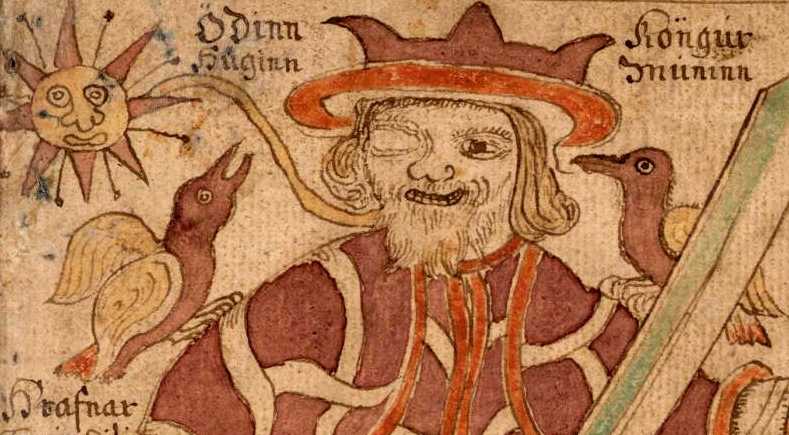
Snorri Sturluson's Prose Edda (Gylfaginning 38), written in Iceland around 1220 CE, contains the most detailed account of Odin's two ravens: Huginn (Thought) and Muninn (Memory). Every morning they fly out across the nine worlds; every evening they return to Odin's shoulders and report what they have seen. The text gives us Odin's own concern: he worries more about Muninn (Memory) than Huginn (Thought), which 13th-century interpreters read as a statement about the primacy of memory to identity.
These are ravens (hrafn), not strictly crows, though the Anglo-Saxon and medieval European traditions blurred corvid species distinctions regularly. The key point is that Huginn and Muninn are divine instruments, Odin's eyes across the world, not signs sent to individual humans. A person who reads a crow as a personal message from Odin is importing the Norse framework but reversing its direction: in the Prose Edda, the ravens report to Odin, they are not dispatched to mortals.
British and Appalachian tradition: the omen legacy
John Brand's Observations on the Popular Antiquities of Great Britain (rev. Henry Ellis, 3 vols., John Russell Smith, 1849) is one of the most comprehensive archives of British folk-belief. Brand documents the English counting-rhyme for corvids, "one for sorrow, two for joy," with the earliest traceable manuscripts, noting that the rhyme applied originally to magpies but was commonly applied to any black crow-like bird. In America the rhyme migrated further still, from magpie specifically to crow and blackbird generally, as magpies became a far less familiar bird across most of the country than they'd been in Britain. The underlying tradition, that a single crow or magpie observed alone was a bad sign while a pair was good, was widespread across Britain by the 18th century at least.
Vance Randolph's Ozark Superstitions (1947) and Puckett's 1926 Southern folk archive both document American crow-omen traditions clearly descended from British inheritance. A crow calling repeatedly near a house was read as a death sign in both archives. A large crow gathering (what we would call a roost) was a significant omen of change, weather, or coming hardship. These readings had been in the American folk corpus for long enough by 1920 that Puckett and Randolph record them as common knowledge, not newly arrived beliefs.
Cherokee tradition: kâgû
James Mooney's Myths of the Cherokee (Smithsonian Bureau of American Ethnology, 1900) is the foundational primary source. The Cherokee kâgû (crow) appears in animal-council narratives and in origin stories alongside other birds. The crow does not carry a uniformly negative or positive fixed valence in Mooney's record; it is one member of the bird community with its own behavioral characteristics. Mooney's index is specific: he names species, records Cherokee names, and distinguishes the crow from the raven and from related birds. Any treatment of "Cherokee crow meaning" that does not name specific Mooney entries or cite living Cherokee cultural authorities is likely generalizing from the pan-tribal "crow = change" shorthand. Cherokee tradition isn't the only Indigenous framework where the crow, or a close relative, escapes the death-omen reading entirely: Raven, a trickster-creator figure central to Pacific Northwest coast Indigenous traditions, carries none of the doom associations that define the British and Appalachian corvid-omen lineage.
Medieval bestiary tradition
Edward Topsell's The History of Four-Footed Beasts and Serpents and Fowls (1658) transmitted earlier bestiary crow-lore into the English printed tradition. The crow in this lineage carried associations with longevity, marital fidelity (crows were said to mate for life), and, occasionally, prophetic ability. The fidelity reading is absent from most contemporary American crow-symbolism, which focuses on the death-omen and magic-messenger poles.
Where the contemporary "crow as messenger" reading comes from
Ted Andrews's Animal Speak (Llewellyn, September 1993) treats the crow as "the keeper of sacred law" and a figure who "helps us to see magic in the ordinary." Andrews drew on the Norse Huginn-and-Muninn tradition and on general Indo-European intelligence-of-crows material, filtered through a Jungian transformative-messenger frame. His book positioned the crow as a positive mystical figure, explicitly contrasting with the folk omen-tradition it was competing against.
By the late 1990s, the Andrews vocabulary was dominant in American metaphysical culture. The older death-omen reading didn't disappear (it persists in Appalachian and rural communities), but the "crow as magic messenger" reading now coexists with it across American folk-spiritual culture. Both are real; the death-omen version is significantly older.
The bird itself
American crows (Corvus brachyrhynchos) are among the most cognitively sophisticated birds in North America. Research at the University of Washington (John Marzluff, 2008 and subsequent studies) demonstrated that crows recognize and remember individual human faces and pass that information to their offspring. They use tools, plan for the future, and hold what appear to be "funeral" gatherings around dead conspecifics, a behavior potentially related to predator-risk learning rather than mourning, but still striking. The winter roosting behavior that produced so many crow-flock omen traditions involves communal roosts of hundreds of thousands of birds in some Midwestern cities, with Cornell Lab data documenting individual roosts exceeding 200,000 birds. None of that is a sign. It's social thermoregulation and information-exchange about where the food is, and the reason it reads as ominous has everything to do with the visual: a dark sky, constant calling, a mass of birds moving as one. Cornell Lab's citizen-science data puts the North American breeding population at roughly 27 million birds.
The crow's intelligence is real. Whether its visits carry messages is a function of which interpretive tradition you bring to the encounter.
Sources
- PRIMARY Snorri Sturluson, Prose Edda (Gylfaginning 38) . Trans. Anthony Faulkes, Everyman, 1987. Huginn and Muninn — Odin's two ravens/crows dispatched at dawn, returning at dusk with news of all nine worlds.
- PRIMARY John Brand, Observations on the Popular Antiquities of Great Britain . Rev. Henry Ellis, 3 vols., John Russell Smith, 1849. Records the English counting-rhyme for crows and magpies ('One for sorrow, two for joy') with the earliest datable manuscripts.
- PRIMARY Newbell Niles Puckett, Folk Beliefs of the Southern Negro . University of North Carolina Press, 1926. Crow and black-bird omens in Southern US tradition, pp. 230–235.
- PRIMARY Vance Randolph, Ozark Superstitions . Columbia University Press, 1947. Crow calls and crow-flock behavior as weather and change omens.
- PRIMARY James Mooney, Myths of the Cherokee . Smithsonian Bureau of American Ethnology Annual Report 19, 1900. Crow (kâgû) in Cherokee oral tradition.
- PRIMARY Edward Topsell, The History of Four-Footed Beasts and Serpents (and Fowls) . E. Cotes, 1658. Medieval bestiary crow-lore transmitted to the English printed tradition.
- REFERENCE Cornell Lab of Ornithology, American Crow (Corvus brachyrhynchos) species account
- REFERENCE Ted Andrews, Animal Speak . Llewellyn, September 1993.