Spirit Animal
Dragonfly Spirit Animal
Dragonfly spirit animal meaning: transformation, forward movement and water. Traced from the modern transformation-and-illusion reading back through Ted Andrews's Animal Speak to Japan's ancient name Akitsushima ('Island of Dragonflies') in the Nihon Shoki, samurai kabuto helmet crests, and the Zuni and Hopi Sikyátki dragonfly pottery motif.
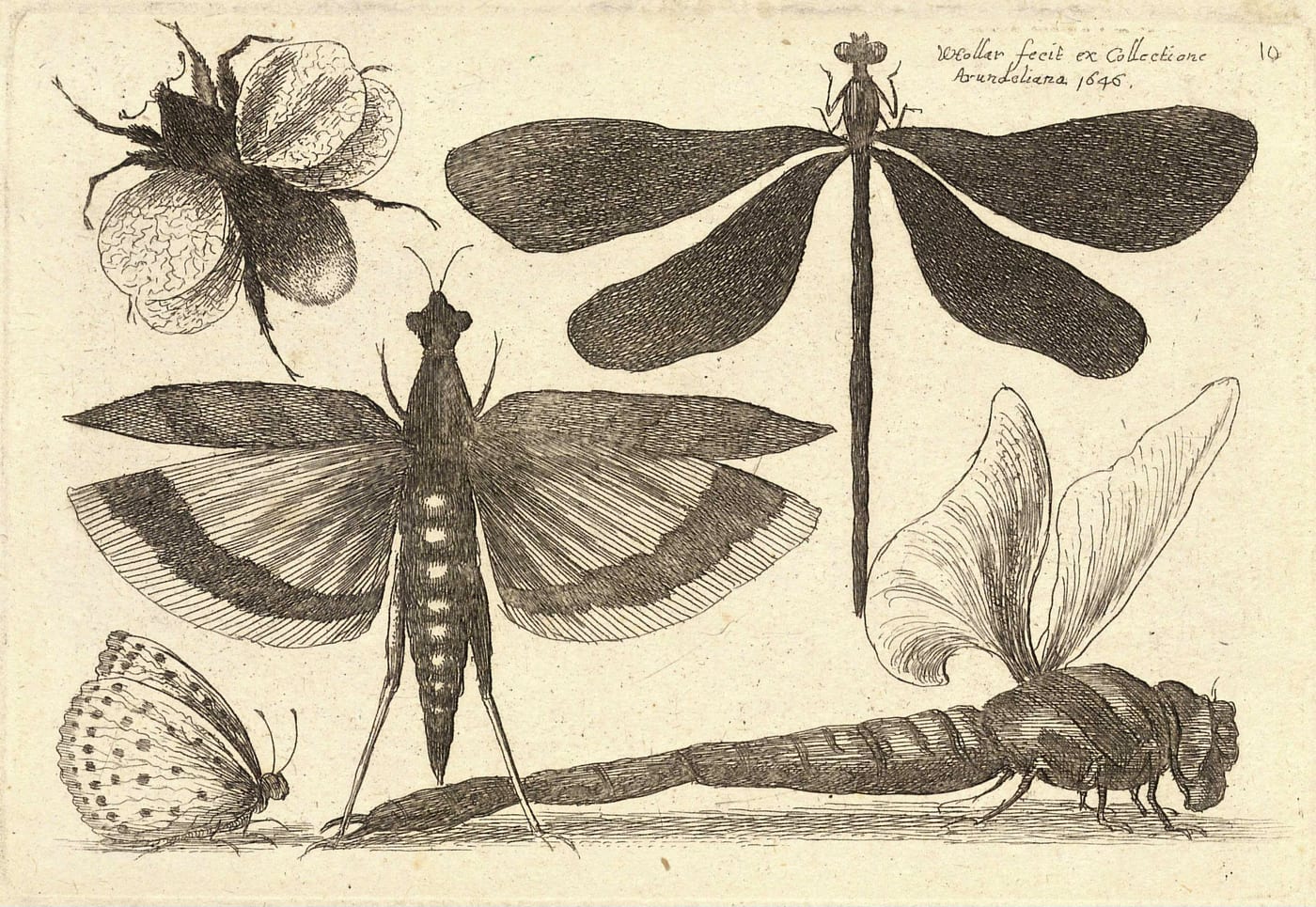
In modern American "spirit animal" usage, the dragonfly stands for transformation, lightness, the illusion-piercing gaze, and a joyful self-knowledge. That reading comes through Ted Andrews's Animal Speak (Llewellyn, 1993). The older traditions are specific. The Nihon Shoki (720 CE) records that Japan's emperor Jinmu compared the shape of the islands to an akitsu (dragonfly) mating pair, giving the archipelago its ancient poetic name Akitsushima ("Island of the Dragonfly"). Samurai wore dragonfly crests (known as katchi-mushi, 'the victory insect') on their kabuto helmets because the dragonfly only flies forward. The Zuni and Hopi Sikyátki pottery tradition (c. 1375–1625 CE) used the dragonfly as a water-associated motif. And in various European folklore traditions the dragonfly was called 'devil's darning needle' or 'ear-cutter,' a darker reading.
The dragonfly is one of those animals where the Eastern and Western folk traditions diverge almost completely. Japan calls the islands themselves “Akitsushima,” Island of the Dragonfly, in a naming-passage that goes back to the 720 CE Nihon Shoki. Samurai wore the dragonfly on their helmets because they believed it only flew forward. The Hopi put the dragonfly on some of the most beautiful ceramic work in North America because it meant water was near. Meanwhile in 18th-century England, the same insect was called “devil’s darning needle” and accused of sewing up the lips of lying children.
One animal. Radically different readings.
The Japanese positive tradition
Akitsushima. The Nihon Shoki narrative has Emperor Jinmu comparing the shape of the islands, at a moment of viewing from a high place, to a pair of mating dragonflies. The resulting name, Akitsushima, is an honorific for Japan still occasionally used in classical poetry. Aston’s 1896 translation preserves the passage.
Katchi-mushi, the victory insect. Samurai observed, accurately in general terms, that the dragonfly tends to fly forward rather than backward. (Modern entomology notes dragonflies can in fact hover and reverse with great agility, but the folk observation captured their dominant flight pattern.) The forward-only reading became a martial virtue. Dragonfly crests appear on kabuto helmets, arrow-feathers, and sword-guard tsuba from the Kamakura period (1185–1333) forward. The Tokyo National Museum has many surviving examples. The image persisted into the Meiji era and remains a motif in Japanese martial-arts iconography.
The Pueblo water tradition
The Sikyátki polychrome pottery tradition of the Hopi Mesas (c. 1375–1625 CE) is one of the great pre-contact Pueblo ceramic traditions. The dragonfly is a recurring motif, usually paired with water imagery (clouds, rain, frogs). J.W. Fewkes’s Hopi Pottery Symbols (Smithsonian BAE, 1919) documents the iconography in detail; Alexander Stephen’s Hopi Journal (edited by Elsie Clews Parsons for Columbia University Press, 1936) preserves Hopi-speaker commentary.
The biological basis of the association is direct: dragonflies require water to breed, so their presence in the arid Southwest signals the rare and precious presence of water. In Hopi and Zuni reading, the dragonfly is a water-messenger, not a transformation-symbol. The contemporary Hopi Dictionary (Sekaquaptewa et al., University of Arizona Press, 1998) preserves the term and the context.
The European negative tradition
This is the layer modern pop-spiritual articles almost never mention. English folk tradition called the dragonfly “devil’s darning needle,” believing it would sew up the lips of lying children. Other English folk names include “ear-cutter,” “horse-stinger,” and “snake doctor.” Swedish tradition called it skam (devil). Jacob Grimm’s Teutonic Mythology (1883) records the Germanic-language variants.
None of these beliefs has biological basis. Dragonflies don’t sting. They don’t hurt horses. They don’t bother children. But the folk tradition is well-documented, recorded in the Oxford English Dictionary for “devil’s darning needle,” and still audible in Iona and Peter Opie’s 1959 schoolchildren-folklore collection. The European dragonfly is a demonic insect in a way the Japanese and Pueblo dragonflies are not.
What the pop reading keeps and drops
Andrews’s 1993 Animal Speak synthesis keeps the Japanese positive tradition and the Pueblo water-messenger tradition (though largely without naming them) and drops the European negative tradition entirely. The resulting “transformation, lightness, joy” reading is a selective one-hemisphere synthesis.
Knowing the European negative tradition exists doesn’t make the positive reading wrong. It just makes the dragonfly a more complicated animal than the pop treatment suggests. The divergence by hemisphere is one of the cleaner examples of how much cultural-folk tradition shapes what an animal “means.”
Across traditions
Japanese (Akitsushima, katchi-mushi, the samurai crest)
The Nihon Shoki (720 CE) records a passage in which Emperor Jinmu, Japan's legendary first emperor, surveys the land and compares its shape to a pair of mating dragonflies (akitsu). The name Akitsushima (蜻蛉島, "Island of the Dragonfly") becomes an ancient poetic name for Japan. Aston's 1896 translation of the Nihon Shoki preserves the passage.
The samurai tradition picked up the dragonfly as katchi-mushi (勝ち虫, "victory insect") because the dragonfly, in traditional Japanese observation, only flies forward and never in retreat. Dragonfly crests appear on kabuto (samurai helmets), arrow-feathers, sword-guard tsuba, and other military objects from the Kamakura period (1185–1333) forward. The Tokyo National Museum holds numerous surviving examples. The dragonfly image remained a standard military-symbolic motif into the Meiji era.
- PRIMARY Nihon Shoki (Jinmu chapter) . Aston trans., Tuttle reissue 1972 (originally 1896).
- MUSEUM Tokyo National Museum, samurai kabuto collection with dragonfly crests
- PEER-REVIEWED Stephen Turnbull, The Samurai: A Military History . Routledge, 1996.
Zuni and Hopi (Sikyátki pottery)
The Sikyátki polychrome pottery tradition of the Hopi Mesas (c. 1375–1625 CE) produced some of the finest surviving pre-contact Pueblo ceramic work. The dragonfly (Hopi: paavatàlangw; Zuni: soononnaawe) is a recurrent motif, often paired with water-associated iconography (clouds, rain, frogs). J.W. Fewkes's Hopi Pottery Symbols (Bureau of American Ethnology, 1919) and Alexander Stephen's Hopi Journal (edited by Elsie Clews Parsons, Columbia University Press, 1936) document the iconography.
The dragonfly's water-association in Pueblo iconography is tied to its real biology: dragonflies indicate the presence of water, and in the arid Southwest, water is the substance most bound up with life and ceremonial significance. The dragonfly is not a "transformation" symbol in the Hopi and Zuni readings; it is a water-witness and a messenger.
- PRIMARY J.W. Fewkes, Hopi Pottery Symbols . Smithsonian BAE Annual Report 33, 1919.
- PRIMARY Alexander M. Stephen, Hopi Journal . Parsons ed., Columbia University Press, 1936.
- PEER-REVIEWED Emory Sekaquaptewa, Hopi Dictionary . University of Arizona Press, 1998.
European folklore (the 'devil's darning needle')
European folk traditions, particularly English, German, and Scandinavian, often treated the dragonfly as a sinister insect. English folk names include devil's darning needle, ear-cutter, horse-stinger, and snake doctor. The Oxford English Dictionary records these usages from the 18th century onward; earlier attestations are more fragmentary. The names reflect a folk belief that the dragonfly would sew up the lips of lying children or sting horses.
Swedish folk tradition called the dragonfly skam (devil) or pärnryttare (the devil's rider). None of these beliefs has any basis in dragonfly biology; dragonflies are harmless to humans and livestock. But the folk tradition is well-documented and remains a curious counterpoint to the sunnier modern pop-spiritual reading. Iona and Peter Opie's The Lore and Language of Schoolchildren (Oxford, 1959) preserves some of the lingering English-language expressions.
- REFERENCE Oxford English Dictionary, 'devil's darning needle'
- PEER-REVIEWED Iona and Peter Opie, The Lore and Language of Schoolchildren . Oxford University Press, 1959.
- PRIMARY Jacob Grimm, Teutonic Mythology . Stallybrass trans., George Bell & Sons, 1883.
Ted Andrews (1993)
Andrews's 1993 dragonfly is the Japanese-positive + Southwestern-water-messenger synthesis, softened into a personal-spirit keyword: transformation, illusion-piercing, joyful lightness. The European negative tradition is absent. The result is a one-sided reading that genuinely differs by hemisphere: the dragonfly is celebrated in East Asian and Pueblo traditions, feared in much European folk tradition.
- REFERENCE Ted Andrews, Animal Speak . Llewellyn, September 1993.
Working with the Dragonfly
If you want a regular practice rather than a one-time read, an oracle deck is the standard tool: you draw a card and sit with whatever animal comes up. Our ranked guide to spirit animal oracle decks compares the field.
Frequently asked
- What does a dragonfly symbolize spiritually?
- In modern pop usage, transformation, lightness, and joyful clarity, the Andrews 1993 reading. Older traditions are specific. The Nihon Shoki (720 CE) records Japan's ancient name Akitsushima ('Island of the Dragonfly'). Samurai wore dragonfly crests (katchi-mushi, 'victory insect') on kabuto helmets because the dragonfly only flies forward. The Sikyátki pottery tradition of the Hopi and Zuni used the dragonfly as a water-associated motif. And European folklore called it 'devil's darning needle,' a darker reading usually omitted from pop-spiritual articles.
- Why is Japan called the 'Island of the Dragonfly'?
- Because the Nihon Shoki (720 CE), Japan's second-oldest extant book, records that Emperor Jinmu, the legendary first emperor, surveyed the land and compared its shape to a pair of mating dragonflies (akitsu). The resulting name Akitsushima (蜻蛉島) became a classical-poetic name for Japan. Aston's 1896 translation preserves the passage.
- Why did samurai wear dragonfly crests?
- Because the dragonfly, in traditional Japanese observation, only flies forward and never in retreat, making it an ideal symbol for a warrior. Samurai called it katchi-mushi (勝ち虫, 'victory insect'). Dragonfly crests appear on kabuto helmets, arrow-feathers, and sword-guard tsuba from the Kamakura period (1185–1333) forward. The Tokyo National Museum holds numerous surviving examples with the motif.
- Is the dragonfly really called 'devil's darning needle'?
- Yes, in English folk tradition. The Oxford English Dictionary records 'devil's darning needle' as a name for the dragonfly from at least the 18th century; other folk names include 'ear-cutter,' 'horse-stinger,' and 'snake doctor.' Swedish folk tradition called it skam (devil). None of these beliefs has biological basis, since dragonflies are harmless to humans and livestock. But the folk tradition is well-documented and survives into modern Iona and Peter Opie's 1959 Lore and Language of Schoolchildren.
Sources
- PRIMARY Nihon Shoki . Aston trans., Tuttle, 1896/1972.
- MUSEUM Tokyo National Museum, samurai kabuto collection
- PEER-REVIEWED Stephen Turnbull, The Samurai: A Military History . Routledge, 1996.
- PRIMARY J.W. Fewkes, Hopi Pottery Symbols . Smithsonian BAE Annual Report 33, 1919.
- PRIMARY Alexander M. Stephen, Hopi Journal . Columbia University Press, 1936.
- PEER-REVIEWED Emory Sekaquaptewa, Hopi Dictionary . University of Arizona Press, 1998.
- REFERENCE Oxford English Dictionary, 'devil's darning needle'
- PEER-REVIEWED Iona and Peter Opie, The Lore and Language of Schoolchildren . Oxford University Press, 1959.
- PRIMARY Jacob Grimm, Teutonic Mythology . Stallybrass trans., 1883.
- REFERENCE Ted Andrews, Animal Speak . Llewellyn, September 1993.