Animal encounters, sourced
What It Means When a Dragonfly Visits You: Japan's Akitsushima, Lakota Invulnerability, and the Devil's Darning Needle
One of the few animals for which Japan named its entire country. Also a devil's darning needle in English schoolyard rhyme. Context decides meaning.
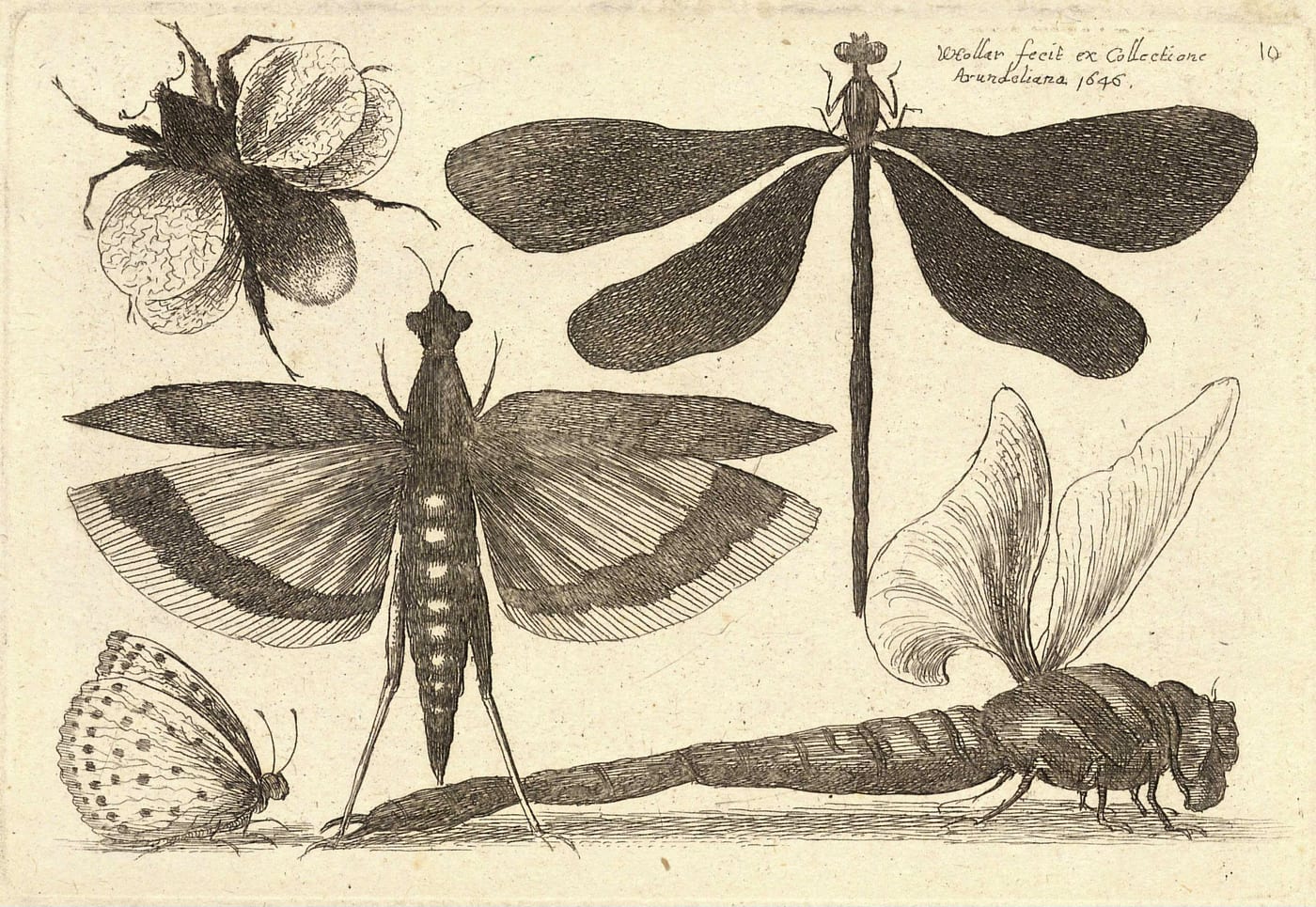
The dragonfly (Japanese tonbo; Lakota tȟašíyagnunpa) carries markedly different meanings across its major traditions. Japan's oldest literary name is Akitsushima — 'Dragonfly Island' — from Nihon Shoki Book 5 (720 CE). Lakota warriors painted dragonflies on war gear for invulnerability (Densmore, BAE Bulletin 61, 1918). Hopi iconography connects the dragonfly to rain and agricultural fertility (Fewkes, BAE Annual Report 21, 1903). European folk tradition (Grimm 1883; Opie 1959) called it the devil's darning needle. The contemporary 'transformation and illusion-breaking' reading derives primarily from Ted Andrews's Animal Speak (1993).
Japan was once called Akitsushima. The name comes from Nihon Shoki — the second-oldest Japanese chronicle, compiled in 720 CE — where Emperor Jinmu describes the Yamato plain as resembling a dragonfly licking its own abdomen. That is a serious pedigree. No other insect in world literature gave its name to an entire island nation. Which makes the dragonfly's European reputation as the "devil's darning needle" — a diabolical hovering insect that would sew shut the lips of children who swore — a considerable contrast.
Japan: Akitsushima and martial virtue
Nihon Shoki (Chronicles of Japan, 720 CE), Book 5, records Emperor Jinmu's survey of the Yamato plain from a mountain peak. He compares the landscape to a dragonfly licking its own body — a tight, self-contained, perfectly bounded island. The name Akitsushima (akitsu = dragonfly, shima = island) became Japan's poetic name for itself in classical literature. The dragonfly's ability to hover, pivot instantaneously, and fly backward made it a natural symbol of precision and agility in Japanese warrior culture. Samurai helmets (kabuto) in the Tokyo National Museum collection incorporate dragonfly crests. The dragonfly (kachi-mushi, "winning insect") was considered an exclusively forward-moving creature — it cannot, it was believed, fly backward — which made it an emblem of martial resolve and victory.
Lakota: invulnerability medicine
Frances Densmore's Teton Sioux Music (Smithsonian BAE Bulletin 61, 1918) documents the dragonfly's role in Lakota warrior medicine. The tȟašíyagnunpa (dragonfly) was associated with invulnerability because of its speed and near-impossible-to-catch quality; a warrior who could not be caught could not be killed. Dragonfly imagery was painted on horses and shields before battle. The Lakota use is specific: the dragonfly is not a general totem or spiritual guide but a specific medicine symbol deployed for a specific battlefield purpose.
Hopi: the rain-bringer
Jesse Walter Fewkes's Hopi Katcinas Drawn by Native Artists (BAE Annual Report 21, 1903) and his earlier Hopi Pottery Symbols (1898) document the dragonfly as a recurring motif on Sikyátki polychrome pottery. In Hopi ceremonial iconography, the dragonfly is a water and rain symbol, connected to the agricultural ceremonial cycle and to the kachina complex associated with growth and moisture. The dragonfly's connection to water in Hopi art reflects its actual ecology: odonates (dragonflies and damselflies) are always found near standing water, which in a desert environment makes them a natural water-sign.
Europe: the devil's darning needle
Jacob Grimm's Teutonic Mythology (Deutsche Mythologie, 4th ed., 1883) documents Germanic folk-belief about the dragonfly as a devil-associated or uncanny insect. In German, the dragonfly was Teufelsnadel (devil's needle) or Teufelspferd (devil's horse). In English, the most persistent folk name was "horse-stinger" — the dragonfly was believed to sting horses — and "devil's darning needle," the belief that dragonflies could sew up the lips, ears, or eyes of misbehaving children overnight. Iona and Peter Opie's The Lore and Language of Schoolchildren (Oxford University Press, 1959) documents these beliefs as still active in British schoolyards in the 1950s. The European dragonfly tradition is almost entirely negative, the precise opposite of the Japanese, Lakota, and Hopi readings.
The contemporary reading and its source
Ted Andrews's Animal Speak (Llewellyn, 1993) reframes the dragonfly as a figure of "seeing past illusions" and "the power of light." Andrews drew on the dragonfly's iridescent wing-structure — which produces different colors depending on the angle of observation — as a metaphor for the ability to see reality from multiple perspectives. His reading is internally consistent and has been influential; it is also unconnected to any of the primary-source traditions above, none of which frame the dragonfly as a figure of illusion or perspective.
The actual insect
Dragonflies (Order Odonata) have been on Earth for approximately 300 million years; fossil species from the Carboniferous period had wingspans exceeding 70 cm. Modern species range from under 2 cm to over 10 cm. The common green darner (Anax junius) undertakes a multi-generational migration across North America comparable in scale, proportionally, to the monarch butterfly migration. Adults are apex predators of the insect world, catching 95% of their prey on the wing. Their compound eyes cover nearly 360 degrees, giving them effectively omnidirectional vision. The hovering ability that made them a martial symbol in Japan is real: dragonflies can hover indefinitely, fly backward, and independently control each of their four wings. These are not the behaviors of a creature that needs mythological enhancement to be interesting.
Frequently asked
- What does it mean when a dragonfly visits you?
- In contemporary American folk-spiritual culture (primarily Ted Andrews, Animal Speak, 1993), a dragonfly visit is read as a call to see past illusions. In Japan, the dragonfly (tonbo) is a symbol of martial virtue and good harvest; Japan's literary name Akitsushima ('Dragonfly Island') comes from Nihon Shoki Book 5. In Lakota tradition, the dragonfly (tȟašíyagnunpa) is associated with invulnerability — warriors painted dragonflies on their horses and shields (Densmore 1918). In European folk tradition (Grimm 1883; Opie 1959), the dragonfly was the 'devil's darning needle,' an ominous insect. These four readings have opposite valences.
- Is a dragonfly a sign from a deceased loved one?
- No primary source predating the 1990s connects the dragonfly specifically to deceased loved ones. The 'dragonfly as spirit of the dead' reading appears in contemporary American grief culture by the 2000s, likely as an extension of the more general 'insects carry souls' tradition visible in the Japanese and some Indigenous traditions. But neither the Japanese tonbo tradition nor the Lakota dragonfly medicine connects the insect specifically to recently deceased relatives visiting the living.
- Why is Japan called Akitsushima (Dragonfly Island)?
- Nihon Shoki (Chronicles of Japan, compiled 720 CE) records in Book 5 that Emperor Jinmu, surveying the Yamato plain from a peak, described the landscape as resembling a dragonfly (akitsu) licking its own abdomen. The name Akitsushima — Dragonfly Island — became one of Japan's earliest poetic names. The dragonfly's association with Japan is thus one of the oldest and most formally recorded national animal-symbolism moments in world literature.
- What do dragonflies symbolize in Hopi tradition?
- Jesse Walter Fewkes documented the dragonfly as a recurring motif on Sikyátki polychrome pottery (Hopi Pottery Symbols, 1898; also Annual Report 21, 1903). In Hopi iconography, the dragonfly is a rain-bringer and crop-guardian, associated with the Butterfly Maiden kachina complex and the agricultural ceremonial cycle. The motif appears on bowls and jars specifically tied to water and rain-petitioning ceremonies.
Sources
- PRIMARYNihon Shoki (Chronicles of Japan), Book 5 (Emperor Jinmu) — W.G. Aston trans., Tuttle, 1972 (orig. 1896). Emperor Jinmu surveys the land from a peak and says it 'resembles a dragonfly licking its abdomen.' Japan's earliest literary name is Akitsushima — Dragonfly Island.
- PRIMARYJesse Walter Fewkes, Hopi Katcinas Drawn by Native Artists — Smithsonian Bureau of American Ethnology Annual Report 21, 1903. Sikyátki polychrome dragonfly motif on Hopi pottery; dragonfly as rain-bringer and crop-guardian.
- PRIMARYFrances Densmore, Teton Sioux Music — Smithsonian Bureau of American Ethnology Bulletin 61, 1918. Lakota dragonfly (tȟašíyagnunpa) associated with invulnerability; warriors painted dragonflies on their war gear.
- PRIMARYJacob Grimm, Teutonic Mythology (Deutsche Mythologie), vol. 2 — Trans. J.S. Stallybrass, London, 1883 (4th ed.). European 'devil's darning needle' (Teufelsnadel) tradition; dragonfly as a diabolical or uncanny insect in German and English folk-belief.
- PRIMARYIona and Peter Opie, The Lore and Language of Schoolchildren — Oxford University Press, 1959. British schoolchildren's rhymes and superstitions about dragonflies, including 'horse-stingers' and 'devil's darning needles.'
- REFERENCECornell Lab of Ornithology / Odonata Central, Common Green Darner (Anax junius)
- REFERENCETed Andrews, Animal Speak — Llewellyn, September 1993. Andrews frames the dragonfly as illusion-breaking and the ability to see past surface appearances.