Spirit Animal
Eagle Spirit Animal
Eagle spirit animal meaning: courage, freedom and leadership. Traced from the modern courage-freedom reading back through Ted Andrews's Animal Speak to Zeus's eagle in Homer, the Roman legionary aquila, the Vedic Garuda, the Mexica founding of Tenochtitlan, and Lakota eagle-feather protocol.
In modern American "spirit animal" usage, the eagle most often stands for courage, freedom, leadership, and a high-altitude view of life. That reading descends through Ted Andrews's Animal Speak (Llewellyn, 1993), a late synthesis. The older traditions are sharper. The Greek eagle is Zeus's bird, the bolt-bearer of Homer's Iliad 24.315. The Roman aquila was the standard every legion died to protect, per Tacitus's Annals. Garuda in the Vedic and Puranic record is Vishnu's mount, a cosmic figure in his own right. For the Mexica, an eagle on a cactus devouring a serpent was the omen that told them to found Tenochtitlan, per Sahagún's Florentine Codex. And in Lakota practice, the eagle feather carries strict protocol and is not a decorative object.
Five different peoples, thousands of miles apart, looked at the same bird and told different stories about it. Homer made it Zeus’s messenger. Gaius Marius, around 104 BCE, made it the only standard a Roman legion would die to protect. The Mexica built a city where they saw one eating a snake. The Vedic poets made it the king of all birds and gave it a name, Garuda, that still serves as the national emblem of Indonesia. The Lakota made it so sacred the United States Congress wrote a law in 1940 specifically regulating who can own one of its feathers. And in 1993, a paperback from a small Minnesota press pulled pieces of all of this into a trade-paperback synthesis called Animal Speak.
That last one is the version most readers arrive at when they search “eagle spirit animal.” It’s worth saying which is which.
The eagle with the most weight in modern culture is the Roman one
People don’t always realize this. The bald eagle on the back of an American quarter isn’t an inheritance from any Indigenous tradition. It’s a descendant of the Roman aquila, by way of the Byzantine double-headed eagle and every European heraldic eagle after that. When the Continental Congress adopted the eagle in 1782, they were participating in a Roman political symbol, not borrowing from the Haudenosaunee (whose own bird imagery is different). That lineage is worth knowing if you want to know where the “eagle equals country” reflex comes from in the West.
The Mexica eagle is a founding story, not a personal symbol
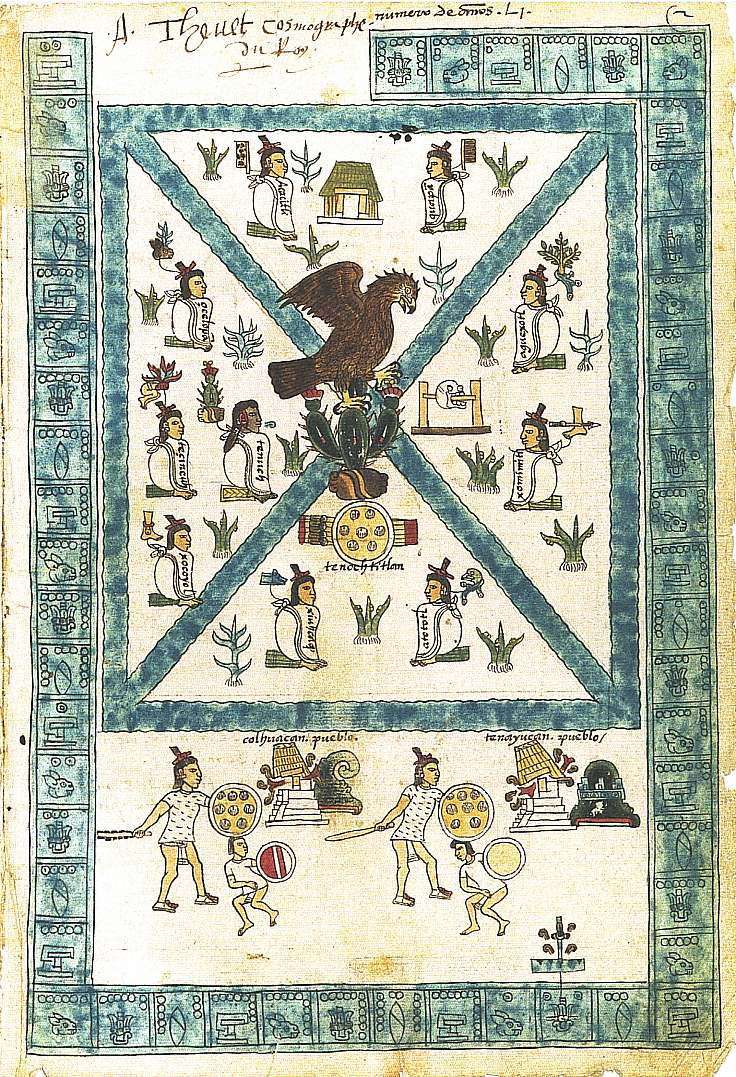
The eagle on the nopal cactus is on the modern Mexican flag, basically unchanged, from a vision Huitzilopochtli gave the Mexica to find the site of their capital. The vision came true. They built Tenochtitlan on the island where they saw the bird. Seven hundred years later the same image stands for the country that grew on those ruins. This is the opposite of a personal-guide reading. The eagle doesn’t tell you anything. It tells a people where to put a city.
Lakota feathers and the law
If you are going to write about the eagle as a spiritual figure in 2026, you need to know that possessing an eagle feather in the United States, without enrollment in a federally-recognized tribe, is a federal crime under the Bald and Golden Eagle Protection Act. The National Eagle Repository exists to distribute feathers to tribal members for ceremonial use. This is not trivia. Every decorative-eagle-feather Etsy listing on the market is either a synthetic replica or an offense. The protocol is serious because the tradition is serious.
What the modern pop-reading is, named plainly
Ted Andrews, Animal Speak, Llewellyn, September 1993. Courage. Freedom. The leader’s high-altitude view. That reading descends from a mix of Roman imperial imagery filed down for a personal-spirit frame, plus 19th-century American bald-eagle nationalism, plus selective borrowing from Plains traditions without specific attribution. It is a reading. It is not the reading. Every popular spirit-animal article about the eagle is some variant of that 1993 synthesis.
The tradition sections below give you the five sources these readings came from, with the primary texts cited, so you can read the one that fits the question you actually have.
Across traditions
Greek (Zeus's eagle)
Homer calls the eagle Zeus's bird outright. Iliad 24.315 has Zeus sending "the blackest of birds, the bolt-bearer," as a sign to Priam; the scholia and later Pindar, Pythian 1.6–8, confirm the eagle as the god's messenger. Aristotle's History of Animals 9.32 catalogs the Greek eagle species (including what he calls the melanaetos, the black eagle, likely the golden eagle), and Greek coinage of Elis, Ptolemaic Egypt, and later Rome all used the bird as a sovereign sign.
The Greek reading is imperial before it is personal. The eagle is the god who throws lightning. The eagle is not, in Homer or Pindar, your personal totem animal.
- PRIMARY Homer, Iliad 24.315 . Murray trans., Loeb Classical Library.
- PRIMARY Pindar, Pythian 1.6–8 . Race trans., Loeb Classical Library.
- PRIMARY Aristotle, History of Animals 9.32 . Peck trans., Loeb Classical Library.
Roman (the legionary aquila)
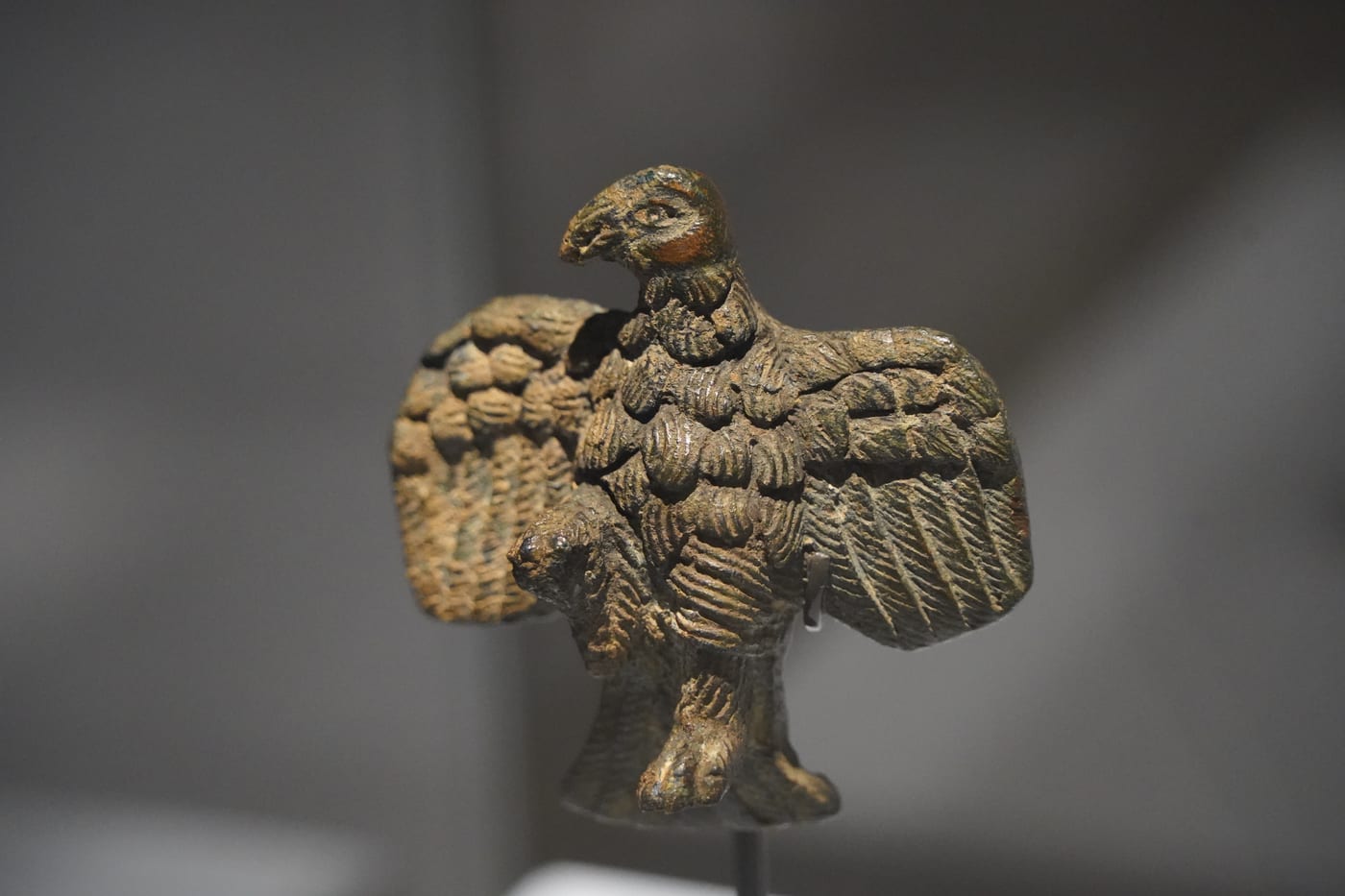
The silver eagle standard of the Roman legion, the aquila, was introduced as the exclusive legionary emblem by Gaius Marius around 104 BCE, per Pliny, Natural History 10.16. Losing the aquila in battle was an unrecoverable disgrace. Tacitus, Annals 1.60, records Germanicus's campaign to recover the eagles of Varus's lost legions from the Teutoburg Forest disaster of 9 CE. The bird was so bound to Roman imperial identity that the Byzantine double-headed eagle and every later European imperial eagle trace back to it.
This is the bird on the back of the American quarter. The "eagle = country" reading in Western culture is Roman at the root, not Greek.
- PRIMARY Pliny the Elder, Natural History 10.16 . Rackham trans., Loeb Classical Library.
- PRIMARY Tacitus, Annals 1.60 . Jackson trans., Loeb Classical Library.
Hindu (Garuda, Vishnu's mount)
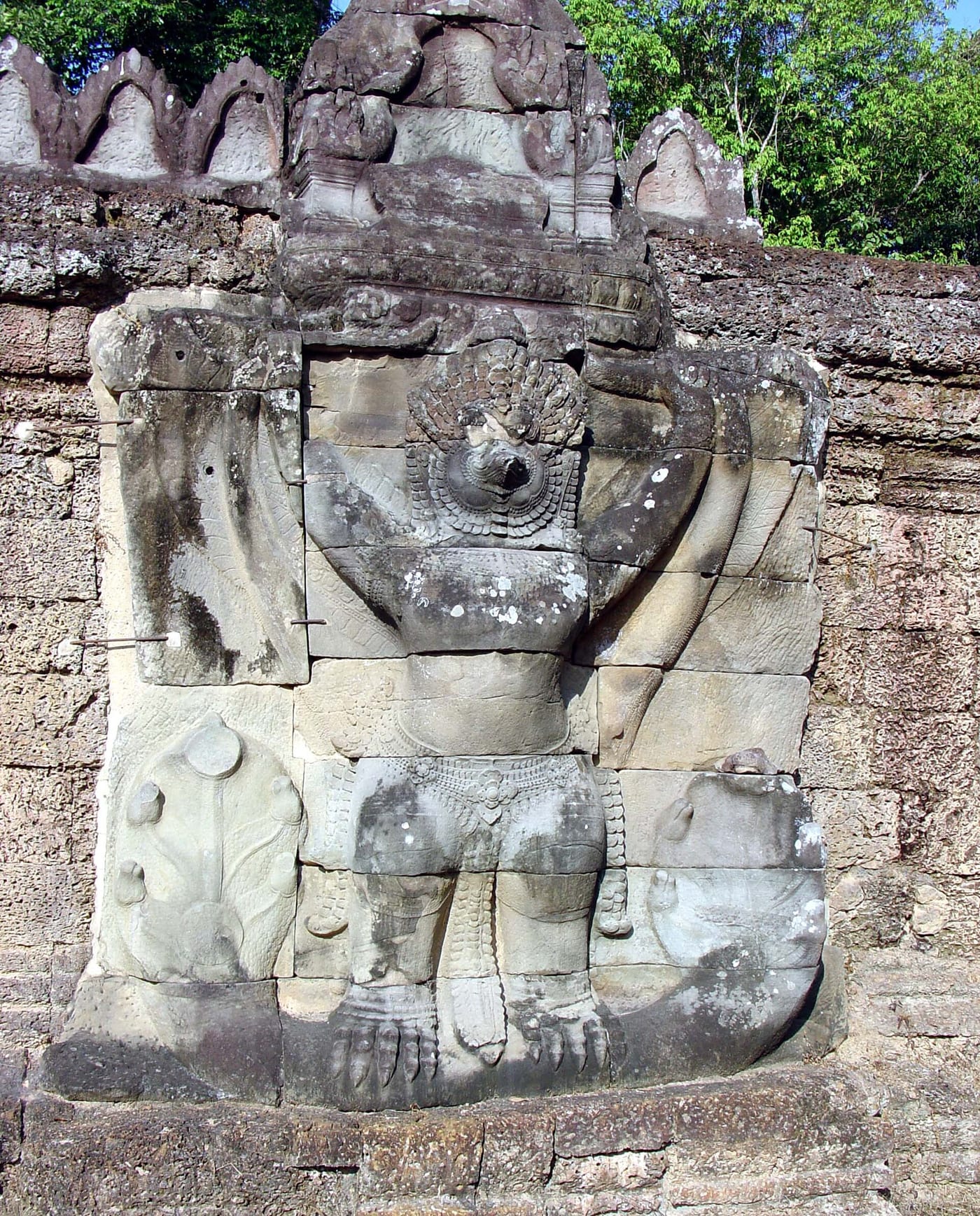
Garuda is not simply "the Hindu eagle." He is Vishnu's vahana, the king of birds, and a figure of epic stature in his own right. The Mahābhārata's Astikaparva (Book 1, Section 29) narrates his birth, his enmity with the nāgas (serpents), and his service to Vishnu. The Garuda Purana is named for him. Cambodian and Indonesian iconography carried Garuda into Southeast Asia, where he remains the national emblem of Indonesia (as Garuda Pancasila) and Thailand.
Garuda's defining myth is the theft of amrita (the nectar of immortality) to free his enslaved mother, told in Mahābhārata 1.29–34. The eagle-versus-serpent motif, so widespread from the Rig Veda forward, has Garuda as its Vedic-Puranic template.
- PRIMARY Mahābhārata 1.29–34 (Astikaparva) . van Buitenen trans., University of Chicago Press, 1973.
- PRIMARY Garuda Purana . Shastri trans., Motilal Banarsidass, 1978.
Mexica (Tenochtitlan's founding omen)
When the Mexica (the people later called Aztec) were looking for the site of their capital, their tribal god Huitzilopochtli told them to build where they saw an eagle perched on a nopal cactus devouring a serpent. Bernardino de Sahagún, Florentine Codex (Book 11), records the omen; the Codex Mendoza frontispiece (1541) illustrates it. They found the sign on an island in Lake Texcoco and built Tenochtitlan there in 1325. The image is on the modern Mexican flag, unchanged in its core composition for seven hundred years.
This is a foundation story, not a personal-guide story. The eagle tells a people where their city belongs.
- PRIMARY Bernardino de Sahagún, Florentine Codex (Historia General de las Cosas de Nueva España) . Anderson & Dibble trans., University of Utah Press, 1950–82.
- ARCHIVE Codex Mendoza (frontispiece, 1541) . Bodleian Library, MS. Arch. Selden. A. 1.
Lakota (eagle-feather protocol)
The eagle feather in Lakota, Dakota, and related Plains traditions is not a generic "spiritual" object. Frances Densmore's Teton Sioux Music and Culture (Smithsonian Bureau of American Ethnology Bulletin 61, 1918) documents the ceremonial and warrior contexts in which feathers were earned; John Neihardt's Black Elk Speaks (1932), based on Black Elk's own testimony, describes eagle imagery within the Great Vision.
Contemporary US federal law recognizes the ceremonial significance: the Bald and Golden Eagle Protection Act restricts eagle-feather possession to enrolled members of federally-recognized tribes, administered through the National Eagle Repository. Buying an "eagle feather" off Etsy and calling it a spirit-animal totem is both protocol-breaking and, depending on species, a federal offense.
- PRIMARY Frances Densmore, Teton Sioux Music and Culture . Smithsonian BAE Bulletin 61, 1918.
- PRIMARY John G. Neihardt, Black Elk Speaks . William Morrow, 1932; premier annotated ed. SUNY Press, 2008.
- REFERENCE US Bald and Golden Eagle Protection Act (16 U.S.C. §§ 668–668d)
Ted Andrews (1993)
Andrews's 1993 eagle is mostly a Roman eagle with the national-emblem sharpness filed off, reframed as personal-spirit language: courage, freedom, the high-altitude view. He nods to Plains traditions without naming specific nations, collapsing distinct nations into a generic reading.
- REFERENCE Ted Andrews, Animal Speak . Llewellyn, September 1993.
Working with the Eagle
If you want a regular practice rather than a one-time read, an oracle deck is the standard tool: you draw a card and sit with whatever animal comes up. Our ranked guide to spirit animal oracle decks compares the field.
Frequently asked
- What does the eagle symbolize spiritually?
- In modern pop usage, courage, freedom, leadership, and a high-altitude perspective, the reading set by Ted Andrews's Animal Speak (1993). The older traditions are sharper. Greek: Zeus's bolt-bearer (Iliad 24.315). Roman: the legionary aquila, introduced as the sole legion emblem by Marius c. 104 BCE. Hindu: Garuda, Vishnu's mount and an epic figure in the Mahābhārata. Mexica: the founding omen of Tenochtitlan, on the Mexican flag today. Lakota: the eagle feather, earned and protocol-bound.
- Is the eagle really sacred in Native American cultures?
- In many specific nations, yes, with specific protocols, not as a generic pan-tribal symbol. Frances Densmore's 1918 Teton Sioux fieldwork documents the earning of eagle feathers in warrior and ceremonial contexts. The US Bald and Golden Eagle Protection Act restricts possession of eagle feathers to enrolled members of federally-recognized tribes, through the National Eagle Repository. Treating the eagle as a generic spirit-symbol flattens distinct nations (Lakota, Cherokee, Diné, many others) with different practices.
- What is Garuda in Hindu mythology?
- Garuda is Vishnu's vahana (mount), the king of birds, and a major mythic figure in his own right. The Mahābhārata narrates his birth and his theft of amrita (the nectar of immortality) to free his enslaved mother (1.29–34). He is the namesake of the Garuda Purana. Indonesia and Thailand both carry his image as a national emblem. He is closer in status to a deity than to a symbolic bird.
- Why is there an eagle on the Mexican flag?
- Because it is the founding omen of Tenochtitlan. The Mexica were told by Huitzilopochtli to build their capital where they saw an eagle perched on a nopal cactus devouring a serpent. They found the sign on an island in Lake Texcoco in 1325. Sahagún's Florentine Codex (Book 11) records the omen; the Codex Mendoza frontispiece (1541) illustrates it. The flag design is continuous with the original sign.
Sources
- PRIMARY Homer, Iliad 24.315 . Murray trans., Loeb Classical Library.
- PRIMARY Pindar, Pythian 1.6–8 . Race trans., Loeb Classical Library.
- PRIMARY Pliny the Elder, Natural History 10.16 . Rackham trans., Loeb Classical Library.
- PRIMARY Tacitus, Annals 1.60 . Jackson trans., Loeb Classical Library.
- PRIMARY Mahābhārata 1.29–34 (Astikaparva) . van Buitenen trans., University of Chicago Press, 1973.
- PRIMARY Garuda Purana . Shastri trans., Motilal Banarsidass, 1978.
- PRIMARY Bernardino de Sahagún, Florentine Codex . Anderson & Dibble trans., University of Utah Press, 1950–82.
- ARCHIVE Codex Mendoza, frontispiece . Bodleian Library, MS. Arch. Selden. A. 1, 1541.
- PRIMARY Frances Densmore, Teton Sioux Music and Culture . Smithsonian BAE Bulletin 61, 1918.
- PRIMARY John G. Neihardt, Black Elk Speaks . William Morrow, 1932.
- REFERENCE US Bald and Golden Eagle Protection Act (16 U.S.C. §§ 668–668d)
- REFERENCE Ted Andrews, Animal Speak . Llewellyn, September 1993.