Spirit Animal
Elephant Spirit Animal
Elephant spirit animal meaning: memory, wisdom and strength. Traced from the modern memory-and-wisdom reading back through Ted Andrews's Animal Speak to Hindu Ganesha and Airavata, the Buddhist white elephant of Queen Maya's dream, the Thai royal white elephant tradition, and African Bantu matrilineal totemism.
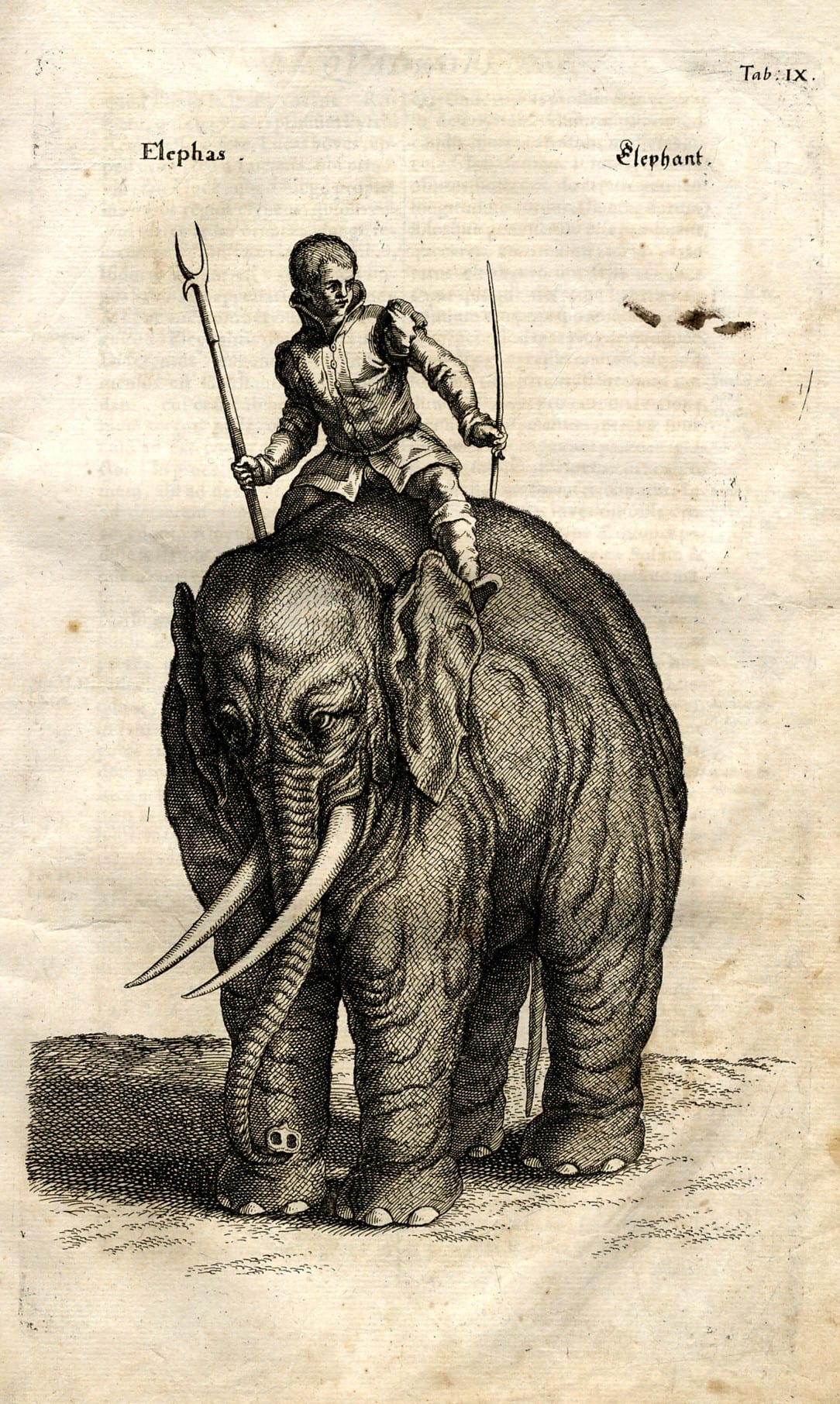
In modern American "spirit animal" usage, the elephant stands for memory, wisdom, strength, and familial depth. That reading comes through Ted Andrews's Animal Speak (Llewellyn, 1993) and the broader Western cultural idea that 'elephants never forget.' The older traditions treat the elephant as divine. Ganesha, the elephant-headed remover-of-obstacles and lord of beginnings, is one of the most widely-worshipped deities in Hinduism, with his mythic backstory in the Shiva Purana and Skanda Purana. Indra's mount Airavata is a white four-tusked elephant in Vedic cosmology (Rigveda 1.84, Mahābhārata). Queen Maya's dream of a white elephant entering her womb is the conception-scene of the Buddha, recorded in the Lalitavistara Sūtra. The Thai royal white elephant is a sacred state-symbol whose possession has been tied to legitimate sovereignty since the Sukhothai period.
Walk into almost any Hindu household in India on a festival morning and the first deity you see honored is Ganesha. Not Vishnu. Not Shiva. Not Lakshmi. Ganesha, the elephant-headed son who got his head replaced after a misunderstanding with his father, invoked first because he is the one who removes the obstacles to every other devotion. That priority is not incidental. It is the structure of Hindu ritual. You call on Ganesha before you call on anyone else. Ganesha Chaturthi, his annual festival, shuts down parts of Mumbai for ten days. More than a hundred million people participate across India every year.
No other spiritual elephant in the world operates at that scale. Ganesha is, by any honest measure, the most-worshipped elephant-figure in human history.
The pop reading inherits almost none of this
Ted Andrews’s 1993 Animal Speak elephant is the Western zookeeper’s elephant, cleaned up for spirit-animal use. Memory. Patience. Matriarchal family structure. The observation that “elephants never forget.” That reading borrows from Cynthia Moss’s Amboseli field studies, Iain Douglas-Hamilton’s Serengeti work, the 20th-century ethology that documented the genuine cognitive depth of elephants in the wild. It is a real reading. It happens to be ninety-eight percent absent from the actual ancient religious literature.
Four traditions worth standing inside
Ganesha. Hindu, lord of beginnings, elephant-headed because of a Shiva-Parvati family episode in the Puranas. Invoked at the start of every ritual. Scholarly treatment: Paul Courtright’s 1985 Oxford book.
Airavata. Vedic. Indra’s white four-tusked mount, emerged from the churning of the ocean in the Mahābhārata. Carries into Southeast Asian iconography at Angkor and Prambanan. Still worshipped as Erawan at Bangkok’s busiest Hindu-Buddhist shrine, where he draws thousands of daily visitors from across the world.
Queen Maya’s dream. Buddhist. The conception-scene of the Buddha is a white elephant with six tusks entering the queen’s side. The image is on the Bharhut Stūpa from the 2nd century BCE and every subsequent Buddhist iconographic tradition. This is the elephant as the animal of the Awakened One’s incarnation.
The Thai royal white elephant. A living political-religious institution. King Ramkhamhaeng mentioned white elephants in his 1292 CE inscription. King Naresuan’s 1593 elephant-battle victory is commemorated as Royal Thai Armed Forces Day. The white elephant was on the Thai flag from 1855 to 1917. A white elephant’s birth is still formally reported to the monarch for ceremonial presentation.
What this adds up to
The elephant in pop-spiritual writing is a gentle wise matriarch. The elephant in the ancient religious literature is a god, a god’s mount, the animal of a divine conception, and the proof of a king’s legitimate rule. These are not the same reading softened. They are genuinely different traditions, operating on different scales of seriousness.
A reader coming to “elephant spirit animal” in 2026 deserves to know that when they reach for the word, they are reaching into a tradition where more than a hundred million Hindus invoke Ganesha before every important beginning. That is worth carrying in your head.
Across traditions
Hindu (Ganesha)
Ganesha (also Ganapati, Vinayaka) is the elephant-headed son of Shiva and Parvati, lord of beginnings, remover of obstacles, and patron of letters and learning. The classical mythic narrative, preserved in the Shiva Purana and the Skanda Purana (8th–11th centuries CE in their current form, but drawing on earlier material), narrates how Parvati fashioned the boy Ganesha from clay to guard her doorway; Shiva, not recognizing him, beheaded him; Parvati's grief led Shiva to replace the head with that of the first creature he encountered, a passing elephant.
Ganesha is invoked at the start of Hindu rituals, business openings, and academic examinations, a practice known as mangalacharana. The Ganesha Chaturthi festival, celebrated across India and the Hindu diaspora, is one of the largest Hindu festivals of the year. Paul Courtright's Ganesa: Lord of Obstacles, Lord of Beginnings (Oxford University Press, 1985) is a standard English-language scholarly treatment.
- PRIMARY Shiva Purana . Shastri trans., Motilal Banarsidass, 1950.
- PRIMARY Skanda Purana . Bhatt & Shastri trans., Motilal Banarsidass, 1950–2003.
- PEER-REVIEWED Paul B. Courtright, Ganesa: Lord of Obstacles, Lord of Beginnings . Oxford University Press, 1985.
Vedic (Indra's Airavata)
Airavata is the white four-tusked elephant who serves as the vahana of Indra, king of the Vedic gods. The Rigveda (c. 1500–1200 BCE) references Indra's white elephant; the Mahābhārata (Book 1, Ādiparva) narrates Airavata's emergence from the samudra manthana, the churning of the ocean by gods and asuras together. He is the lord of elephants, and in Southeast Asian Buddhist and Hindu iconography (Cambodian Angkor, Javanese Prambanan) he appears consistently as the bearer of the storm-king.
The Airavata iconography carries through to modern Thailand, where Erawan (the Thai form of Airavata) gives his name to the Erawan Shrine in Bangkok, one of the most-visited Hindu-Buddhist shrines in Southeast Asia.
- PRIMARY Rigveda 1.84 (references to Indra's mount) . Jamison & Brereton trans., Oxford, 2014.
- PRIMARY Mahābhārata, Book 1 (Ādiparva, samudra manthana) . van Buitenen trans., University of Chicago Press, 1973.
- REFERENCE Erawan Shrine, Bangkok (Thao Maha Phrom)
Buddhist (Queen Maya's dream)
Queen Maya, wife of King Śuddhodana of the Shakya clan, dreamed of a white elephant with six tusks entering her right side before the conception of the future Buddha. The Lalitavistara Sūtra (2nd–3rd century CE in its current form) gives the canonical account; the Mahāvastu and the Buddhacarita of Aśvaghoṣa (c. 1st–2nd century CE) preserve parallel traditions. The scene has been depicted across Buddhist art from the Bharhut and Sanchi stūpas (2nd–1st centuries BCE) onward.
The white elephant is therefore the animal of the Buddha's incarnation. This is a specifically Buddhist theological position, not a generic 'elephants are wise' folk-belief.
- PRIMARY Lalitavistara Sūtra . Mitra trans., Asiatic Society, 1881; revised Dharma Publishing ed., 1983.
- PRIMARY Aśvaghoṣa, Buddhacarita 1.8–15 . Olivelle trans., Clay Sanskrit Library, 2008.
- MUSEUM Bharhut Stūpa (dream of Maya relief) . Indian Museum, Kolkata; c. 2nd c. BCE.
Thai / Southeast Asian (the royal white elephant)
In Thai tradition, the possession of a white elephant (chang phueak) has been a marker of legitimate royal sovereignty since at least the Sukhothai period (13th century CE). The inscriptions of King Ramkhamhaeng (1292 CE) reference white elephants as symbols of rule. King Naresuan's 1593 victory over the Burmese heir-apparent Mingyi Swa was fought from elephant-back and is commemorated in the Thai Royal Thai Armed Forces Day (18 January) to this day.
The white elephant was on the flag of Siam from 1855 to 1917 (now the Royal Standard); a white elephant's birth is still formally reported to the Thai monarch for ceremonial presentation. Katherine Bowie's Of Beggars and Buddhas: The Politics of Humor in the Vessantara Jataka in Thailand (University of Wisconsin Press, 2017) treats the broader context.
- PRIMARY Ramkhamhaeng Inscription (1292 CE) . Bangkok National Museum; UNESCO Memory of the World register.
- REFERENCE Thai Royal Family white elephant registry
- PEER-REVIEWED Katherine A. Bowie, Of Beggars and Buddhas . University of Wisconsin Press, 2017.
Ted Andrews (1993)
Andrews's 1993 elephant is a Western cultural-memory-and-wisdom figure: "elephants never forget," patient strength, family loyalty (drawing on the 20th-century ethology of matrilineal elephant herds popularized by Cynthia Moss and Iain Douglas-Hamilton). He gestures at Ganesha without the Hindu theological frame. The Vedic Airavata, the Buddhist Queen Maya tradition, and the Thai royal white elephant tradition are essentially absent.
- REFERENCE Ted Andrews, Animal Speak . Llewellyn, September 1993.
Working with the Elephant
If you want a regular practice rather than a one-time read, an oracle deck is the standard tool: you draw a card and sit with whatever animal comes up. Our ranked guide to spirit animal oracle decks compares the field.
Frequently asked
- What does an elephant symbolize spiritually?
- In modern pop usage, memory, wisdom, and patient strength, the reading set by Andrews 1993 and the 19th-century Western idea that 'elephants never forget.' Older traditions are vastly deeper. Hindu Ganesha is the elephant-headed remover-of-obstacles, invoked at the start of every ritual. Vedic Airavata is Indra's white four-tusked mount. The Buddha was conceived when Queen Maya dreamed a white elephant entered her side (Lalitavistara Sūtra). And the Thai royal white elephant has been a mark of legitimate sovereignty since the 13th century.
- Why does Ganesha have an elephant head?
- The Shiva Purana and Skanda Purana narrate that Parvati fashioned the boy Ganesha from clay to guard her doorway. Shiva, not recognizing him, beheaded him; Parvati's grief led Shiva to replace the head with that of the first creature he encountered, a passing elephant. Ganesha is the lord of beginnings and the remover of obstacles, invoked at the start of every Hindu ritual, business opening, or examination.
- What is the white elephant's religious meaning?
- In Buddhism, the Buddha's conception is signaled by Queen Maya dreaming a white elephant with six tusks entering her side (Lalitavistara Sūtra, 2nd–3rd century CE). In Thai royal tradition, possession of a white elephant is a mark of legitimate sovereignty, documented from King Ramkhamhaeng's 1292 inscription through the modern monarchy. The white elephant was on the Thai flag from 1855 to 1917.
- Who is Airavata?
- Airavata is Indra's white four-tusked elephant, mount of the Vedic storm-king. He emerges from the churning of the ocean (samudra manthana) in the Mahābhārata's Ādiparva. Southeast Asian iconography at Angkor, Prambanan, and other sites shows him consistently as Indra's bearer. The Thai form 'Erawan' names the famous Hindu-Buddhist shrine at the intersection of Ratchadamri and Rama I Roads in Bangkok.
Sources
- PRIMARY Shiva Purana . Shastri trans., Motilal Banarsidass, 1950.
- PRIMARY Skanda Purana . Motilal Banarsidass, 1950–2003.
- PEER-REVIEWED Paul B. Courtright, Ganesa: Lord of Obstacles, Lord of Beginnings . Oxford University Press, 1985.
- PRIMARY Rigveda 1.84 . Jamison & Brereton trans., Oxford, 2014.
- PRIMARY Mahābhārata, Ādiparva (samudra manthana) . University of Chicago Press, 1973.
- PRIMARY Lalitavistara Sūtra . Mitra trans., Asiatic Society, 1881.
- PRIMARY Aśvaghoṣa, Buddhacarita 1.8–15 . Clay Sanskrit Library, 2008.
- MUSEUM Bharhut Stūpa, Indian Museum Kolkata . c. 2nd century BCE.
- PRIMARY Ramkhamhaeng Inscription (1292 CE) . Bangkok National Museum.
- PEER-REVIEWED Katherine Bowie, Of Beggars and Buddhas . University of Wisconsin Press, 2017.
- REFERENCE Ted Andrews, Animal Speak . Llewellyn, September 1993.