Spirit Animal
Giraffe Spirit Animal
Giraffe spirit animal meaning: farseeing, gentle height and perspective. Traced from the modern farseeing-perspective reading back through Ted Andrews's Animal Speak to the Egyptian giraffe-hieroglyph sr, the 1414 Ming-dynasty episode in which a giraffe gifted by the Bengal Sultan was identified as a qilin, and the San Bushmen rain-dance tradition.
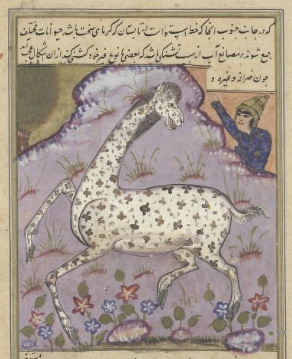
In modern American "spirit animal" usage, the giraffe stands for farseeing perspective, gentle height, and the capacity to reach things others cannot. That reading comes through Ted Andrews's Animal Speak (Llewellyn, 1993). The older traditions are specific. The Egyptian hieroglyph sr (𓆷, Gardiner E27) depicts a giraffe and functions as the determinative for 'to foretell' or 'to announce.' In 1414, a giraffe gifted by the Sultan of Bengal to the Yongle Emperor of Ming China was received at court as a qilin (auspicious mythological creature); Shen Du's Pictures of the Qilin (1414, now in the Philadelphia Museum of Art) preserves the moment. San Bushmen rock art across southern Africa depicts giraffes alongside eland in shamanic-trance contexts associated with rain-making.
In 1414, at the court of the Yongle Emperor in Beijing, a giraffe was identified as a qilin. The giraffe had arrived as a gift from the Sultan of Bengal, delivered via the fourth voyage of Zheng He’s treasure-fleet expeditions. The court scholar Shen Du produced a painting and an accompanying poem, Pictures of the Qilin, reading the animal’s unexpected arrival as an auspicious portent of the emperor’s legitimate rule. The painting is now in the Philadelphia Museum of Art’s Elkins Collection. The identification probably rests on a linguistic coincidence: the Swahili word for giraffe is girin, and the Chinese character for qilin is qílín.
It is one of the more delightful translation-reception events in world history.
Three specific pre-modern traditions
The Egyptian sr-hieroglyph. The hieroglyph 𓆷 (Gardiner E27) depicts a giraffe and serves as the determinative for the Middle Egyptian verb sr, “to foretell” or “to announce.” The logic: the giraffe’s height allowed it to see approaching threats long before lower animals or humans. The Egyptian scribe who wrote “to announce” with a giraffe-determinative was making a specific zoological observation about the animal’s utility as a sentinel. Gardiner’s Egyptian Grammar (Griffith Institute, 1957) is the philological reference.
The 1414 Ming qilin. Zheng He’s treasure-fleet voyages (1405–1433) were the largest naval expeditions in world history to that point. The 1414 delivery of the Bengal-giraffe produced one of the great interpretive moments in Chinese cultural history. Shen Du’s painting, Louise Levathes’s When China Ruled the Seas (1994), and Edward Dreyer’s Zheng He (2007) treat the episode.
San Bushmen rock art. One of the oldest continuously-documented human-animal spiritual traditions on earth. David Lewis-Williams’s The Mind in the Cave (2002) and earlier Believing and Seeing (1981) argue, based on ethnography by Lorna Marshall and others, that San rock art encodes trance-experiences central to rain-making rituals. Megan Biesele’s Women Like Meat (Witwatersrand, 1993) provides ethnographic ground.
What Andrews offers
A generic farseeing-perspective reading drawn from the animal’s most obvious feature. The Egyptian, Ming, and San traditions are absent. Reading any one of them gives the giraffe more weight than the keyword approach. Reading all three gives it the weight it actually has.
Across traditions
Egyptian (the sr hieroglyph)
The Egyptian hieroglyph sr (𓆷, Gardiner sign E27), depicting a giraffe, functions as the determinative for the verb sr, 'to foretell' or 'to announce.' The association rests on the practical observation that the giraffe's height allowed it to see approaching threats (or approaching visitors) long before lower animals or humans could. The Egyptian scribe who wrote 'to announce' with a giraffe-determinative was making a specific zoological point.
The giraffe was not native to dynastic-period Egypt proper but was known through trade with Punt and Nubia; New Kingdom reliefs at the Tomb of Rekhmire (TT100, c. 1450 BCE) depict giraffes being brought as Nubian tribute. Alan Gardiner's Egyptian Grammar (Griffith Institute, 3rd ed. 1957) is the philological standard.
- PEER-REVIEWED Alan H. Gardiner, Egyptian Grammar (sign E27) . Griffith Institute, 3rd ed. 1957.
- MUSEUM Tomb of Rekhmire (TT100), Nubian tribute scenes . Sheikh Abd el-Qurna, Thebes; c. 1450 BCE.
Ming Chinese (the 1414 'qilin' tribute)
In 1414, the Sultan of Bengal gifted a giraffe to the Yongle Emperor of Ming China, delivered via the fourth voyage of Zheng He's treasure-fleet expeditions. Court scholar Shen Du produced a painting and accompanying poem, Pictures of the Qilin (麒麟圖, 1414), identifying the animal as a qilin, the auspicious Chinese mythological creature whose appearance was said to presage the birth or death of a sage.
The identification was a translation-reception event: the Swahili word for giraffe is girin, which plausibly seeded the Chinese identification. The original painting with Shen Du's poem is now in the Philadelphia Museum of Art (Elkins Collection). Louise Levathes's When China Ruled the Seas (Simon & Schuster, 1994) treats the Zheng He voyages; Edward Dreyer's Zheng He (Pearson Longman, 2007) is the standard scholarly treatment.
- MUSEUM Shen Du, Pictures of the Qilin (1414) . Philadelphia Museum of Art, Elkins Collection.
- PEER-REVIEWED Louise Levathes, When China Ruled the Seas . Simon & Schuster, 1994.
- PEER-REVIEWED Edward L. Dreyer, Zheng He: China and the Oceans in the Early Ming Dynasty . Pearson Longman, 2007.
San Bushmen (rock art, rain-making)
San Bushmen rock art across southern Africa (estimated 75,000 sites in South Africa alone, spanning 27,000 years of continuous tradition) frequently depicts giraffes alongside eland in shamanic-trance contexts. David Lewis-Williams's The Mind in the Cave (Thames & Hudson, 2002) and earlier Believing and Seeing (Academic Press, 1981) argue, based on ethnography by Lorna Marshall and others, that San rock art encodes trance experiences central to rain-making rituals in which large-animal spirits (eland, giraffe, rhinoceros) are called upon.
The giraffe's role in rain-making is documented ethnographically from Kalahari !Kung fieldwork in the 1950s–70s (Harvard Kalahari Research Group). Megan Biesele's Women Like Meat (Witwatersrand University Press, 1993) is a more recent ethnographic treatment. This is one of the oldest continuously-documented human-animal spiritual traditions on earth.
- PEER-REVIEWED David Lewis-Williams, The Mind in the Cave . Thames & Hudson, 2002.
- PEER-REVIEWED David Lewis-Williams, Believing and Seeing . Academic Press, 1981.
- PEER-REVIEWED Megan Biesele, Women Like Meat . Witwatersrand University Press, 1993.
- PRIMARY Lorna Marshall, Nyae Nyae !Kung: Beliefs and Rites . Harvard University, 1999.
Ted Andrews (1993)
Andrews's 1993 giraffe is the farseeing-perspective-gentle-height figure drawn generically from the animal's most obvious biological feature. The Egyptian sr-hieroglyph, the 1414 Ming-qilin episode, and the San rock-art tradition are all absent. Lewis-Williams's 1981 monograph was already in print twelve years before Andrews's book, so the research gap is a research gap.
- REFERENCE Ted Andrews, Animal Speak . Llewellyn, September 1993.
Working with the Giraffe
If you want a regular practice rather than a one-time read, an oracle deck is the standard tool: you draw a card and sit with whatever animal comes up. Our ranked guide to spirit animal oracle decks compares the field.
Frequently asked
- What does a giraffe symbolize spiritually?
- In modern pop usage, farseeing perspective and gentle height, the Andrews 1993 reading. Older traditions are specific. The Egyptian hieroglyph sr (𓆷) depicts a giraffe and serves as the determinative for 'to foretell' or 'to announce.' In 1414, a giraffe gifted by the Sultan of Bengal to the Yongle Emperor of Ming China was received as a qilin (auspicious mythological creature); Shen Du's Pictures of the Qilin (1414) preserves the moment. And San Bushmen rock art across southern Africa depicts giraffes in shamanic-trance contexts associated with rain-making.
- Why did the Chinese emperor think the giraffe was a qilin?
- Because of a translation coincidence and a politically opportune identification. In 1414, a giraffe gifted by the Sultan of Bengal to the Yongle Emperor arrived via the fourth of Zheng He's treasure-fleet voyages. The Swahili word for giraffe is girin, which plausibly seeded the Chinese identification with qilin, the auspicious mythological creature. Shen Du's Pictures of the Qilin (1414, Philadelphia Museum of Art) identifies the animal as a qilin and frames its arrival as a portent of the Yongle Emperor's legitimate rule.
- What is the Egyptian giraffe hieroglyph?
- The hieroglyph sr (𓆷, Gardiner sign E27) depicts a giraffe and functions as the determinative for the verb sr, 'to foretell' or 'to announce.' The association rests on the giraffe's height allowing it to see approaching threats long before lower animals or humans. The Tomb of Rekhmire (TT100, c. 1450 BCE) at Thebes depicts giraffes being brought as Nubian tribute, so the animal was known to dynastic-period Egypt even though it was not native to the Nile Valley proper.
- Did giraffes appear in African rock art?
- Extensively. San Bushmen rock art across southern Africa (estimated 75,000 sites in South Africa alone) frequently depicts giraffes alongside eland in shamanic-trance contexts. David Lewis-Williams's The Mind in the Cave (Thames & Hudson, 2002) argues that San rock art encodes trance experiences central to rain-making rituals in which large-animal spirits are called upon. The tradition is one of the oldest continuously-documented human-animal spiritual traditions on earth.
Sources
- PEER-REVIEWED Alan H. Gardiner, Egyptian Grammar . Griffith Institute, 3rd ed. 1957.
- MUSEUM Tomb of Rekhmire (TT100) . Sheikh Abd el-Qurna, Thebes; c. 1450 BCE.
- MUSEUM Shen Du, Pictures of the Qilin (1414)
- PEER-REVIEWED Louise Levathes, When China Ruled the Seas . Simon & Schuster, 1994.
- PEER-REVIEWED Edward L. Dreyer, Zheng He . Pearson Longman, 2007.
- PEER-REVIEWED David Lewis-Williams, The Mind in the Cave . Thames & Hudson, 2002.
- PEER-REVIEWED David Lewis-Williams, Believing and Seeing . Academic Press, 1981.
- PEER-REVIEWED Megan Biesele, Women Like Meat . Witwatersrand University Press, 1993.
- PRIMARY Lorna Marshall, Nyae Nyae !Kung . Harvard University, 1999.
- REFERENCE Ted Andrews, Animal Speak . Llewellyn, September 1993.