Animal encounters, sourced
What It Means When a Hummingbird Visits You: Huitzilopochtli, Taíno Ancestors, and the Joy Reading
The hummingbird was the sun deity in Mexica theology and the patron bird of warriors who died in battle. The contemporary "joy and love" reading is a significant step down in intensity.
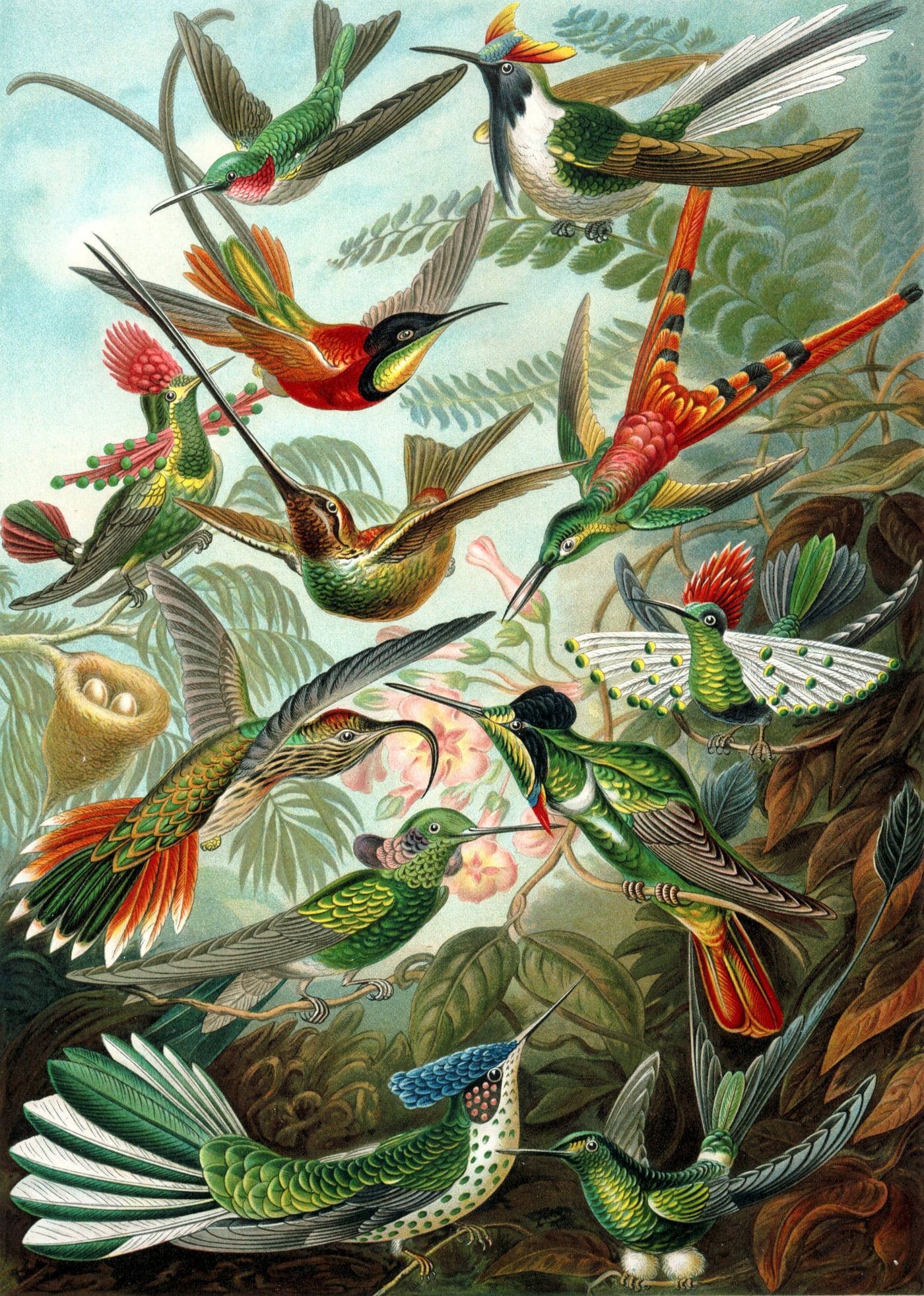
The hummingbird's most documented pre-modern spiritual role is as the form of warriors who died in battle, per Sahagún's Florentine Codex Book 3: after four years accompanying the sun, the souls of fallen warriors transformed into hummingbirds. Huitzilopochtli — 'Hummingbird of the South' — was the Mexica sun-and-war deity, patron of Tenochtitlan. Taíno tradition (Ramón Pané, c. 1498) connected hummingbirds to ancestor-spirits. The contemporary American 'hummingbird = joy, love, and the presence of a loved one' reading (Andrews 1993) is a 20th-century synthesis with a much softer register than its historical predecessors.
The hummingbird is the only bird in this cluster where a deity is named after the animal rather than the other way around. Huitzilopochtli, the Mexica sun-and-war god, was the Hummingbird of the South — the cosmic force that powered the sun on its daily journey. The Templo Mayor in Tenochtitlan was partly his house. Thousands of sacrifices were made to keep him fed. That is the hummingbird's primary-source legacy in the Americas. The "hummingbirds are joy and sweetness" reading is a real tradition, but it's about forty years old.
Mexica: Huitzilopochtli and the warrior-soul
Sahagún's Florentine Codex, compiled with Nahua collaborators at the Colegio de Santa Cruz de Tlatelolco roughly 1540–1585, is the most comprehensive record of Mexica religious belief. Book 3 documents the Mexica afterlife. Warriors who died in battle or on the sacrificial stone were called tlahuauanime. After accompanying the sun for four years on its morning journey from eastern horizon to zenith, these warriors transformed into hummingbirds and butterflies. They were free to drink from flowers in the living world.
Huitzilopochtli himself — the name means "Hummingbird of the Left" or "Hummingbird of the South" (huitzilin = hummingbird; opochtli = left/south) — was the Mexica patron deity and the force that drove the sun. Eduardo Matos Moctezuma's excavations of the Templo Mayor, conducted from the late 1970s after the discovery of the Coyolxauhqui disc in 1978, documented the scale of Huitzilopochtli's cult. The south side of the double pyramid was his temple; the offerings recovered number in the thousands. The hummingbird is not just a symbol in the Mexica tradition — it is the god himself, in name.
Taíno: the earliest European record of hummingbird spirit-belief
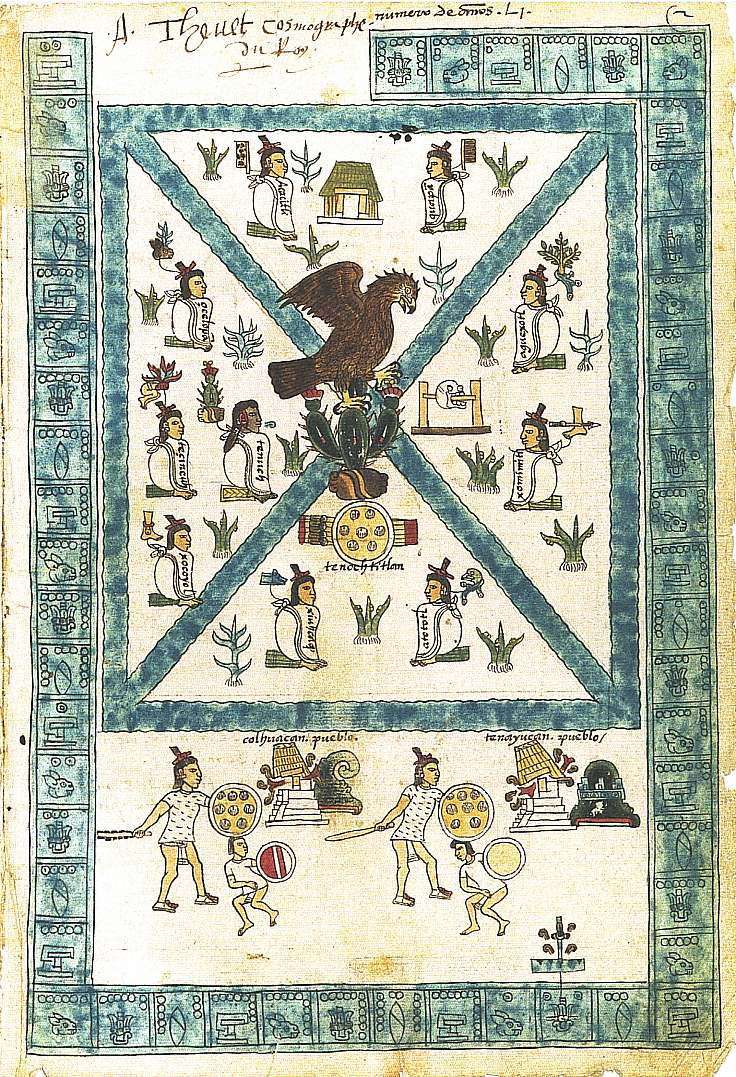
Ramón Pané was a Catalan friar who accompanied Columbus on his second voyage (1493) and spent years living among the Taíno of Hispaniola. His Relación acerca de las antigüedades de los indios (c. 1498) is the earliest European ethnographic record from the Americas. Pané documents the Taíno zemís — spirit-entities associated with specific animals and natural forces. The hummingbird (colibrí in the Spanish record) appears in the context of ancestral spirit-connection. Irving Rouse's The Tainos (Yale, 1992) provides the scholarly context: the zemí system connected living persons to the spiritual power of deceased ancestors and natural forces, with specific animals as intermediary forms.
Gonzalo Fernández de Oviedo's Historia general y natural de las Indias (1535) provides the first printed European description of the hummingbird as a trade object: dried hummingbirds were used as amulets across the Caribbean. This is consistent with Pané's record of the bird's spiritual significance; the amulet use suggests the hummingbird's soul-connecting power was recognized in material form.
The contemporary reading
Ted Andrews's Animal Speak (1993) frames the hummingbird as joy, tirelessness, and "the ability to find the sweetness in any situation." This reading draws on the hummingbird's actual biology — it must feed almost constantly to sustain its metabolic rate — and maps it onto a positive-psychology metaphor. The resulting folk-spiritual reading is widely cited in American grief literature, where the hummingbird becomes a symbol of a deceased person's love or presence.
The Andrews reading is not historically false: there is a genuine Indigenous tradition connecting hummingbirds to the souls of the honored dead. But the Mexica version of that connection involves warriors who died violent deaths, not peaceful visits from grandparents. The Taíno version involves a broader spirit-connection tradition. The specific "a hummingbird at the feeder means your late mother is visiting" reading has no pre-1990s primary-source backing.
The bird itself
Ruby-throated hummingbirds (Archilochus colubris) are the only breeding hummingbird species in eastern North America. They weigh approximately 3 grams — about the weight of a penny — and beat their wings 53 times per second in normal flight. During courtship displays, the wings beat up to 200 times per second. Cornell Lab research documents their exceptional spatial memory: individuals return to the same territories, feeders, and flower patches across multiple years. A hummingbird that visits your garden is almost certainly a bird that has specifically mapped your property as a resource. The repeated visits that feel intentional are intentional — in an ecological, not supernatural, sense.
Frequently asked
- What does it mean when a hummingbird visits you?
- In Mexica (Aztec) theology (Sahagún Florentine Codex Book 3), the hummingbird was the most sacred bird: Huitzilopochtli, the sun-and-war deity, was the 'Hummingbird of the South.' Warriors who died in battle became hummingbirds after four years, joining the sun on its morning journey. In Taíno tradition (Ramón Pané, c. 1498), the hummingbird was associated with ancestral soul-spirits. In contemporary American folk-belief (Andrews 1993), the hummingbird represents joy and tirelessness. The warrior-soul reading is the oldest documented connection between the hummingbird and the deceased.
- Is a hummingbird a sign from a deceased loved one?
- The Mexica warrior-soul tradition (Florentine Codex Book 3) is the oldest documented tradition connecting hummingbirds specifically to the souls of those who died. It is not the contemporary 'grandparent visiting' reading; it is a specific class of honored dead (warriors) transforming into a specific form (hummingbird) after a specific period (four years). The contemporary 'hummingbird = deceased loved one visiting' belief is a late-20th-century development in American grief culture, probably drawing loosely on the Mexica tradition without the specificity.
- Who is Huitzilopochtli?
- Huitzilopochtli (Nahuatl: 'Hummingbird of the South' or 'Hummingbird of the Left') is the Mexica sun-and-war deity, the patron god of Tenochtitlan (present-day Mexico City). His temple occupied the south side of the Templo Mayor, the double-pyramid at the center of Tenochtitlan, alongside Tlaloc's rain-temple on the north side. Eduardo Matos Moctezuma's excavations of the Templo Mayor in the 1970s–80s recovered thousands of sacrificial offerings. The war-and-solar cycle that Huitzilopochtli embodied required the feeding of the sun with sacrificial blood to keep it moving; warriors who died in battle were the sun's nourishment and returned as hummingbirds.
- Why do hummingbirds visit the same spots repeatedly?
- Ruby-throated hummingbirds (Archilochus colubris) and other North American species are site-faithful and have exceptional memory for food locations. Cornell Lab research documents that individual hummingbirds return to the same feeders, the same flower patches, and the same territories across multiple years. A hummingbird that appears at your window on a particular day is almost certainly a bird that has mapped your property as a feeding resource. The folk-spiritual reading of repeated visits as intentional visitation is consistent with behavior that has a straightforward ecological explanation.
Sources
- PRIMARYFray Bernardino de Sahagún, Florentine Codex, Book 3 — Trans. Anderson and Dibble, School of American Research, 1950–82. Huitzilopochtli — 'Hummingbird of the South' or 'Hummingbird of the Left' — the Mexica sun-and-war deity. Warriors who died in battle became hummingbirds after four years.
- PEER-REVIEWEDEduardo Matos Moctezuma, The Great Temple of the Aztecs — Thames & Hudson, 1988. Huitzilopochtli's iconography at the Templo Mayor excavation; the hummingbird-god's role in the solar-war cycle.
- PRIMARYRamón Pané, Relación acerca de las antigüedades de los indios — c. 1498; trans. Susan C. Griswold, ed. José Juan Arrom, Duke University Press, 1999. The earliest European ethnography of the Americas; the Taíno hummingbird as ancestral spirit-bird (colibrí).
- PEER-REVIEWEDIrving Rouse, The Tainos: Rise and Decline of the People Who Greeted Columbus — Yale University Press, 1992. Taíno spiritual tradition including hummingbird-soul associations.
- PRIMARYGonzalo Fernández de Oviedo, Historia general y natural de las Indias, Book 14 — Madrid, 1535. First European printed description of the hummingbird; Oviedo describes it as 'the smallest bird in the world,' noting it was traded dried as an amulet.
- REFERENCECornell Lab of Ornithology, Ruby-throated Hummingbird (Archilochus colubris)
- REFERENCETed Andrews, Animal Speak — Llewellyn, September 1993. Andrews frames the hummingbird as joy, tirelessness, and the ability to find sweetness in any situation.