Mythical creatures
Griffin: Herodotus's Gold-Guardian, Pliny's Real Animal, and the Fossil Hypothesis
Pliny the Elder believed griffins were real. Adrienne Mayor thinks she may know why: Protoceratops skulls eroding from gold-bearing rock in Central Asia.
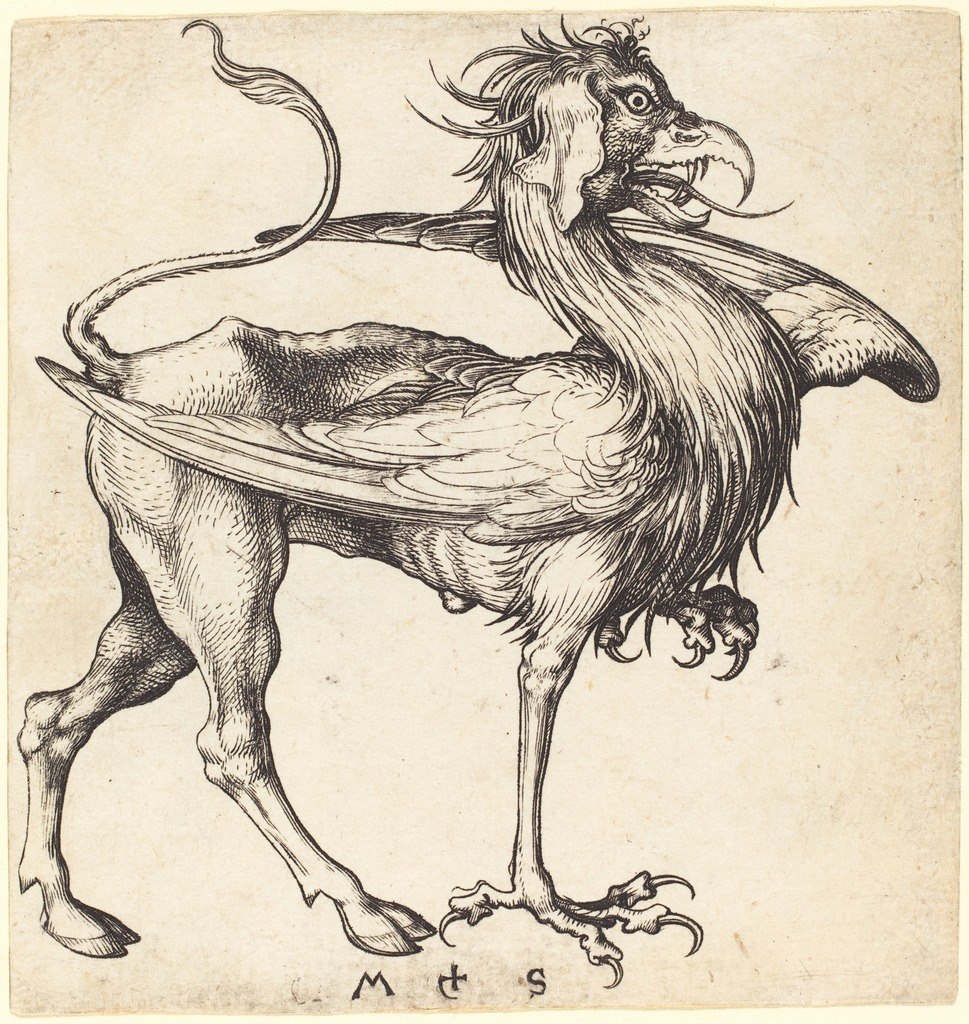
The griffin (Greek grups) is documented from Herodotus (4.13, 4.27; 5th century BCE), who reports it guarding gold in the north against the one-eyed Arimaspi. Pliny the Elder (Natural History 7.2) treats it as a real zoological animal. The Physiologus (c. 2nd century CE) established the griffin as a Christ-figure in medieval Christian typology. Adrienne Mayor's The First Fossil Hunters (Princeton, 2000) proposes that Protoceratops fossil discoveries in the gold-bearing Altai region may underlie the Greek literary tradition.
Most mythological animals are easy to dismiss as pure invention. The griffin is harder. Pliny the Elder, one of the most systematic natural historians of the ancient world, treated it as a real animal. The Minoan throne room at Knossos had griffin frescoes 3,500 years ago. Adrienne Mayor spent years examining the fossil record of Central Asia to produce a credible hypothesis for why specific people in specific places reported specific things about a creature that looks like an eagle-lion hybrid. This is a more interesting story than "the ancient world had good imaginations."
Older griffin images, before Herodotus
The Greek literary tradition isn't where the griffin image starts. Eagle-lion composite creatures appear in ancient Near Eastern art from Mesopotamia and Egypt, developed independently of anything Greek. The Minoan palace at Knossos had griffins frescoed into its throne room centuries before Herodotus ever wrote a word about the Arimaspi. Whether the Greek griffin descends from this older pan-Mediterranean tradition of composite creatures, or arose on its own, is an open question. Adrienne Mayor's fossil hypothesis explains the specific Scythian reports Herodotus recorded; it doesn't require that every griffin image in the ancient world share a single origin.
Herodotus: griffins and Scythian gold
Herodotus (c. 484–425 BCE) is the first Greek historian to describe griffins in any detail. In the Histories Book 4, describing the peoples beyond Scythia, he reports a tradition going back to Aristeas of Proconnesus (c. 7th century BCE): one-eyed men called the Arimaspi live in the far north and steal gold from griffins. Herodotus is careful to note that he personally does not vouch for this; he reports what the sources say. But the gold-and-griffins association is specific enough that it represents a piece of geographic knowledge circulating in the Greek world with some consistency.
Adrienne Mayor's fossil hypothesis
Mayor's The First Fossil Hunters (Princeton University Press, 2000) is the most rigorous examination of the relationship between fossil discoveries and mythological animals in the ancient world. Her specific argument for the griffin: the Altai Mountain region of Central Asia, the northernmost gold-bearing region accessible to Scythian nomads, is also one of the richest repositories of Protoceratops and Psittacosaurus fossils in the world. Protoceratops was a sheep-sized ceratopsid dinosaur with a pronounced beak, four legs, and a prominent frill. Its fossil skulls, eroding from gold-bearing rock strata, present a shape that a 5th-century BCE Greek listener to a Scythian description might plausibly reconstruct as a four-legged creature with an eagle's beak and prominent wing-nubs (the frill). Mayor is careful to note this is a hypothesis, not a proof; but she marshals significant geographic and morphological evidence.
Pliny and natural history
Pliny the Elder's Natural History (77 CE) treats the griffin in two passages. In Book 7.2, describing the peoples of the north, he includes griffins among the inhabitants of remote regions. In Book 10.70, he describes it as a wild beast with wings and eagle's beak. Pliny draws on older Greek sources and does not distinguish between what he has personally verified and what he has inherited from the tradition. For Pliny, the griffin occupies the same category as other animals he has not personally observed but for which he has reliable-seeming sources. His Natural History is itself a primary source for what educated Romans believed about the natural world.
The Physiologus and the Christ-griffin
The Physiologus (c. 2nd century CE, probably Alexandria) is the foundational text of the medieval bestiary tradition. Its griffin entry establishes an allegorical reading that became standard in Christian art: the griffin combines eagle (heavenly nature) and lion (earthly nature), as Christ combines divine and human natures. Michael Curley's translation (University of Chicago Press, 2009) is the standard English edition. The Christ-griffin reading persisted through the entire medieval period; Dante uses the griffin in this allegorical sense in the Purgatorio (Canto 29). The creature that Herodotus reported as guarding Scythian gold became, within six centuries, a theological figure of the Incarnation.
That Christ-typology fed directly into heraldry. By the high medieval period the griffin had become one of the most common beasts on European coats of arms, prized because it combined the highest qualities of the two noblest animals in their respective domains: the eagle's aerial mastery and the lion's terrestrial power. A ruler bearing a griffin was claiming both spiritual and worldly dominion in a single figure. Heralds even had a name for the wingless variant, an "alce," distinguishing it from the standard winged form.
Sources
- PRIMARY Herodotus, Histories 4.13, 4.27 . Loeb Classical Library. The first detailed Greek literary description of the griffin (grups): it guards gold in the north, in the territory of the Arimaspi. Herodotus cites Aristeas of Proconnesus as his source.
- PRIMARY Aeschylus, Prometheus Bound (lines 803–806) . Loeb. The sharp-beaked hounds of Zeus (kunes akrageis Dios) who do not bark — often read as griffin-adjacent creatures guarding the Arimaspians' gold.
- PRIMARY Pliny the Elder, Natural History 7.2 and 10.70 . Loeb. Pliny treats the griffin as a real animal: 'griffins, a kind of wild beast with wings, as is commonly reported, having a beak like an eagle, and great strength in their talons.'
- PRIMARY Physiologus (Early Christian bestiary, c. 2nd century CE) . Trans. Michael Curley, University of Chicago Press, 2009. The Physiologus entry on the griffin establishes its medieval allegorical reading as a figure of Christ (combining earthly and divine natures).
- PEER-REVIEWED Adrienne Mayor, The First Fossil Hunters: Paleontology in Greek and Roman Times . Princeton University Press, 2000. Mayor's argument that Scythian-reported griffin descriptions may derive from Protoceratops fossil discoveries in Central Asian gold-bearing regions.
- PEER-REVIEWED Daniel Ogden, Dragons, Serpents, and Slayers in the Classical and Early Christian Worlds . Oxford University Press, 2013. Chapter on the griffin in classical zoological and mythological literature.