Mythical creatures
Kitsune: The Japanese Fox Spirit
Inari's messenger, trickster shape-shifter, and nine-tailed celestial being: three distinct roles that the fox plays in Japanese supernatural tradition, and they're not always compatible.
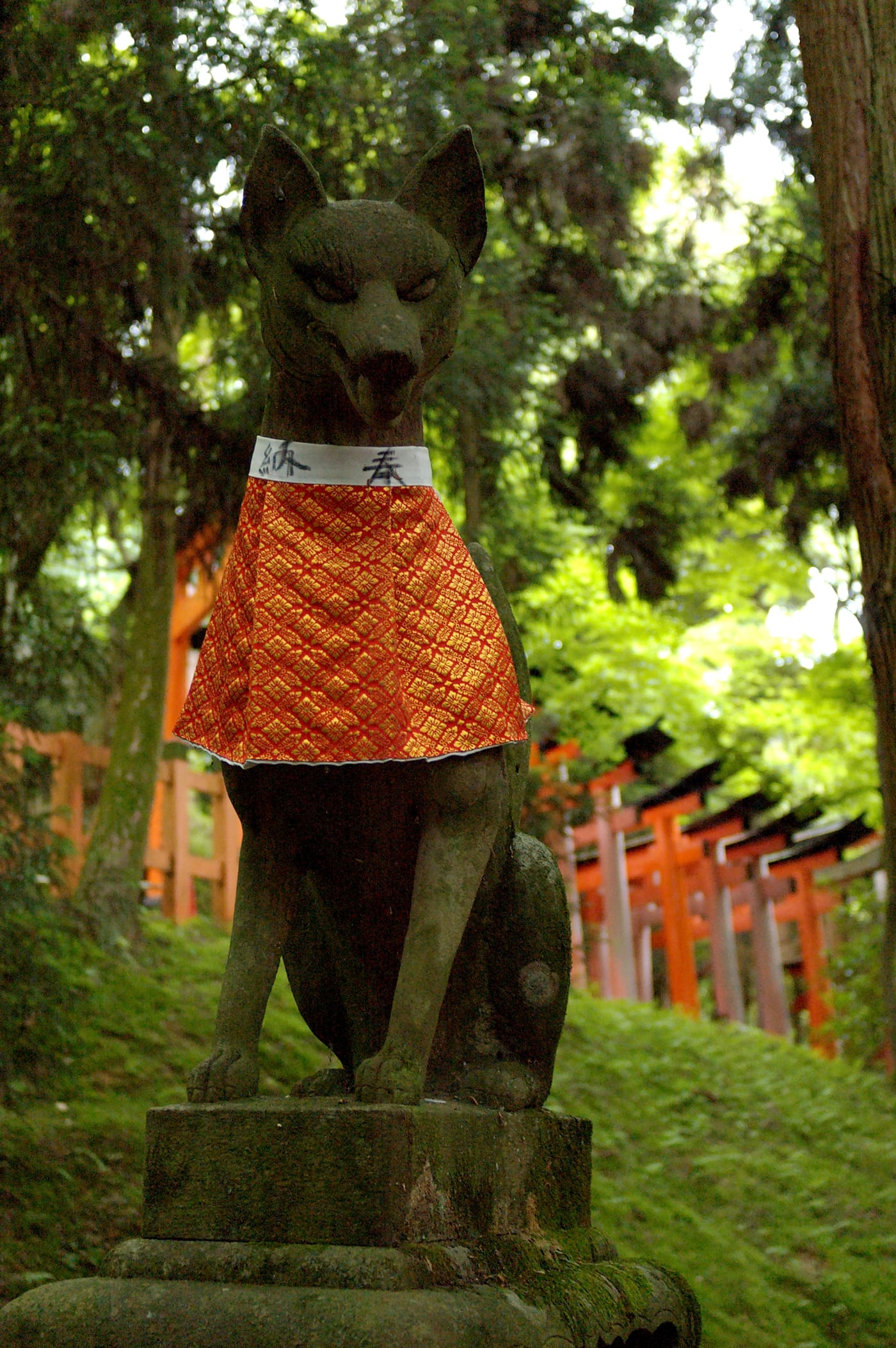
The kitsune in Japanese tradition is documented from the Nihon Shoki (720 CE) onward, classified by Toriyama Sekien in 1776 (zenko = celestial Inari messenger; yako = harmful field fox), and studied in the living Fushimi Inari shrine tradition by Karen Smyers (The Fox and the Jewel, 1999). The Fushimi Inari Taisha in Kyoto, founded 711 CE, is the head shrine of approximately 32,000 Inari shrines across Japan; the fox serves as Inari's messenger. The nine-tailed fox (kyūbi no kitsune) tradition entered Japan from China, where the jiǔwéi hú appears in the Shanhai Jing (c. 4th century BCE).
Of all the mythological animals in the East Asian tradition, the kitsune is probably the most thoroughly documented across a variety of primary sources. It appears in Japan's second-oldest chronicle, gets its own classified entry in Toriyama Sekien's 18th-century supernatural taxonomy, is the subject of a major 1999 academic monograph on living shrine tradition, and still appears as foxes carved in stone at the entrance of thousands of Shinto shrines across Japan today. This is not folklore in the sense of something past; it is ongoing.
The Nihon Shoki and the fox-woman narrative
The Nihon Shoki (Chronicles of Japan, compiled 720 CE) contains one of the earliest documented fox-woman narratives in Japanese literature, in Book 14. A man marries a woman of unknown origin; she gives birth to a child. When the child cries at night and a dog begins to bark at the woman, she cannot maintain her human form and reveals herself as a fox. She flees. The man calls after her: "Come back whenever you miss me." She continues to visit, sleeping with him in human form. Her name in this narrative becomes the etymological substrate for the Tamamo no Mae tradition (the beautiful woman who is a fox spirit) that runs through Japanese literature for centuries afterward. W.G. Aston's translation (Tuttle, 1972) is the standard English edition.
Toriyama Sekien and the taxonomy of fox spirits
Toriyama Sekien (1712–1788) produced four illustrated yōkai compendiums between 1776 and 1784. The Gazu Hyakki Yagyō series is the founding document of illustrated supernatural taxonomy in Japan. Michael Dylan Foster's The Book of Yokai (2015) is the standard scholarly treatment in English. Sekien distinguishes two major categories of fox spirit. The zenko (celestial fox, Inari messenger) is benevolent, serves the kami of rice and agriculture, and appears white or gold with multiple tails at the entrances of Inari shrines. The yako (field fox, also called nogitsune) is a mischievous or dangerous trickster that possesses humans, causes illness, and creates chaos. Both are kitsune; they are not the same kind of supernatural entity.
Fushimi Inari and the living fox tradition
The Fushimi Inari Taisha in Fushimi ward, southern Kyoto, is one of the oldest Shinto shrines in Japan. It was established in 711 CE by the Hata clan, and its associations with Inari, the kami of rice, agriculture, sake, and prosperity, made it a major religious center. Karen Smyers's The Fox and the Jewel (University of Hawaii Press, 1999) is the product of extended fieldwork at Fushimi Inari and dozens of affiliated shrines. She documents the complex relationship between the fox, the kami, and the layered meanings attached to them by different worshippers: shrine priests, merchants seeking business luck, elderly women performing daily devotions, and tourists. The stone fox statues (kitsune-zō) that flank the shrine entrances typically hold one of four objects: a jewel (tama, illumination), a key (kagi, to the rice granary), a sheaf of rice (kazari), or a scroll (maki). Each is a distinct iconographic statement.
The nine-tailed fox and its Chinese origins
The kyūbi no kitsune (nine-tailed fox) tradition in Japan is inherited from China. The jiǔwéi hú (nine-tailed fox) appears in the Shanhai Jing (Classic of Mountains and Seas, c. 4th century BCE) as an auspicious creature that foretells prosperity. By the Tang dynasty (618–907 CE), the nine-tailed fox had accrued more ambivalent meanings; it appears as a seductive and dangerous entity in Tang tales. The tradition entered Japan through continental Buddhist and literary influence and merged with the existing indigenous fox-spirit tradition to produce the complex kyūbi no kitsune of later Japanese literature and folklore. Tails accumulate with age in Japanese tradition: a kitsune earns each one over centuries, and only the oldest, most powerful foxes reach nine. At that point they're said to turn white or gold and to see and hear everything happening anywhere, an omniscience well outside what Sekien's other classifications grant.
The nine-tailed motif travels, but the fox spirits around it don't collapse into one tradition. China's huli jing is a related but separate lineage, generally more predatory, with a stock plot of the fox seducing men and draining their life-force, harsher than most kitsune narratives allow. Korea's gumiho, also nine-tailed, is typically framed as outright dangerous rather than ambivalent. The Japanese kitsune, shaped by centuries of Inari devotion, sits in the middle: the zenko genuinely protective, the yako genuinely harmful, both still called by the same name. The nine-tailed fox crossed borders. The moral architecture around it didn't come along for the ride.
Sources
- PRIMARY Nihon Shoki (Chronicles of Japan), Book 14 . W.G. Aston trans., Tuttle, 1972. Records the earliest known Japanese fox-woman narrative (c. 720 CE): a woman who cannot be found after giving birth is revealed as a fox; her name becomes Tamamo no Mae in later tradition.
- PRIMARY Toriyama Sekien, Kōmō Hyakumonogatari (甲子夜話) . 1776 (Gazu Hyakki Yagyō series). Sekien's illustrated classification of supernatural entities; the kitsune appears in both its malevolent and benevolent forms, distinguishing zenko (heavenly fox, Inari messenger) from yako (field fox, harmful).
- PEER-REVIEWED Michael Dylan Foster, The Book of Yokai: Mysterious Creatures of Japanese Folklore . University of California Press, 2015. The most accessible scholarly treatment of the yōkai tradition, including the kitsune's place in Japanese supernatural taxonomy.
- PEER-REVIEWED Karen Smyers, The Fox and the Jewel: Shared and Private Meanings in Contemporary Japanese Inari Worship . University of Hawaii Press, 1999. The foundational scholarly study of the Fushimi Inari tradition and the fox as Inari's messenger.
- REFERENCE Fushimi Inari Taisha (伏見稲荷大社), official documentation . The head shrine of the approximately 32,000 Inari shrines across Japan; founded 711 CE by the Hata clan.
- REFERENCE Kiyoshi Nozaki, Kitsune: Japan's Fox of Mystery, Romance and Humor . Hokuseido Press, 1961. Detailed compilation of kitsune narratives from Japanese folklore.