American folk-belief, sourced
What It Means When an Owl Visits You: Folklore, Omen Traditions, and the Modern Revision
For most of recorded history, an owl near the house was not good news. Contemporary spirituality flipped the script. Both readings have real cultural roots.
In Southern US folk-belief (Puckett 1926), Ozark tradition (Randolph 1947), Roman lore (Suetonius, Divus Iulius 81), and Cherokee tradition (Mooney 1900), an owl heard near a house at night was primarily a death or misfortune omen. The contemporary 'owl as wisdom messenger' reading is largely drawn from Ted Andrews's Animal Speak (Llewellyn, 1993) and from the Athenian Athena-owl association, stripped of context. These are different traditions with opposite valences, and both are genuinely present in Western culture.
The owl is possibly the animal whose modern American spiritual meaning is most at odds with its traditional one. Ask any contemporary crystal-shop what an owl symbolizes and you'll get wisdom, intuition, inner knowing, the ability to see through deception. Read Vance Randolph's 1947 Ozark Superstitions and you'll find the owl hooting near a house is a death notice. Someone inside that house, or nearby, is going to die. These two readings cannot both be ancient and both be right.
The folk-omen record
Vance Randolph collected Ozark folklore across Missouri and Arkansas from roughly 1920 to 1945. His Ozark Superstitions (Columbia University Press, 1947) is one of the most systematically gathered American folk-omen archives ever compiled. Chapter 6 covers bird omens. The owl is the most consistently death-associated bird in his collection. The specific form: an owl hooting close to a house, especially at night, was interpreted as a sign that someone in the household, or a nearby neighbor, would die within days. The belief was not marginal. Randolph notes it across dozens of informants in multiple counties.
Newbell Niles Puckett's 1926 Folk Beliefs of the Southern Negro (University of North Carolina Press) documents the same omen complex across the American South. Pages 233–238 catalog owl superstitions in detail. The primary reading is identical: owl near house equals death warning. Both Puckett and Randolph are documenting traditions that were clearly well-established by the early 20th century, which means the underlying belief is at minimum a 19th-century inheritance, probably older.
Wayland Hand's Frank C. Brown Collection of North Carolina folklore (Duke University Press, 1961–64) adds additional regional confirmation. The owl-as-death-omen is not a Southern outlier; it's a broadly distributed American folk-belief with a consistent form across a wide geographic range.
Rome: the owl at Caesar's Senate
Suetonius, writing in the early 2nd century CE, records in Divus Iulius 81 that an owl was seen perched on the roof of the Senate (or adjacent buildings, depending on the manuscript reading) the night before Julius Caesar's assassination on March 15, 44 BCE. The detail may be retrospective, omens tend to get attached to famous deaths after the fact, but it reflects a real Roman conviction that owls near human habitations were bad signs. This was not uniquely Roman: Aristotle's Historia Animalium (9.1, 619b) notes the owl's nocturnal habits and its antagonistic relationship with crows, though without assigning omen-status.
The Athenian little owl (Athene noctua) is an exception to the ominous European owl tradition because its association was with Athena, goddess of craft and strategy, and thus by extension with wisdom. But the association is with Athena's divine attributes, not with anything the bird itself demonstrates. Aristotle, a careful empiricist, did not treat owls as specially wise.
Cherokee tradition: the tsgili and the barred owl
James Mooney's Myths of the Cherokee (Smithsonian Bureau of American Ethnology, 1900) is the foundational primary source for Cherokee animal tradition. Owls appear in two distinct roles. The tsgili is a witch-figure capable of taking owl form: a dangerous entity associated with bad medicine and malicious supernatural power. The barred owl, uguku, is a specific species with its own call-lore, its call transcribed in Cherokee tradition as "who cooks for you, who cooks for you-all." The screech owl, wahuhu, is a third named entity. Mooney's record is specific; it is not "the owl is a wisdom totem."
Contemporary Cherokee educators have noted that generic Anglo-American owl-symbolism content does not track the Cherokee record. The tsgili tradition in particular is essentially the opposite of a friendly messenger: it is a night-witch. Cherokee owl knowledge is nation-specific, species-specific, and not available as a generalized personal-spiritual meaning for a non-Cherokee audience.
Three separate traditions, American folk-belief, Roman lore, and Cherokee tradition, converge on roughly the same reading without borrowing from one another, which is itself notable. None of them says owls are generally bad. What they agree on is narrower: an owl close to a house, calling at an unusual hour, is the specific sign that mattered.
Where the wisdom reading actually comes from

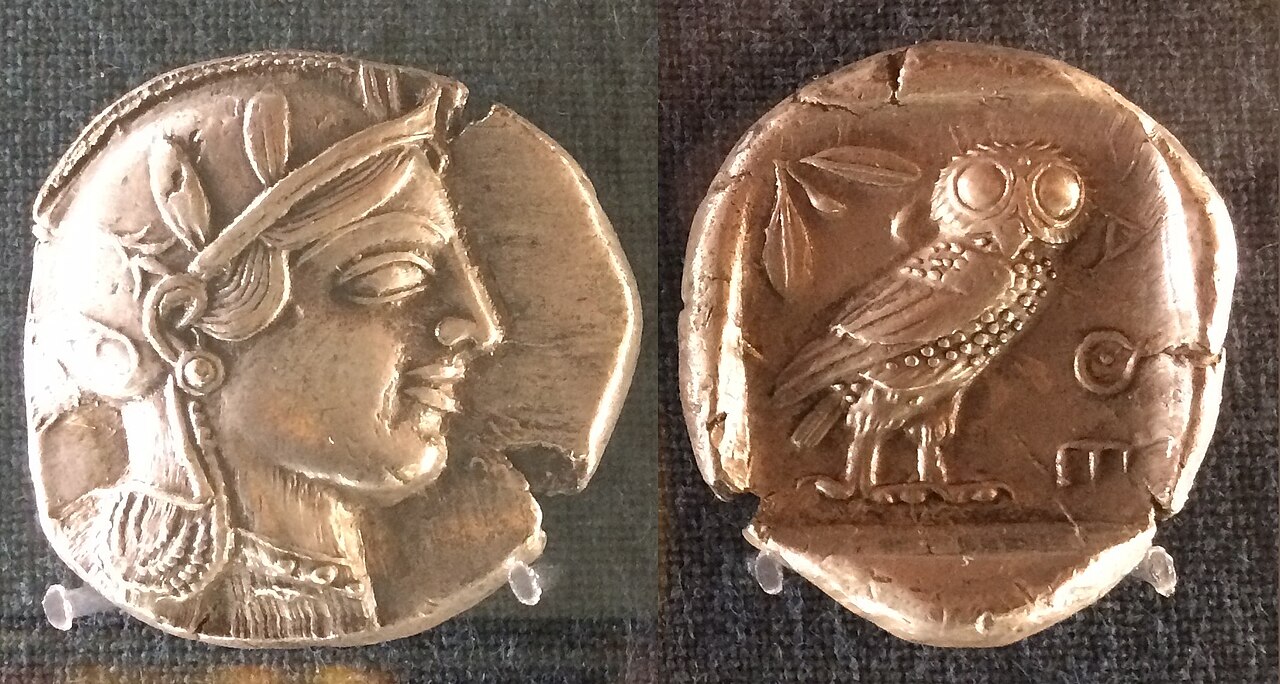
The contemporary owl-as-wisdom reading has two sources. First, the Athena-owl: 5th-century BCE Athenian coins showed Athena on one side and the little owl on the other, exporting the Athena-wisdom-owl equation across the ancient Mediterranean and, eventually, into European learned culture. By the medieval period, the owl was simultaneously a bad omen in folk tradition and a wisdom symbol in the heraldic and literary tradition inherited from Athens.
Second, Ted Andrews's Animal Speak (September 1993). Andrews's treatment of the owl leads with "the mystery of magic, omens, silent wisdom, and vision in the night." He drew on the Athena tradition and on Jungian feminine-mystery symbolism to reframe the owl as a guide to the unconscious. The book's influence on subsequent owl-symbolism writing is hard to overstate: effectively every major American metaphysical publisher's owl content from 1995 onward descends from his framework.
So you have a genuine ancient lineage (Athena's owl) and a recent synthesis (Andrews 1993) both pointing at wisdom, and a separately genuine ancient and folk lineage (Rome, Ozarks, Southern US, Cherokee) pointing at death or danger. The contemporary "wisdom messenger" reading won in popular culture because of its obvious appeal. That does not make it older.
The bird itself
Great horned owls (Bubo virginianus) are the largest and most widely distributed American owl. They are territorial, vocally active in winter breeding season (November–February), and not shy about calling near human habitation. Barn owls (Tyto alba) nest in human structures by preference. Eastern screech-owls (Megascops asio) are common suburban birds. All three are nocturnal and largely invisible during the day, which is why an unexpected nighttime hoot registers as significant: it breaks the usual absence. The startle effect is genuine. Whether the content of the sign is wisdom or warning is a function of which tradition you're operating in.
A daytime owl sighting breaks the pattern even harder, since owls are rarely seen awake and active in daylight at all. Randolph and Puckett's folk record doesn't actually treat a daytime owl any differently from a nighttime one, the omen is the same either way. It's the modern reading, descended from Andrews's 1993 synthesis, that gives the daytime owl extra weight: an especially potent sign of insight, reversing the old bad-luck reading rather than just moving it to a different clock. Both readings, old and new, circulate in American culture at the same time.
Sources
- PRIMARY Vance Randolph, Ozark Superstitions . Columbia University Press, 1947. Chapter 6 catalogs owl-hooting omens across Missouri and Arkansas. Randolph's fieldwork covers roughly 1920–1945.
- PRIMARY Newbell Niles Puckett, Folk Beliefs of the Southern Negro . University of North Carolina Press, 1926. Extensive catalog of owl omens in Southern tradition, pp. 233–238.
- PRIMARY James Mooney, Myths of the Cherokee . Smithsonian Bureau of American Ethnology Annual Report 19, 1900. Cherokee owl traditions pp. 296–300; tsgili (owl/witch) and uguku (barred owl).
- PRIMARY Suetonius, Divus Iulius 81 . Loeb Classical Library. An owl perched on the Senate roof the night before Caesar's assassination, 44 BCE.
- PRIMARY Aristotle, Historia Animalium 9.1 (619b) . Loeb. The owl as the crow's enemy; nocturnal habits noted.
- PRIMARY Wayland Hand (ed.), Popular Beliefs and Superstitions from North Carolina (Frank C. Brown Collection) . Duke University Press, vols. VI–VII, 1961–64. Owl omens, pp. 641–647.
- REFERENCE Cornell Lab of Ornithology, Great Horned Owl (Bubo virginianus) species account
- REFERENCE Ted Andrews, Animal Speak . Llewellyn, September 1993.