Animal encounters, sourced
What It Means When a Robin Visits You: Leaf-Coverers, the Babes in the Wood, and Spring Luck
The British robin covered dead bodies with leaves and was protected from killing by centuries of folk law. Robert Herrick, in 1648, asked one to cover his own corpse. That is its actual tradition.
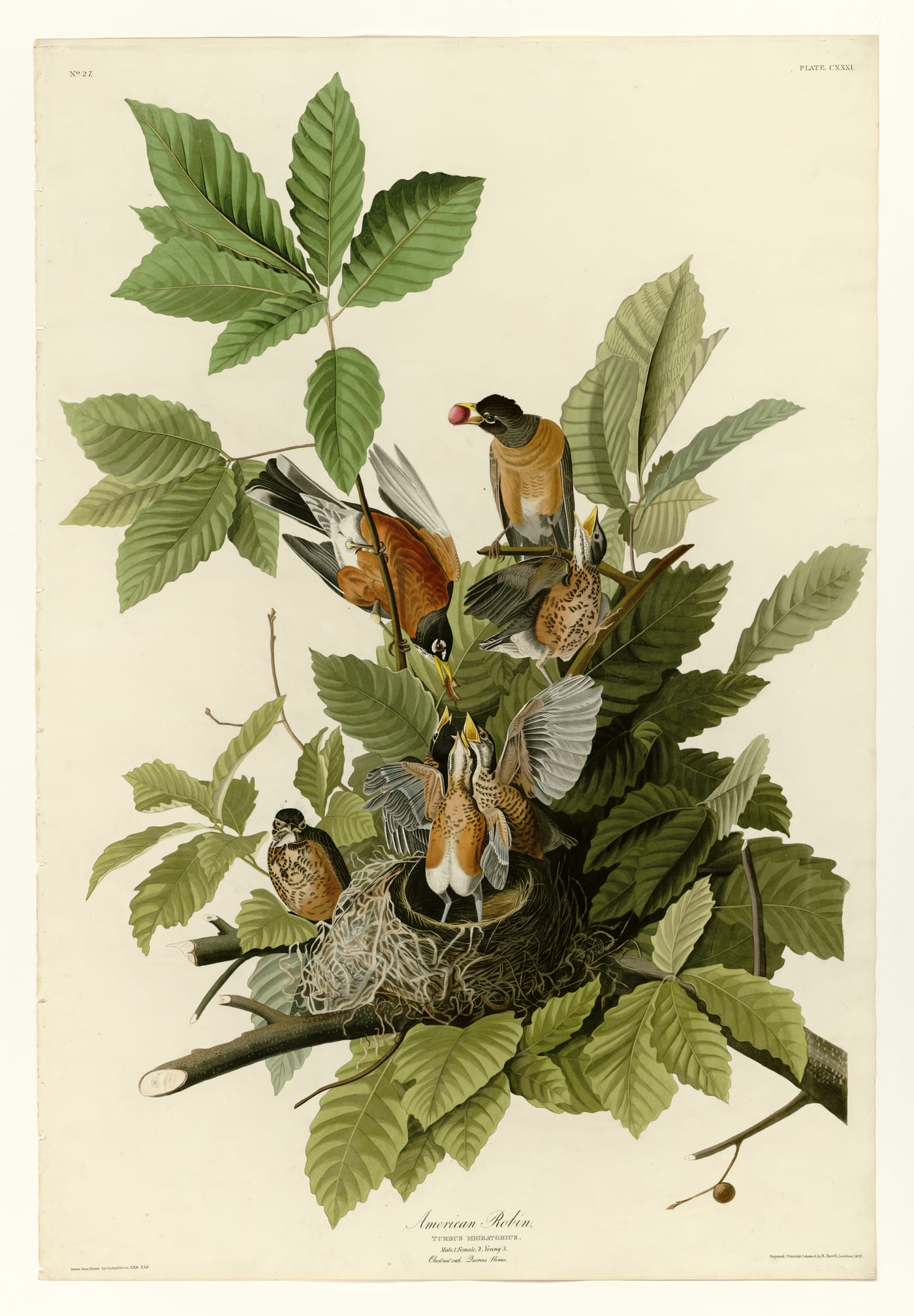
In British folk tradition, the robin's primary association is with covering the unburied dead. The 'Babes in the Wood' ballad (first printed c. 1595) establishes the robins-covering-corpses motif. Robert Herrick's poem 'To Robin Red-Breast' (Hesperides, 1648) asks a robin to perform this service for the poet himself. John Brand's Popular Antiquities (1849) documents the widespread belief that killing a robin brought ill luck. In American Appalachian tradition (Frank C. Brown Collection, 1961–64), the first robin of spring was a luck-sign. The 'robin as messenger from the deceased' reading in contemporary culture has genuine historical roots in this leaf-covering tradition, though the folk source is British, not American.
The robin that appears in your garden carries more folklore than almost any other small British-origin bird in the English-speaking world. Not "joy" or "new beginnings," though those readings exist. The old readings are darker and more specific: a bird that covers the dead, a bird you do not kill if you value your luck, a bird that a 17th-century poet asked to serve as his undertaker. The contemporary cheerful-messenger reading is a selective inheritance from a much stranger tradition.
The Babes in the Wood and the leaf-covering tradition
The ballad of "The Babes in the Wood" — also called "The Children in the Wood" — was entered in the Stationers' Register in 1595 and circulated in broadside form across Britain for the next two centuries. The story: two orphaned children, abandoned in the woods by their treacherous uncle, die of cold and hunger. Robins cover their bodies with leaves. The ballad was widely known; Shakespeare alludes to it in King John (Act 4, Scene 1), and Thomas Percy's Reliques of Ancient English Poetry (1765) includes it as a foundational English folk ballad.
The leaf-covering motif attached to the robin before the ballad existed as a literary text; the ballad crystallized it in print, not invented it. John Webster's The White Devil (1612) contains the line "Call for the robin redbreast and the wren, / Since o'er shady groves they hover, / And with leaves and flowers do cover / The friendless bodies of unburied men." Webster was drawing on existing folk belief. By the early 17th century, the robin-as-body-coverer was established enough to be a literary reference point.
Robert Herrick: the robin as personal undertaker
Robert Herrick's Hesperides (1648) contains the short poem "To Robin Red-Breast": "Laid out for dead, let thy last kindness be / With leaves and moss-work for to cover me; / And while the wood-nymphs my cold corpse inter, / Sing thou my dirge, sweet-warbling chorister!" This is not metaphor; Herrick is requesting the same service the robins gave the Babes in the Wood. The poem places the folk belief in literary form and confirms it was still active in the mid-17th century. Herrick was a clergyman, not a folk-superstition collector; the belief was mainstream enough for a Church of England vicar to incorporate into a personal poem.
The taboo on killing robins
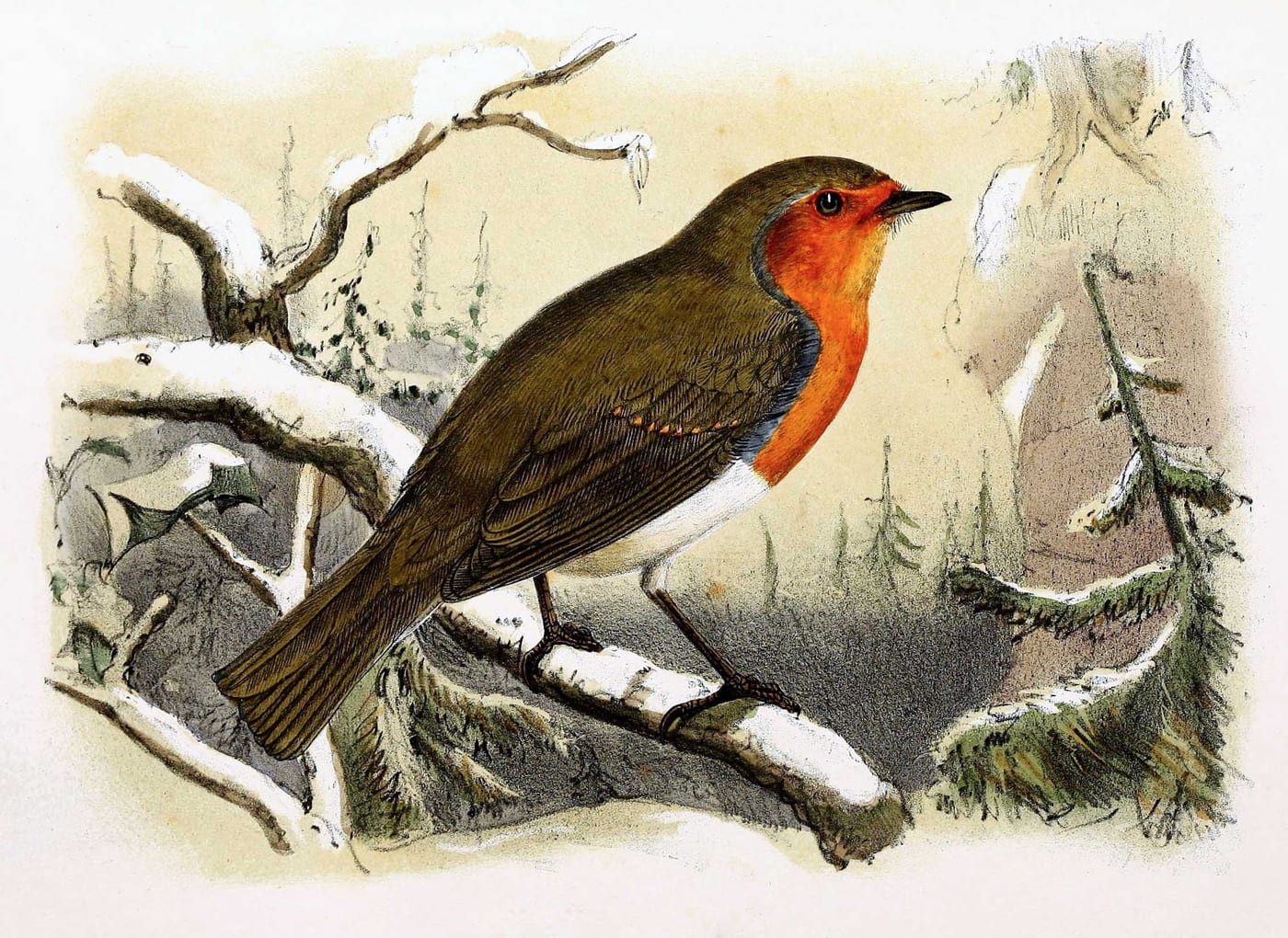
John Brand's Popular Antiquities (3 vols., 1849 edition) documents the widespread British belief that killing a robin brought ill luck, including specific forms: broken limbs, trembling hands, sickness of animals, or general misfortune. The belief was not unique to any region; Brand records variants from across England, Scotland, and Wales. The folk logic is consistent with the leaf-covering tradition: a bird that performs charitable service for the dead has a kind of sacred protection. You do not kill a grave-tender.
The "Who Killed Cock Robin?" nursery rhyme, documented by Brand and appearing in multiple 18th-century printed versions, frames the killing of a robin as a crime requiring testimony from the entire natural world. The rhetorical structure — "who saw him die? / I, said the fly, with my little eye, / I saw him die" — reinforces the cosmic significance of the robin's death.
American folk inheritance
The American robin (Turdus migratorius) inherited the British bird's folk luck-associations despite being a different species. In Appalachian tradition documented in the Frank C. Brown Collection (1961–64), the first robin of spring was a luck-sign: seeing it and making a wish before it flew away brought the wish luck. In Puckett's 1926 Southern archive, robin appearances carried minor positive luck associations. The death-associated aspect of the British tradition transferred less directly; American folk culture inherited the luck and spring-sign readings more readily than the body-covering and killing-taboo traditions.
The contemporary reading
The contemporary "robin as message from a deceased loved one" reading draws on the British body-covering tradition without usually naming it. The robin's red breast, its tameness near humans (European robins in particular follow gardeners closely, picking earthworms from turned soil), and its cheerful song combine to make it feel approachable and personal. The folk-spiritual reading that a robin's appearance is a sign from someone who has died has older roots than most people realize — the Babes in the Wood ballad links robins and the dead since 1595 — but the contemporary "comfort visit" reading transforms the undertaker-bird into a messenger, which is a meaningful change in register.
Frequently asked
- What does it mean when a robin visits you?
- In British folk tradition (Brand 1849; Herrick 1648; the Babes in the Wood ballad, c. 1595), the robin has a specific association with covering the dead — robins were believed to cover unburied human corpses with leaves and moss. Killing a robin was considered deeply unlucky in British folk tradition; the bird's sanctity derived from its leaf-covering behavior. In American Appalachian tradition (Frank C. Brown Collection, 1961–64), the first robin of spring was a luck sign. The contemporary 'robin as messenger from a deceased loved one' belief is a late-20th-century American development; the British folk tradition that underlies it is older and stranger.
- Why is killing a robin considered bad luck?
- The prohibition against killing robins is documented in British folk tradition by at least the 17th century. Brand's Popular Antiquities (1849) records it as widespread. The origin appears to be in the 'Babes in the Wood' ballad tradition (printed c. 1595), where robins cover the dead children with leaves — a specifically charitable and holy behavior that made the bird sanctified. Herrick's 1648 poem 'To Robin Red-Breast' asks the robin to cover the poet's own body after death, showing the leaf-covering belief was fully established in literary culture by the mid-17th century.
- What is the robin's connection to Christianity?
- Several European folk-etymologies connect the robin's red breast to Christian sacrifice: the most common story is that the robin was burned red-breasted while attempting to remove a thorn from the Crown of Thorns at the Crucifixion. This tradition appears in various regional forms across Britain and France and is documented in Brand's Popular Antiquities, though Brand does not cite a primary text for its origin. The story is folk etymology, not scripture; it does not appear in the canonical Gospels.
- Is the American robin the same as the British robin?
- No. The American robin (Turdus migratorius) is a thrush — a large, migratory bird with an orange-red breast. The European robin (Erithacus rubecula) is a much smaller flycatcher-family bird. They are not closely related; they were given the same name by English settlers who noticed the red-breast coloring. The folk traditions attached to the European robin do not automatically apply to the American species, though American folklore has inherited the British robin-luck beliefs and applied them to the American bird.
Sources
- PRIMARYJohn Brand, Observations on the Popular Antiquities of Great Britain — Rev. Henry Ellis, 3 vols., John Russell Smith, 1849. 'Who killed Cock Robin?' ballad origins; the robin's sanctity and the ill-luck of killing one.
- PRIMARYThe Babes in the Wood (traditional ballad) — First printed c. 1595 (Stationers' Register); broadside tradition. The robins who cover the dead children with leaves — the oldest literary association of the robin with the dead.
- PRIMARYRobert Herrick, Hesperides, 'To Robin Red-Breast' — Hesperides, 1648. Herrick's poem asking the robin to cover his body with leaves after death — the classical English poetic tradition on the robin as undertaker-bird.
- PRIMARYWayland Hand (ed.), Popular Beliefs and Superstitions from North Carolina (Frank C. Brown Collection) — Duke University Press, vols. VI–VII, 1961–64. Robin as spring sign and luck omen in Appalachian tradition.
- PRIMARYNewbell Niles Puckett, Folk Beliefs of the Southern Negro — University of North Carolina Press, 1926. Robin luck omens; first robin of spring.
- PRIMARYFrancis Darwin (ed.), The Life and Letters of Charles Darwin, vol. 1 — John Murray, 1887. Darwin's note on the European robin's (Erithacus rubecula) tameness and its folk associations in England.
- REFERENCECornell Lab of Ornithology, American Robin (Turdus migratorius) species account