Spirit Animal
Spider Spirit Animal
Spider spirit animal meaning: creativity, patience and connection. Traced from the modern creativity-and-weaving reading back through Ted Andrews's Animal Speak to the West African Anansi trickster cycle, Diné and Hopi Grandmother Spider, Ovid's Arachne, and the Japanese jorōgumo of Edo-era folklore.
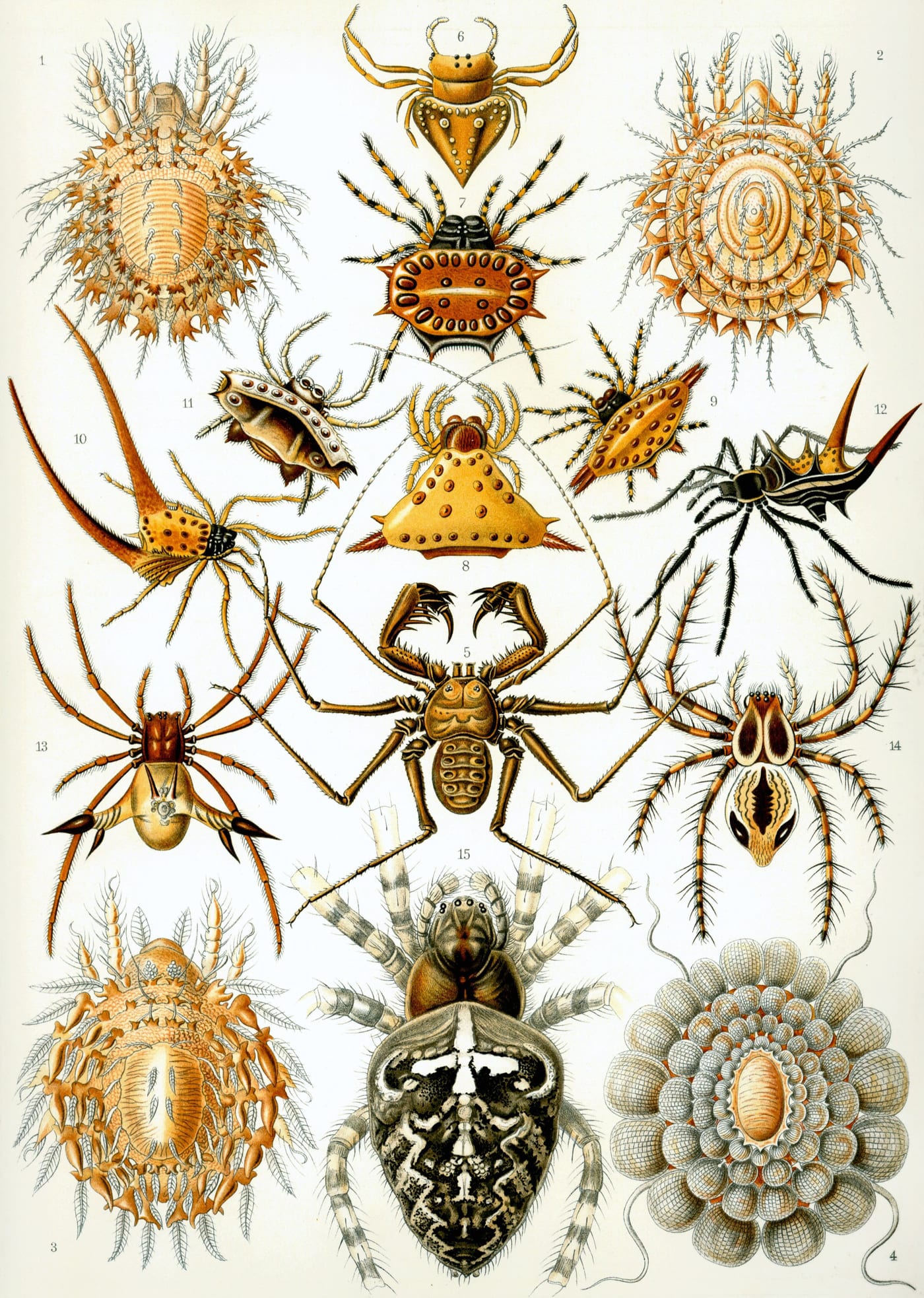
In modern American "spirit animal" usage, the spider stands for creativity, weaving (both literal and as life-pattern-making), and the connecting of distant things via invisible threads. That reading comes through Ted Andrews's Animal Speak (Llewellyn, 1993). The older traditions are richer. The West African Anansi is the Akan spider-trickster who steals all the stories from the sky-god Nyame, documented in Robert Sutherland Rattray's 1930 Akan-Ashanti Folk-Tales. The Diné (Navajo) and Hopi Grandmother Spider (Na'ashje'ii Asdzáá, Kokyangwuti) is a creator-figure who taught humans to weave, recorded by Washington Matthews's 1897 Navaho Legends and Hopi oral tradition. Ovid's Metamorphoses 6.1–145 has Arachne challenge Athena to a weaving contest and be turned into a spider for her hubris. And the Japanese jorōgumo (絡新婦) is a shape-shifting spider-woman of Edo-era folklore, documented by Toriyama Sekien's 1776 Gazu Hyakki Yagyō.
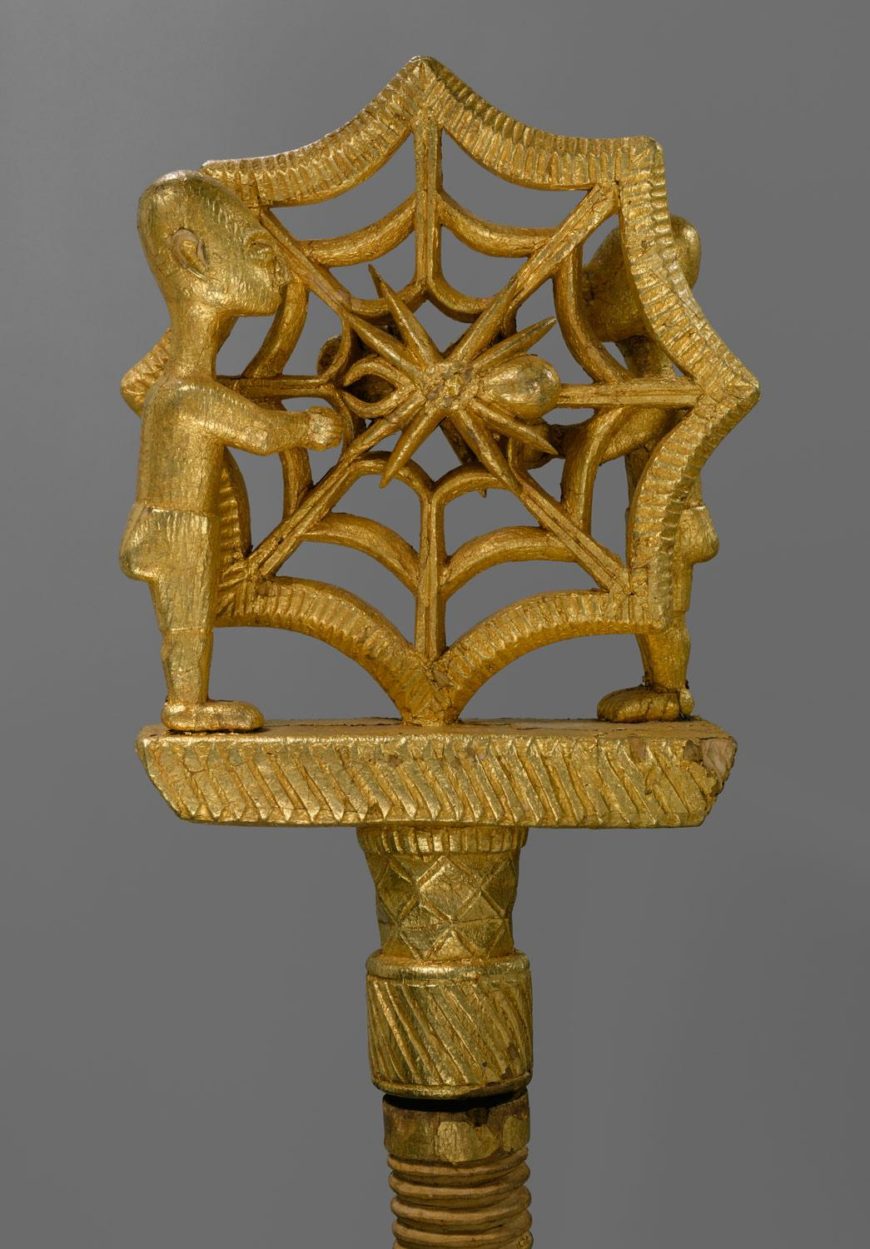
Anansi bought all the stories in the world from Nyame, the sky-god. That is the Akan tradition, recorded by Robert Sutherland Rattray in 1930 from named Twi-speaking storytellers in what was then the Gold Coast. Anansi paid for the stories by completing an impossible series of tasks: capturing the python Onini, the leopard Osebo, the hornets Mmoboro, and the fairy Mmoatia. He used cleverness, not force. And when the tasks were done, Nyame gave him the stories, and from then on every story was Anansi’s story, and every storyteller was speaking Anansi-talk when they spoke.
That is a spider-tradition. It is three hundred years old in the documented English-language record. It is the single most-told spider-narrative in the African diaspora, and it is one of the great contributions of West African culture to the storytelling of the Americas.
The four traditions, each alive
Anansi. West African, Akan-Asante, then Caribbean and American. Rattray’s 1930 ethnography. The spider as the culture-hero who made the world a storytelling place. Br’er Rabbit (see our rabbit page) is a sibling tradition, carried across the Middle Passage from overlapping Akan-Gbe source material.
Grandmother Spider. Two distinct traditions, Diné (Na’ashje’ii Asdzáá) and Hopi (Kokyangwuti), often collapsed in Western writing into a single “Native American” figure and usually on grounds that neither tradition would endorse. The Diné spider taught weaving; Spider Rock in Canyon de Chelly is her home. The Hopi spider emerged with humanity from the Third World into the Fourth. Matthews 1897 and Waters 1963 are the standard English sources; contemporary Diné and Hopi scholars continue to refine the record.
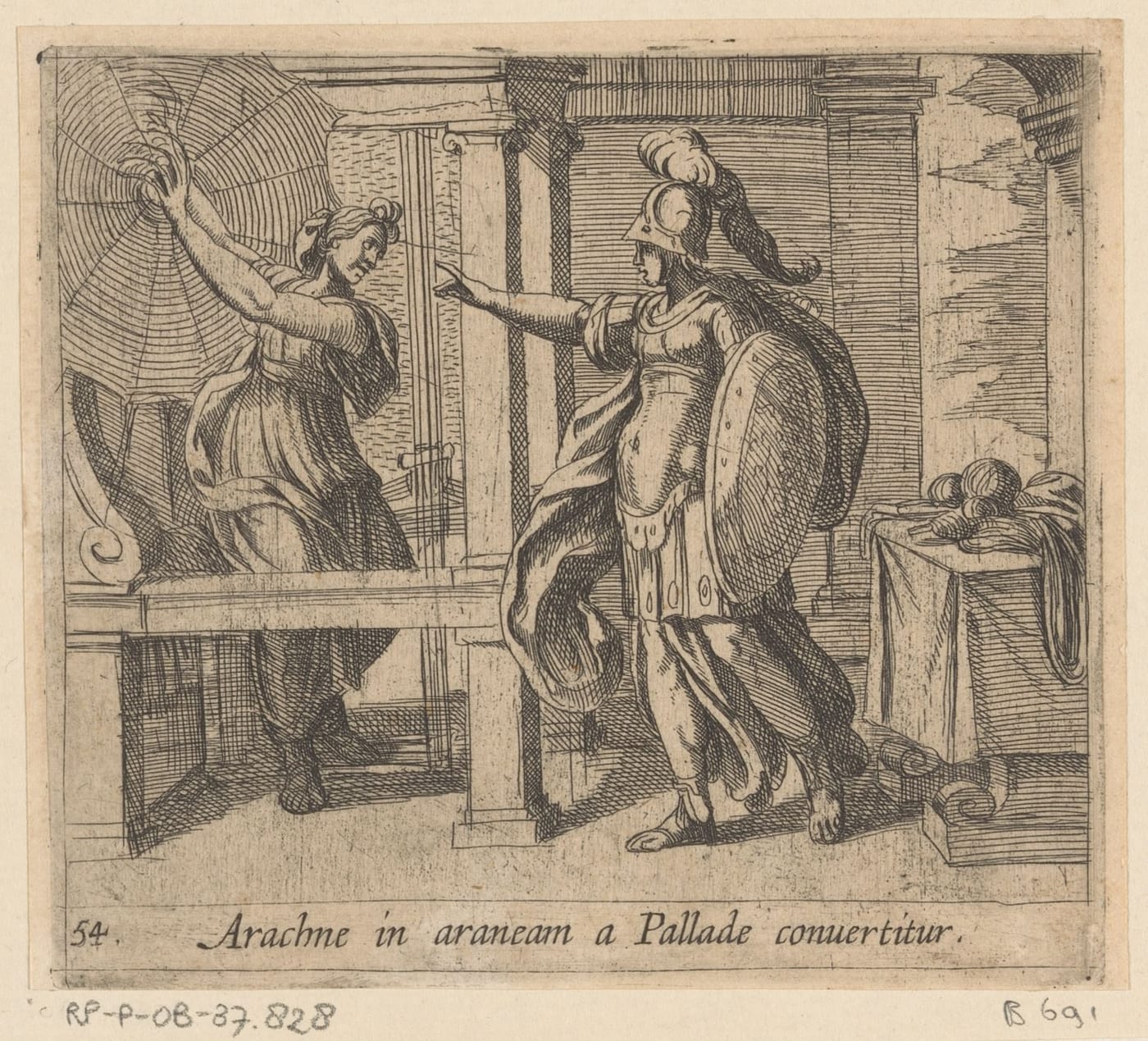
Arachne. Greek. The mortal weaver who challenges Athena and is punished for her hubris, preserved in Ovid’s Metamorphoses 6.1–145. The story gives us the word “arachnid” and the genus Arachne. Ovid’s original is starker than the Renaissance paintings that softened Arachne’s fate into pathos.
Jorōgumo. Japanese. Edo-era yōkai, a shape-shifting spider-woman who takes the form of a beautiful woman to entangle men in her webs. Toriyama Sekien’s 1776 Gazu Hyakki Yagyō is the canonical source; earlier traditions like the Muromachi-period Earth-Spider Scroll at the Tokyo National Museum extend the lineage. The jorōgumo remains alive in contemporary Japanese horror.
What the four share
The spider-as-creator-by-web, the spider-as-trickster-who-outwits-power, and the spider-as-shape-shifter-at-the-threshold are all present across these four. What they also share is specificity: each tradition has named sources, specific motifs, and cultural contexts that do not collapse into a single “spider symbolism” keyword list.
The Andrews 1993 reading
The modern pop-spiritual spider is “creativity, weaving, connection” and a note about patience. That is a real reading, drawn mostly from Grandmother Spider and Arachne. It is a thin version of a genuinely dense tradition. Anansi and the jorōgumo are much more interesting animals, and a reader who wants the full inheritance has them to reach for.
Across traditions
West African / Akan (Anansi, the spider-trickster)
Anansi (Akan Kwaku Ananse) is the spider-trickster of Akan-Asante folklore, a culture hero, deceiver, and storyteller. In the foundational tale, Anansi purchases all the stories of the world from the sky-god Nyame by completing an impossible task: capturing the python Onini, the leopard Osebo, the hornets Mmoboro, and the fairy Mmoatia. Robert Sutherland Rattray's Akan-Ashanti Folk-Tales (Clarendon Press, 1930), compiled from Twi-language informants in the Gold Coast, is the foundational English-language source.
The Anansi cycle traveled the Middle Passage with enslaved West Africans to the Caribbean and the Americas. Jamaican "Anansi story" tradition, Gullah-Geechee storytelling, and figures like Br'er Rabbit all carry the Anansi inheritance (see our rabbit page). Nigerian-American novelist Nnedi Okorafor and Ghanaian Canadian writer Esi Edugyan have both written contemporary Anansi-adjacent fiction. The figure remains alive.
- PRIMARY Robert Sutherland Rattray, Akan-Ashanti Folk-Tales . Clarendon Press, 1930.
- PRIMARY Peggy Appiah, Ananse the Spider: Tales from an Ashanti Village . Pantheon, 1966.
- PEER-REVIEWED William Bascom, African Folktales in the New World . Indiana University Press, 1992.
Diné and Hopi (Grandmother Spider)
In Diné (Navajo) tradition, Na'ashje'ii Asdzáá (Spider Woman) taught the Diné the art of weaving. Washington Matthews's Navaho Legends (Houghton Mifflin, 1897) and subsequent work by Gladys Reichard (Navajo Religion: A Study of Symbolism, Bollingen, 1950) document the narrative tradition. A small hole in the center of a Diné loom is traditionally kept open in honor of Spider Woman's teaching. Spider Rock in Canyon de Chelly, Arizona, is said to be her home.
In Hopi tradition, Kokyangwuti (Spider Grandmother) is a creator-figure who emerged with humanity from the Third World into the Fourth. Frank Waters's Book of the Hopi (Viking, 1963), drawing on named Hopi elders, preserves the narrative, though contemporary Hopi scholars including Emory Sekaquaptewa have noted limits in Waters's presentation. The two traditions (Diné and Hopi) are distinct, despite the overlapping English glossing.
- PRIMARY Washington Matthews, Navaho Legends . Houghton Mifflin, 1897.
- PEER-REVIEWED Gladys Reichard, Navajo Religion: A Study of Symbolism . Bollingen Foundation, 1950.
- PRIMARY Frank Waters, Book of the Hopi . Viking, 1963.
- PEER-REVIEWED Emory Sekaquaptewa, Hopi Dictionary: Hopìikwa Lavàytutuveni . University of Arizona Press, 1998.
Greek (Arachne)
Ovid, Metamorphoses 6.1–145, narrates the contest between the mortal weaver Arachne and the goddess Athena. Arachne, proud of her weaving, refuses to acknowledge Athena as her teacher and challenges the goddess to a weaving contest. Arachne's tapestry depicts the gods' crimes, especially Zeus's transformations to rape mortal women; Athena's tapestry depicts the gods' triumphs. Athena, finding nothing wrong in Arachne's work but enraged by its subject, beats her with a shuttle. Arachne hangs herself in shame; Athena transforms her into a spider so she can go on weaving forever.
The story is a classic tragic origin-tale. The word "arachnid" and the genus Arachne descend directly from it. Renaissance treatments (Velázquez's Las Hilanderas, c. 1657) render the scene in ways that foreground Arachne's humiliation; Ovid's original is starker.
- PRIMARY Ovid, Metamorphoses 6.1–145 . Miller trans., Loeb Classical Library.
- MUSEUM Velázquez, Las Hilanderas (c. 1657) . Museo del Prado, Madrid.
Japanese (jorōgumo, Edo folklore)
The jorōgumo (絡新婦, "binding bride") is a shape-shifting spider-woman in Japanese folklore, a large spider who takes the form of a beautiful woman to seduce men and then entangle them in her webs. The figure is documented in Toriyama Sekien's Gazu Hyakki Yagyō (Illustrated Night Parade of a Hundred Demons, 1776), the foundational Edo-era compendium of yōkai.
Earlier layers appear in the Muromachi-period (14th–16th c.) Tsuchigumo Sōshi, the Earth-Spider Scroll, which narrates the general Minamoto no Yorimitsu's defeat of the monstrous Tsuchigumo (Earth Spider) on Mount Kazuraki. The scroll is held in the Tokyo National Museum. The jorōgumo tradition remains alive in contemporary Japanese horror, most recently in the Kwaidan adaptations and in Junji Ito's manga.
- PRIMARY Toriyama Sekien, Gazu Hyakki Yagyō (画図百鬼夜行, 1776) . Alt trans., University Press of Mississippi, 2017.
- PRIMARY Tsuchigumo Sōshi (Earth-Spider Scroll, Muromachi period) . Tokyo National Museum.
- PEER-REVIEWED Michael Dylan Foster, The Book of Yōkai . University of California Press, 2015.
Ted Andrews (1993)
Andrews's 1993 spider is mostly the Grandmother Spider plus Arachne imagery softened into a personal-spirit keyword: creativity, the weaving of one's own life pattern, the connection of disparate threads. Anansi gets a mention without the necessary African-diaspora context. The jorōgumo is absent. The reading is real but shallow compared to the cultural weight behind it.
- REFERENCE Ted Andrews, Animal Speak . Llewellyn, September 1993.
Working with the Spider
If you want a regular practice rather than a one-time read, an oracle deck is the standard tool: you draw a card and sit with whatever animal comes up. Our ranked guide to spirit animal oracle decks compares the field.
Frequently asked
- What does a spider symbolize spiritually?
- In modern pop usage, creativity, weaving, and the connection of distant things via invisible threads, the reading set by Andrews 1993. Older traditions are richer. The West African Anansi is a culture-hero trickster who buys all the stories from the sky-god (Rattray 1930). The Diné Na'ashje'ii Asdzáá and Hopi Kokyangwuti are Grandmother Spider figures who taught weaving and helped create the world. Ovid's Arachne is a mortal weaver turned into a spider by Athena. The Japanese jorōgumo is a shape-shifting spider-woman of Edo folklore.
- Who is Anansi?
- Anansi (Akan Kwaku Ananse) is the spider-trickster of Akan-Asante folklore, a culture hero and storyteller who purchases all the world's stories from the sky-god Nyame. Robert Sutherland Rattray's Akan-Ashanti Folk-Tales (Clarendon Press, 1930), compiled from Twi-language informants, is the foundational English source. The Anansi tradition traveled with enslaved West Africans to the Caribbean and the Americas, seeding Jamaican Anansi-story tradition and influencing American figures including Br'er Rabbit.
- Who is Grandmother Spider?
- In Diné (Navajo) tradition, Na'ashje'ii Asdzáá (Spider Woman) taught the Diné to weave; a small hole in the center of a Diné loom is kept open in honor of her teaching. In Hopi tradition, Kokyangwuti (Spider Grandmother) is a creator-figure who emerged with humanity from the Third World to the Fourth. The two traditions are distinct and should not be collapsed into a single 'Native American' figure. Washington Matthews's Navaho Legends (1897) and Frank Waters's Book of the Hopi (1963) are the foundational English-language sources.
- Why did Athena turn Arachne into a spider?
- Ovid's Metamorphoses 6.1–145 narrates the story. Arachne, a mortal weaver proud of her skill, refused to acknowledge Athena as her teacher and challenged the goddess to a weaving contest. Arachne's tapestry depicted the gods' crimes, especially Zeus's transformations to rape mortal women. Athena, finding no fault in the weaving but enraged by its subject, beat Arachne with a shuttle. Arachne hanged herself in shame; Athena transformed her into a spider so she could go on weaving forever.
Sources
- PRIMARY Robert Sutherland Rattray, Akan-Ashanti Folk-Tales . Clarendon Press, 1930.
- PRIMARY Peggy Appiah, Ananse the Spider . Pantheon, 1966.
- PEER-REVIEWED William Bascom, African Folktales in the New World . Indiana University Press, 1992.
- PRIMARY Washington Matthews, Navaho Legends . Houghton Mifflin, 1897.
- PEER-REVIEWED Gladys Reichard, Navajo Religion . Bollingen, 1950.
- PRIMARY Frank Waters, Book of the Hopi . Viking, 1963.
- PEER-REVIEWED Emory Sekaquaptewa, Hopi Dictionary . University of Arizona Press, 1998.
- PRIMARY Ovid, Metamorphoses 6.1–145 . Loeb Classical Library.
- MUSEUM Velázquez, Las Hilanderas
- PRIMARY Toriyama Sekien, Gazu Hyakki Yagyō (1776) . Alt trans., UPM, 2017.
- PEER-REVIEWED Michael Dylan Foster, The Book of Yōkai . University of California Press, 2015.
- REFERENCE Ted Andrews, Animal Speak . Llewellyn, September 1993.