Tattoo style guide, sourced
Japanese Irezumi: Dragon, Koi, Tiger, and the Kuniyoshi Woodblock Tradition
The animal iconography of irezumi was largely codified in three years: 1827 to 1830, when Kuniyoshi Utagawa produced the 108 Heroes of the Suikoden print series.
Japanese irezumi is a full-body tattoo tradition whose iconographic canon was established by Kuniyoshi Utagawa's 1827–1830 woodblock print series depicting the 108 tattooed heroes of the Chinese novel Shuihu Zhuan (Water Margin). The four principal animals — dragon (ryū), carp (koi), tiger (tora), phoenix (hō-ō) — each draw on classical Japanese and Chinese literary symbolism. The tebori (hand-needle) technique produces characteristic ink dispersion distinct from machine work. Donald McCallum's 1988 scholarly article and Kitamura and Kitamura's 2010 documentation of Horiyoshi III are the primary academic sources.
Three years of woodblock prints shaped the next two centuries of tattoo iconography. Between 1827 and 1830, Kuniyoshi Utagawa produced his series of the 108 heroes of the Suikoden — each tattooed hero depicted in full-body irezumi, each with a specific animal or design. The series sold widely in Edo. Men began requesting the same designs. The canon was set. Every contemporary irezumi design with a dragon or koi swimming upstream traces back to those prints in a direct artistic lineage.
The Kuniyoshi Suikoden prints
The Chinese novel Shuihu Zhuan (Water Margin, c. 14th century) describes 108 outlaw heroes. Kuniyoshi's Tsūzoku Suikoden gōketsu hyakuhachinin no hitori (1827–1830) depicted each hero with distinctive full-body tattoos — dragons, tigers, carp, supernatural beings. The prints were enormously popular in Edo, and the demand for tattoos matching the illustrated designs drove a significant expansion of the irezumi practice in the city. This is documented in McCallum's 1988 article and in Kitamura's monograph (1997).
The dragon (ryū)
The Japanese ryū is a water-and-sky creature: it inhabits rivers, seas, and clouds, brings rain, and transforms between states. It is categorically different from the Western fire-breathing dragon (see our dragon spirit animal page for the full comparison). In irezumi, the dragon typically coils around the body and is depicted in blue-black with red or orange flame accents. Its association with water makes it appropriate for imagery flowing across the back and arms, following the body's contours. The ryū in irezumi tradition carries prosperity, transformation, and protective power.
The koi (carp)
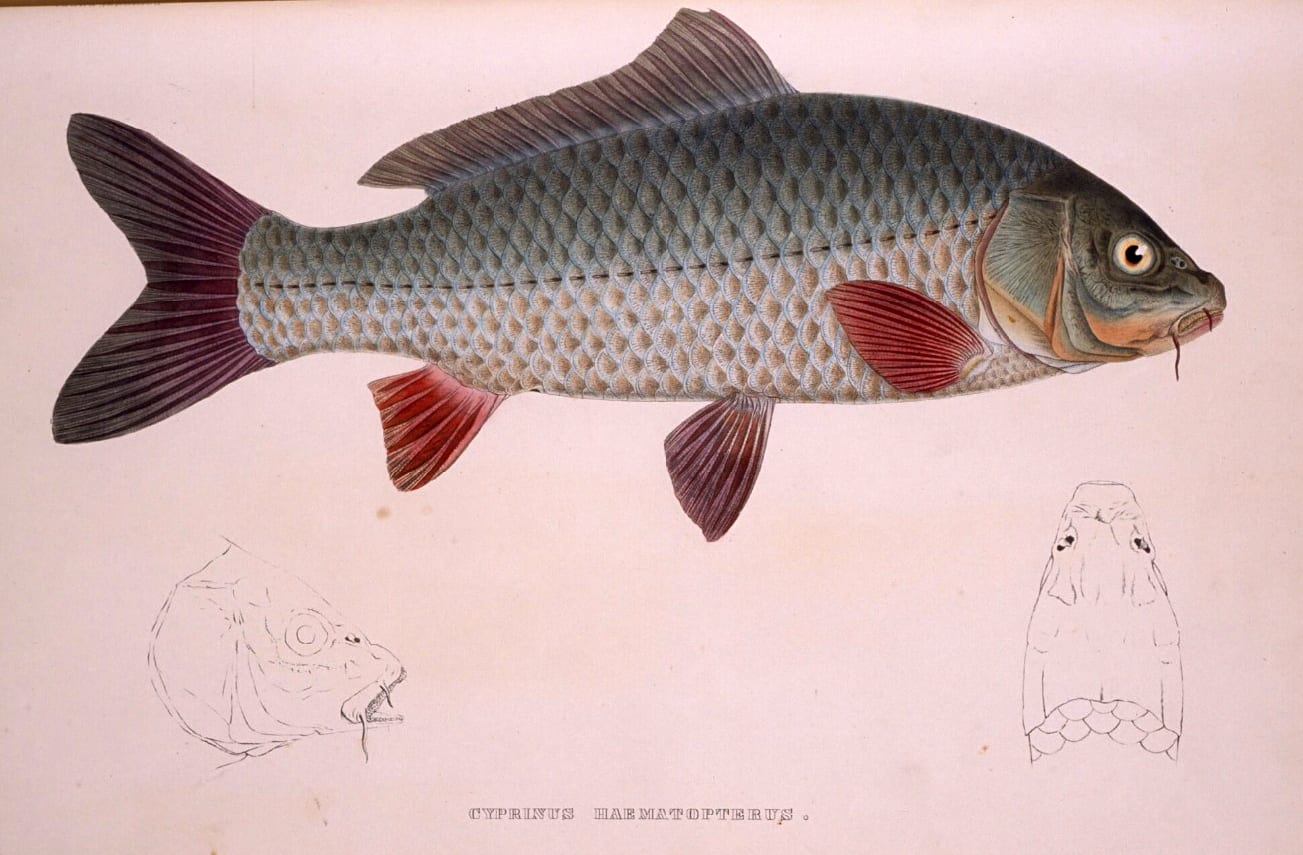
The koi's symbolic significance in irezumi derives from the Dragon Gate (Ryūmon) legend, documented in Chinese literature and adopted into Japanese tradition: a carp that swims upstream and leaps the waterfall at the Dragon Gate transforms into a dragon. The journey upstream = perseverance through adversity; the transformation = achievement and transcendence. In irezumi, koi are typically depicted mid-swim, often against waves or among lotus flowers. Upstream koi symbolize striving; downstream koi can indicate a completed struggle or acceptance. Our koi-fish tattoo page discusses these meanings in detail.
The tiger (tora)
The tiger in Japanese irezumi tradition is the creature of earthly power, paired in classical East Asian cosmology with the dragon as sky/water creature. The pairing of tiger (earth) and dragon (sky) represents cosmic balance. In irezumi, the tiger is typically depicted in a snarling frontal stance or in bamboo, reflecting the Japanese understanding of the tiger's natural habitat (Japan has no native tigers; the tradition is inherited from Chinese sources). The tiger's earth-association means it is often combined with wind and water imagery in irezumi compositions.
Cultural considerations
The cultural-sensitivity question around irezumi is primarily one of context and setting in Japan. The yakuza association documented in McCallum's scholarship has made heavily tattooed individuals unwelcome in some Japanese public facilities. For Western clients, irezumi-style tattoos by non-Japanese practitioners are a long-established practice; the question is one of quality (machine versus tebori, knowledge of the iconographic tradition's meaning) rather than strict cultural ownership. Requesting irezumi with accurate iconographic meaning — knowing that the koi goes upstream for this reason, that the dragon is water not fire — is the minimum level of engagement with the tradition.