Spirit Animal
Tiger Spirit Animal
Tiger spirit animal meaning: strength, courage and sovereignty. Traced from the modern strength-and-courage reading back through Ted Andrews's Animal Speak to Durga's mount in the Devi Mahatmya, the Korean mountain-god sanshin, the Chinese Bai Hu (White Tiger) of the Four Symbols, and the Siberian Tungusic Amba.
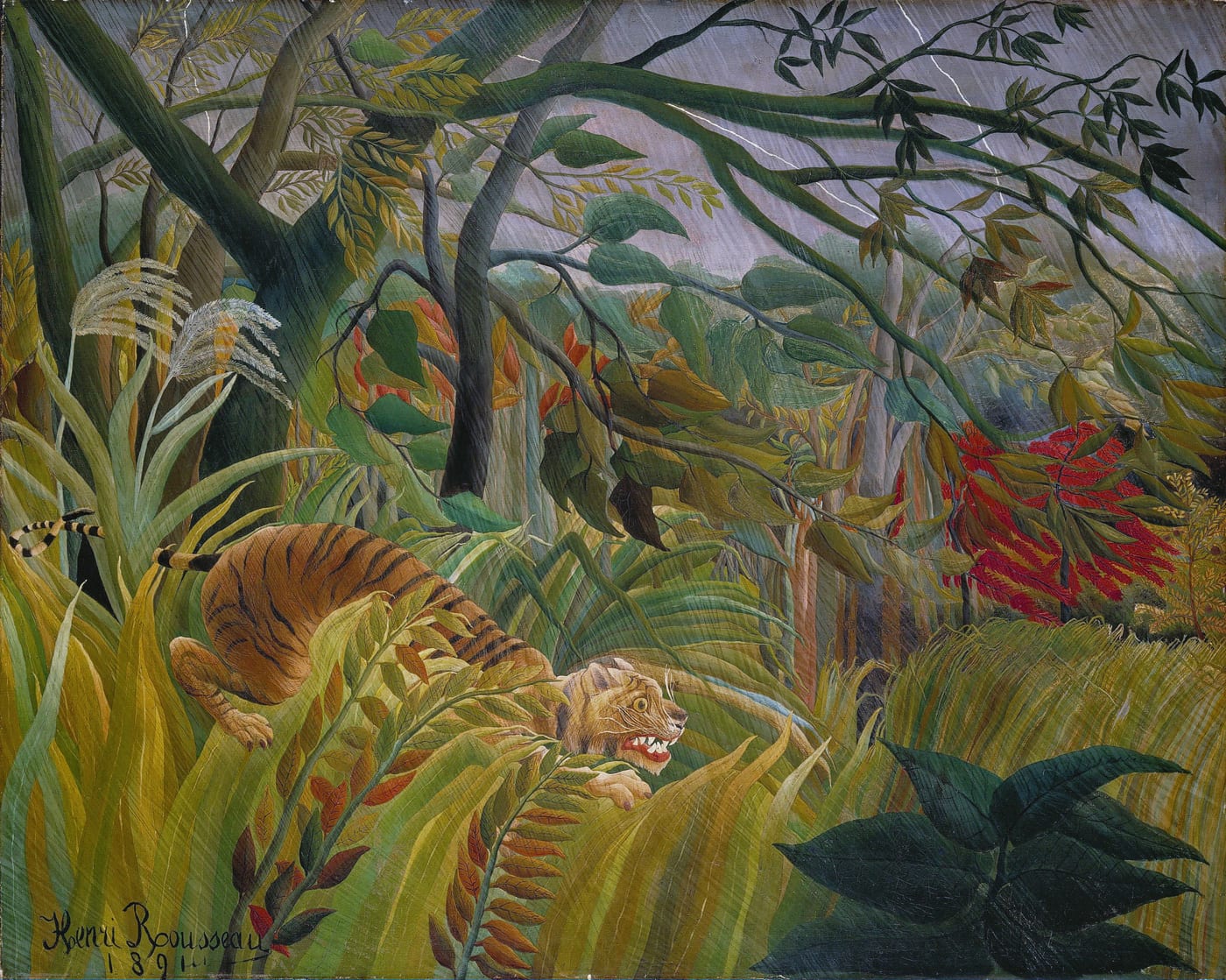
In modern American "spirit animal" usage, the tiger stands for fierce courage, sovereignty, and a controlled predatory power. That reading comes through Ted Andrews's Animal Speak (Llewellyn, 1993). The older traditions treat the tiger more specifically. The Hindu goddess Durga rides a tiger (sometimes a lion) in the Devi Mahatmya (c. 400–500 CE) and across subsequent iconography. The Korean sanshin (산신), the mountain-god, is invariably depicted accompanied by a tiger in Joseon-era paintings and contemporary shrine art. The Chinese Bai Hu (白虎), the White Tiger of the West, is one of the Four Symbols of the cardinal directions, a Han-dynasty cosmic figure documented in the Shiji and Han tomb murals. And in Siberian Tungusic-Manchu traditions, the tiger (amba) is a forest-owner spirit whose name is avoided in hunting talk.
Walk into the back of almost any Korean Buddhist temple, and you will find a small hall with a painting in it. The painting shows a bearded elder in Korean traditional costume, seated on a mountain, accompanied by a tiger. The elder is the sanshin, the mountain-god. The tiger is not decoration. It is the mountain-god’s companion, sometimes his visible form, always his sign. Korean folk religion’s oldest layer is older than Korean Buddhism, which arrived in the 4th century CE. When Buddhism came, it did not displace the sanshin. It put him a hall at the back of the temple and let him keep his tiger.
That is one way to read the tiger. Most Western spirit-animal writing has never heard of it.
The four traditions, each with its own specificity
Durga. Hindu, warrior-goddess, rides a tiger or lion. The Devi Mahatmya (c. 400–500 CE) narrates her creation by the assembled male gods who were not individually strong enough to defeat the buffalo-demon Mahishasura. She takes each god’s weapon, mounts her tiger, and kills the demon. Her annual festival in Bengal is the year’s largest religious event. Scholarly treatment: Kinsley 1986.

Bai Hu. The White Tiger of the West, one of the Four Symbols of the Chinese cardinal-direction cosmology. Han-dynasty formalization, documented in the Shiji and Han tomb murals. Autumn. Metal. Military matters. The Tang-era imperial palace had a White Tiger Hall where military policy was debated. This is the tiger as cosmic orientation, not personal spirit.
Sanshin. Korean mountain-god, always depicted with a tiger. Pre-Buddhist in origin, survives at the back of every traditional Korean Buddhist temple. Mason 1999 is the Western-language standard.
Amba, the forest-owner. Tungusic-Manchu hunting taboo. The Amur tiger is addressed as “grandfather” while hunting, because pronouncing its name directly is said to bring its attention. Arseniev’s 1923 Dersu Uzala, the journal of his Amur-basin expeditions with the Nanai hunter Dersu Uzala, is the best-known Western record of the tradition.
What the four share and what they don’t
What they share: the tiger is treated with ritual seriousness in each. It is a goddess’s mount, a cosmic cardinal direction, a mountain-god’s companion, a forest-owner whose name is not spoken. None of the four is the personal-spirit tiger of an American paperback.
What they don’t share: Durga’s tiger is a warrior’s mount in a specific theological combat. Bai Hu is an orientation and a season. Sanshin’s tiger is a folk-religious companion to a specific local spirit. The Tungusic amba is a presence whose name is a taboo.
These readings are richer than “fierce courage.” Any article that gives you only the last one has averaged them out of existence.
The Andrews 1993 reading, named plainly
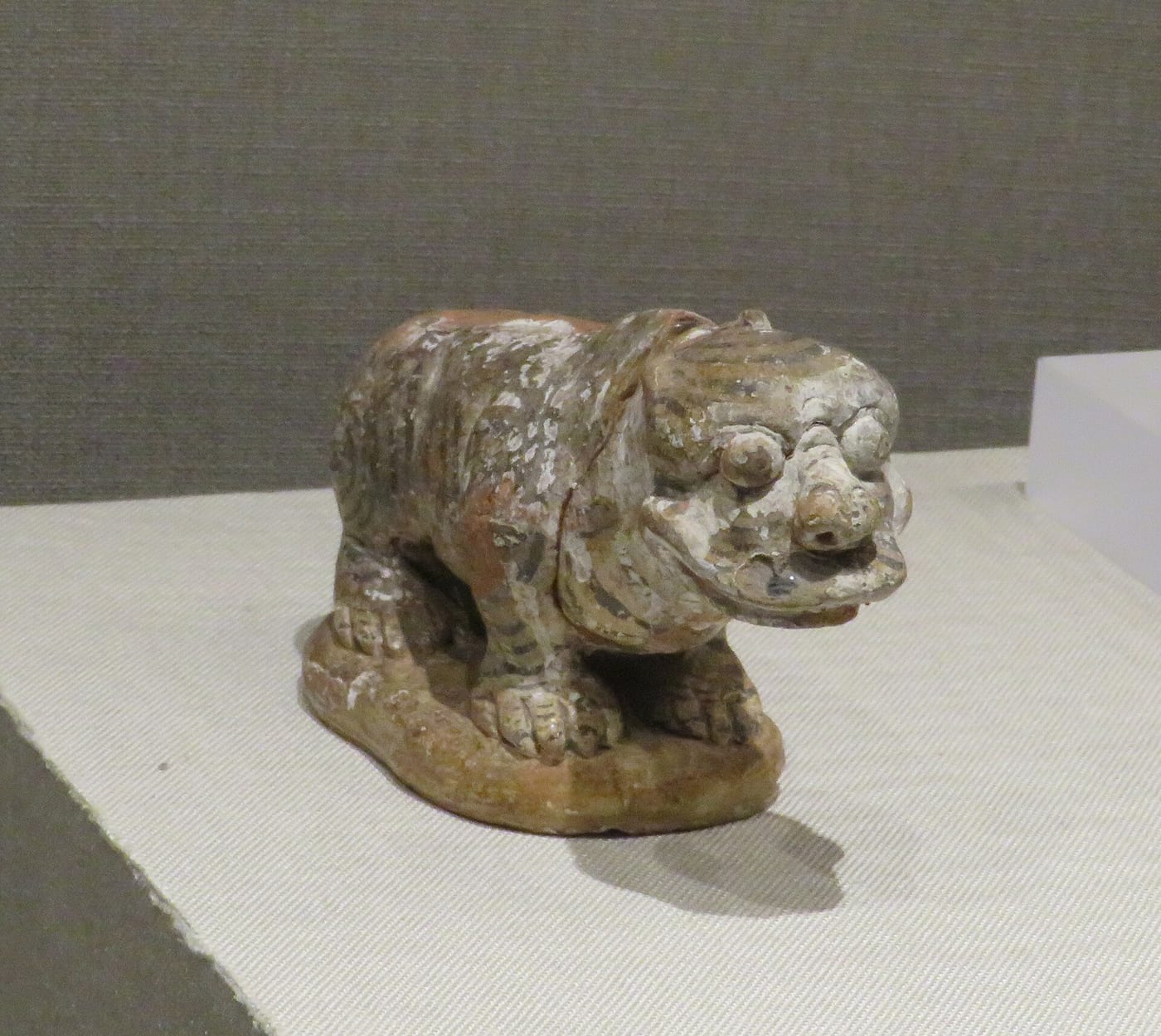
Ted Andrews’s 1993 Animal Speak tiger is the fierce-courage-and-sovereignty figure, drawn from the Durga and Bai Hu imagery without their theological context. He treats the tiger and lion as largely interchangeable, which the actual traditions do not. Every popular spirit-animal article about the tiger since inherits that synthesis.
Reading the Devi Mahatmya, standing in front of the Bai Hu mural at a Han tomb in Luoyang, looking up at a Korean sansin-gak painting, or reading the Amur hunters’ recorded talk gives you the tiger at depths no paperback synthesis can reach.
Across traditions
Hindu (Durga and her tiger)
Durga, the warrior-goddess, rides a tiger or lion in the Devi Mahatmya (also called Durgasaptashati), composed c. 400–500 CE and inserted into the Markandeya Purana. Chapters 2 and 3 narrate her creation by the assembled gods to defeat the buffalo-demon Mahishasura, whom no male god could kill. She is armed with weapons given by each god and rides a lion (simha) or tiger (vyaghra) depending on tradition and region; Bengal-Odisha temple sculpture typically gives her a lion, while Himachal Pradesh and parts of South India give her a tiger.
Her annual festival, Durga Puja, centered in Bengal but celebrated across the Hindu world, is the year's largest religious event for many communities. Kinsley's Hindu Goddesses: Visions of the Divine Feminine (University of California Press, 1986) is the standard scholarly treatment.
- PRIMARY Devi Mahatmya (Markandeya Purana, chapters 81–93) . Coburn trans., Crystal Cave ed., 1991.
- PEER-REVIEWED David Kinsley, Hindu Goddesses: Visions of the Divine Feminine . University of California Press, 1986.
Korean (sanshin, the mountain-god)
The sanshin (산신, "mountain-god") is one of the central figures of Korean folk religion and shamanic practice. Virtually every Korean Buddhist temple includes a sansin-gak (mountain-god hall) at its back, where the sanshin is painted as a bearded elder in the Korean traditional costume, accompanied by a tiger. The tiger is never incidental; it is the mountain-god's companion animal and, in some local traditions, his visible form.
The tradition predates Buddhism's 4th-century arrival in Korea and persists today across Seoul, Busan, and the provinces. David Mason's Spirit of the Mountains: Korea's San-Shin and Traditions of Mountain-Worship (Hollym, 1999) is the definitive English-language treatment. The Joseon-era (1392–1897) tradition of minhwa folk paintings preserves hundreds of tiger-and-sanshin images.
- PEER-REVIEWED David A. Mason, Spirit of the Mountains: Korea's San-Shin and Traditions of Mountain-Worship . Hollym, 1999.
- MUSEUM Korean National Folk Museum, minhwa collection
Chinese (Bai Hu, the White Tiger of the West)
The Bai Hu (白虎, "White Tiger") is one of the Four Symbols (Sì Xiàng) of the Chinese cosmological scheme, pairing with the Azure Dragon (Qinglong) of the East, the Vermilion Bird (Zhuque) of the South, and the Black Tortoise (Xuanwu) of the North. The system is formalized by the Han dynasty; Han-era mortuary art at Mawangdui and subsequent tomb murals consistently show the Four Symbols at their cardinal directions.
In the Shiji (Sima Qian, c. 94 BCE), the Bai Hu is associated with autumn, the element metal, and military matters. The White Tiger is therefore not simply a strong animal; it is a cosmic orientation, an astrological marker (the western seven of the twenty-eight lunar mansions), and a military emblem. The Tang-era White Tiger Hall (Baihu-dian) was the palace debate-chamber where military policy was settled.
- PRIMARY Sima Qian, Shiji (Records of the Grand Historian) . Nienhauser ed. and trans., Indiana University Press, 1994–.
- MUSEUM Han-era tomb murals, Mawangdui and subsequent sites . Hunan Provincial Museum; Luoyang tomb murals.
- PRIMARY Ban Gu, Bohutong (White Tiger Hall Discussions) . Tjan trans., Brill, 1949.
Tungusic-Manchu (Amba, the forest-owner)
In the Udegei, Nanai, and other Tungusic-Manchu peoples of the Amur-Ussuri region, the Amur tiger (known locally as amba) is the owner-spirit of the forest, addressed indirectly in hunting talk under the name "grandfather" (dusa or equivalent). The specific taboo against pronouncing the tiger's own name while in the forest is structurally similar to the Anglo-Saxon beowulf (bee-wolf) kenning for the bear, treated on our bear page.
Vladimir Arseniev's Dersu Uzala (1923, Russian), the journal of his expeditions with the Nanai hunter Dersu Uzala, is the best-known Western-language record of the tradition. Contemporary ethnographic work by Bruce Grant and others continues to document it.
- PRIMARY Vladimir Arseniev, Dersu Uzala (Дерсу Узала) . Moscow, 1923; English trans. W.E. Bennet, 1939.
- PEER-REVIEWED Bruce Grant, In the Soviet House of Culture: A Century of Perestroikas . Princeton University Press, 1995.
Ted Andrews (1993)
Andrews's 1993 tiger is mostly the Durga-and-Bai-Hu imagery reduced to a personal-spirit keyword: fierce strength, sovereign courage, controlled predatory power. He treats the tiger as near-interchangeable with the lion, a flattening that the actual Hindu and Chinese traditions specifically resist (Durga's mount distinction, the Bai Hu's cardinal-west position as opposed to any leonine imagery).
- REFERENCE Ted Andrews, Animal Speak . Llewellyn, September 1993.
Working with the Tiger
If you want a regular practice rather than a one-time read, an oracle deck is the standard tool: you draw a card and sit with whatever animal comes up. Our ranked guide to spirit animal oracle decks compares the field.
Frequently asked
- What does a tiger symbolize spiritually?
- In modern pop usage, fierce courage, sovereignty, and controlled power, the reading set by Andrews 1993. Older traditions are more specific. Durga rides a tiger in the Devi Mahatmya. The Korean mountain-god sanshin is always accompanied by a tiger in his shrine-hall paintings. The Chinese Bai Hu (White Tiger of the West) is one of the Four Symbols of the cardinal directions in the Han-formalized cosmological system. And Tungusic hunters call the tiger 'grandfather' out of respect for its owner-spirit status.
- Is the tiger Durga's only mount?
- Durga rides either a lion or a tiger depending on region and tradition. Bengali and Odishan iconography typically shows her on a lion (simha); Himachal Pradesh, parts of Tamil Nadu, and Sri Lankan Tamil traditions often show her on a tiger (vyaghra). Her brother Ayyappan in Kerala is more specifically tiger-associated. David Kinsley's Hindu Goddesses (UC Press, 1986) walks through the regional variants.
- What is the Chinese White Tiger?
- Bai Hu (白虎) is the White Tiger of the West, one of the Four Symbols (Sì Xiàng) of the Chinese cosmological scheme alongside the Azure Dragon, Vermilion Bird, and Black Tortoise. The system is formalized in the Han dynasty and documented in the Shiji (c. 94 BCE) and Han tomb murals. The White Tiger corresponds to autumn, the element metal, and military matters; the Tang-era White Tiger Hall was the palace debate-chamber for military policy.
- Why do Korean temples have tigers?
- Because virtually every Korean Buddhist temple includes a sansin-gak (mountain-god hall) at the back, where the sanshin (mountain-god) is painted as a bearded elder in traditional Korean costume, accompanied by a tiger. The sanshin tradition predates Buddhism's 4th-century arrival in Korea and was absorbed into the temple architecture rather than replaced. David Mason's Spirit of the Mountains (Hollym, 1999) is the standard English-language treatment.
Sources
- PRIMARY Devi Mahatmya (Coburn trans., 1991)
- PEER-REVIEWED David Kinsley, Hindu Goddesses . UC Press, 1986.
- PEER-REVIEWED David Mason, Spirit of the Mountains . Hollym, 1999.
- MUSEUM Korean National Folk Museum
- PRIMARY Sima Qian, Shiji (Nienhauser ed., 1994–)
- PRIMARY Ban Gu, Bohutong (Tjan trans., Brill, 1949)
- MUSEUM Han-era tomb murals, Hunan Provincial Museum and Luoyang
- PRIMARY Vladimir Arseniev, Dersu Uzala (1923)
- PEER-REVIEWED Bruce Grant, In the Soviet House of Culture . Princeton University Press, 1995.
- REFERENCE Ted Andrews, Animal Speak . Llewellyn, September 1993.