Tradition · Scandinavia
The Fylgja: What Old Norse Sources Actually Say About the 'Fetch' Animal
The fylgja in Old Norse tradition: a close read of the primary saga passages (Njáls saga, Hallfreðar saga, Þorsteins þáttr uxafóts, Gísla saga) and the scholarly reconstruction of a Viking-Age concept that is not, strictly, a 'spirit animal.'
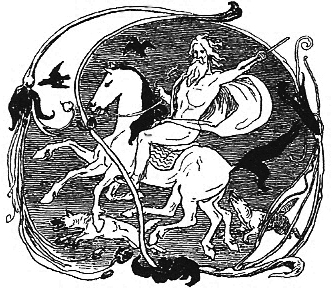
The fylgja (plural fylgjur) is a figure in Old Norse sources usually translated as 'fetch' or 'following-spirit.' In the sagas it appears most often as an animal that accompanies a person, visible in dreams or to those with second sight. It is not a personal guide in the modern New Age sense. It's closer to an externalized soul or fate-figure, often tied to the family line, and its wounding or death in a dream foreshadows the person's own. The canonical passages are in Hallfreðar saga, Njáls saga, Gísla saga, and Þorsteins þáttr uxafóts.
The fylgja is one of those Old Norse concepts that every serious reader of the sagas meets early and then has to spend years unlearning the New Age version of. The word means “follower,” from the verb fylgja (“to follow, to accompany”). In the sagas it almost always takes animal form, and it shows up in a very specific grammar: seen in a dream, visible to a person with second sight, arriving before the person arrives, dying before the person dies.
That is not a spirit animal in the contemporary retail sense. Nobody in the sagas “finds” their fylgja through a guided meditation. Nobody consults it for advice. The fylgja is closer to a piece of a person’s fate that walks around outside the body, visible to people who can see such things, and tied so closely to the person’s life that its death is the person’s death.
The four saga passages that do most of the work
Every modern treatment of the fylgja cycles through roughly the same four primary-source scenes.
In Hallfreðar saga, the skald Hallfreðr Óttarsson sees a woman in armor walking away from his ship just before his death. She is named as his fylgjukona, his female fylgja, and she announces that she is leaving him because he is about to die. This is the “disir” or “fylgjukona” strand of the tradition, where the spirit takes the form of a woman rather than an animal, often a guardian-ancestress figure.
In Njáls saga, chapter 23, Gunnar of Hliðarendi’s brother Kolskeggr dreams of a great bear coming toward him, and he takes this to mean Gunnar himself, whose fylgja is the bear. The animal matches the man. A fighter’s fylgja is a fighter-animal. The scene establishes the basic saga convention.
In Gísla saga, Gísli dreams of two women before he dies: one who brings him good counsel, one who brings bloodshed. The dream-women are read by the saga’s narrative voice as fylgjur too, sliding across the fylgja-fylgjukona-disir boundary in exactly the way the scholars later struggle to pin down.
And in Þorsteins þáttr uxafóts, the young hero’s companion has a dream in which he sees a pack of wolves running toward them; when he wakes and tells Þorsteinn, they take it as a warning that enemies are on the way. The wolves are not Þorsteinn’s fylgja, they are the enemies’ fylgjur, visible in the dream-world before the men themselves arrive.
What the scholars say the fylgja isn’t
Gabriel Turville-Petre’s Myth and Religion of the North (Weidenfeld & Nicolson, 1964) is still the clearest English-language overview. His reading, which most subsequent scholars have followed, is that the fylgja is a specific kind of externalized soul-figure, distinct from the hamr (skin/shape, used of shape-shifters who actually change form) and from the hugr (thought/intention), though overlapping with both. Else Mundal’s 1974 Norwegian-language monograph Fylgjemotiva i norrøn litteratur catalogs every saga appearance and maps the internal grammar.
Neil Price’s The Viking Way (revised 2019) situates the fylgja in the broader Viking-Age magical complex alongside seiðr practice, arguing that the fylgja is best understood as part of a coherent folk-psychology in which the self is distributed across several interacting spirit-parts. That reading makes more sense of the sagas than the pop-occult “spirit animal” importation.
Why this matters for how the animals are read
If you are working on a spiritualanimals.com article about the wolf or the bear or the raven, and you want to include the Norse layer, the fylgja is the hook. But the hook has to carry its actual shape. In the sagas, a wolf-fylgja signals a wolf-man, usually a violent or outlaw figure. A bear-fylgja signals a warrior-protector with weight behind him. A swan or she-bear fylgja signals something about the family line of the woman it follows. Specific animals signal specific characters, because the fylgja is a piece of that specific person made visible.
That is close to the opposite of a “pick your spirit animal” framework. Any spirit-animal article that invokes the fylgja without explaining this point is importing the word while dropping the meaning, the difference between using a term and actually knowing what it carried.
Key terms
- fylgja
- (pl. fylgjur). A following-spirit in Old Norse tradition, usually appearing as an animal. From the verb fylgja, 'to follow, accompany.'
- hamr
- 'Skin' or 'shape.' The changeable outward form of a person or spirit. Related to hamrammr ('shape-strong') used of shape-shifters.
- hugr
- Thought, intention, or soul-as-mental-faculty. The fylgja sometimes appears as the externalized hugr.
- ættarfylgja
- 'Family fylgja.' A fylgja passed down through a family line rather than attached to one individual.
Frequently asked
- Is a fylgja a Viking spirit animal?
- Not in the modern sense. The fylgja in the sagas is not consulted for guidance, summoned for protection, or experienced as a spiritual guide. It appears in dreams, it follows the person, and it dies when they die. It is closer to a visible piece of the person's fate or soul than to a personal totem.
- What animals appear as fylgjur in the sagas?
- Wolves and bears are most common for violent or powerful men. A swan, a she-bear, and a fox appear for specific characters in Hallfreðar saga, Njáls saga, and Gísla saga respectively. The animal form tends to match the person's character, a point the sagas make explicitly in several passages.
- What is the difference between a fylgja and a hamingja?
- The hamingja is the luck or fate of a family, also capable of being transferred or followed across generations. The fylgja is more strictly the animal-shaped spirit that accompanies a person. The two concepts overlap and sometimes merge in the saga literature. Neil Price's Viking Way treats them as closely related.
- Is the fylgja the same as the Irish 'fetch'?
- The word 'fetch' (a doppelgänger or death-warning apparition) is a convenient English translation, but the concepts are not identical. The Irish fetch is almost always a human double; the Norse fylgja is almost always an animal. Scholars including Gabriel Turville-Petre (1964) treat them as parallel rather than identical traditions.
Sources
- EDITION Poetic Edda . Larrington trans., Oxford World's Classics, revised 2014.
- EDITION Snorri Sturluson, Prose Edda . Faulkes trans., Everyman, 1995.
- PRIMARY Hallfreðar saga (Íslenzk fornrit VIII) . Einar Ól. Sveinsson ed., 1939; Whaley trans., Viking Society, 2003.
- PRIMARY Njáls saga (Brennu-Njáls saga) . Cook trans., Penguin Classics, 2001.
- PRIMARY Gísla saga Súrssonar . Regal trans., Penguin Classics, 2003.
- PRIMARY Þorsteins þáttr uxafóts . In Complete Sagas of Icelanders, Viðar Hreinsson ed., Leifur Eiríksson, 1997.
- PEER-REVIEWED Gabriel Turville-Petre, Myth and Religion of the North . Weidenfeld & Nicolson, 1964.
- PEER-REVIEWED Neil Price, The Viking Way: Magic and Mind in Late Iron Age Scandinavia . Oxbow, revised ed. 2019.
- PEER-REVIEWED Else Mundal, Fylgjemotiva i norrøn litteratur . Universitetsforlaget, 1974 (Norwegian).