Dream Meaning
Dreams of Deer: Actaeon's Transformation, Psalm 42, and the Celtic White Stag
Dreams of deer: Ovid's Actaeon transformation myth (Metamorphoses 3.155–252), Psalm 42's stag-at-the-spring as soul-thirst tradition, and the Celtic White Stag as otherworld guide.
Deer dreams carry three distinct cultural substrates. Ovid's Actaeon (Metamorphoses 3.155–252) is the Western classical figure: the hunter transformed into a stag after seeing Artemis/Diana bathing. The deer as the mark of transformation forced on someone who witnessed what they were not supposed to see. Psalm 42:1 ('As the deer pants for streams of water, so my soul pants for you') is the Christian substrate: the stag at the spring as the soul's thirst for the divine. The Celtic White Stag tradition (Mabinogion, Arthurian literature) treats the deer as an otherworld guide, the creature that initiates the journey beyond ordinary life.
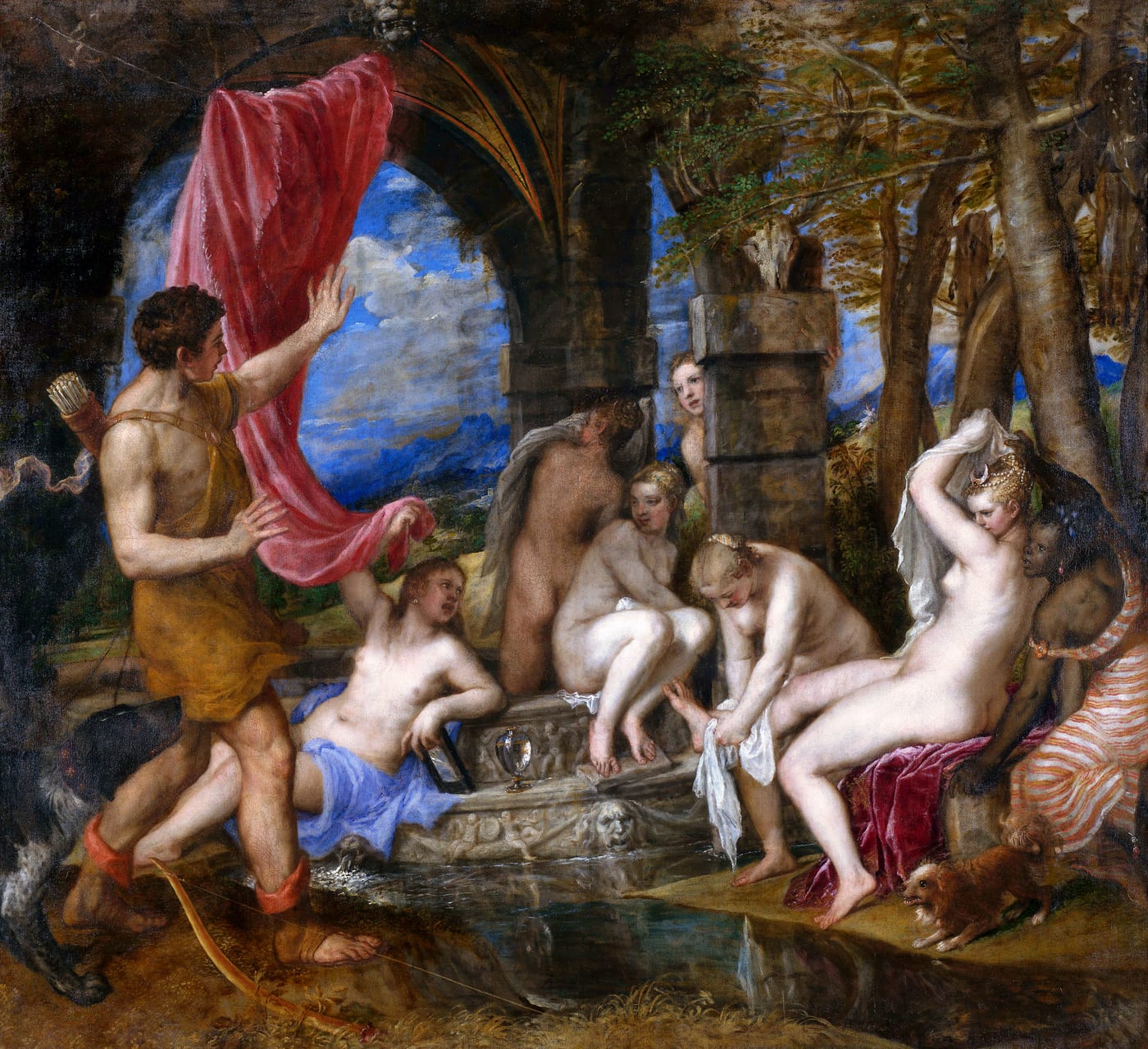
Actaeon is the definitive Western deer-dream figure. Not because deer dreams are common (though they are), but because Ovid’s account in the Metamorphoses (3.155–252) is so structurally precise that it functions as a template for the entire category of transformation-by-witnessing. Actaeon, the skilled hunter, goes into the forest, comes upon a pool he didn’t know was there, and finds Artemis and her nymphs bathing. He sees what he was not supposed to see. Artemis splashes him with water. He reaches for his bow and realizes his hands are already hooves. His dogs hear a stag, not their master. They bring him down.
The myth encodes the specific experience of being transformed into the thing you hunted, of crossing a threshold you didn’t know was there and finding yourself on the wrong side of it with no way back.
Psalm 42 and the soul’s thirst
The other deep substrate for deer-dream imagery in the Western tradition is Psalm 42:1: “As the deer pants for streams of water, so my soul pants for you, my God.” The stag drinking at a spring became one of the most enduring images in Early Christian art (catacomb paintings, Romanesque tympana, Coptic textiles) as visual shorthand for the soul’s thirst for the divine.
The stag-at-the-spring generates a specific dream-grammar in Christian-influenced contexts: the deer as the soul in its state of longing, seeking the source that will satisfy a thirst nothing ordinary can touch. Jerome’s Vulgate renders it with full force; it’s the Old Testament’s most portable image for the contemplative soul’s native orientation. A dream deer near water, or drinking from a stream, carries this charge in a context shaped by the Psalm.
The Celtic White Stag
The White Stag in Celtic and Arthurian literature is the creature you cannot quite catch, the one that leads you past the visible world into the territory that lies beyond it. In the First Branch of the Mabinogion (Pwyll Prince of Dyfed; Sioned Davies trans., Oxford World’s Classics, 2007), Pwyll’s pursuit of a stag leads him to the forest boundary where he encounters Arawn, King of the Otherworld. The stag is not the destination; it’s the initiating encounter that makes the journey possible.
The same structural function appears across the Arthurian cycle: the white stag whose pursuit opens the adventure, whose capture is always deferred, who takes the knights past the boundaries of the ordinary court into the territory where something real can happen. The stag cannot be caught in the ordinary world because catching it would end its function. Its job is to lead you to the place where the ordinary rules have stopped applying.
Miranda Aldhouse-Green’s work on Romano-Celtic animal symbolism documents how the stag functioned as psychopomp in British and Gaulish traditions, the animal that carries souls between worlds, specific to the liminal territories of forest and mountain.
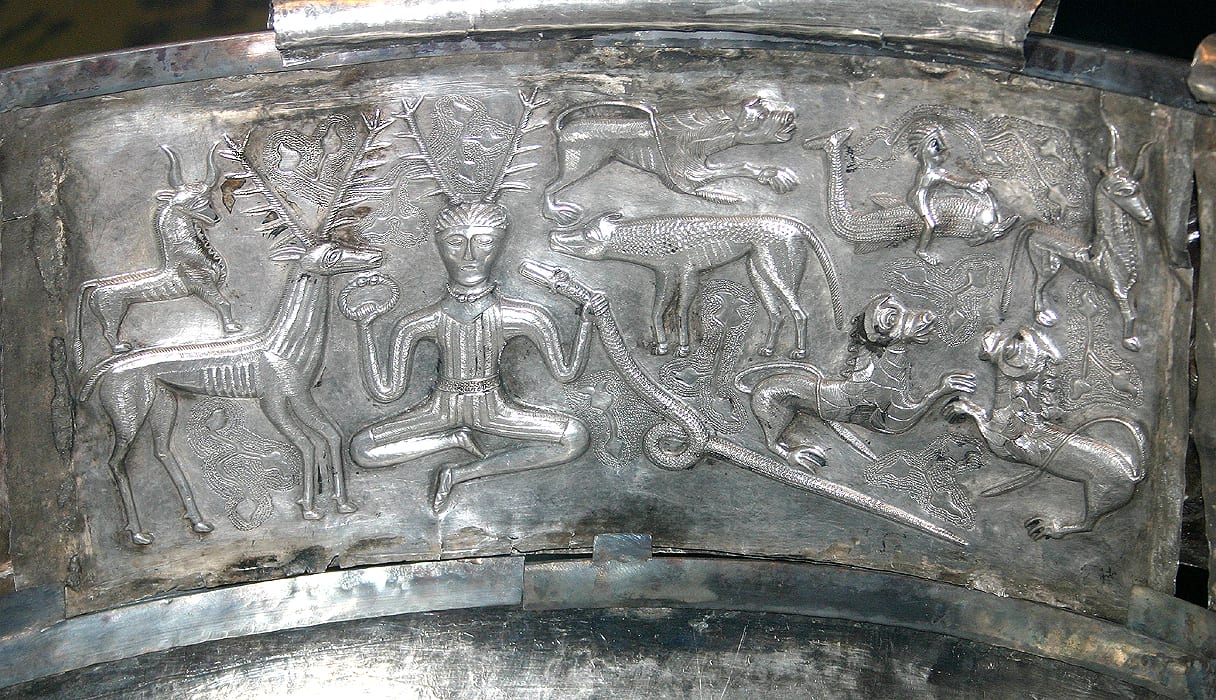
Cernunnos on the Gundestrup Cauldron (c. 1st century BCE, Nationalmuseet Copenhagen), the antlered deity surrounded by a stag and other animals, is the iconographic center of this tradition. He is named once epigraphically, on the Pillar of the Boatmen (c. 14–37 CE, Notre-Dame de Paris). The antlered man with his stag companion represents the intersection of human and animal powers: the figure who belongs to both worlds and can move freely between them.
What deer dreams share
None of these three traditions treat the deer as the endpoint. Actaeon doesn’t go looking for transformation; it finds him at the pool. The stag-at-the-spring in Psalm 42 is not the divine; it’s what leads there. The White Stag can’t be caught because catching it would end its function.
A dream deer is typically moving. Away from you, toward something you can’t see yet. The question is whether you follow. Ted Andrews treats the deer in Animal Speak (Llewellyn, 1993) as a gentleness teacher, drawing on the prey-animal’s alertness and grace. That reading is real. The older traditions reach further: the deer as the creature that marks where the ordinary world runs out.
Frequently asked
- What does it mean to dream of a deer?
- Three primary cultural frames. In the classical tradition: the deer recalls Actaeon (Ovid, Metamorphoses 3), transformed after seeing the goddess, a dream of witnessing or becoming the hunted. In the Christian tradition: Psalm 42's stag-at-the-spring, soul-thirst for the divine. In the Celtic tradition: the White Stag as guide into the Otherworld, the initiating encounter in many Arthurian narratives. In Japanese tradition at Kasuga Taisha: the deer as divine messenger (shinroku) of the kami.
- What is the Actaeon transformation myth?
- Ovid's Metamorphoses 3.155–252: Actaeon, the skilled hunter, accidentally comes upon the goddess Artemis (Diana) bathing with her nymphs in a forest pool. She splashes him with water and transforms him into a stag. His own hunting dogs, no longer recognizing their master, tear him apart. The myth is the definitive Western image of transformation forced by dangerous knowledge: becoming the thing you hunted after crossing a threshold you didn't know was there.
- What is the Celtic White Stag tradition?
- The White Stag (white hind) in Celtic and Arthurian literature appears at the beginning of an adventure as an otherworld signal: the creature you cannot catch, whose pursuit leads you beyond the ordinary world. Pwyll's pursuit of the stag in the First Branch of the Mabinogion and the white stag that launches hunts in the Arthurian cycle both function as initiating encounters: the deer shows you that the boundary to the otherworld is permeable, and crossing it is what the story is about.
Sources
- PRIMARY Ovid, Metamorphoses 3.155–252 (Actaeon) . Humphries trans., Indiana University Press, 1983.
- PRIMARY Psalm 42:1 . RSV / BHS.
- PRIMARY The Mabinogion, First Branch (Pwyll Prince of Dyfed) . Sioned Davies trans., Oxford World's Classics, 2007.
- PEER-REVIEWED Miranda Aldhouse-Green, Sacred Britannia: The Gods and Rituals of Roman Britain . Thames & Hudson, 2018.
- PEER-REVIEWED C.G. Jung, Archetypes and the Collective Unconscious . Collected Works 9i, Princeton, 1959.
- PEER-REVIEWED J. Allan Hobson, Dreaming: An Introduction to the Science of Sleep . Oxford University Press, 2002.