Fire Sign · March 21 – April 19
Aries Spirit Animal
Aries the Ram: Babylonian LÚ.ḪUN.GÁ and the vernal equinox origin of the zodiac's first sign, Greek Chrysomallus (the golden-fleeced ram that carried Phrixus to Colchis), the Argonautic quest the ram's sacrifice set in motion, and the First Point of Aries and precession.
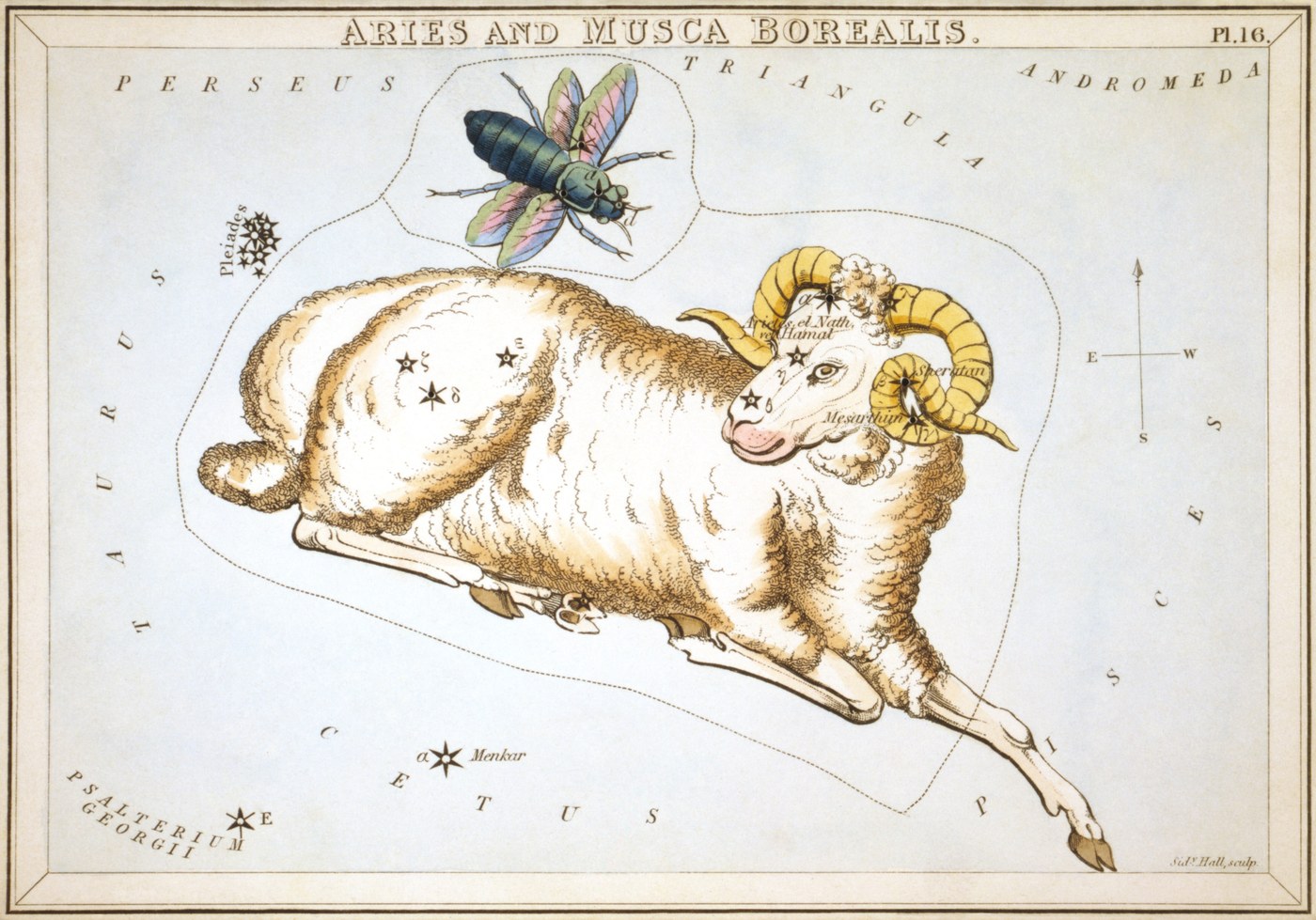
Aries is the Ram, the first sign of the tropical Western zodiac (March 21 – April 19, Fire element). The zodiacal ram traces to the Babylonian MUL.APIN tablets (c. 1000–686 BCE), where the sign is called LÚ.ḪUN.GÁ ('the Hired Man'), not yet a ram by name. The ram identification crystallized in the Hellenistic period through the myth of Chrysomallus: the golden-fleeced divine ram that rescued Phrixus and Helle, was sacrificed at Colchis, and whose fleece became the object of the Argonautic quest. Apollodorus Library 1.9.1 and Pindar's Pythian 4 are the key Greek sources. When the tropical zodiac was formalized in the 5th–3rd centuries BCE, the vernal equinox fell in Aries, fixing 0° Aries as the 'First Point of Aries' and making it the zodiac's permanent starting sign.
Aries is the Ram, but the zodiac didn’t start here because of the myth. When Babylonian astronomers formalized the twelve-sign sequence in the MUL.APIN tablets (c. 1000–686 BCE), the vernal equinox stood in this sign. Their name for it was LÚ.ḪUN.GÁ (“the Hired Man”) not “Ram.” The ram identification is a Hellenistic development, not an ancient Babylonian one. Ptolemy’s Tetrabiblos (c. 150 CE) formalized the Hellenistic astrological system that most Western astrology still runs on. The myth came after the astronomy, and the astronomy came from the observation that this was where the year began.
LÚ.ḪUN.GÁ: the Babylonian origin
The MUL.APIN tablets represent a Babylonian astronomical compendium compiled from observations going back to the 2nd millennium BCE. LÚ.ḪUN.GÁ (the Hired Man) was the first sign of the zodiacal sequence because the Babylonian new year (the Akitu festival) was anchored to the vernal equinox, and the sun stood in this sign at that moment. The association with the beginning of the agricultural year, the hiring of seasonal laborers, and the restart of the solar calendar gave the sign its priority in the zodiacal sequence well before any ram mythology was attached.
The figure depicted in Babylonian star-lore for this constellation is uncertain. Some reconstructions suggest a human laborer; others show a sheep or ram in a working posture. Aratus of Soli’s Phaenomena (c. 270 BCE) (the earliest surviving Greek verse account of the constellations) describes Aries as a faint constellation without a particularly memorable shape. The mythological density of the sign came from Greece, not Babylon.
Chrysomallus and the rescue from Boeotia
The Greek mythological identification of Aries is Chrysomallus, the golden-fleeced divine ram. The narrative begins with Athamas, king of Boeotia, whose second wife Ino plotted the sacrifice of his children from his first wife Nephele: Phrixus and Helle. Nephele, their divine mother, intervened. She sent Chrysomallus (a ram with a fleece of actual gold, capable of flight) to carry her children eastward out of reach of Ino’s scheme.
They climbed onto its back and it flew across the Aegean. Over the narrow strait between Europe and Asia, Helle lost her grip and fell into the water below. The strait still bears her name: Hellespont, “Sea of Helle”, what the modern world calls the Dardanelles. Phrixus held on and reached Colchis on the eastern shore of the Black Sea, the kingdom of Aeëtes. There he sacrificed Chrysomallus to Zeus (or, in some accounts, to Ares) and hung the golden fleece in the sacred grove of Ares, guarded by a dragon that never slept.
Apollodorus’s Library 1.9.1 is the fullest prose account. Pindar’s Pythian 4, composed in 462 BCE for the foundation myth of the Argonautic expedition, is the oldest substantial poetic treatment. Zeus catasterized the ram as the constellation Aries: a memorial to the animal that made the rescue possible, and whose sacrificed fleece set the stage for the next generation’s defining quest.

Jason, the Argonauts, and what the fleece actually was
The golden fleece that Chrysomallus left behind at Colchis became the central object of one of the oldest surviving Greek heroic cycles. Jason, the rightful heir to the throne of Iolcos, was sent by his usurping uncle Pelias to retrieve it, a task designed to be fatal. Instead, Jason assembled the Argonauts: the largest gathering of heroes in the Greek tradition before the Trojan War. Heracles, Orpheus, Castor and Pollux, Peleus (who would father Achilles), the wind-sons Calais and Zetes, Meleager, the healer Asclepius in some versions. Aratus lists them in the Phaenomena; Apollonius of Rhodes’s Argonautica (3rd century BCE) is the fullest epic account.
They sailed through the Hellespont (through the strait named for Helle’s fall) and east along the Black Sea coast to Colchis. To retrieve the fleece, Jason had to plow a field with fire-breathing bulls (the Khalkotauroi, bulls with bronze hooves given to Aeëtes by Hephaestus), sow the field with dragon’s teeth, and fight the soldiers who grew from them. He succeeded only through the help of Aeëtes’s daughter Medea, a priestess of Hecate who gave him an ointment of invulnerability, told him to throw a stone among the earth-born soldiers to set them fighting each other, and charmed the sleepless dragon so he could take the fleece. What the fleece was in the oldest stratum of the story is uncertain: some scholars read it as a metaphor for gold panning along the rivers of Colchis, where sheepskins were used to trap alluvial gold flakes. A golden fleece hung in a grove guarded by a dragon is also a recognizable mythological structure: the dangerous treasure in the unreachable place, the task that proves the hero.
The First Point of Aries and the precession problem
When the Greek and Babylonian astronomers formalized the tropical zodiac between the 5th and 3rd centuries BCE, the vernal equinox (the moment when the sun crosses the celestial equator heading northward, marking the astronomical start of spring in the Northern Hemisphere) fell in the constellation Aries. This made Aries the starting sign of the zodiacal year. The intersection was fixed as 0° Aries and called the “First Point of Aries.” Ptolemy’s Almagest and Tetrabiblos take this for granted as the foundation of the system.
The complication: Earth’s rotational axis wobbles over a cycle of approximately 26,000 years, a phenomenon called the precession of the equinoxes. This wobble slowly shifts the zodiacal constellations relative to the equinox points. Since the Greek formalization, the vernal equinox has moved westward through Pisces and is now technically approaching Aquarius, the astronomical basis for the pop-cultural “Age of Aquarius.” The constellation Aries no longer contains the vernal equinox.
The tropical zodiac (Western astrology) handles this by retaining 0° Aries as the fixed starting point by definition, regardless of where the constellation Aries sits in the sky. The zodiac measures angular distance from the vernal equinox, not from the constellation. Sidereal astrology (used in Vedic jyotisha) tracks the constellations directly and corrects for precession via an ayanamsha (correction factor). The two systems differ by approximately 24 degrees in 2026: a person born in early April is an Aries in Western astrology and a Pisces in Vedic astrology. Both are internally consistent. They are measuring different things.
Mars and the ruling planet
In Hellenistic astrology, Aries is ruled by Mars (Ares). The connection is direct in the mythological record: the golden fleece was hung in the sacred grove of Ares at Colchis. The war god owns the object that the sign commemorates. The ram’s behavioral profile (a creature that charges headlong, meets resistance horn-first, leads the flock without hesitation) maps precisely onto the Martian energy that Hellenistic astrologers attributed to the sign: initiative, forward action, willingness to go first, the charge rather than the tactical retreat.
Mars governs both Aries and Scorpio in traditional Hellenistic astrology. The difference the tradition draws is this: Aries-Mars is the direct force, the soldier in the field, the initiative that meets the obstacle head-on. Scorpio-Mars is the strategic force, working through indirection, patience, the general behind the lines rather than the soldier in front. The same planet; two different expressions of the same fundamental drive, separated by the element (Fire versus Water) and the quality (cardinal versus fixed).
The ram in the sacrificial tradition
The ram was the preferred sacrificial animal across much of the ancient Mediterranean and Near East. The connection runs deeper than Chrysomallus. The ram that Abraham found caught in the thicket at the moment he was about to sacrifice his son Isaac (Genesis 22:13) is not incidentally a ram: the ram was the standard substitute offering, the animal whose sacrifice was accepted as equivalent to what could not be given. The Akedah story and the Chrysomallus story share a structural element (the intervention that redirects the sacrifice from human to animal) that may reflect the same underlying sacrificial shift, or at minimum the same cultural understanding of what the ram stood for in the sacrificial economy: the appropriate animal at the appropriate moment.
The hawk and falcon appear in modern zodiac-spirit-animal literature as secondary Aries animals through Mars’s association with birds of prey, the predator’s directness and strike speed parallel the Aries archetype’s forward momentum. Ted Andrews’s Animal Speak (Llewellyn, 1993) connects the hawk to Aries through Mars and through the hawk’s solar associations in Egyptian tradition (Horus as the hawk-headed solar deity). Neither hawk nor falcon has deep ancient roots in the Aries constellation specifically; both enter through modern synthesis rather than classical primary sources.
The animal
The ram is Aries’s only primary animal in the ancient record, and it carries a specific character worth holding onto: the ram in the Chrysomallus story is not a warrior. It is a rescue vehicle. It carries the vulnerable across impossible terrain at a moment of crisis, and what it leaves behind (the fleece, the impossible shining object in the guarded grove) is more significant than what it carried. The ram gives everything and disappears. The quest the fleece enables outlasts the animal by a generation.
The ram spirit animal entry covers the Egyptian ram of Amun (the ram-headed god of Thebes, whose sacred animals were the physical manifestations of the divine), the Vedic ram of Agni (the fire god whose vehicle is the ram: significant given Aries’s Fire element assignment), and the role of the ram across pastoral cultures as the animal that leads the flock and whose virility ensures the next generation.
Associated animals
Primary: Ram , Sheep
Frequently asked
- What animal is Aries?
- The Ram. The sign's Babylonian origin is LÚ.ḪUN.GÁ ('the Hired Man') in the MUL.APIN tablets (c. 1000–686 BCE); the ram identification is a Hellenistic development through the myth of Chrysomallus: the golden-fleeced divine ram that carried Phrixus to Colchis, was sacrificed, and whose fleece Jason and the Argonauts later retrieved (Apollodorus Library 1.9.1).
- Why does the zodiac start with Aries?
- When the tropical zodiac was formalized in the 5th–3rd centuries BCE, the vernal equinox (the astronomical moment when the sun crosses the celestial equator heading north) fell in the constellation Aries. This fixed 0° Aries as the zodiac's starting point. Due to the precession of the equinoxes (Earth's ~26,000-year axial wobble), the equinox has since shifted into Pisces, but the tropical zodiac retains Aries as its starting sign by convention.
- What is the golden fleece and how does it connect to Aries?
- Chrysomallus, the divine golden-fleeced ram, was sacrificed at Colchis by Phrixus after carrying him from Boeotia. Its fleece was hung in the sacred grove of Ares, guarded by a sleepless dragon. The fleece became the object of Jason's quest: he assembled the Argonauts and sailed to Colchis to retrieve it (Apollodorus Library 1.9.16–27, Apollonius of Rhodes Argonautica). Zeus catasterized the ram as the constellation Aries after its sacrifice.
- What is the 'First Point of Aries'?
- The astronomical name for 0° in the tropical zodiac, the vernal equinox point. When the zodiac was formalized, the equinox fell in Aries. Due to precession, the equinox has since shifted into Pisces, but tropical astrology retains the Aries starting point by convention. Sidereal astrology (Vedic jyotisha) corrects for precession and does not use the First Point of Aries as fixed.
Sources
- PRIMARY MUL.APIN astronomical tablets (Babylonian) . Hermann Hunger and David Pingree ed., MUL.APIN: An Astronomical Compendium in Cuneiform, Archiv für Orientforschung Beiheft 24, 1989.
- PRIMARY Apollodorus, Library 1.9.1 (Chrysomallus) . Frazer trans., Loeb Classical Library.
- PRIMARY Pindar, Pythian 4 . Race trans., Loeb Classical Library.
- PRIMARY Apollonius of Rhodes, Argonautica . Race trans., Loeb Classical Library.
- PRIMARY Ptolemy, Tetrabiblos . Robbins trans., Loeb Classical Library.
- PRIMARY Aratus, Phaenomena . Kidd trans., Cambridge University Press, 1997.
- PRIMARY Pseudo-Eratosthenes, Catasterismi . Hard trans., Oxford World's Classics, 2015.