Spirit Animal
Ram Spirit Animal
Ram spirit animal meaning: force, initiative and virility. Traced to sources that exist: the ram-headed sphinxes of Amun at Karnak and the two Egyptian sheep whose horns tell them apart, the Ur statuette Woolley named for Genesis 22 that is not a ram, Agni's mount in the Vedic fire cult, and the Mishnah's ruling on why a shofar cannot be a cow's.
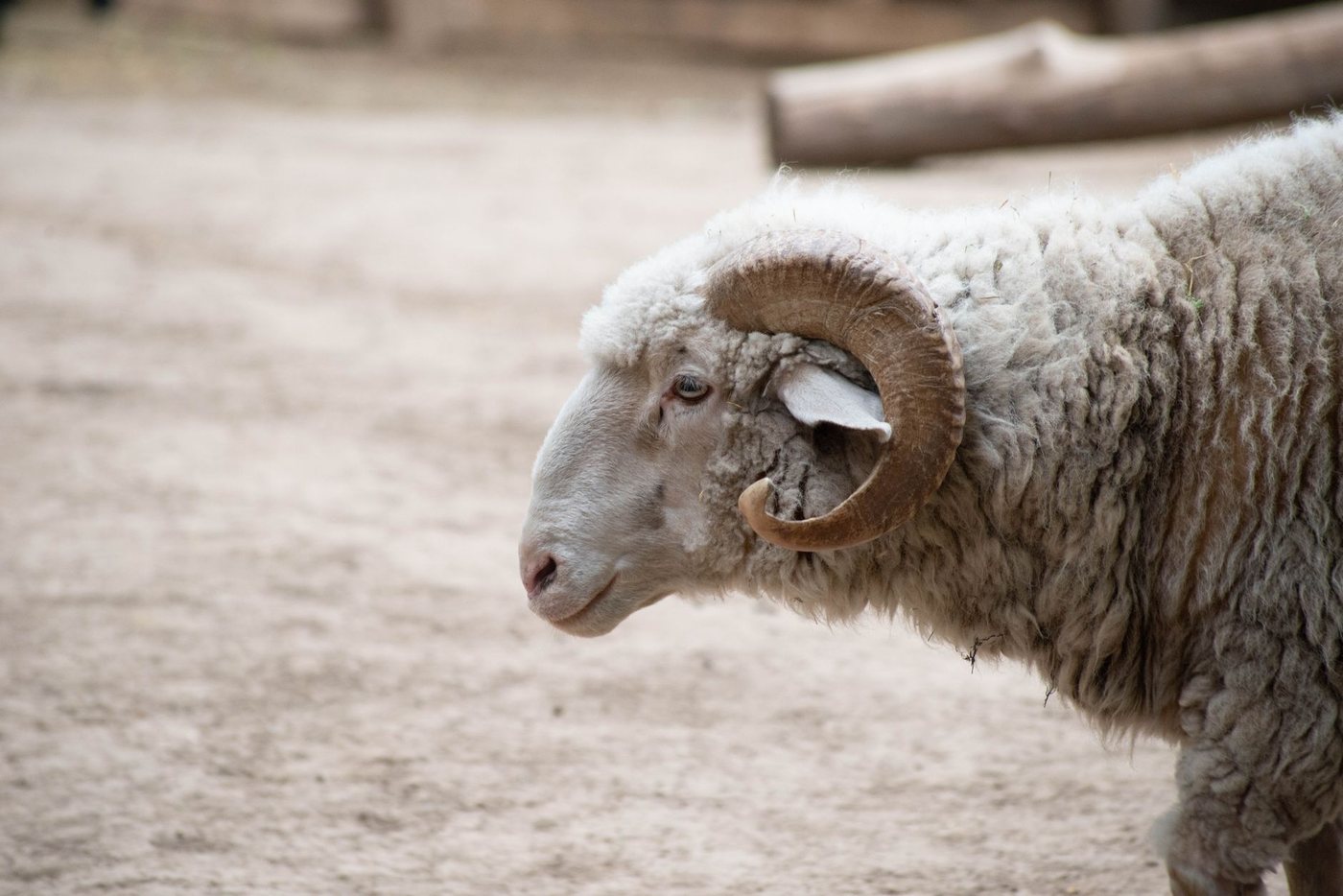
The ram is read as force, initiative, and the head-on charge, and that reading comes from astrology rather than from folklore: Aries is the ram, and the ram inherits the sign's profile. The older record says something narrower. In Egypt the ram is the living form of Amun, in the Rigvedic fire cult it carries Agni, and in Jewish law it supplies the one horn a shofar may be made from. In all three the horn does the work, not the animal.
Start with the animal, because most pages about the ram are not about one.
A ram is an intact adult male sheep, Ovis aries. Castrate him and he is a wether. Leave him and the horns keep growing, spiralling outward and back around the ear for the whole of his life, adding a ridge for roughly every year. That spiral is the whole reason the ram has a symbolic career and the ewe does not, and it is why nearly every tradition below turns out, on inspection, to be a tradition about horns.
It also explains the confusion that runs through this subject. Sheep, goats and rams get swapped for one another constantly in popular writing, and once you know that, the single most famous “ram” in any museum turns out not to be one.
Why is Aries a ram when Babylon called it a hired man?
The keyword list attached to the ram online (bold, headstrong, first through the door, impatient) is not folklore about sheep. It is the Aries personality profile, and it arrives from astrology rather than from anyone’s observation of livestock.
The sign itself did not begin as a ram. In the Babylonian MUL.APIN tablets the first zodiacal sign is LÚ.ḪUN.GÁ, the Hired Man, and it comes first because the vernal equinox stood there when the sequence was fixed, not because of any story. The ram identification is a Hellenistic development, arriving with Chrysomallus, the golden-fleeced ram that carried Phrixus out of Boeotia and was sacrificed at Colchis. The Aries entry follows that thread in full.
Which leaves the modern ram in an odd position. Its personality comes from a sign that was a labourer before it was an animal, and the animal was attached to it by Greek myth several centuries after the astronomy was settled.
What ram is Amun’s ram?
Egypt is where the ram is most obviously a god and least obviously one animal.
Walk into the great court at Karnak and you pass rows of criosphinxes: lion bodies with ram heads, each with a small figure of the king held between the forepaws. The ram is Amun, the chief deity of the temple, and the processional way to Karnak was known as the Way of the Rams. The wider avenue running the 2.7 kilometres between Karnak and Luxor was completed under Nectanebo I in the fourth century BC and carried something in the order of a thousand statues, of which around 250 were ram-headed. It was buried under sand for centuries and formally reopened in November 2021.
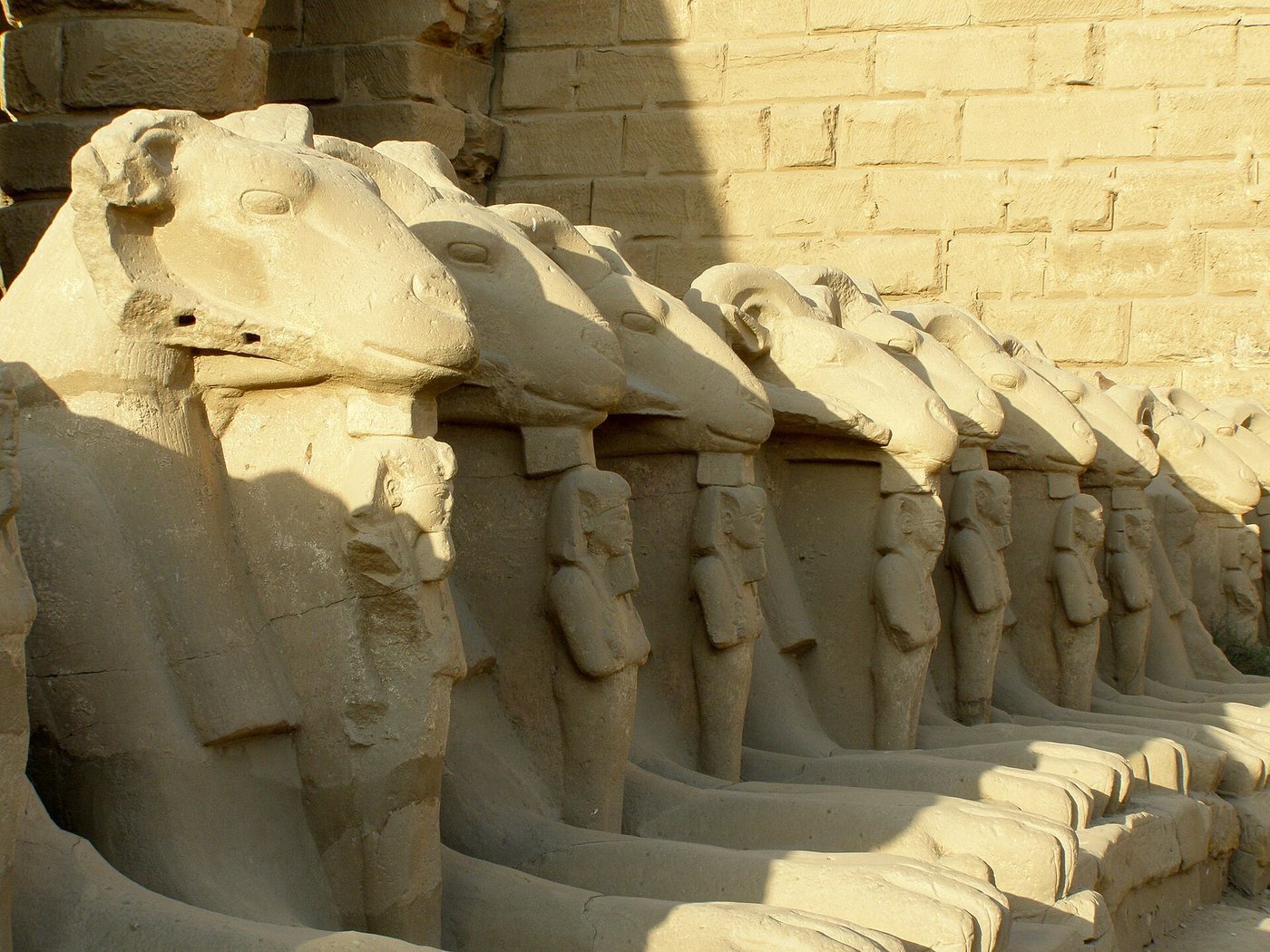
Now the detail that most pages miss. Egypt had two sheep and they belong to different gods. The earlier one, Ovis longipes palaeoaegyptiacus, had loose corkscrew horns that stuck out sideways, and it is the animal on Khnum, who moulds human beings on a potter’s wheel at Elephantine, and on Banebdjedet, the ram of Mendes. That breed went extinct, most likely around the close of the Middle Kingdom. Amun’s ram is the later breed, Ovis platyura aegyptiaca, whose horns curl down and forward and hug the skull.
So the horns are a dating tool. A ram-headed god with sideways horns is being drawn in the old convention, which the artists kept using long after the animal itself had gone. Egyptian religion held on to a sheep that Egyptian farming had already dropped.
Is the Ram in a Thicket a ram?
No, and it is worth being blunt about it, because the object is probably the first image search returns.
In the 1928 to 1929 season at Ur, Leonard Woolley’s expedition, jointly funded by the British Museum and the University of Pennsylvania, opened grave PG 1237, which he named the Great Death Pit. Lying close together were two statuettes of a caprid rearing up against a golden flowering plant: gold leaf head and legs over a wooden core, lapis lazuli horns and shoulder fleece, shell for the body fleece, all fixed with bitumen. They date to roughly 2600 to 2400 BC. One went to London, registration 122200; the other to Philadelphia, object 30-12-702.
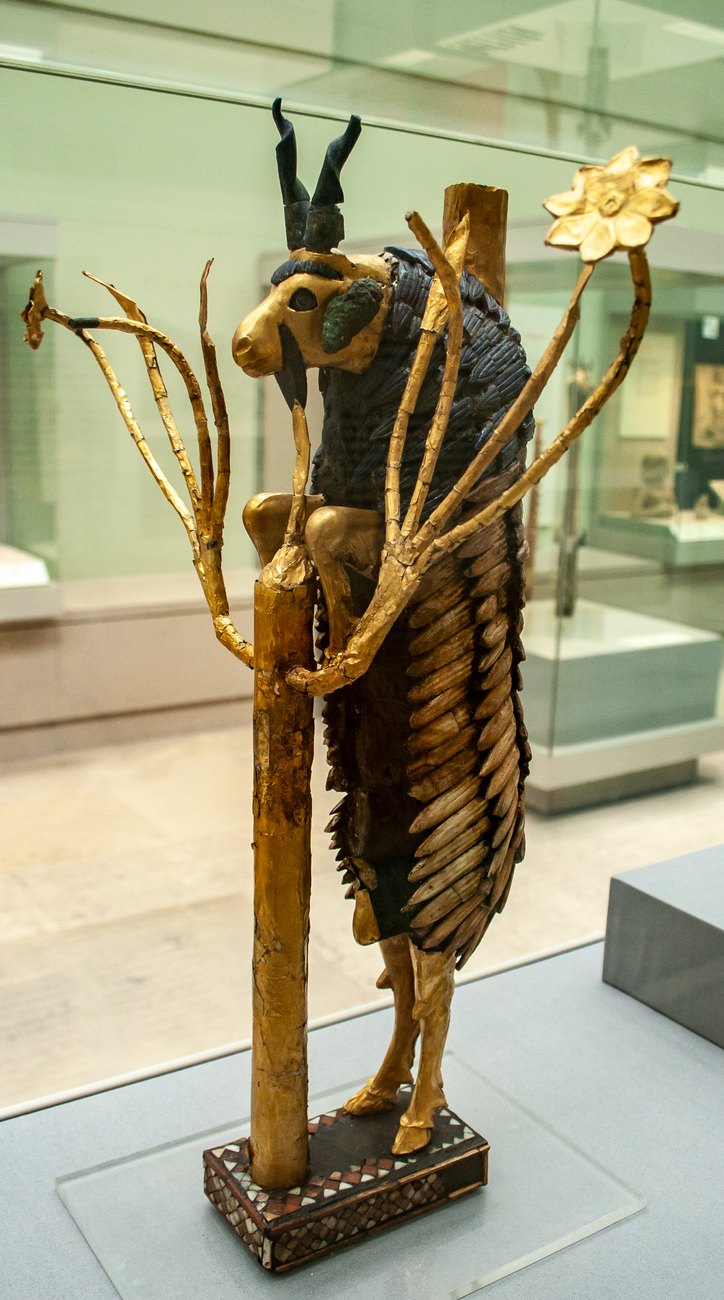
Woolley named it after Genesis 22:13, the ram Abraham finds caught in a thicket. The title is a nineteenth-century excavator’s flourish applied to an object made roughly two thousand years before the text he took it from, and the animal it depicts is read as a goat, most often a markhor, whose horns twist in exactly the open spiral the statuettes show. The gold tubes rising from the shoulders mean the figures held something up, so they are usually described as stands rather than as sculpture in their own right.
None of that makes the piece less extraordinary. It just means that a century of ram symbolism has been illustrated with a goat.
What does a ram actually do in a flock?
Very little, for most of the year, and then everything at once.
A working flock keeps one ram to a few dozen ewes, because one is enough. He is turned in for tupping and taken out again, and for the rest of the calendar he is fed, watched and kept away from the ewes he is not meant to reach. Shepherds strap a raddle harness on him, a crayon block against the brisket, so that every ewe he mounts carries a coloured mark and the lambing dates can be worked out backwards. It is a system built around the fact that a flock’s whole next generation runs through one animal.
That is the actual pastoral logic underneath the virility symbolism, and it is worth stating plainly because the symbolism usually arrives dressed as something grander. The ram is not honoured for being brave. He is valuable because he is a bottleneck, and a bottleneck is worth guarding.
He is also, contrary to the phrase, not the leader. The bellwether is a wether, a castrated male, belled and trusted to walk ahead so the flock follows the sound. Shepherds pick a wether for the job precisely because he is placid and has no seasonal interest in going somewhere else. The animal that leads the flock and the animal that fathers it are two different sheep, and English has quietly collapsed them into one image of the ram out front.
What is the ram doing under Agni?
Agni is fire, and in the Rigveda he is everywhere. Over two hundred hymns are addressed to him, and his name or a synonym for it turns up in roughly a third of the collection’s 1,028. He is the one who eats the offering and carries it up, which makes him less a character than the working part of the entire sacrificial apparatus.
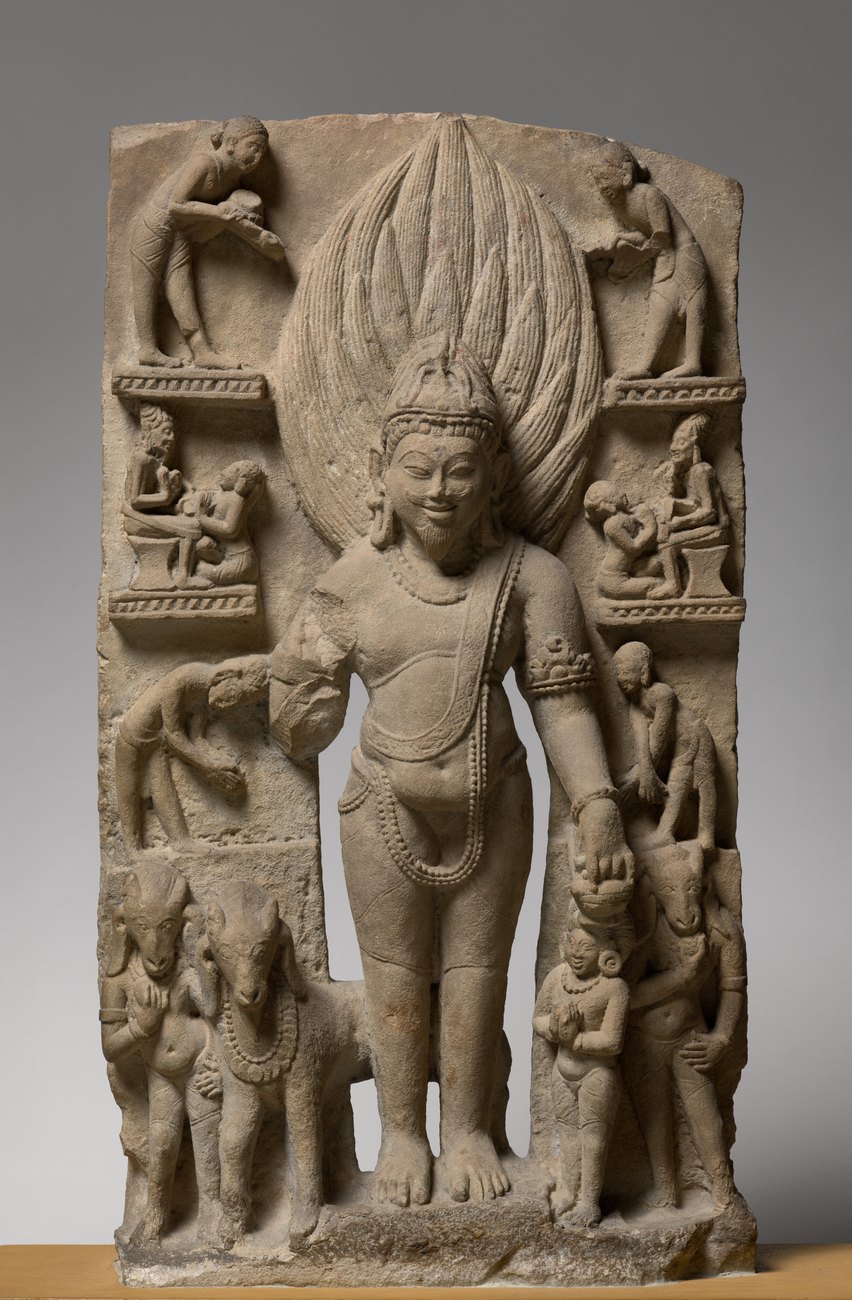
The ram is his vahana, the mount a deity travels on, and it stands at his feet in the sculpture above with a garland round its neck. Two traditions with no contact between them ended up putting a ram and fire together, which is the kind of coincidence worth pausing on rather than explaining away.
One correction to make before anyone reads it backwards. The vahana belongs to the later iconographic tradition, not to the hymns. The Rigveda is addressed to fire; the ram arrives with the sculptors.
Why must a shofar be a ram’s horn and not a cow’s?
Because a cow’s horn has the wrong name. That is not a joke, it is the actual reasoning, and it is preserved as an argument rather than as a symbol.
Mishnah Rosh Hashanah 3:2 rules that every shofar is fit for blowing except a cow’s, on the grounds that a cow’s is a keren, a horn, and not a shofar. Rabbi Yosei objects immediately: scripture calls every shofar a keren, including at Joshua 6:5, the horn of a ram. The Gemara’s response is unusually generous. It says Rabbi Yosei is arguing well, and then distinguishes: other horns get called both words, while a cow’s only ever gets called keren.
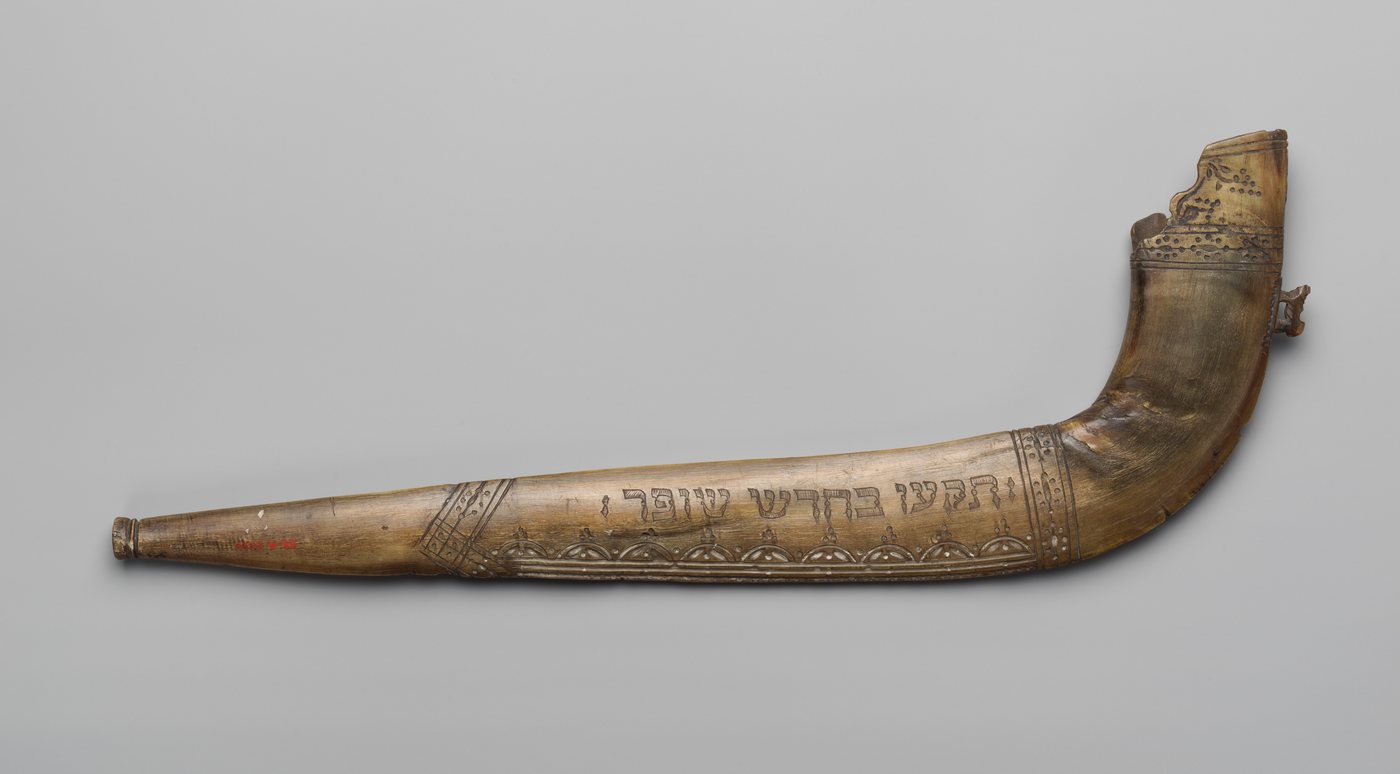
Underneath the vocabulary sits the real reason. Rosh Hashanah 16a records Rabbi Abbahu asking why a ram’s horn in particular, and answering in the divine voice: sound it before me so that I will remember for you the binding of Isaac, in whose stead a ram was sacrificed. The instrument points at one verse. Genesis 22:13, the ram caught by its horns.
There is a quiet argument in the exclusion, too. The cow’s horn is the calf’s horn, and a horn from that animal would be an awkward thing to raise on the Day of Judgment.
Ram, sheep, or goat?
Three animals, constantly swapped, and the swaps run in a consistent direction: whichever one has the most dramatic horns gets called a ram.
The Ur statuettes are goats sold as rams. Aries is drawn as a ram but named for a hired labourer. Amun’s animal is a specific extinct-adjacent breed, not sheep in general. And the modern keyword list is a temperament borrowed from a birth chart.
What survives all of it intact is a single mechanism: the horn is a substitute. It stands in for the animal in the shofar, it stands in for the god in the criosphinx, and in Genesis it stands in for a child. That is the one thread here that does not need any help from astrology.
Across traditions
Ancient Egyptian (Amun, Khnum, Banebdjedet)
Egypt had more than one ram god and they are told apart by their horns. The earlier form, Ovis longipes palaeoaegyptiacus, carried loosely spiralling horns that projected sideways from the skull. It was the first sheep domesticated in Egypt, and it is the animal behind Khnum, the potter god of Elephantine who shapes human beings on his wheel, and behind Banebdjedet, the ram lord of Mendes in the Delta. That breed died out; the standard sources place its disappearance around the end of the Middle Kingdom. Its horns stayed on the gods anyway, centuries after the last living example, which is a useful reminder that religious iconography preserves animals long after agriculture has replaced them.
Amun's ram is the later breed, Ovis platyura aegyptiaca, whose horns curl downward and forward against the head. That is the shape on every criosphinx at Karnak and on the ram amulets in museum cases, and it is the shape Europe eventually borrowed as the Horns of Ammon. The association appears to have hardened through Kush, where Egyptian occupiers identified the local chief deity with Amun and depicted him as a woolly, curl-horned ram; Jebel Barkal in Nubia was held to house a primeval form of the Amun of Karnak. Because the ram also stood for virility, Amun absorbed the fertility god Min and acquired the epithet Kamutef, bull of his mother, which is the sort of collision that happens when a symbol is doing two jobs at once.
- REFERENCE Ancient Egyptian corkscrew-horned sheep (Ovis longipes palaeoaegyptiacus) . Summarises the horn-form distinction between the earlier corkscrew-horned breed of Khnum and Banebdjedet and the later curl-horned breed of Amun, and the breed's disappearance by the end of the Middle Kingdom.
- REFERENCE Richard H. Wilkinson, The Complete Gods and Goddesses of Ancient Egypt . Thames and Hudson, 2003. Standard reference for Amun, Khnum and Banebdjedet and for the ram forms attached to each.
- MUSEUM Metropolitan Museum of Art 45.2.9, Ram head made for attachment to a barque . Third Intermediate Period, c. 1080 to 664 BCE. Rogers Fund, 1945. Amun's sacred barque carried a ram head at prow and stern.
Sumerian (the Ur statuette, and what it actually shows)
Two gold and lapis statuettes of a caprid rearing against a flowering plant were found lying close together in grave PG 1237 at Ur, the pit Leonard Woolley called the Great Death Pit, during the 1928 to 1929 season of the joint British Museum and University of Pennsylvania expedition. They date to roughly 2600 to 2400 BC. Woolley named them the Ram in a Thicket after Genesis 22:13, where Abraham looks up and sees a ram caught in a thicket by its horns. One is in the British Museum, registration 122200; the other is at the Penn Museum, object 30-12-702.
The name has outlived the identification. The animal is generally read now as a goat rather than a sheep, and specifically as a markhor, whose horns twist in the open corkscrew the statuettes show. Woolley was an excavator with a gift for a phrase, and he applied a biblical title to a Sumerian object nearly two millennia older than the text he took it from. It stuck so hard that a goat has spent a century as the internet's leading image of a ram.
What the statuettes were for is less argued over than what species they are. The gold tubes rising from the shoulders indicate the figures supported something, which is why they are usually described as offering stands rather than as free-standing sculpture.
- MUSEUM The 'Ram in a Thicket', British Museum 122200 . Excavated by Woolley at Ur, grave PG 1237, 1928 to 1929 season. Gold leaf, copper, lapis lazuli, shell, limestone and bitumen over a wooden core.
- MUSEUM 'Ram in the Thicket', Penn Museum 30-12-702 . The second of the pair, held in Philadelphia. Joint expedition of the British Museum and the University of Pennsylvania.
- ARCHIVE Ur Excavations (Joint Expedition of the British Museum and of the Museum of the University of Pennsylvania to Mesopotamia) . Woolley, Hall and Legrain, eds. The excavation report series in which the statuettes were published.
Vedic and Hindu (Agni's mount)
Agni is the fire, and in the Rigveda he is close to inescapable: his name or a synonym for it appears in something near a third of the collection's 1,028 hymns, with more than two hundred addressed to him directly. He is the mouth of the gods, the one who eats the offering and carries it upward, which makes him the working mechanism of the whole sacrificial system rather than a personality within it.
The ram is his vehicle. In the later iconography he rides or stands with a ram, red or smoke-grey, bearded, flames leaping from his crown, a rosary in one hand, and often seven tongues of fire. The pairing is worth noticing for one reason above the others: the Western zodiac assigns Aries to the element of fire and to a ram, and Vedic India assigns a ram to the god who is fire, by an entirely separate route. Nobody borrowed. Two traditions independently attached the same animal to the same element, which suggests the connection is being made by something about rams rather than something about either tradition.
One caution. The vahana is a feature of Puranic and post-Vedic iconography, not of the Rigvedic hymns themselves; the hymns are addressed to fire, and the animal arrives with the sculptural tradition. Reading the ram back into the Rigveda is the ordinary mistake here.
- PRIMARY Rigveda . Agni is the dedicatee of over 200 hymns; his name or its synonyms occurs in close to a third of the 1,028 hymns. Standard English edition: Jamison and Brereton, The Rigveda, Oxford University Press, 2014.
- MUSEUM Agni, God of Fire, Cleveland Museum of Art 1955.51 . Sandstone stele, c. 1000, Uttar Pradesh, India. A garlanded ram stands in the base register at the god's feet.
Jewish law (why the shofar is a ram's horn)
The most precise ram tradition in the record is a rule about material, and it is stated as an argument rather than as a symbol. Mishnah Rosh Hashanah 3:2: all shofarot are fit for blowing except that of a cow, because it is a keren, a horn, and not a shofar. Rabbi Yosei objects that every shofar is called a horn somewhere in scripture, citing Joshua 6:5 on the horn of a ram. The Gemara concedes that his argument is a good one and then answers it: other horns are called both shofar and keren, while the cow's is only ever called keren.
Underneath the vocabulary is the Akedah. Rosh Hashanah 16a preserves Rabbi Abbahu's reason for the ram's horn specifically: sound a blast before me with a ram's horn, so that I will remember for you the binding of Isaac, in whose stead a ram was sacrificed. The instrument is a memory device pointed at a single verse, Genesis 22:13, the ram caught by its horns in the thicket.
This is the cleanest case on the page of a tradition that is genuinely about a ram and not about a sheep, a goat, or a temperament. The ram matters because a specific ram in a specific text was accepted in place of a son, and the horn is what is left of it.
- PRIMARY Mishnah Rosh Hashanah 3:2 . "All shofarot are fit for blowing except for the horn of a cow, because it is a horn [keren] and not a shofar." Sefaria, William Davidson digital edition of the Koren Noe Talmud.
- PRIMARY Babylonian Talmud, Rosh Hashanah 16a . Rabbi Abbahu: "Sound a blast before Me with a shofar made from a ram's horn, so that I will remember for you the binding of Isaac, son of Abraham, in whose stead a ram was sacrificed."
- MUSEUM Shofar, Metropolitan Museum of Art 89.4.2899 . 18th century (?), medium catalogued as ram's horn. The Crosby Brown Collection of Musical Instruments, 1889.
Working with the Ram
If you want a regular practice rather than a one-time read, an oracle deck is the standard tool: you draw a card and sit with whatever animal comes up. Our ranked guide to spirit animal oracle decks compares the field.
Sources
- PRIMARY Mishnah Rosh Hashanah 3:2 . The cow's horn is excluded; a ram's horn is not.
- PRIMARY Babylonian Talmud, Rosh Hashanah 16a . Rabbi Abbahu on the ram's horn and the binding of Isaac.
- MUSEUM The 'Ram in a Thicket', British Museum 122200 . Ur, grave PG 1237, c. 2600 to 2400 BC.
- MUSEUM 'Ram in the Thicket', Penn Museum 30-12-702 . The second statuette of the pair.
- MUSEUM Shofar, Metropolitan Museum of Art 89.4.2899 . Catalogued as ram's horn.
- MUSEUM Agni, God of Fire, Cleveland Museum of Art 1955.51 . Sandstone, c. 1000, Uttar Pradesh.
- REFERENCE Richard H. Wilkinson, The Complete Gods and Goddesses of Ancient Egypt . Thames and Hudson, 2003.
- PRIMARY MUL.APIN astronomical tablets . Hunger and Pingree, eds., MUL.APIN: An Astronomical Compendium in Cuneiform, Archiv für Orientforschung Beiheft 24, 1989. The zodiac's first sign is LÚ.ḪUN.GÁ, the Hired Man, not a ram.