Water Sign · June 21 – July 22
Cancer Spirit Animal
Cancer the Crab: Babylonian origins as AL.LUL (the crab or crayfish), the Greek myth of the giant crab sent by Hera to harass Heracles during the Lernaean Hydra labor, and the modern zodiac-animal associations.
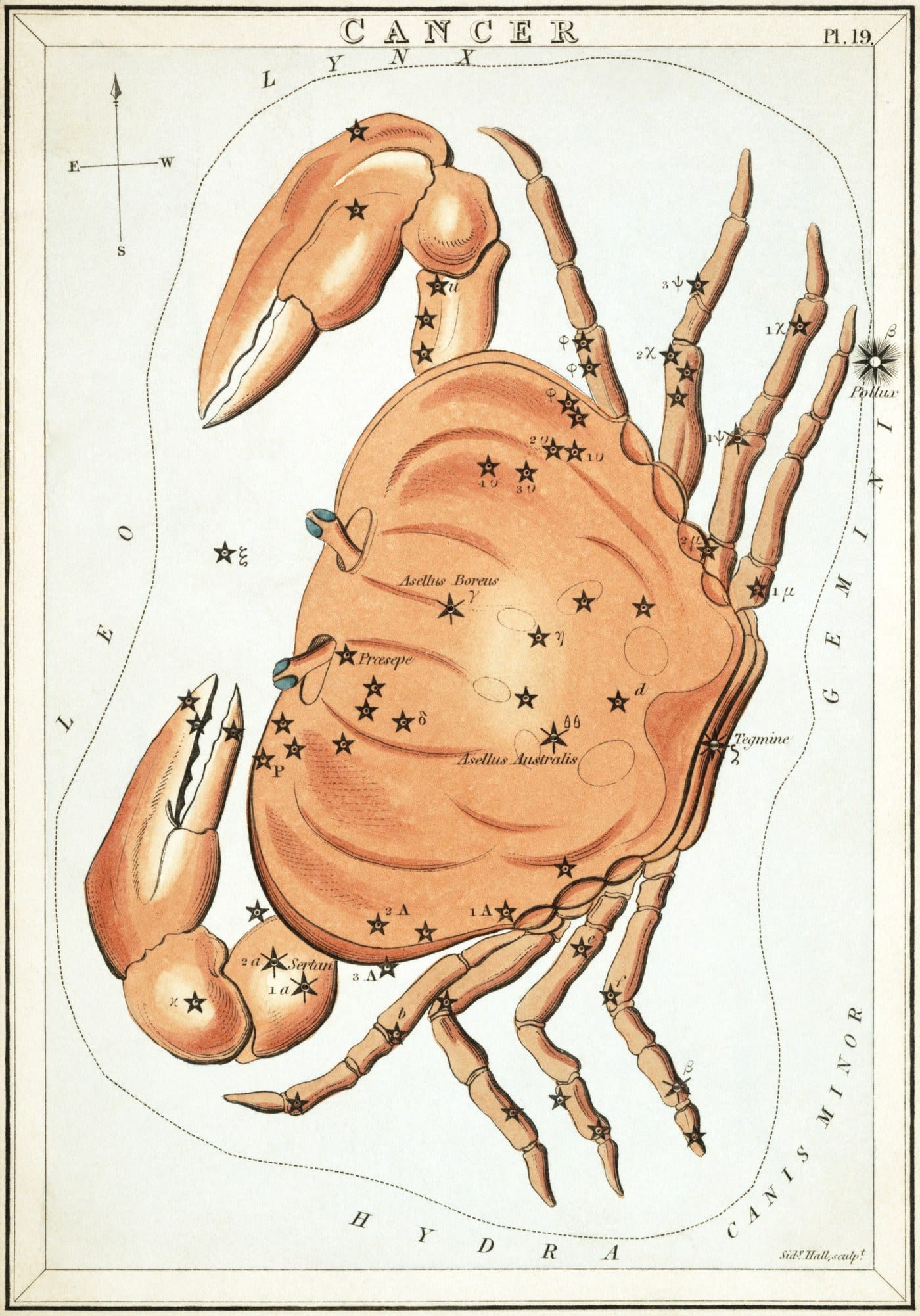
Cancer is the Crab (June 21 – July 22, Water element). Babylonian MUL.APIN names the sign AL.LUL (crab or crayfish). The Greek myth: Hera sent a giant crab to harass Heracles during his second labor (defeating the Lernaean Hydra); Heracles crushed it, and Hera catasterized it. Apollodorus Library 2.5.2 and Pseudo-Eratosthenes Catasterismi preserve the narrative.
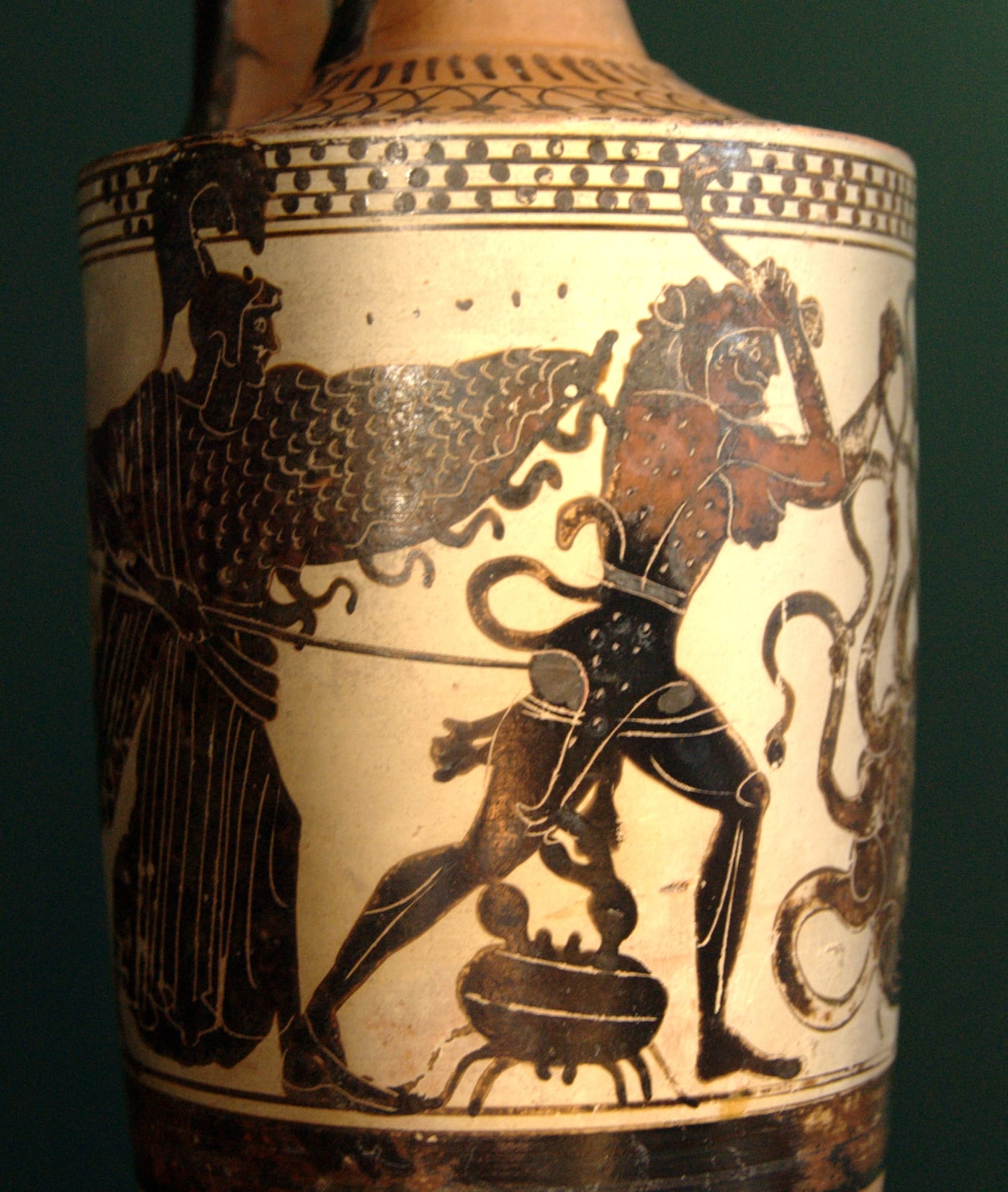
Cancer is the least dramatic zodiacal myth, and the ancient sources are candid about this. Hera sent a crab to distract Heracles while he was fighting the Lernaean Hydra. Heracles crushed it underfoot. Hera rewarded the crab’s loyalty (however ineffectual) by placing it among the stars. Apollodorus’s Library 2.5.2 preserves the summary; Pseudo-Eratosthenes’s Catasterismi gives the catasterism account. This is not the most stirring foundation myth in the zodiacal tradition.
Why the sign matters astronomically
What Cancer lacks in myth, it makes up in calendrical significance. During the Hellenistic period, when the zodiacal system was formalized, the summer solstice occurred in Cancer. The summer solstice is the moment when the sun reaches its northernmost point and begins its return south. Ancient astronomers called this the “turning” of the sun. The Latin word “tropic” derives from Greek tropikos, “of a turning.” The Tropic of Cancer (the latitude line on Earth that marks the sun’s maximum northward reach) is named for the constellation Cancer because that is where the summer solstice stood at the time of naming. Due to axial precession, the solstice has since shifted into Gemini, but the name persists.
This astronomical significance made Cancer the sign of the threshold between the sun’s northward and southward journeys. It was the gate of souls in Neoplatonic tradition: souls descended to Earth through Cancer (the summer solstice gate) and ascended back through Capricorn (the winter solstice gate). Macrobius’s Commentary on the Dream of Scipio (c. 400 CE) preserves this doctrine in detail.
The Babylonian AL.LUL
The Babylonian name AL.LUL designates a crab or crayfish, though some scholars have read it as a tortoise in certain contexts. The MUL.APIN tablets (c. 1000–686 BCE) preserve the sign in its Babylonian astronomical context: a weak zodiacal marker, occupying the space between the Twins and the Lion.

The animal associations
The crab is the primary Cancer animal. The lobster appears as secondary, it is biologically closer to a crayfish than a true lobster, but the association is consistent. The turtle sometimes appears in modern zodiacal animal lists, connected to Cancer’s water element and the creature’s shell as protective retreat; see the turtle spirit animal entry for the Cherokee, Hindu, and Haudenosaunee turtle traditions. The crab’s sideways walk and hard outer shell protecting a soft interior handed astrology its Cancer metaphors on a plate: indirect approach, protective instinct, emotional self-defense. The biology does the symbolic work here.
Associated animals
Primary: Crab , Lobster
Frequently asked
- What animal is Cancer?
- The Crab. Babylonian AL.LUL (crab or crayfish) in MUL.APIN. The Greek myth catasterizes the crab sent by Hera against Heracles during the Lernaean Hydra labor (Apollodorus 2.5.2, Pseudo-Eratosthenes Catasterismi).
- What is the Greek myth behind Cancer the crab?
- In the Heracles second-labor cycle (Apollodorus, Library 2.5.2; Eratosthenes Catasterismi 11), Hera sends the crab Karkinos to distract Heracles during his battle with the Lernaean Hydra. The crab pinches Heracles' foot; he crushes it. Hera, in gratitude for the crab's loyal sacrifice, places the figure among the stars. The constellation's position at the summer solstice in Ptolemy's era (the Tropic of Cancer) gave it particular calendrical importance.
- Why does Cancer rule the home and family in modern astrology?
- The classical sources do not give the sign a home-and-family domain explicitly. The modern reading derives from two Hellenistic associations: the crab's habit of returning to a fixed home-hole (Pliny, Natural History 9.51) and the Moon's domicile in Cancer in Ptolemaic astrology (Tetrabiblos 1.17). Moon-as-mother and crab-as-home combine in modern American astrology (Linda Goodman, Sun Signs, 1968 and after) into the canonical Cancer-as-mother reading.
Sources
- PRIMARY MUL.APIN (AL.LUL) . Hunger & Pingree, 1989.
- PRIMARY Apollodorus, Library 2.5.2 . Loeb Classical Library.
- PRIMARY Pseudo-Eratosthenes, Catasterismi . Hard trans., Oxford World's Classics, 2015.
- PRIMARY Ptolemy, Tetrabiblos . Loeb Classical Library.
- PRIMARY Ptolemy, Tetrabiblos 1.17 . Robbins trans., Loeb Classical Library.