Earth Sign · April 20 – May 20
Taurus Spirit Animal
Taurus the Bull: Babylonian origins as GU4.AN.NA ('Bull of Heaven' in the Epic of Gilgamesh), Minoan Knossos bull-imagery, the Mithraic tauroctony, and the Greek myth of Zeus-as-Bull and Europa.
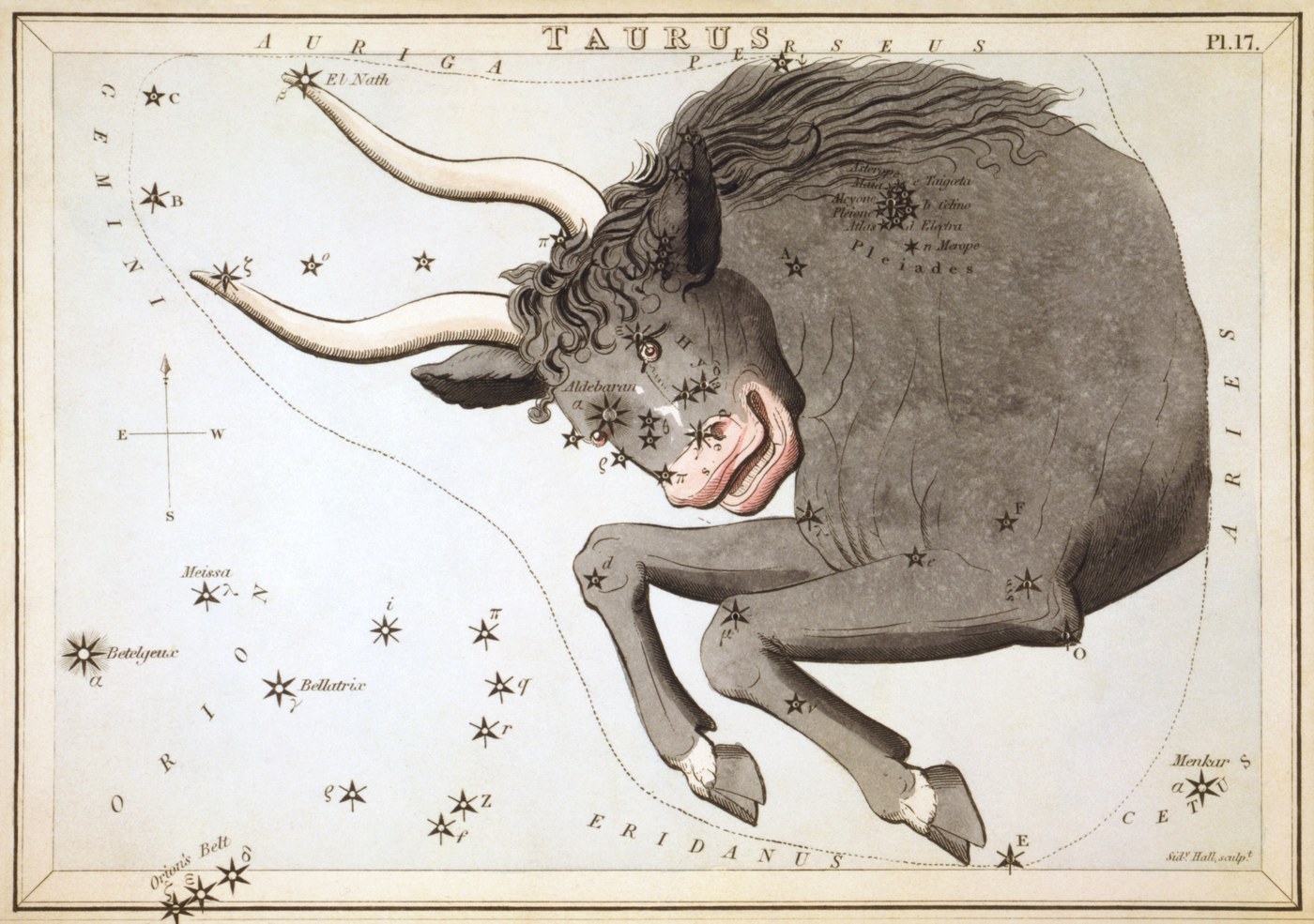
Taurus is the Bull, the second sign of the tropical Western zodiac (April 20 – May 20, Earth element). The Babylonian name GU4.AN.NA, 'Bull of Heaven,' appears in the MUL.APIN tablets and as the demonic creature in Tablet VI of the Epic of Gilgamesh. Minoan Knossos bull-leaping frescoes (c. 1500 BCE) preserve the earliest Mediterranean bull-cult imagery. The Mithraic tauroctony was central to the Roman imperial mystery cult (c. 100–400 CE). Zeus-as-bull seduces Europa in Ovid Metamorphoses 2.
Of all the zodiacal animals, the bull has the longest and densest paper trail in the ancient world. The Babylonian MUL.APIN tablets call the second zodiacal sign GU4.AN.NA, “Bull of Heaven,” and the name itself connects to one of the more dramatic scenes in the oldest surviving epic literature: when Ishtar demands that her father Anu send the Bull of Heaven against Gilgamesh in Tablet VI, the bull’s arrival is described in terms of cosmic disruption. Three hundred warriors fall into the pits opened by its snortings. Enkidu eventually seizes it by the horns while Gilgamesh drives his sword between neck and horns, and Ishtar tears her garments in rage when the heroes dedicate the bull’s heart to Shamash. Andrew George’s Oxford critical edition (2003) preserves the Akkadian.
The Minoan tradition
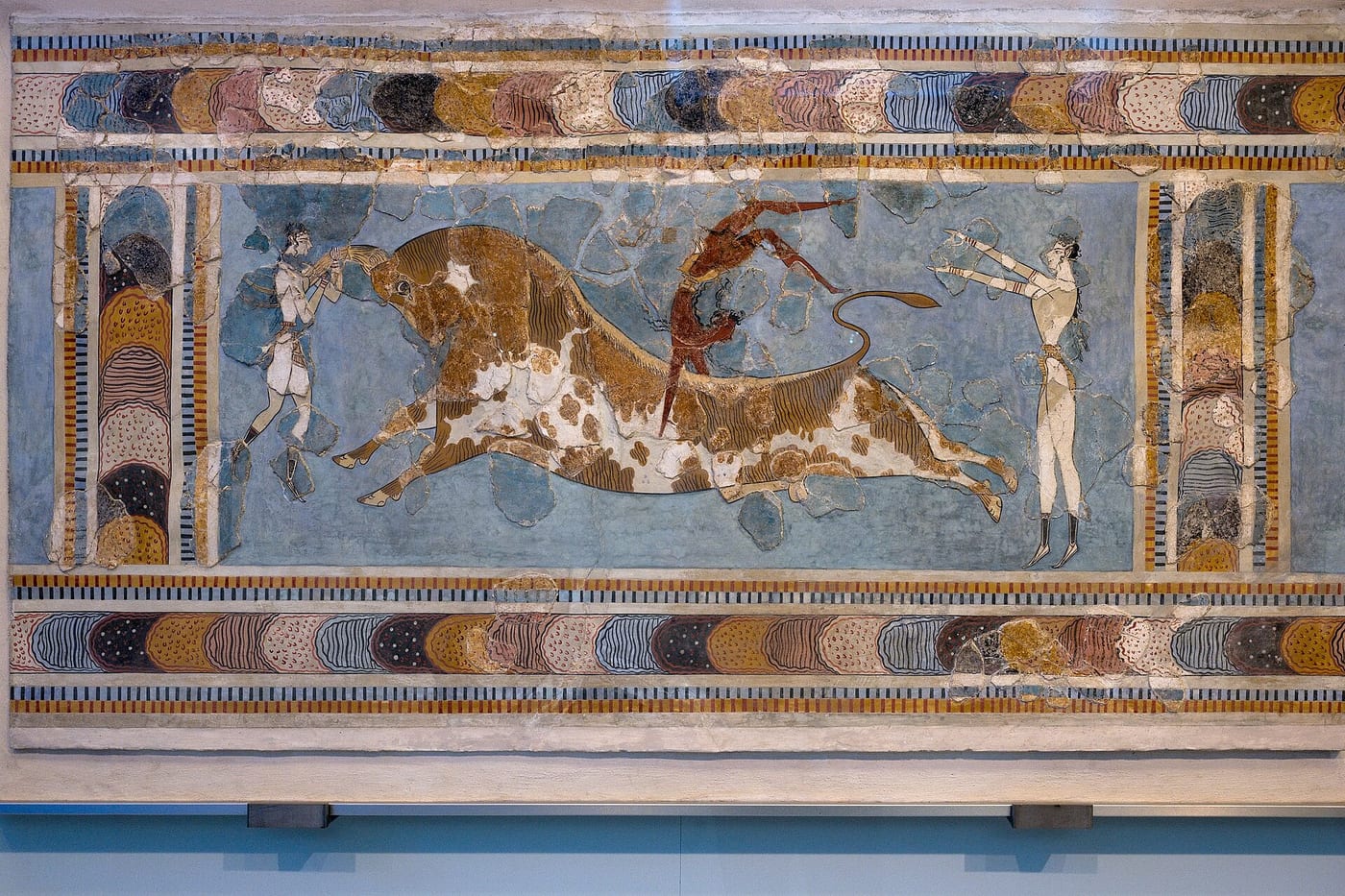
The Knossos bull-leaping frescoes (c. 1500 BCE), now in the Heraklion Archaeological Museum, show athletes (men and women both) vaulting over charging bulls. Whether this was ceremonial, athletic, or ritual-religious remains contested. What is clear is that the bull was central to Minoan palatial culture in a way that no other animal matches. The bull-head drinking rhyton found at Knossos, fashioned from black steatite with crystal eyes, is now one of the canonical objects of Aegean Bronze Age archaeology. Arthur Evans’s original excavations between 1899 and 1935 brought the site to the world’s attention, though subsequent scholarship has substantially revised his interpretations.
The Mithraic tauroctony
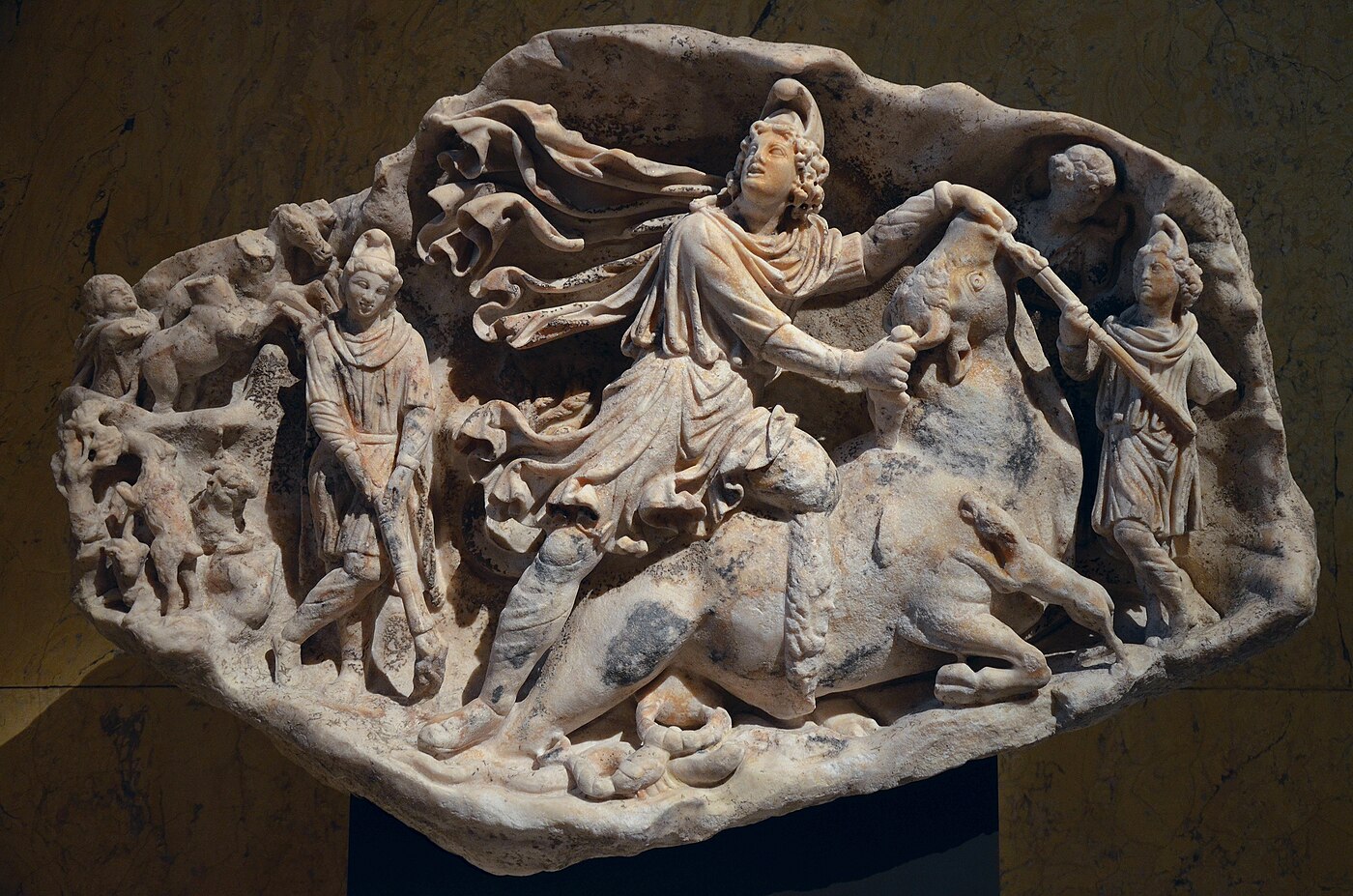
The Roman mystery cult of Mithras, active roughly from the 1st century BCE through the 4th century CE, centered on a bull-slaying image: Mithras in a peaked Phrygian cap driving a sword through the neck of a bull, while a dog, snake, scorpion, and raven attend. This image, the tauroctony, was installed in every Mithraic sanctuary (mithraeum) from Scotland to Mesopotamia. Over 400 examples survive. Roger Beck’s The Religion of the Mithras Cult in the Roman Empire (Oxford, 2006) is the standard modern treatment, arguing that the tauroctony encodes a specific star map.
Zeus and Europa
Ovid’s Metamorphoses 2.833–875 gives the most polished version: Zeus, captivated by the Phoenician princess Europa, transforms into a beautiful white bull among the king’s herds. Europa garlands the bull with flowers and climbs on its back. The bull swims to Crete. From this union come Minos, Rhadamanthus, and Sarpedon. Minos later receives the Cretan Bull as tribute from Poseidon, which he is supposed to sacrifice but keeps instead, leading directly to the Minotaur. The bull-chain runs from Europe’s abduction through the Cretan bull through the Minotaur through Theseus through Ariadne. It is one of the more genealogically dense single-animal traditions in Greek mythology.
The animal associations
The bull is the primary Taurus animal, the cow as secondary. The Pleiades star cluster sits within the constellation Taurus and has its own rich mythological tradition, the Seven Sisters, pursued by Orion, catasterized by Zeus for their protection. The Pleiades’ rising was used across ancient societies (Greek, Polynesian, Aboriginal Australian, Mesoamerican) as a calendrical marker, which reinforces Taurus’s connection to agricultural time-keeping and the productive earth.
Associated animals
Primary: Bull , Cow
Secondary: Beaver
Frequently asked
- What animal is Taurus?
- The Bull. The Babylonian name GU4.AN.NA ('Bull of Heaven') appears in the MUL.APIN tablets and in Tablet VI of the Epic of Gilgamesh as the demonic creature Anu sends against Gilgamesh. Minoan Knossos bull-leaping frescoes (c. 1500 BCE) preserve the earliest Mediterranean bull-cult imagery. The Greek myth is Zeus-as-bull seducing Europa (Ovid Met. 2.833–875).
- What is the Mithraic tauroctony?
- The tauroctony ('bull-slaying') was the central cult image of Mithraism, the Roman imperial mystery cult active c. 100–400 CE. Mithras is depicted slaying a bull in a cave, with specific zodiacal and astronomical symbolism. Roger Beck's The Religion of the Mithras Cult in the Roman Empire (Oxford, 2006) is the standard scholarly treatment.
- Why was the bull so central to the ancient Mediterranean world?
- Bulls were the largest, most powerful, and most economically important domesticated animals in the ancient Mediterranean: the foundation of agriculture, warfare, and elite cuisine. They were also the most prestigious sacrificial animals: the Greek hekatomb (one-hundred-bull sacrifice) was the highest civic ritual, and the Roman taurobolia in the Cybele cult required a bull whose blood literally bathed the initiate. The Minoan bull-leaping fresco from Knossos (c. 1500 BCE) and the Mithraic tauroctony (c. 100–400 CE) bracket two millennia of bull-centered ritual in the same Mediterranean basin.
Sources
- PRIMARY MUL.APIN . Hunger & Pingree, Archiv für Orientforschung Beiheft 24, 1989.
- PRIMARY Epic of Gilgamesh, Tablet VI . Andrew George ed., Oxford University Press, 2003.
- MUSEUM Knossos Bull-Leaping Fresco . Heraklion Archaeological Museum, c. 1500 BCE.
- PEER-REVIEWED Roger Beck, The Religion of the Mithras Cult . Oxford University Press, 2006.
- PRIMARY Ovid, Metamorphoses 2.833–875 . Loeb Classical Library.
- PRIMARY Ptolemy, Tetrabiblos . Loeb Classical Library.