Fire Sign · November 22 – December 21
Sagittarius Spirit Animal
Sagittarius the Archer-Centaur: Babylonian PA.BIL.SAG (a composite deity distinct from the Greek centaur), the ancient dispute over whether the figure is Crotus or Chiron, Chiron's catasterism as Centaurus not Sagittarius, and the galactic center that lies in this sign's direction.
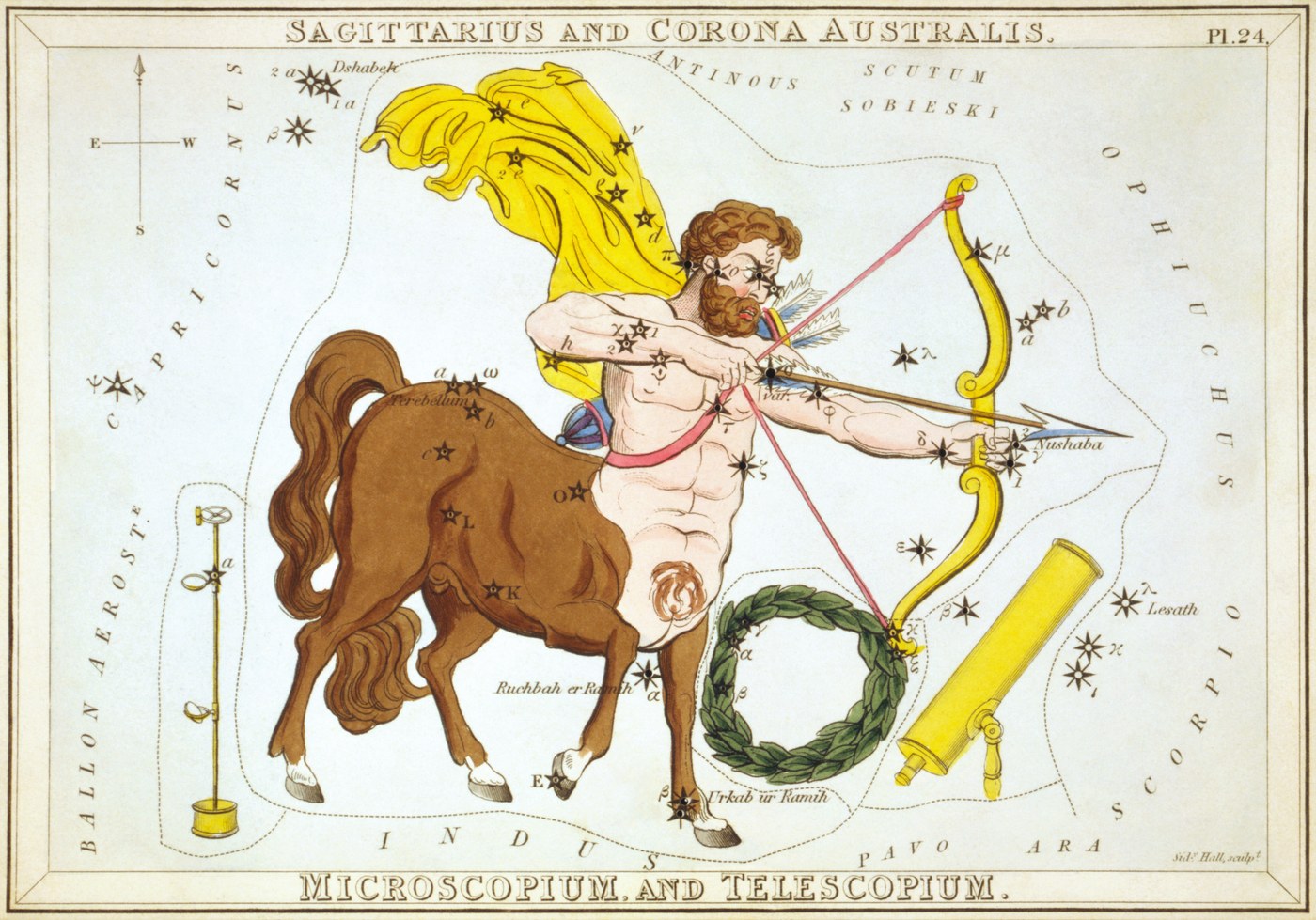
Sagittarius is the Archer-Centaur (November 22 – December 21, Fire element). The Babylonian form in MUL.APIN is PA.BIL.SAG, a composite deity (part human, part equine or canine, sometimes winged, sometimes with a scorpion tail) identified with the underworld and war god Nergal. The centaur identification is Hellenistic. The ancient Greek sources are split: Eratosthenes's Catasterismi (c. 200 BCE) identifies the figure as Crotus, son of Pan and inventor of archery: not Chiron, who is more reliably associated with the constellation Centaurus. The horse is the primary animal-association through the centaur's equine nature. The direction of Sagittarius points toward the galactic center of the Milky Way.
PA.BIL.SAG in the MUL.APIN tablets is not a centaur. This is worth establishing at the outset, because the Greek reinterpretation of the figure into a human-horse hybrid has dominated the subsequent tradition so completely that the original form (a composite deity, part human, part equine or canine, sometimes winged, sometimes with a scorpion’s tail curled above, shooting a bow) has become nearly invisible in contemporary zodiac discussion. PA.BIL.SAG is a Babylonian deity, identified with Nergal, the Sumero-Akkadian god of the underworld, plague, and war. The figure is older than the Greek zodiac, stranger in its composite shape, and carries entirely different meanings from the philosophical archer-centaur that Hellenistic and modern astrology inherited.
PA.BIL.SAG and Nergal in Babylonian astronomy
Nergal presides over the realm of the dead and over the destructive aspects of the sun: the killing summer heat, plague, drought, violent war. He is the consort of Ereshkigal, queen of the underworld. His animal associations in Mesopotamian religion include the lion and the serpent-dragon. The composite figure PA.BIL.SAG, depicted on Babylonian boundary stones (kudurru) and cylinder seals as a archer with a human torso, an equine or canine lower body, and sometimes a scorpion’s tail raised over his back, is one of the more striking images in Babylonian astronomical iconography.
The arrow of PA.BIL.SAG pointed toward Antares, the red star at the heart of Scorpio. In the Babylonian sky, the archer’s aim was fixed on the scorpion’s center: an opposition that Babylonian astronomical texts recorded and that modern astronomy confirms: Sagittarius and Scorpius are neighboring constellations on the southern ecliptic, and when one is rising, the other is setting. The arrow encodes an observed astronomical relationship. The opposition between the archer and the scorpion runs through the Babylonian, Greek, and Roman zodiacal traditions as a recurring structural element.
Crotus: the actual Greek identification
The popular identification of Sagittarius with Chiron is common in modern astrology but uncertain in the ancient sources. Eratosthenes of Cyrene, the 3rd-century BCE polymath who served as chief librarian of the Library of Alexandria and wrote the earliest surviving systematic account of the constellation myths, distinguishes carefully between the two centaur constellations in his Catasterismi (c. 200 BCE): Centaurus (the southern centaur constellation, in the direction of the Southern Cross) is Chiron; Sagittarius is Crotus.
Crotus was the son of Pan, the goat-footed god of the wild, and Eupheme, the nurse of the Muses. He grew up on Mount Helicon with the nine Muses and developed two skills: archery (which he invented, or first practiced as a systematic art) and rhythmic applause, striking his hands together to show his appreciation for the Muses’ singing. The Muses, grateful for both his companionship and his innovations, asked Zeus to place him among the stars after his death. Zeus honored the request and catasterized him as the archer Sagittarius.
Crotus is a liminal figure: half-divine (son of Pan), half-mortal, associated with the arts (the Muses) and with the hunt (archery). His placement among the stars is an honor for creativity and skill, not for heroism or wisdom in the Chiron mold. Hyginus’s Astronomica 2.27 preserves this identification in Latin alongside the competing Chiron tradition, without fully resolving the conflict.
Chiron and the wound that cannot heal
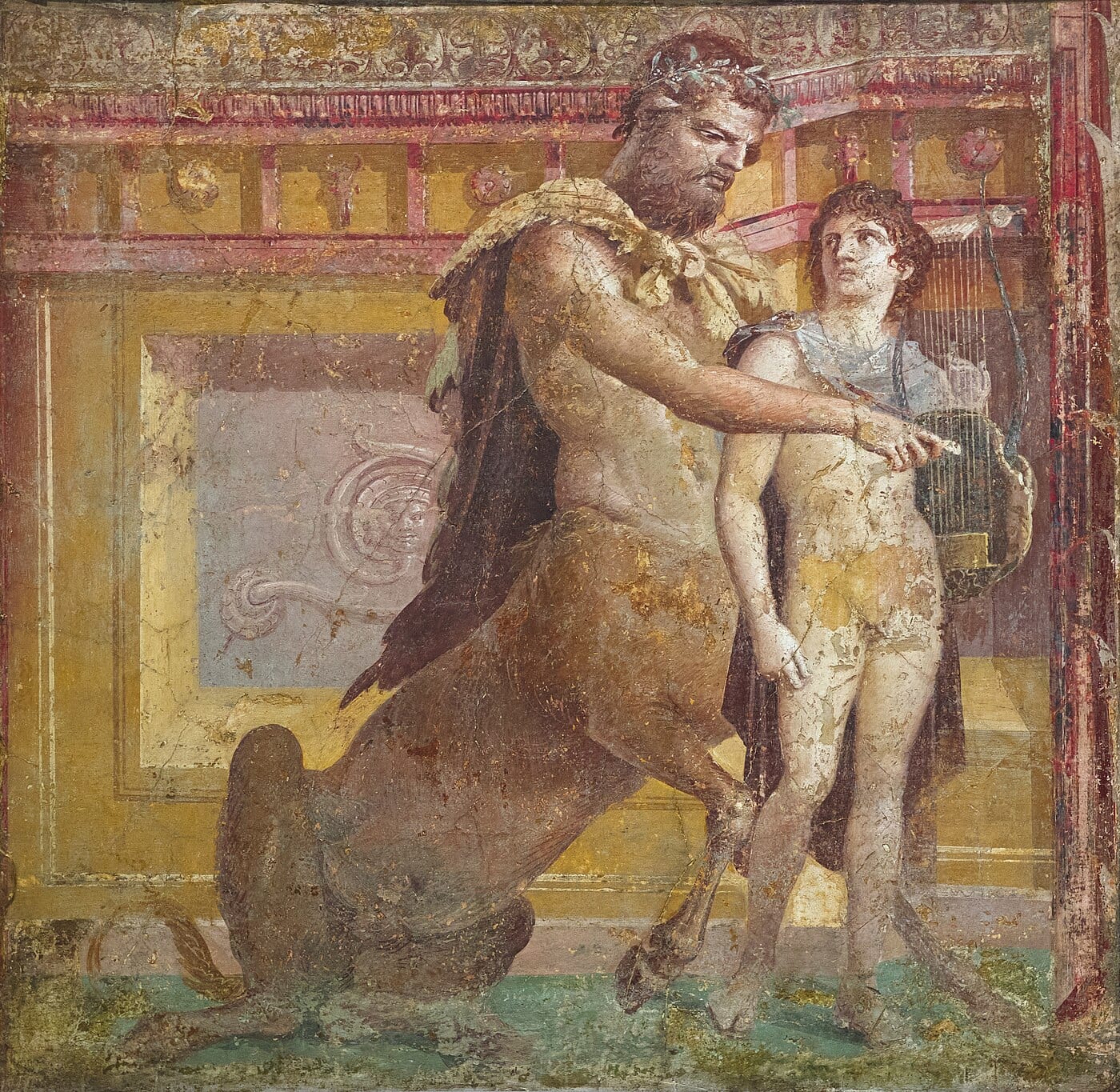
Chiron’s story is worth telling precisely because it belongs to a different constellation, and the distinction matters for understanding what the two centaur figures represent. Chiron was the son of Kronos (who took the form of a horse to approach the nymph Philyra), not a standard centaur by lineage. He was known for wisdom, medicine, music, prophecy, and his role as tutor to the greatest Greek heroes: Achilles, Asclepius (who became the god of medicine), Jason, Peleus, and others. His knowledge was the accumulated wisdom of a being older than the Olympian order: Kronos’s son, outside the standard genealogy, with no stake in the wars of the younger gods.
During Heracles’s battle with the centaurs on Mount Pholoe (a separate conflict from the Labors), one of Heracles’s arrows (dipped in the blood of the Lernaean Hydra, making it lethally poisonous) accidentally struck Chiron. Chiron was immortal and could not die, but the hydra-poison could not be healed. He suffered without end. He eventually negotiated an exchange: he would give up his immortality so that the Titan Prometheus could be freed from his own perpetual torment (the eagle eating his liver). Zeus accepted the bargain and catasterized Chiron as Centaurus. Apollodorus’s Library 2.5.4 records the catasterism; Hesiod’s Theogony 1001–1002 gives Chiron’s parentage.
The wound that cannot heal (an injury inflicted not in war but by accident, by someone who had no reason to harm him) is the specific mythological signature of the Chiron figure. That theme (the unhealable wound, the healing power in the wounded being) is what Jungian psychology called the “wounded healer,” and it entered modern astrological interpretation as a quality associated with Sagittarius through the misidentification of Chiron with that sign. The mythology is richer for knowing that the wound belongs to Centaurus (a separate figure) rather than to Sagittarius-as-Crotus. But both traditions are now embedded in the astrological language of the sign, and both are worth understanding on their own terms.
The centaur tradition and its likely origins
Most centaurs in Greek mythology were savage: the Centauromachy (the battle between the Lapiths and the centaurs at the wedding of Pirithous) was one of the canonical scenes of Greek monumental sculpture (the Parthenon metopes, the Temple of Zeus at Olympia, the Temple of Apollo at Bassae). The centaurs, invited to the wedding feast, became drunk and attempted to abduct the Lapith women. Theseus and the Lapiths drove them back. The battle was a standard emblem of civilization over barbarism, Greeks over their monstrous Others.
The historical origin of the centaur figure is debated. The most widely accepted hypothesis is that settled Mediterranean peoples’ first encounter with horse-riding Eurasian steppe nomads produced the composite image: men who seemed to be one with their horses, who fought from horseback with bows at speeds and over distances that foot-soldiers could not match. The skilled mounted archer (lethal, fast, appearing from nowhere and disappearing before retaliation) was incomprehensible to those who had never seen it. The composite figure encoded that encounter: the archer whose horse was part of him, whose mobility was the mobility of an animal.
Chiron’s exception (wisdom, healing, teaching) may represent the same encounter understood from a different angle: the nomad who knows the herbs of the steppe, who understands the sky, who can teach what settled civilization doesn’t know. The wise horseman as the bearer of older, stranger, harder-won knowledge.
The Milky Way center and Jupiter’s rulership
The direction of Sagittarius points toward the galactic center of the Milky Way, roughly 26,000 light-years from Earth: the densest concentration of stars in the galaxy, the gravitational anchor around which the Milky Way’s 200–400 billion stars orbit. Ancient observers could not know this, but they knew the Milky Way was brightest and most complex in this direction. Without light pollution, the core of the Milky Way in Sagittarius is visually overwhelming: a dense river of light, far richer in this direction than anywhere else in the sky. The region was understood as special, as dense with significance, without any precise astronomical language for what that significance was.
Jupiter (Zeus) rules Sagittarius in Hellenistic astrology. The connection runs through expansion, generosity, philosophy, and the arrow’s natural direction: not backward, not sideways, but forward and outward, toward the farthest visible horizon. The arrow of Sagittarius aims toward the scorpion and beyond it toward the center of things. Jupiter’s amplifying quality (more, farther, larger, with more confidence than caution) fits the figure of the archer who draws back the string and releases without hesitation toward a target others cannot see.
The animal associations
The horse is the primary Sagittarius animal through the centaur’s equine nature, and through the broader tradition of the horse as the great traveler: the animal that extends human range across distance, time, and (in shamanic traditions) across the boundary between the living world and what lies beyond it. The horse spirit animal entry covers the Vedic Ashvamedha (horse sacrifice as cosmic renewal), Norse Sleipnir (Odin’s eight-legged steed that carried him between the nine worlds), Celtic horse goddess Epona, and the shamanic horse as the vehicle for the soul’s journey between realms. All of these traditions converge on the horse as the animal that makes impossible distances navigable, which is precisely what the centaur represents in the zodiacal system: the being who can travel where others cannot follow.
The eagle appears as a secondary Sagittarius animal in modern zodiac-spirit-animal literature through the archer’s far-sightedness and the predator’s precision. The wolf connects to the Babylonian Nergal tradition, whose animal associations include destructive-solar and underworld creatures. Ted Andrews’s Animal Speak (Llewellyn, 1993) grounds the Sagittarius-horse association in the fire-sign, Jupiter-ruled astrological context and connects the eagle to the sign’s expansive horizon-seeking quality. Neither wolf nor eagle has deep ancient roots in the Sagittarius constellation specifically; both are modern synthesized additions.
What PA.BIL.SAG (the Babylonian composite, stranger and more dangerous than a centaur-philosopher) brings to the reading is this: the archer who aims at the heart of the scorpion is not simply a seeker. He is armed, and he is pointed at something. The arrow is always in flight toward something specific. The direction matters: toward the scorpion’s heart, toward the center of the Milky Way, toward the longest horizon. The wisdom associated with the sign is the wisdom of the archer who knows what to aim at.
Associated animals
Primary: Horse
Frequently asked
- What animal is Sagittarius?
- Sagittarius is the Archer-Centaur, half-human half-horse. The Babylonian form (PA.BIL.SAG) was a composite deity identified with the war god Nergal, older and stranger than the Greek centaur. The horse is the primary animal-association through the centaur's equine nature; the horse spirit animal entry covers the Diné, Celtic, Norse (Sleipnir), and Greek horse traditions.
- Is Sagittarius Chiron or Crotus?
- The ancient sources disagree. Eratosthenes's Catasterismi (c. 200 BCE) identifies Sagittarius as Crotus, son of Pan and foster-brother of the Muses, who invented archery. Chiron (the wise healer-centaur who tutored Achilles, Asclepius, and Jason) is more reliably associated with the constellation Centaurus in the ancient sources, not Sagittarius. The popular conflation of Sagittarius with Chiron is a later simplification; Hyginus's Astronomica preserves both identifications.
- Why is the galactic center in Sagittarius?
- The galactic center (the densest concentration of stars in the Milky Way, roughly 26,000 light-years away) lies in the direction of Sagittarius as seen from Earth. Ancient observers could not know this, but they did observe that the Milky Way was brightest and most complex in this direction, which the ancient senses registered as significant. The sign's Jupiter rulership and its association with philosophical expansion in Hellenistic astrology may partly reflect this orientation toward the sky's most overwhelming feature.
- What is PA.BIL.SAG in Babylonian astronomy?
- PA.BIL.SAG is the Babylonian name for the Sagittarius constellation in the MUL.APIN tablets. It denotes a deity associated with the god Nergal (lord of the underworld, plague, and war) depicted as a composite figure drawing a bow, sometimes with a scorpion's tail and wings. It is not a simple centaur; the Greek centaur identification came later through Hellenistic mythography.
Sources
- PRIMARY MUL.APIN (PA.BIL.SAG) . Hunger & Pingree, 1989.
- PRIMARY Pseudo-Eratosthenes, Catasterismi (Crotus / Sagittarius) . Condos trans., 1997.
- PRIMARY Hyginus, Astronomica 2.27 . Grant trans., University of Kansas Press, 1960.
- PRIMARY Apollodorus, Library 2.5.4 (Chiron / Centaurus) . Frazer trans., Loeb Classical Library.
- PRIMARY Hesiod, Theogony 1001–1002 (Chiron's parentage) . Loeb Classical Library.
- PRIMARY Ptolemy, Tetrabiblos . Robbins trans., Loeb Classical Library.