Spirit Animal
Armadillo Spirit Animal
Armadillo spirit animal meaning: boundaries, protection and armour. Traced from the modern boundaries reading back to Jamie Sams and David Carson's Medicine Cards (1988), and set against the documented record: the Nahuatl turtle-rabbit in Sahagun's Florentine Codex, the Classic Maya armadillo, the Andean charango, identical quadruplets, and leprosy research.
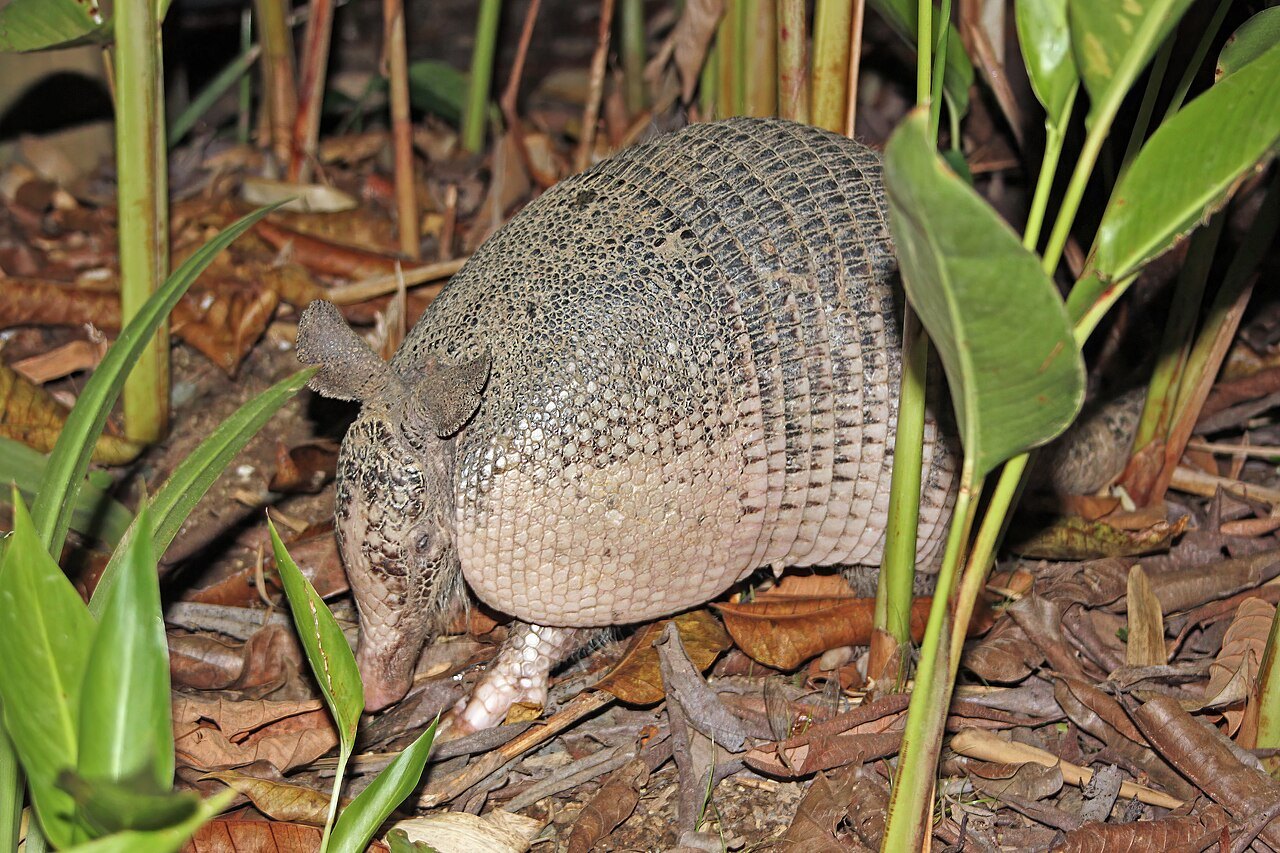
In modern usage the armadillo means boundaries, protection and knowing what to let in, a reading that comes from Jamie Sams and David Carson's Medicine Cards (Bear & Company, 1988), whose armadillo card is titled Boundaries. Its central image, an animal rolling into an impenetrable ball, describes the South American three-banded armadillo and not the nine-banded one the deck's readers actually encounter.
Most animals on this site arrive with too much symbolism and not enough evidence. The armadillo has the opposite problem. The spirit-animal genre gives it one idea, boundaries, repeated on every page in almost identical words, while the documented material sits somewhere else entirely and is far stranger.
So this page spends its time on the strange part: a name built out of two other animals, a lute made from a dead one, four identical siblings in every litter, and a bacterium that will grow in an armadillo and almost nothing else.
Turtle, rabbit, hedgehog, tortoise: nobody could name it either
In Nahuatl it is ayotochtli, from ayotl, turtle, and tochtli, rabbit. Sahagún’s informants explain the compound in Book XI of the Florentine Codex: the head is a rabbit’s, and the body goes about wrapped in a shell like a turtle. It is a name made by welding two known animals together, because the thing itself did not fit anywhere.
The Florentine Codex is worth a moment on its own terms, because it is not a Spaniard writing about Mexico. Sahagún ran the project out of the college at Tlatelolco with Nahua scholars trained there, working in Nahuatl first and Spanish second, over roughly four and a half decades from the 1540s. Book XI, the volume on earthly things, is a natural history compiled by people who had grown up naming these animals. When it says the armadillo is called turtle-rabbit because its head is a rabbit’s and it goes about wrapped like a turtle, that is a Nahuatl-speaking naturalist explaining a Nahuatl word.
Europe reached the same solution independently.

Shell-hedgehog. Turtle-rabbit. Two continents, two languages, the same grammatical shrug.
The rabbit half then did something odd: it survived into the science. Francisco Hernández, sent to New Spain by Philip II in the 1570s to catalogue its natural history, rendered ayotochtli into Latin as Dasypus cucurbitinus, gourd-like rabbit, having apparently taken Nahuatl ayotl, turtle, for ayohtli, squash. Dasypus is Greek for rough-footed, an old word for a hare, which Pliny used for a rabbit. Linnaeus adopted Dasypus as the genus. It is the genus still. Whether Linnaeus knew he was carrying a Nahuatl rabbit into the binomial system is an inference and I will not present it as more than that, but Hernández’s Latin name and Linnaeus’s genus are both on the page and both say hare.
The Maya put it under the world
Sarah Newman and Franco Rossi published a study of Classic Maya animal categories in Ancient Mesoamerica in 2023, taking the gray fox and the armadillo as their two cases. They read the armadillo in the hieroglyphic script as ibak’ and call it a central source of protein, myth and metaphor.
Two of their observations are worth carrying away. The first is that the armadillo works as what they call a dualizer, an animal that lands in one category or another depending on which feature you are explaining, which is the turtle-rabbit instinct again, arriving by a different road. The second is that the animal appears as the seat or footstool of the Earth Lord, an underworld deity, and that armadillo burrows are understood as leading to his home.
That is not decorative. It is a piece of reasoning from behaviour. An armadillo confronted with a problem does not fight it, and does not curl up. It goes down, fast, and the hole it leaves is a hole into somewhere.
Four identical siblings, every single litter
Here is the fact that ought to be on every armadillo page and is on almost none.
A nine-banded armadillo does not have a litter of four. It has one fertilised egg, which implants after a delay of roughly fourteen weeks and then splits, and produces four genetically identical young. Not usually four. Four, as the normal condition of the species. The eleven-banded relative Dasypus hybridus does the same thing and produces between seven and twelve.
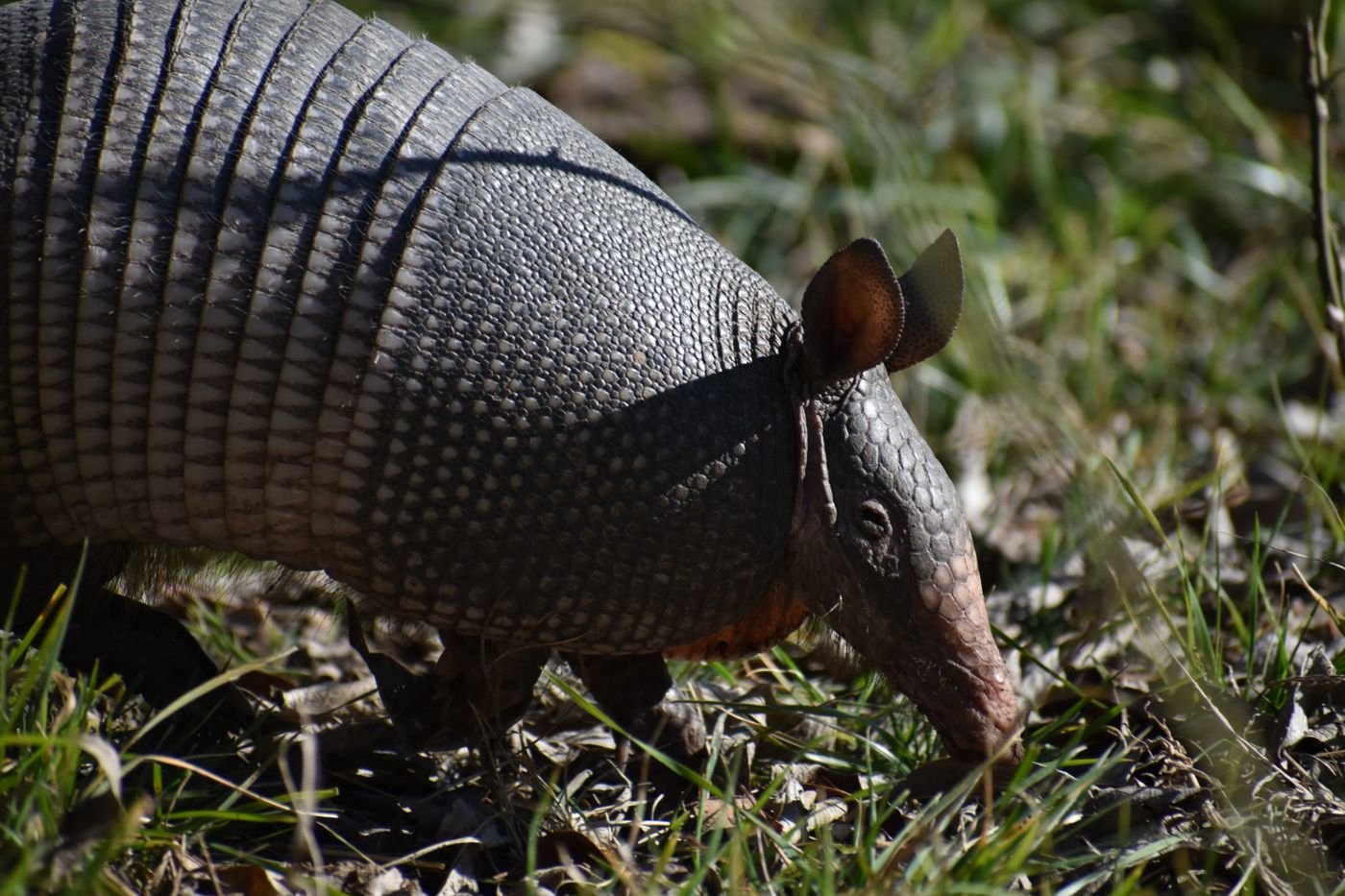
This is called obligate polyembryony, and Dasypus is the only vertebrate group known to do it. Every other set of identical siblings in the vertebrate world is an accident. Here it is the design. Which is why the armadillo turns up constantly in research on genetics and development: it hands scientists natural clone sets, four at a time, with the environmental variables held loosely constant.
The Maya connected the animal to fertility because it multiplies fast. They had noticed something real from the outside.
The bacterium that will grow in almost nothing else
Mycobacterium leprae is a difficult organism. It will not grow in culture. For most of the twentieth century researchers had no animal in which to propagate it, which meant no reliable supply of bacilli and slow progress on a disease affecting millions.
Then W. F. Kirchheimer and E. E. Storrs reported in the International Journal of Leprosy in 1971 that they had established infection in the nine-banded armadillo. The reason is thermal. This animal runs a body temperature of roughly 30 to 35 degrees Celsius, well below a human’s, and M. leprae prefers the cool. That is also why in people the disease attacks the extremities and the face rather than the core. The armadillo is, in effect, a person-shaped cold spot, and the bacterium moves in.
It cuts both ways. Richard Truman and colleagues reported in the New England Journal of Medicine in April 2011 that a single M. leprae genotype, 3I-2-v1, was shared by 25 patients and 28 wild armadillos in the southern United States, and that whole-genome sequencing of strains from one wild animal and three patients found them essentially identical. Leprosy in Louisiana and Texas is, in part, a zoonosis.
Be careful with the sentence that usually follows. The armadillo is often called the only natural reservoir of leprosy besides humans, and that is no longer accurate. In November 2016 Charlotte Avanzi and colleagues reported in Science that red squirrels in the British Isles carry leprosy bacilli, with Scottish animals showing diffuse lepromatous disease caused by Mycobacterium lepromatosis. The defensible claim is narrower and still remarkable: the nine-banded armadillo is the principal known non-human reservoir in the Americas.
The low body temperature buys researchers something beyond a bacterial supply. Leprosy’s lasting damage in people is nerve damage, and human peripheral nerves are hard to study for the obvious reason. Armadillos develop the same nerve involvement, which has made them a working model for the neuropathy rather than only for the organism. It is a peculiar debt. The animal that gave the American South a homegrown route to an ancient disease is also the animal that made the disease tractable.
A shell that became an instrument
The charango is a small fretted lute of the Bolivian and Peruvian highlands, five courses and usually ten strings, and its traditional body is an armadillo’s carapace with the hair left on.
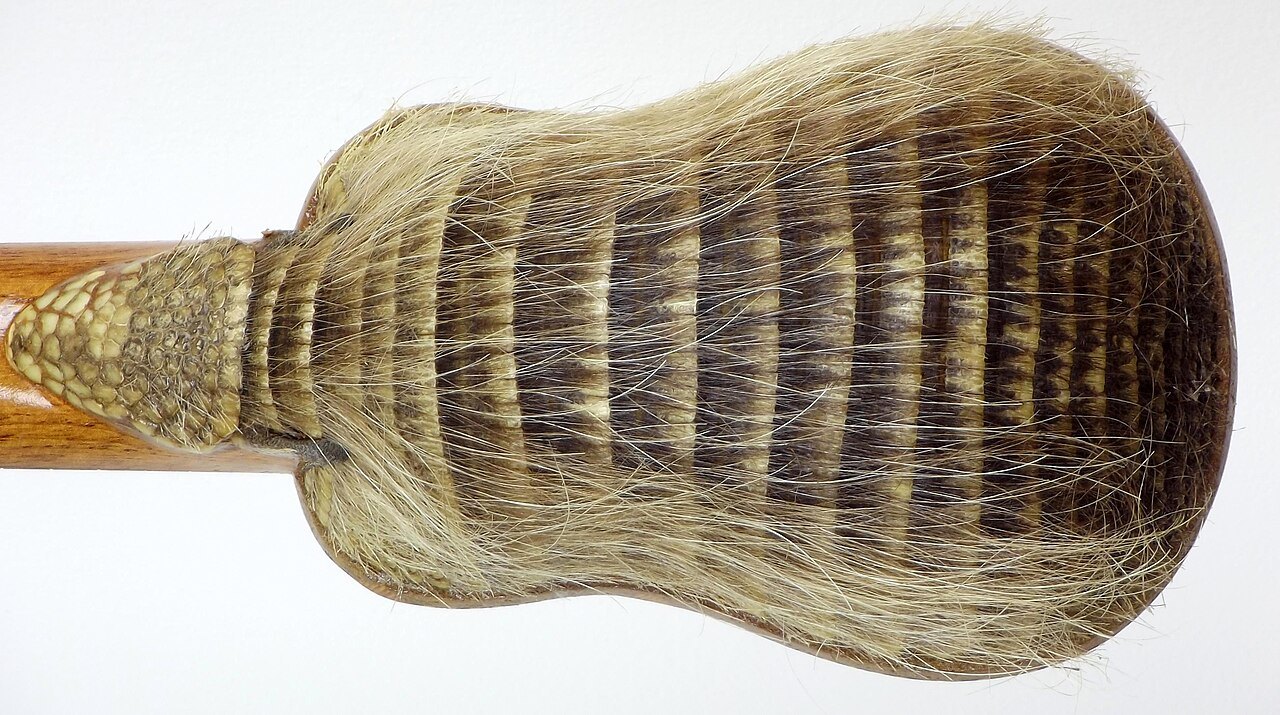
The instrument is not ancient. It is colonial, a Spanish string design rebuilt out of what the Andes had, and the substitution changed the sound into something that belongs to neither tradition. In Quechua the animal and the instrument share the word kirkinchu. Most charangos made now have wooden backs, for tone, for durability and for law, so the shell-backed one is drifting toward being a museum object.
Boundaries, and the wrong armadillo
The reading everybody repeats has a specific origin, and unusually for this site it is not Ted Andrews. It is Jamie Sams and David Carson’s Medicine Cards, published by Bear & Company in 1988 with illustrations by Angela Werneke, five years before Animal Speak. The armadillo card is titled Boundaries. Its argument is that the animal’s underside is soft, the armour exists to protect that softness, and the reader should draw lines firm enough that unkind words and intentions roll off.
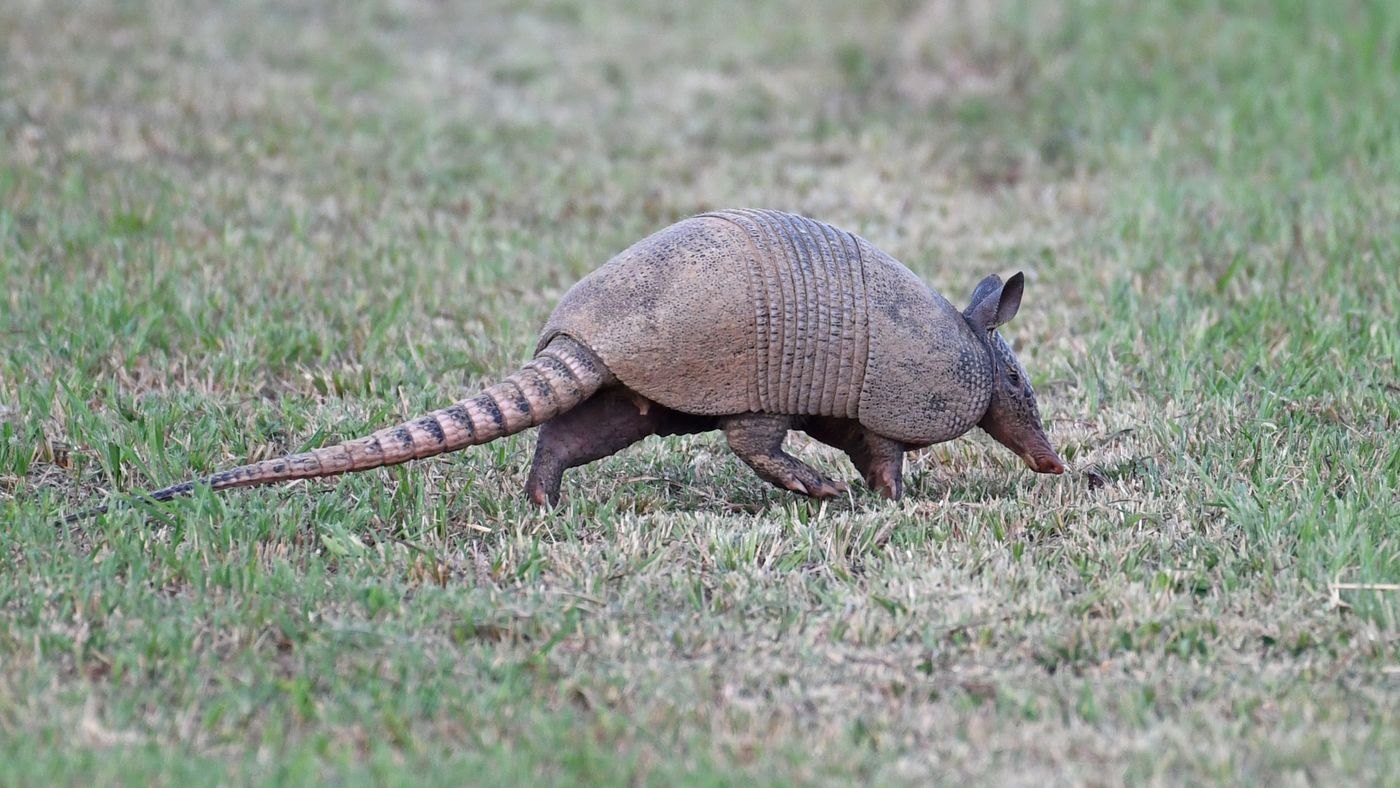
The card’s supporting picture is the animal rolling into an impenetrable ball. Two species do that, both in the genus Tolypeutes, both South American. The nine-banded armadillo that lives across the American south, the one a reader in Texas or Florida is actually thinking of, has too many plates to close. Its response to a threat is a vertical jump, which is why so many end up under cars, and then a sprint, and then a hole.
Which leaves a better reading available for anyone who wants one, and it is the animal’s own. This is a creature that got its name by being two things at once, that arrived in the United States by walking there, that reproduces in identical fours, and that survives contact by going straight down. None of that is about keeping the world out.
Across traditions
Nahua (ayotochtli, the turtle-rabbit)
In Nahuatl the armadillo is ayotochtli, from ayotl, turtle, and tochtli, rabbit. Bernardino de Sahagún's informants explain the name in Book XI of the Florentine Codex, the volume on earthly things: the head is a rabbit's, and the animal goes about wrapped in a shell like a turtle. It is a compound built out of two familiar animals to describe a third that fits neither.
Europe did exactly the same thing, independently and at almost the same moment. The Zurich naturalist Conrad Gessner's German Thierbuch of 1563 gives it as Schaligel, shell-hedgehog, alongside the Latin Tatus, which is the Tupi and Guaraní word tatu that still supplies the Portuguese and Spanish names. Gessner's page calls it a strange and adventurous foreign beast brought from the island of Brazil, covered all over with a hard shell like a tortoise.
The rabbit survived into the science. Francisco Hernández, physician to Philip II and in New Spain during the 1570s, latinised ayotochtli as Dasypus cucurbitinus, gourd-like rabbit, apparently reading Nahuatl ayotl as ayohtli, squash. Dasypus is Greek for rough-footed and was an ancient word for a hare, which Pliny used for a rabbit. Linnaeus took Dasypus as the genus, and it is still the genus today. The chain from the Nahuatl name to the modern binomial is an argument rather than a documented fact, but the two ends of it are both checkable.
- PRIMARY Bernardino de Sahagún, Florentine Codex, Book XI (Earthly Things) . Compiled in Nahuatl and Spanish, 1545-1590. Explains ayotochtli by the rabbit-like head and turtle-like shell.
- REFERENCE Nahuatl Dictionary, ayotochtli . Wired Humanities Projects, University of Oregon. Gloss: turtle-rabbit, from ayotl and tochtli.
- PRIMARY Conrad Gessner, Thierbuch . Christoph Froschauer, Zurich, 1563. Gives the armadillo as Schaligel and Tatus quadrupes, brought from Brazil. Library of Congress copy, shelfmark QL41.G41 1563a.
Classic Maya (the Earth Lord's footstool)
Sarah Newman and Franco Rossi examined how Classic Maya scribes and artists treated the armadillo in Ancient Mesoamerica in 2023, reading it as a named individual in specific relationships rather than a generic beast. They identify the animal in the hieroglyphic script as ibak', and describe it as a central source of protein, myth and metaphor.
Two threads in their account are worth having. The armadillo functions as what they call a dualizer, an animal that falls into two categories depending on which of its features you are explaining, which is the same instinct that produced the turtle-rabbit name further north. And it serves as the stool or footstool of the Earth Lord, an underworld deity whose subterranean home is where armadillo burrows lead. That is a piece of reasoning about the animal's actual behaviour, not a symbolic flourish. It digs, it disappears downward, and the burrow is treated as a route into somewhere.
They also connect it to fertility, and attribute that association to how quickly armadillos multiply. Anyone who has read the reproductive biology below will recognise the observation.
- PEER-REVIEWED Sarah E. Newman and Franco D. Rossi, The Fox and the Armadillo: An Inquiry into Classic Maya Animal Categories . Ancient Mesoamerica 34, no. 2 (2023).
Andean (the charango's shell)
The charango is a small fretted lute of the Bolivian and Peruvian Andes, five courses, usually ten strings, and its traditional soundbox is the carapace of an armadillo. In Quechua the instrument and the animal share a word, kirkinchu; in South American Spanish the animal is quirquincho or mulita, in Argentina tatu.
The instrument is a colonial hybrid rather than a pre-Columbian survival. It takes the shape and tuning logic of Spanish plucked strings and replaces the carved wooden back with what was available, which produced an instrument that sounds like neither parent. The Metropolitan Museum of Art holds examples of both periods: a nineteenth-century charango of armadillo shell, wood and metal from the Crosby Brown Collection, accession 89.4.704, and a twentieth-century Bolivian one of armadillo shell, wood and pearloid, accession 1995.541.32.
Most charangos sold today have wooden backs. That is partly tone and durability and partly law, and the shift means the shell-backed instrument is now more often a heritage object than a working one.
- MUSEUM Charango, Bolivian, 20th century. The Metropolitan Museum of Art . Accession 1995.541.32. Medium: armadillo shell, wood, pearloid.
- MUSEUM Charango, probably Bolivian, 19th century. The Metropolitan Museum of Art . Accession 89.4.704, Crosby Brown Collection of Musical Instruments, 1889. Medium: armadillo shell, wood, metal.
Medicine Cards (1988, the pop-concept's source)
The modern armadillo reading is not Ted Andrews. It is Jamie Sams and David Carson's Medicine Cards: The Discovery of Power Through the Ways of Animals (Bear & Company, 1988), illustrated by Angela Werneke, whose armadillo card is titled Boundaries. The teaching is that the animal's underside is soft, the armour protects that softness, and the reader should set boundaries firmly enough that hostile words and intentions roll off.
The supporting image is that the armadillo rolls into a ball no enemy can penetrate. That is true of two species in the genus Tolypeutes, the three-banded armadillos of Brazil, Bolivia, Paraguay and Argentina, which are the only armadillos that rely on their armour that way. The nine-banded armadillo that lives across Texas, Florida and much of the American south has too many plates to close up. Threatened, it jumps, then runs, then digs. The deck is describing an animal almost none of its readers will ever meet.
- REFERENCE Jamie Sams and David Carson, Medicine Cards: The Discovery of Power Through the Ways of Animals . Illustrated by Angela C. Werneke. Bear & Company, 1988. The armadillo card is Boundaries.
Working with the Armadillo
If you want a regular practice rather than a one-time read, an oracle deck is the standard tool: you draw a card and sit with whatever animal comes up. Our ranked guide to spirit animal oracle decks compares the field.
Sources
- PRIMARY Bernardino de Sahagún, Florentine Codex, Book XI
- PRIMARY Conrad Gessner, Thierbuch (Zurich, 1563) . Library of Congress copy, QL41.G41 1563a.
- PEER-REVIEWED Newman and Rossi, The Fox and the Armadillo . Ancient Mesoamerica 34, no. 2 (2023).
- PEER-REVIEWED Richard W. Truman et al., Probable Zoonotic Leprosy in the Southern United States . New England Journal of Medicine 364, no. 17 (28 April 2011), pp. 1626-1633.
- PEER-REVIEWED Charlotte Avanzi et al., Red Squirrels in the British Isles Are Infected with Leprosy Bacilli . Science 354, no. 6313 (11 November 2016), pp. 744-747.
- PEER-REVIEWED W. F. Kirchheimer and E. E. Storrs, Attempts to Establish the Armadillo as a Model for the Study of Leprosy . International Journal of Leprosy 39 (1971), pp. 693-702.
- MUSEUM Charango, The Metropolitan Museum of Art . Accession 1995.541.32.
- REFERENCE Nahuatl Dictionary, ayotochtli
- REFERENCE Jamie Sams and David Carson, Medicine Cards . Bear & Company, 1988.