Water Sign · October 23 – November 21
Scorpio Spirit Animal
Scorpio the Scorpion: Babylonian GIR.TAB, the Gilgamesh Tablet IX scorpion-men, and the Orion-Scorpio catasterism.
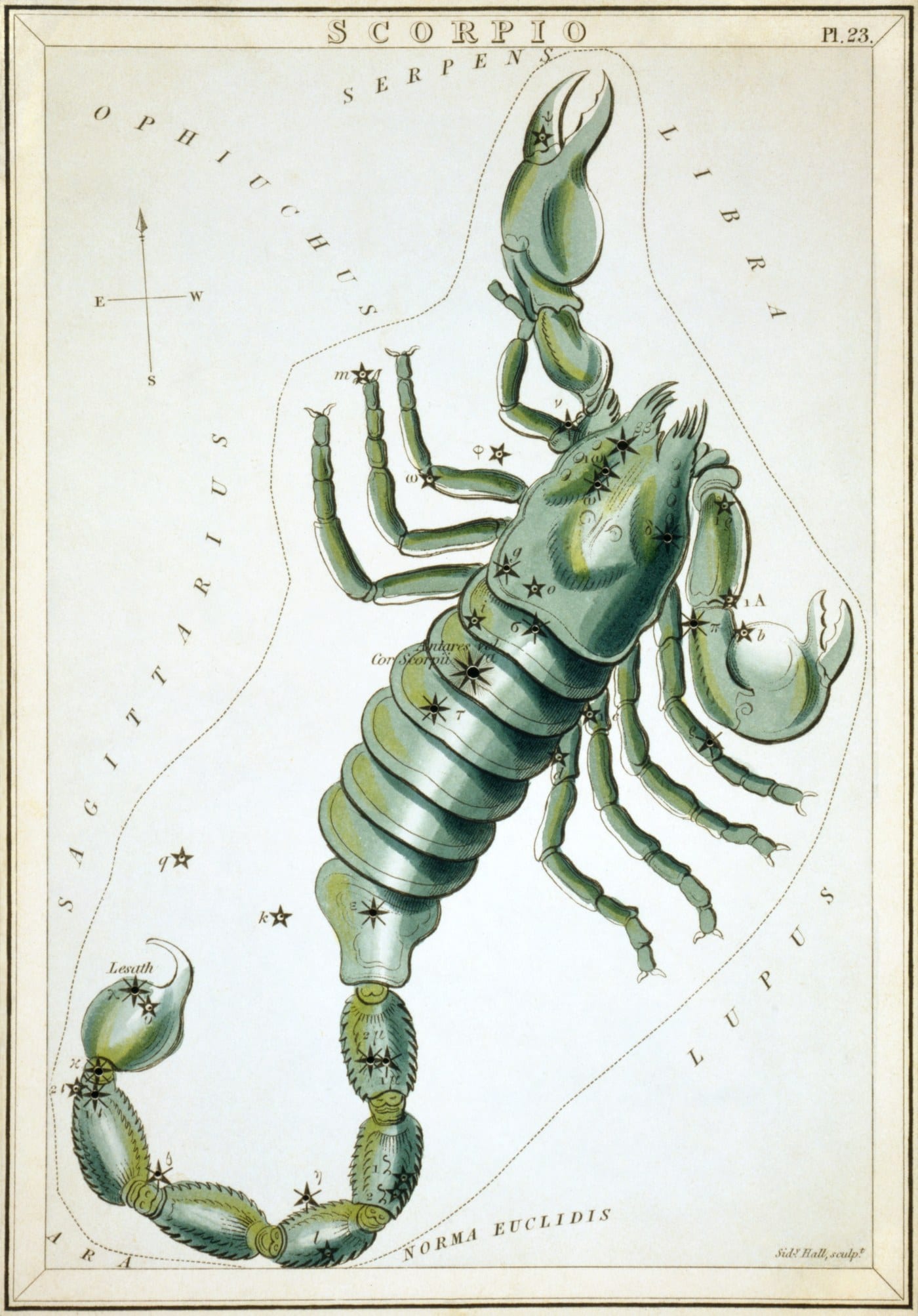
Scorpio is the Scorpion (October 23 – November 21, Water element). Babylonian GIR.TAB in MUL.APIN. The Greek myth pairs it with Orion: Gaia sent the scorpion to kill the boastful hunter Orion; both were catasterized into opposing constellations so that Scorpio rises as Orion sets. Hesiod Astronomia (fragmentary) and Ovid Fasti 5.539–544 preserve the narrative. The scorpion spirit animal entry covers the fuller Egyptian Serqet, Gilgamesh scorpion-men, and Isis-and-seven-scorpions treatment.
The Babylonian astronomers called it GÍR.TAB in the MUL.APIN tablets, a name that simply means “scorpion” in Sumerian. It is one of the oldest named constellations in the record. The Scorpion appears in the sky across a wide swath of the southern ecliptic, and ancient observers had no trouble seeing the curved tail and the raised stinger in the arrangement of stars. What they built around it is more interesting than the shape.
The scorpion-men of Gilgamesh
Before the constellation Scorpius had astrological meanings, the scorpion had a specific cosmological function in Mesopotamian religion. Tablet IX of the Epic of Gilgamesh describes the hero’s journey to find Utnapishtim and the secret of immortality. To reach the waters of death, Gilgamesh must pass through the mountains where the sun sets, guarded by the scorpion-men, acrabi, composite beings whose upper half is human and whose lower half is scorpion. They are terrifying to look at: “their terror is awesome and their glance is death, their shimmering halo sweeps the mountains.” Gilgamesh is the first human ever to have passed them. Andrew George’s critical edition (Oxford University Press, 2003) preserves the Akkadian.
These scorpion-men are not spirit guides. They are threshold guardians at the boundary between the world of the living and the realm below. The contemporary pop-spiritual Scorpio (depth, transformation, intensity) kept the underworld address but dropped the terror. A creature whose glance is literally death and a symbol of your psychological transformation are not the same thing. The gap is worth naming.
The Orion-Scorpio catasterism
The Greek mythological tradition pairs Scorpius with Orion as opposing constellations, explaining why they are never in the sky at the same time. The standard narrative: Orion boasted that he would kill every animal on earth. Gaia, the earth, could not tolerate this, and sent a giant scorpion to kill him. Both were catasterized (turned into constellations) but placed on opposite sides of the sky so that when Scorpius rises in the east, Orion sets in the west, and vice versa. Hesiod’s Astronomia preserves fragments of this narrative; Ovid’s Fasti 5.539–544 is the fuller Latin version.
That pairing is still real: Scorpius rises in late spring and early summer in the Northern Hemisphere, and Orion disappears below the horizon. The myth encodes an observed astronomical fact.
The Egyptian connection: Serqet
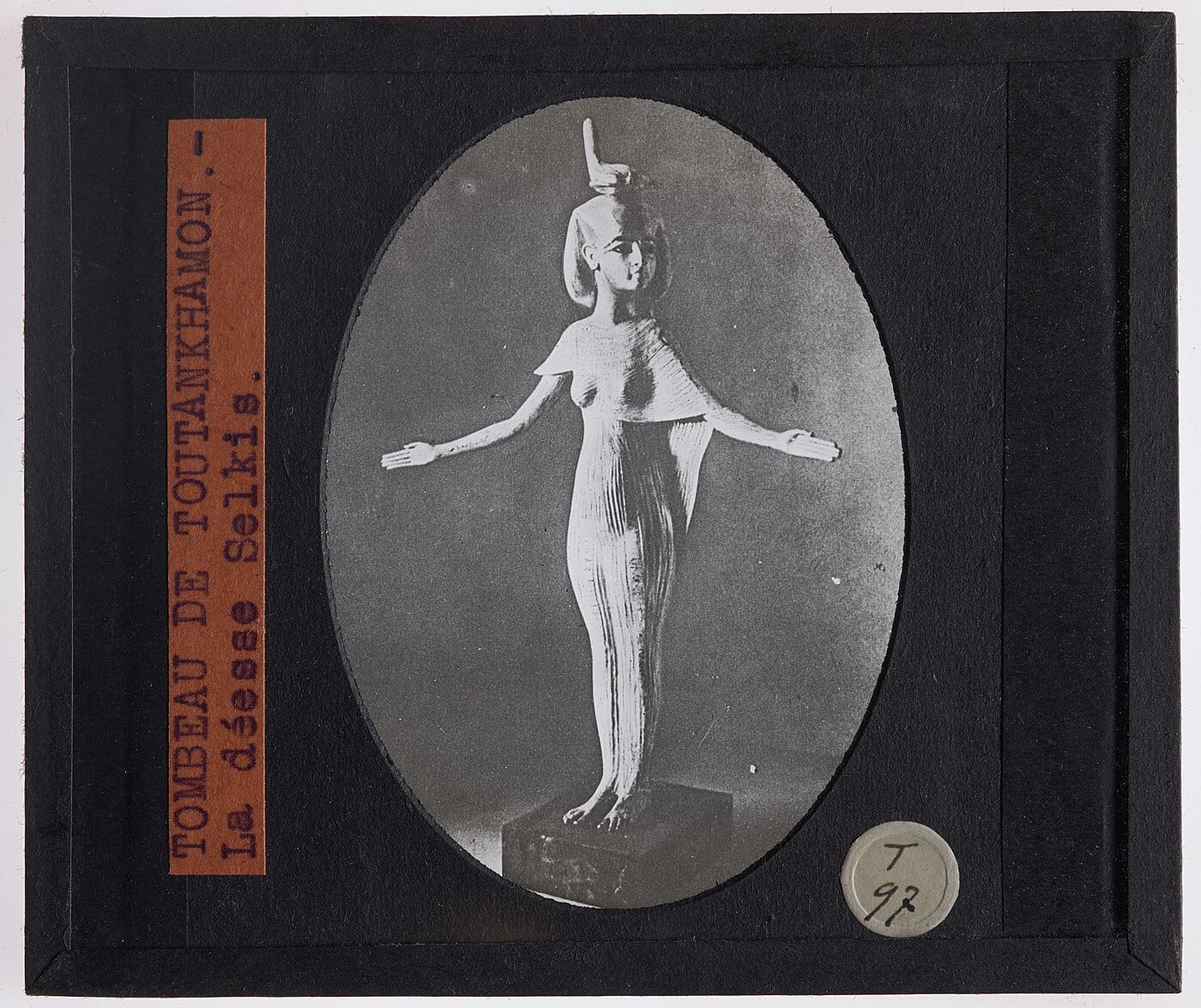
Egyptian scorpion iconography runs alongside the Babylonian and Greek material independently. The goddess Serqet (also spelled Selket), depicted as a woman with a scorpion on her head, was the protective guardian of one of the four canopic jars of the dead. She protected the intestines of the deceased. In the Book of the Dead (Spell 17), she appears as one of the four goddesses who protect Osiris. The scorpion’s venom (painful, potentially lethal) was understood as medicinal as well as deadly: Serqet was invoked against scorpion stings and snakebites. Isis and the seven scorpions (Papyrus Chester Beatty XI) narrates a protective journey across the Delta in which seven scorpion-goddesses clear the path for Isis and her son Horus. See the scorpion spirit animal entry for the full treatment of Serqet, Isis, and the Egyptian scorpion tradition.
The animal associations
The scorpion is Scorpio’s primary animal. The snake appears as a secondary association in many modern astrological traditions, tied to the sign’s symbolic connection to death and regeneration (the snake sheds its skin; Scorpio governs transformation). The eagle or phoenix (birds associated with rising above) appear as the sign’s “higher vibration” animals in 20th-century esoteric astrology, the idea being that the scorpion’s poison can be transcended by the eagle’s flight. Ted Andrews’s Animal Speak (Llewellyn, 1993) contributed to the popular spread of this three-animal Scorpio reading (scorpion, snake, eagle) as stages of spiritual evolution within the sign.
The Babylonian astronomers and the Greek mythmakers did not read Scorpio that way. For them the scorpion stood for the lethal, the threshold, the untranscended boundary. The modernizing reframe is not without its uses, but knowing where it comes from (20th-century esoteric astrology rather than the ancient sources) is the difference between a reading and a retelling.
Associated animals
Primary: Scorpion
Frequently asked
- What animal is Scorpio?
- The Scorpion. Babylonian GIR.TAB. Greek Orion-Scorpio catasterism. The scorpion spirit animal entry covers the Egyptian Serqet, Mesopotamian Gilgamesh scorpion-men, and Isis-and-seven-scorpions traditions in full.
- Where does the Orion-Scorpio opposition come from?
- In the Greek catasterism myth (Hesiod's Astronomia, Ovid's Fasti 5.539–544), Orion the hunter boasted he could kill every animal on earth; Gaia sent the scorpion to kill him. Both were placed in the sky on opposite sides so they would never appear simultaneously: when Scorpius rises in the east, Orion sets in the west. The astronomical observation drove the myth, not the other way around, the figures were placed where the sky actually shows them.
- What did the Babylonian PA.BIL.SAG figure have in common with the Greek Scorpius?
- In Kassite-period boundary stones (kudurru), PA.BIL.SAG appears as a composite deity with scorpion tail, equine lower body, and drawn bow, the figure that the Greeks later split into Sagittarius (archer-centaur) and Scorpius (the scorpion alone). The arrow of Sagittarius in every Western zodiac illustration still points toward Antares, the heart of Scorpius, preserving the Babylonian composite's internal geometry.
Sources
- PRIMARY MUL.APIN (GIR.TAB) . Hunger & Pingree, 1989.
- PRIMARY Ovid, Fasti 5.539–544 . Loeb Classical Library.
- PRIMARY Hesiod, Astronomia (fragments) . Loeb.
- PRIMARY Ptolemy, Tetrabiblos . Loeb.
- PRIMARY Eratosthenes, Catasterismi 7 . Mair trans., Loeb Classical Library.