Spirit Animal
Blue Jay Spirit Animal
Blue jay spirit animal meaning: boldness, mimicry and curiosity. Traced honestly: a corvid found only in North America, so no ancient European or Asian tradition can be behind it. What the record does hold is a Cherokee feather charm in Mooney 1900, a Chinookan trickster who is a different bird, a Southern jaybird-and-devil belief, and Ted Andrews in 1993.
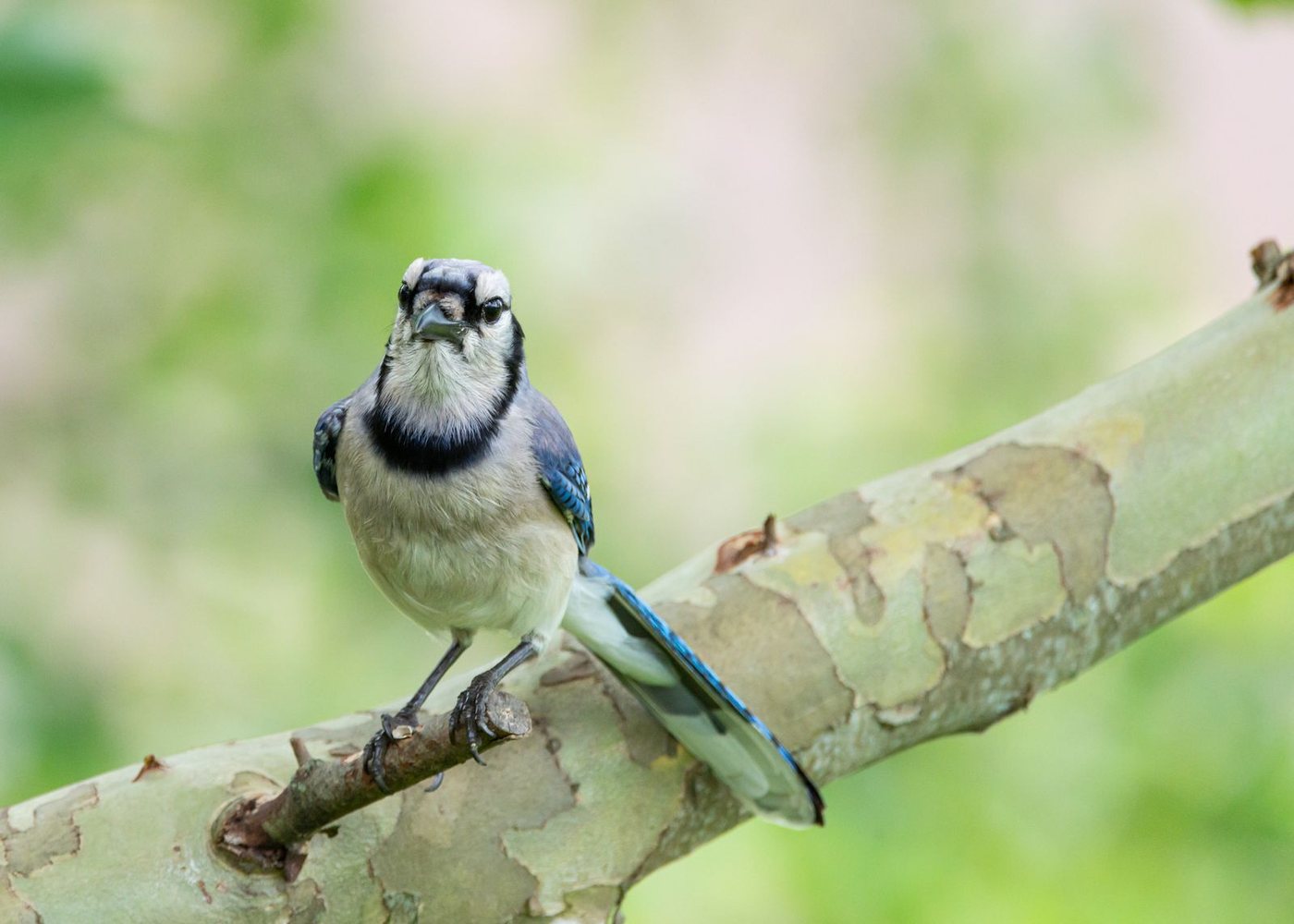
In current usage the blue jay signals boldness, clever talk, and the right use of power, a reading that traces directly to Ted Andrews's Animal Speak (Llewellyn, 1993), whose keynote for the bird is the proper use of power. Nothing older is available in Europe or Asia, because the species lives only in North America. The documented material is Cherokee, Chinookan, and nineteenth-century Southern, and it is specific.
Start with the fact that settles most of the argument. Cyanocitta cristata lives in eastern and central North America and nowhere else. No Greek saw one. No Roman, no Norse skald, no Vedic poet, no Tang dynasty painter. The first European to describe the bird did so in a colonial context, and the species was unknown to every literate civilisation that produced the ancient symbolism the internet keeps attributing to it.
So when a page tells you the blue jay was sacred to the Celts, or that ancient traditions held it as a messenger between worlds, you can stop reading. Not because the claim is unlikely. Because it is impossible.
That leaves a more interesting question. What is actually on the record, and what is the bird itself really like? Both answers are better than the invented version.
The bird is not blue
There is no blue pigment in a blue jay. The feathers contain melanin, which is brown. The colour you see is structural: as the feather grows, keratin in the barb cells separates from water, and when the cell dies and dries it leaves a sponge of tiny air pockets. That structure scatters light so that blue wavelengths come back to your eye and the rest are absorbed by the melanin underneath.
The test is easy and destructive. Crush a blue jay feather between your fingers and the blue goes out of it, because you have wrecked the geometry that was producing the colour. Grind a cardinal’s feather and it stays red, because red really is a pigment. Hold the jay feather up with the light behind it rather than in front of it and it looks brown.
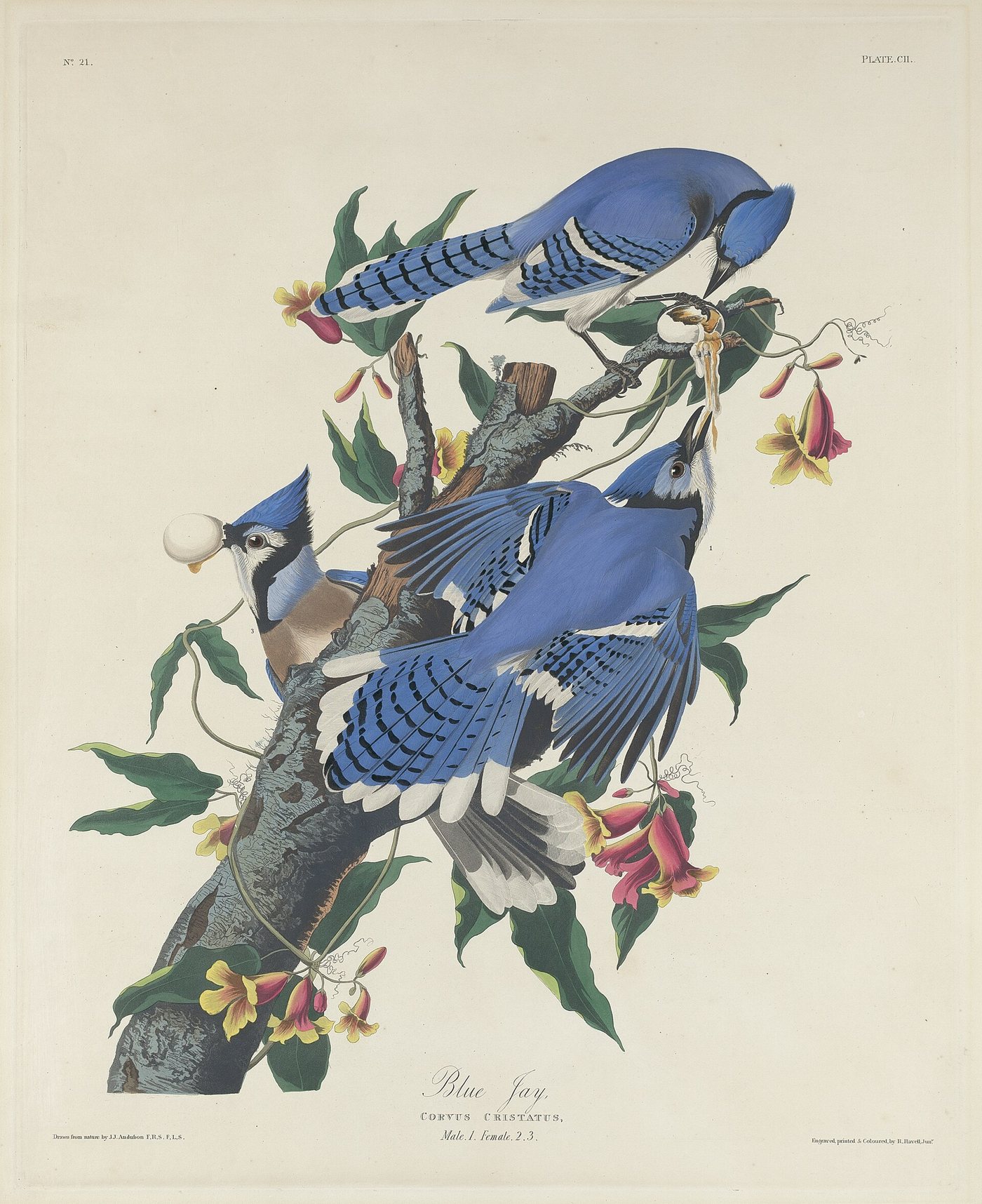
This is worth knowing before anyone builds a meaning on the colour. Whatever the blue jay is a sign of, it is not a sign of blueness. It is a brown bird running an optical trick, and the trick only works from one direction.
It sounds like a hawk, and it does that on purpose
Jays are corvids. They sit in the same family as crows, ravens, magpies and rooks, which is the family that keeps embarrassing psychologists by solving problems it should not be able to solve.
The blue jay’s party piece is vocal mimicry, and its favourite target is the red-shouldered hawk. The imitation is good enough to fool experienced birders regularly, and the same trick gets played with red-tailed hawks and Cooper’s hawks. Why remains genuinely open. The leading candidates are that the jay is clearing a feeder by making smaller birds think a raptor has arrived, that it is announcing a real hawk it has spotted, and that it is testing whether one is nearby by listening for the response. These are not mutually exclusive and the honest answer is that nobody has settled it.
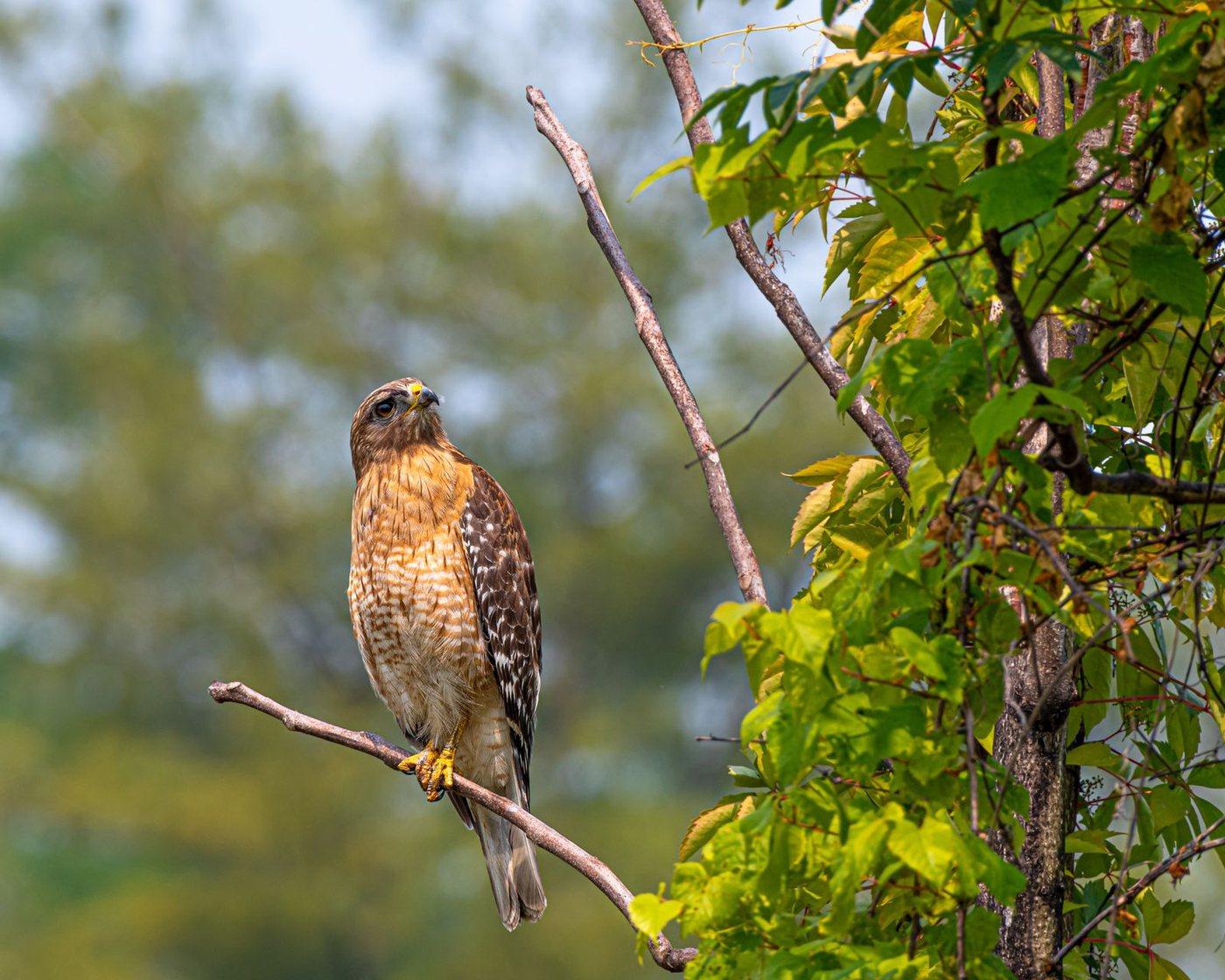
Set that beside the pop reading for a second. The keyword lists say the jay means clear communication and speaking your truth. The bird’s most famous vocal behaviour is a convincing lie.
The jays that moved the oak forests north
This is the part of the blue jay’s biography that deserves to be the symbolism, and almost nobody uses it.
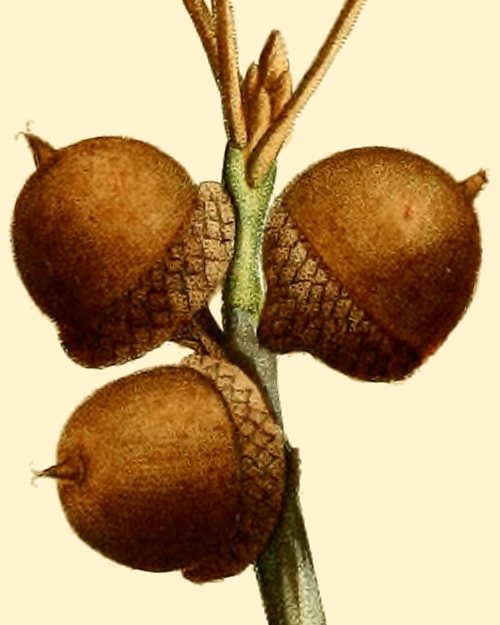
Blue jays cache nuts. In a study published in Oecologia in 1981, Susan Darley-Hill and W. Carter Johnson watched a stand of pin oaks in Blacksburg, Virginia, and counted jays carrying off and burying 133,000 acorns in a single season, roughly 54 percent of the entire crop, with another fifth eaten on the spot. Birds carried one to five nuts per trip, averaging just over two, and buried them a mean of 1.1 kilometres from the parent tree, some as far as 1.9 kilometres. Each acorn went into the ground singly, covered with leaf litter, which happens to be excellent planting technique.
That last number is the interesting one. An acorn is heavy and a squirrel does not take it far. A jay will fly it a kilometre and put it in soil, and then fail to come back for a good share of what it hid. Johnson and Thompson Webb argued in the Journal of Biogeography in 1989 that this is how oaks kept up with the retreating ice after the last glaciation, spreading north at rates that otherwise only make sense for light wind-blown seeds. The eastern oak forest, in other words, has been partly planted by birds that were trying to hoard it.
If you want a symbol out of the blue jay, take that one. A loud, quarrelsome, thieving bird buries more than it can remember and leaves a forest behind by accident.
What the actual record says
Three named bodies of material, none of them ancient, all of them checkable.
The Cherokee one is a household charm, and it is precise. Mooney recorded in 1900 that water in which a blue jay’s feather had been soaked would make a child an early riser, with the condition that the feather must be found by chance and not gone looking for. The owl feather next to it in his text does the opposite and keeps a child awake all night. That is the whole of it. It is not a totem system and it does not say the jay means anything.
The Chinookan Blue-Jay is a much bigger figure and a different bird. Boas published three Blue-Jay myths in Chinook Texts in 1894, narrated by Charles Cultee, and the character is a greedy loudmouth who blunders through the land of the dead without grasping where he is. It is fine material. It is also from the lower Columbia, where this species does not occur, so the trickster wearing the name is a western jay.
The Southern jaybird belief is the one piece of English-language folklore that really is about Cyanocitta cristata. You will not see a jay on a Friday, because he is downstairs carrying sticks to the devil and telling on you. Whether that is a nineteenth-century belief or older, and how it took the form it did, is not something the collections settle.
What does it mean when a blue jay keeps showing up?
Usually that you have oaks, beeches or a feeder, and that a resident pair has decided your patch is theirs. Blue jays hold territory year-round across much of their range, they remember reliable food to an inconvenient degree, and in autumn they will work the same tree for weeks while the mast is falling. A jay screaming at you from a low branch in May or June is usually defending a nest close by, and it will escalate to dive-bombing if you keep walking that way.
The omen readings layered on top of this are recent. There is no old tradition making a jay sighting lucky or unlucky in the way that magpie-counting rhymes do for magpies in Britain, and the Friday belief described above works the other way round: it explains an absence rather than a presence. If a jay’s arrival means something to you, that meaning is yours and it is being made now. That is not a criticism. It is just worth not dressing as inheritance.
Is a blue jay feather a sign?
The two most searched questions about this bird are what it means when one appears and what it means to find a feather, and only the second has anything old attached to it. The Cherokee charm Mooney recorded is specifically about a found feather, and the condition is doing real work: it counts only if chance put it in your hand. Deliberately pulling one, or buying one, voids it. Traditions that hinge on accident rather than intention are common in the record and they tend to be the ones people actually kept.
Two practical notes. In the United States the Migratory Bird Treaty Act makes it illegal to possess feathers of most native birds, blue jays included, whatever the circumstances of finding them, so leave it where it lies and photograph it. And if you do look closely, hold it up with a light behind it. The blue will vanish and you will see the brown that was there the whole time.
Where the meaning you have read comes from
Andrews, in 1993, page after page of him copied since.
His keynote is the proper use of power, and the supporting argument is that the jay is fearless around animals many times its size, that it is spectacularly noisy, and that it survives well on modest effort. From that he gets a bird about undeveloped talent and about using what you have properly, which is the reading now sitting on every third result for this search.
The thing to notice is the absence underneath it. On the butterfly there is Apuleius and Zhuangzi under Andrews. On the praying mantis there are the ǀXam notebooks. Here there is a Cherokee feather charm, a misfiled Chinookan trickster, a Friday errand to hell, and Mark Twain. None of that adds up to the proper use of power, and Andrews did not claim it did. He looked at the bird and made something up, which is a legitimate thing to do and a different thing from inheriting a tradition.
The bird is still worth the attention. It is a corvid that lies in a hawk’s voice, wears a colour it does not own, and has been quietly planting oak trees across a continent since the ice went.
Across traditions
Cherokee (as recorded by Mooney, 1900)
The best-documented traditional material on this bird sits in James Mooney's Myths of the Cherokee, published as part of the Nineteenth Annual Report of the Bureau of American Ethnology in 1900 and drawn from fieldwork among the Eastern Band in North Carolina in the 1880s. Mooney gives the Cherokee word for the jay in his dialect table: tsayʼkû' in the Eastern and Middle dialects, tlayʼkû' in the Western.
The specific belief he records is small and exact. In his account of the bird tribes he writes that water in which a blue jay's feather has been soaked, applied to a child, will make the child an early riser, and that the feather has to be found by chance rather than sought on purpose. It sits directly beside the opposite charm using an owl feather, which keeps a child awake all night. Notice what this is and is not. It is a household charm with a condition attached, not a totem, not a spirit guide, and not a statement that the jay stands for anything. Sites that cite Cherokee tradition for blue jay symbolism almost never quote this, which is a fair sign they have not looked at it.
One further caution from Mooney's own notes. Discussing the Spearfinger myth, he flags a published version by Ten Kate in which the bird is a jay where his own narrators had a tomtit. Even inside the record, which small bird a story means is sometimes contested.
- PRIMARY James Mooney, Myths of the Cherokee . Nineteenth Annual Report of the Bureau of American Ethnology, Washington, 1900. Bird tribes section, blue jay feather charm; dialect table giving tsayʼkû' and tlayʼkû'.
- ARCHIVE Myths of the Cherokee, full text . Project Gutenberg transcription of the 1900 report.
Chinookan (the famous Blue-Jay who is a different bird)
Anyone searching for Indigenous blue jay stories runs quickly into a large and genuinely important body of them: the Blue-Jay cycle in Franz Boas's Chinook Texts, published by the Bureau of American Ethnology in 1894 from the narration of Charles Cultee. Three of the eighteen myths in that volume are titled Blue-Jay and Iô'i, and Blue-Jay runs through much of the rest. He is a loud, greedy, foolish trickster with a long-suffering sister, and in one sequence he travels to the land of the dead and cannot understand what he is seeing.
The problem is geographical. Chinookan territory is the lower Columbia River, in what is now Oregon and Washington. Cyanocitta cristata does not live there and did not live there in 1894; its range covers the eastern and central part of the continent and stops around the Rockies. So the bird in those narratives is a western jay under an English label, and the cycle is not evidence about the eastern blue jay at all.
This matters because the confusion runs one way and always in the same direction. Pop pages harvest the Chinookan trickster's personality, noisy, thieving, comic, and attach it to the bird in an Ohio backyard. The stories are real, the collection is first-rate, and it is about a different animal.
- PRIMARY Franz Boas, Chinook Texts . Bureau of American Ethnology, Government Printing Office, Washington, 1894. Myths 14, 15 and 16, Blue-Jay and Iô'i, narrated by Charles Cultee.
- ARCHIVE Chinook Texts, scanned full text
Nineteenth-century American folklore (the jaybird and the devil)
The one widespread piece of blue jay lore in English is Southern, African American in origin, and dark. In its usual form, you cannot see a jaybird on a Friday, because that is the day he carries a stick or a grain of sand down to the devil, along with a report of what everybody has been doing. He comes back on Saturday in an unusually good mood. Louisiana versions make the errand a punishment for something the bird did at the Crucifixion, with the offence itself forgotten. The standard collection of this material is Newbell Niles Puckett's Folk Beliefs of the Southern Negro (University of North Carolina Press, 1926).
The jay's literary appearance is easier to pin down. Mark Twain gave chapter three of A Tramp Abroad (1880) to Jim Baker's bluejay yarn, in which a jay spends a day trying to fill a knothole in an abandoned cabin roof with acorns and cannot work out where they are going. Twain's bird is a talker, a fool and a hoarder, which is roughly the folk portrait. It is also, since Baker's cabin is in California, not this species either.
- PRIMARY Mark Twain, A Tramp Abroad . American Publishing Company, 1880. Chapter III, Baker's Bluejay Yarn.
- REFERENCE Newbell Niles Puckett, Folk Beliefs of the Southern Negro . University of North Carolina Press, 1926. The standard published collection of the jaybird-and-devil material; cited here at second hand rather than from the page.
Ted Andrews (1993, the pop-concept's source)
The modern reading comes from one book. Ted Andrews gave the blue jay the keynote "the proper use of power" in Animal Speak (Llewellyn, 1993), building it out of the bird's fearlessness around larger animals, its noise, and its habit of getting a great deal done for very little effort. The talent-you-have-not-developed framing on hundreds of pages is his.
What is unusual about the blue jay is how little sits under Andrews. On most animals this site covers, he is a compressor: the Greek, the Sanskrit or the San material is genuinely older and he flattened it. Here there is almost nothing to flatten. Andrews is not passing on an old tradition in simplified form; he is proposing a reading from scratch in 1993, and it has been recopied so many times since that it now reads as ancestral.
- REFERENCE Ted Andrews, Animal Speak: The Spiritual & Magical Powers of Creatures Great and Small . Llewellyn, 1993. Keynote for the blue jay: the proper use of power.
Working with the Blue Jay
If you want a regular practice rather than a one-time read, an oracle deck is the standard tool: you draw a card and sit with whatever animal comes up. Our ranked guide to spirit animal oracle decks compares the field.
Sources
- PRIMARY James Mooney, Myths of the Cherokee . Nineteenth Annual Report of the Bureau of American Ethnology, 1900.
- PRIMARY Franz Boas, Chinook Texts . Bureau of American Ethnology, 1894.
- PRIMARY Mark Twain, A Tramp Abroad . American Publishing Company, 1880.
- PEER-REVIEWED S. Darley-Hill and W. C. Johnson, Acorn dispersal by the blue jay (Cyanocitta cristata) . Oecologia 50, 231-232, 1981. 133,000 acorns moved from one stand of pin oaks; mean carry 1.1 km.
- PEER-REVIEWED W. C. Johnson and T. Webb III, The role of blue jays in the postglacial dispersal of fagaceous trees in eastern North America . Journal of Biogeography 16, 561-571, 1989.
- REFERENCE Ted Andrews, Animal Speak . Llewellyn, 1993.
- REFERENCE Newbell Niles Puckett, Folk Beliefs of the Southern Negro . University of North Carolina Press, 1926.
- PRIMARY 50 CFR 10.13, List of Birds Protected by the Migratory Bird Treaty Act . Cyanocitta cristata is on the protected list; possession of parts, including found feathers, is restricted.