Spirit Animal
Goose Spirit Animal
Goose spirit animal meaning: vigilance, fidelity and migration. Traced to real sources: the geese of Juno who woke Manlius in Livy Book 5, the Egyptian Great Cackler and the Meidum geese, the documented origin of Mother Goose in Perrault 1697, and peer-reviewed work on pair bonds and V-formation that unusually supports the folk reading.

The goose is read as loyalty, vigilance, teamwork and the pull of a journey, and unusually, most of that survives contact with the evidence. Greylags do form long monogamous bonds, and formation flight does save measured energy. The older layer is Roman and Egyptian: the geese of Juno who woke the Capitol in Livy, and the Great Cackler of the Book of the Dead.
Most pages on this site end up separating a modern reading from the older evidence, because the two rarely match. The goose is the exception, and that is the reason to write about it.
Loyalty, vigilance, working together, the pull of a journey. Those are the four things every keyword list gives the goose, and all four have something real underneath. Greylags genuinely form long pair bonds and stay together year-round. Formation flight genuinely saves energy, and somebody has measured how much. Geese genuinely make a racket at anything that approaches, which is why people kept them at gates for centuries and why the most famous goose story in European literature is about exactly that.
It happens so seldom that it is worth saying plainly: on this animal, the folk reading is roughly right.
Livy’s geese, and how much of it to believe
In 390 BC the Gauls broke a Roman army at the Allia, walked into Rome, and besieged the last defenders on the Capitoline hill. One night they found a way up the cliff and climbed it in file, so quietly, Livy says, that they got past the sentries and did not even wake the dogs.
Then this, in Book 5, chapter 47: “But they did not escape the notice of the geese, which were sacred to Juno and had been left untouched in spite of the extremely scanty supply of food. This proved the safety of the garrison, for their clamour and the noise of their wings aroused M. Manlius, the distinguished soldier, who had been consul three years before.” Manlius reached the wall first, shoved the leading Gaul off it, and held the position until others came.
The starvation clause is the whole story in miniature. The garrison was hungry enough that the dogs were not being fed, and still nobody ate Juno’s birds. The piety that looked impractical is what saved them, and the animals that were not a security system outperformed the ones that were.
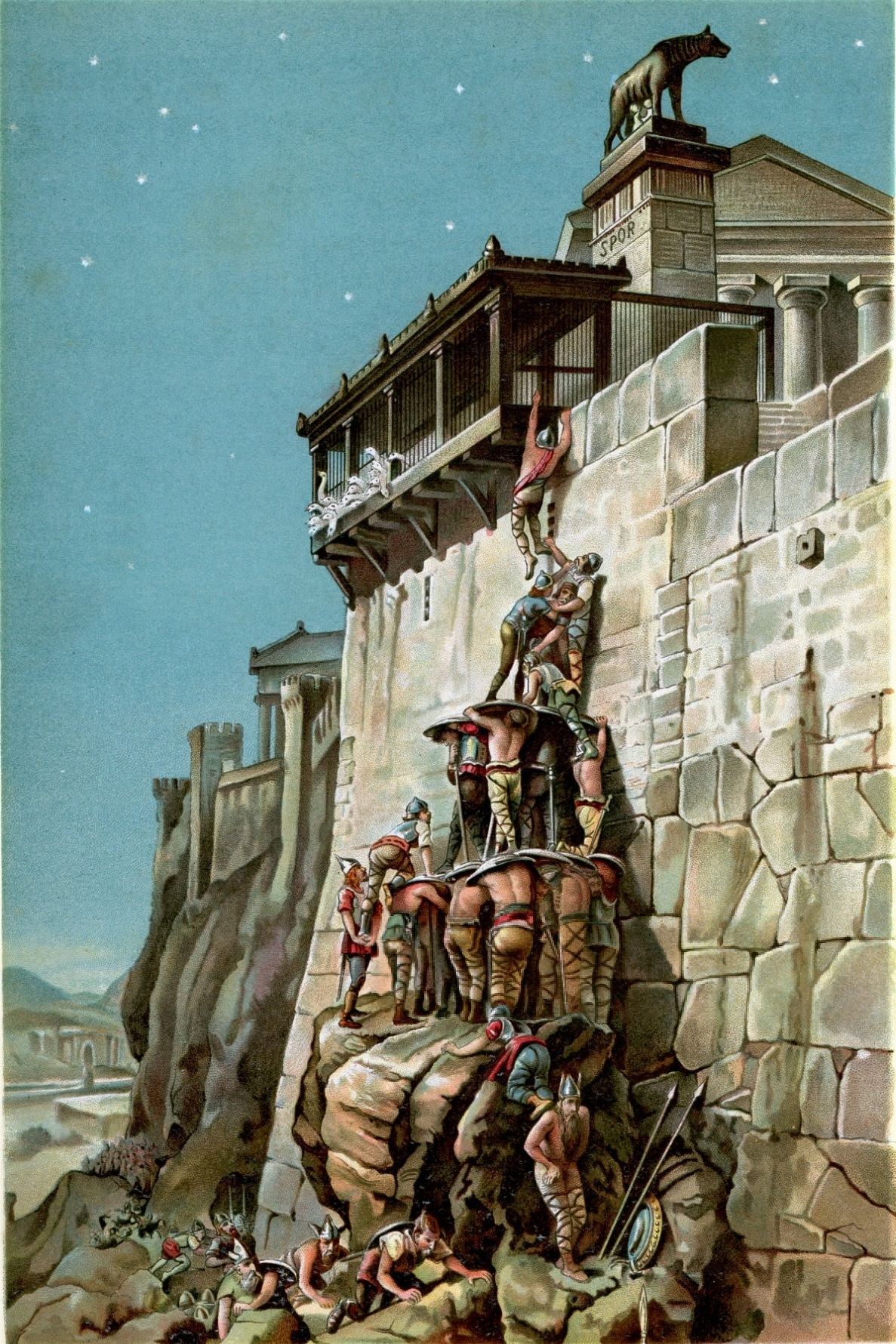
How much of it happened is another matter. Livy wrote between about 27 and 9 BC, roughly four centuries after the events, working from earlier annalists who were themselves reconstructing a period whose records had largely burned. The episode conveniently explains a standing cult practice, and it hands the Manlii their cognomen Capitolinus. It reads like a story that grew to account for things that already existed. That does not make it worthless. It makes it the earliest surviving version of a Roman idea about geese, which is a different and more honest thing to call it.
Why does a goose come at you?
Because you are near the nest, or near the goslings, and because a goose has decided that the correct response to a large approaching animal is to become a larger, louder problem than that animal wants to deal with. The sequence is consistent: head low and level, neck extended, hissing, then a run with the wings out. It is a bluff that works often enough on foxes and dogs to be worth running on people, and geese do not appear to grade the threat by size.
That trait is the reason all of this exists. Nobody kept geese at a gate because they admired their loyalty. They kept them because a goose reacts to anything unfamiliar, immediately, at volume, and cannot be quieted or befriended by an intruder the way a dog sometimes can. Livy’s version is the same observation dressed as piety. The birds that saved the Capitol were not brave and were not on watch. They were geese, and something walked past them in the dark.
If you have been chased by one in a park in April, you have met the actual animal behind the symbol, and it was not being symbolic.
The Egyptian goose, minus the inflation
Geese run through Egyptian material for three thousand years: herded and counted in tomb scenes, force-fed, offered on altars, painted with an accuracy that lets modern ornithologists argue about the species.

The theology, though, has been oversold online. What is solid: the epithet ngg wr, the Great Cackler, and a funerary formula in which the deceased identifies himself with the cosmic egg. Spell 54 of the Book of the Dead has him ask Atum for the sweet air in his nostrils and declare that he is that egg of the Great Cackler. A creator lays the world; the deceased claims to be what was laid; the spell is about breath.
What is not solid is Gengen-Wer as a great Egyptian goose god. He is a minor figure with sparse attestation, and the standard reference treats him in a fraction of a page. The cackling epithet moves between Geb and Amun depending on the text rather than belonging to a single goose deity. If a page tells you the ancient Egyptians worshipped a goose who laid the sun, it has taken one dictionary entry and grown a religion on it.
Mother Goose is French, and she is not a real woman
The origin of Mother Goose is unusually well documented, which means the popular versions can be checked and mostly fail.
The earliest known use is French. Jean Loret, in La Muse Historique collected in 1650, writes comme un conte de la Mère Oye, like a Mother Goose tale, and uses it as a phrase his readers already know. By the middle of that century Mère l’Oye was a stock figure: the older woman telling stories to children, the French equivalent of what English calls old wives’ tales.
Charles Perrault’s Histoires ou contes du temps passé appeared in 1697 with the subtitle Contes de ma mère l’Oye, and that is the first authenticated starting point. Robert Samber translated it into English in 1729 as Histories or Tales of Past Times, Told by Mother Goose, and America reprinted it in 1786.
The Boston claim, that Mother Goose was Elizabeth Foster Goose or Mary Goose and lies in the Granary Burying Ground, seems to have been produced by a descendant in 1860, has no surviving printing behind it, and is beaten to the name by Perrault regardless. The goose-footed queen theory, Berthe la fileuse or Bertrada of Laon, was dismissed by Iona and Peter Opie, and the settled position is that the name never referred to a particular person at all.
Where the biology actually backs the symbol
Two claims get made constantly about geese, and both hold up better than folk claims usually do.
The first is the pair bond. The Konrad Lorenz flock of greylags in the Alm valley in Austria, established in 1973 and studied continuously since, has produced life histories for close to a thousand individually known free-living birds. The basic social unit is a long-term monogamous pair plus offspring who stay with them for a year and sometimes longer, and the pair associates year-round rather than only in the breeding season. “Mate for life” is the shorthand and it overstates slightly, since birds re-pair after a mate dies and bonds do sometimes break. But the underlying claim, that these are durable partnerships rather than seasonal ones, is exactly what the record shows.
The second is the V. Cutts and Speakman photographed 54 skeins of pink-footed geese from directly underneath, measured wing-tip spacing and depth against local wind speed, and published in the Journal of Experimental Biology in 1994. Their measured spacing corresponded to about a 14 percent saving in induced power, which is real but well under a third of the theoretical maximum, and total power saving could be as low as 2.4 percent. The spread in positions was wide enough that they concluded the birds struggle to hold the optimum and deliberately fly outboard of it.
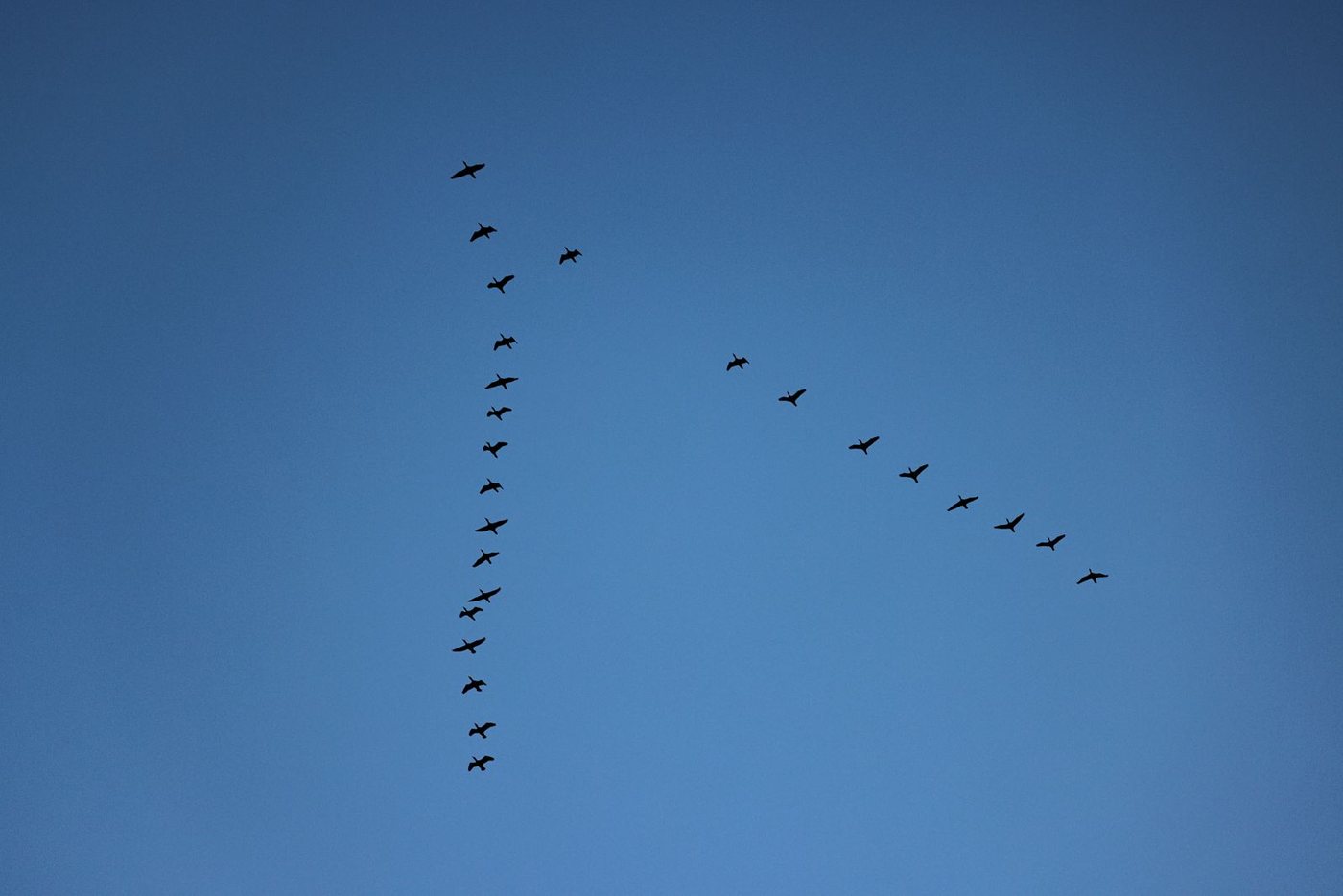
That qualification is worth keeping, because it is the difference between a symbol and a slogan. Geese do not fly in formation because cooperation is beautiful. They do it because it is slightly cheaper, they are not very precise about it, and the saving is a modest fraction of what physics would allow. The teamwork reading survives. The tidy version of it does not.
The wild goose that is not Celtic
One thing to drop before you use any of this.
A large amount of writing states that the wild goose, an geadh-glas, was the ancient Celtic Christian image of the Holy Spirit, chosen over the dove because a goose is loud and untameable. It is a genuinely good image and it appears to be about eighty years old. No text has been produced showing either phrase used that way by Christians in early medieval Ireland or Scotland, and people who use the symbol acknowledge the gap. Its documented life starts in the twentieth century with George MacLeod and the Iona Community, where it is now the community’s emblem.
That is worth keeping and worth crediting correctly. A modern symbol with a known author is not a lesser thing than an old one. It only becomes a problem when somebody antiques it, and with this bird there is no need: Livy’s geese are twenty centuries old, the Great Cackler older still, and the pair bond has been under continuous observation in an Austrian valley since 1973.
Across traditions
Roman (the geese of Juno on the Capitol)
The famous story is in Livy, Ab Urbe Condita 5.47. After the defeat at the Allia in 390 BC the Gauls under Brennus took Rome, and the remaining defenders held the Capitoline. The Gauls found a route up the cliff and climbed it at night in silence, passing the sentries and, Livy stresses, without waking the dogs. Then: "But they did not escape the notice of the geese, which were sacred to Juno and had been left untouched in spite of the extremely scanty supply of food. This proved the safety of the garrison, for their clamour and the noise of their wings aroused M. Manlius, the distinguished soldier, who had been consul three years before." Manlius threw the leading Gaul off the rock and the assault failed.
Two details deserve keeping. The first is the hunger. The garrison was starving and had eaten the dogs' rations before it would touch birds belonging to Juno, which is what makes the geese available to raise the alarm at all. The second is the comparison Livy is building: the sacred birds do the job the guard dogs did not.
Now the caution. Livy was writing between roughly 27 and 9 BC about events nearly four centuries earlier, working from an annalistic tradition that was itself reconstructing a period whose records the Gauls had largely destroyed. He is a superb writer and an unreliable witness for early Rome, and this episode has exactly the shape of an aetiological story explaining an existing cult practice and the Manlii's cognomen Capitolinus. Treat it as the earliest surviving telling, not as reportage.
- PRIMARY Livy, Ab Urbe Condita 5.47 . Composed c. 27-9 BC. Rev. Canon Roberts translation, Perseus Digital Library.
Ancient Egyptian (the Great Cackler and the Nile goose)
Geese are everywhere in Egyptian material culture: herded, counted, force-fed, offered, painted. The most famous single image is the frieze of six geese from the tomb chapel of Nefermaat and Itet at Meidum, Fourth Dynasty, around 2575 to 2551 BC, one of the most accomplished pieces of painting to survive from the Old Kingdom.
The theology is thinner than pop pages suggest, and the honest version is more interesting. There is a real epithet, ngg wr, the Great Cackler, and there is a real formula: in spell 54 of the Book of the Dead the deceased asks Atum for the sweet air in his nostrils and says "I am that egg of the Great Cackler." The image behind it is a creator laying the world as an egg. Beyond that the evidence gets sparse fast. Gengen-Wer, presented online as a major Egyptian goose god of creation, is a minor figure; Richard Wilkinson's The Complete Gods and Goddesses of Ancient Egypt (Thames and Hudson, 2003) gives him a fraction of a page. The epithet also attaches to Geb and to Amun in different contexts rather than belonging to one goose deity.
So the defensible claim is narrow: an Egyptian creation image of a cosmic egg laid by a cackling goose, invoked in a funerary spell about breath. The claim that the Egyptians worshipped a goose creator called Gengen Wer is a small entry in a reference work inflated into a pantheon.
- PRIMARY Book of the Dead, spell 54 . "I am that egg of the Great Cackler." Standard English edition: R. O. Faulkner, The Ancient Egyptian Book of the Dead, British Museum Press.
- MUSEUM Charles K. Wilkinson, Facsimile Painting of Geese, Tomb of Nefermaat and Itet . Metropolitan Museum of Art 31.6.8, Rogers Fund, 1931. Facsimile of a Dynasty 4 painting, original c. 2575-2551 BCE.
- REFERENCE Richard H. Wilkinson, The Complete Gods and Goddesses of Ancient Egypt . Thames and Hudson, 2003. The single scholarly reference behind most Gengen-Wer material online.
European storytelling (Mother Goose, and where she is not from)
Mother Goose is documented, and the documentation contradicts the popular origin stories. The earliest known reference is French: Jean Loret's La Muse Historique, collected 1650, uses the phrase comme un conte de la Mère Oye, like a Mother Goose tale, as something a reader already understands. By the mid seventeenth century Mère l'Oye was a stock name for an older woman telling stories to children, roughly what English means by old wives' tales.
Charles Perrault's Histoires ou contes du temps passé (1697), carrying the subtitle Contes de ma mère l'Oye, is the first authenticated starting point. Robert Samber's English translation of 1729, Histories or Tales of Past Times, Told by Mother Goose, brought the name into English, and it was reprinted in America in 1786.
Two claims to discard. The Boston story, that Mother Goose was Elizabeth Foster Goose or Mary Goose, wife of Isaac Goose, buried in the Granary Burying Ground, appears to have been produced by a descendant in 1860 and there is no surviving printing to support it; Perrault also predates the claim by decades. The other is the medieval French queen, Berthe la fileuse or Berthe pied d'oie, goose-footed Bertha, sometimes identified with Charlemagne's mother Bertrada of Laon. Iona and Peter Opie, the standard authorities on nursery lore, gave that no credence. The general scholarly position is that the name refers to no particular person.
- PRIMARY Charles Perrault, Histoires ou contes du temps passé, avec des moralités (Contes de ma mère l'Oye) . Paris, 1697; manuscript dated 1695. First authenticated Mother Goose collection.
- ARCHIVE The Original Mother Goose's Melody . Facsimile of the Isaiah Thomas reprint (Worcester, Mass., c. 1785) of John Newbery's London edition of c. 1760, with notes by W. H. Whitmore, Albany, 1889. Library of Congress.
- REFERENCE Iona and Peter Opie, The Oxford Dictionary of Nursery Rhymes . Oxford University Press. The standard authority; rejects the Bertha and Boston identifications.
Ted Andrews (1993), and one invented tradition to avoid
Andrews gives the goose the keynote of the call of the quest and travels to legendary places in Animal Speak (Llewellyn, 1993), reading the migration and the honking as a summons to go looking for something. That is where the modern journey-and-calling framing comes from, and it is a fair enough reading of a bird whose defining behaviour is leaving.
The claim to refuse is a different one. Many pages state that the wild goose, an geadh-glas, was the ancient Celtic Christian symbol of the Holy Spirit. No textual evidence has been produced for either phrase being used that way by Christians in Ireland or Scotland in the early medieval period, and proponents of the symbol concede as much. Its documented history begins in the twentieth century with George MacLeod and the Iona Community, for whom the wild goose is now effectively a trademark. That is a real and meaningful modern symbol with a known author. It is not ancient, and calling it ancient is the exact move this site exists to flag. Ian Bradley's Celtic Christianity: Making Myths and Chasing Dreams (Edinburgh University Press, 1999) is the standard account of how the wider Celtic-Christian golden age was constructed by later generations.
- REFERENCE Ted Andrews, Animal Speak: The Spiritual & Magical Powers of Creatures Great and Small . Llewellyn, 1993. Keynote for the goose: the call of the quest and travels to legendary places.
- PEER-REVIEWED Ian Bradley, Celtic Christianity: Making Myths and Chasing Dreams . Edinburgh University Press, 1999. On the modern construction of Celtic Christianity; cited here for that general thesis, not for the wild goose specifically.
Working with the Goose
If you want a regular practice rather than a one-time read, an oracle deck is the standard tool: you draw a card and sit with whatever animal comes up. Our ranked guide to spirit animal oracle decks compares the field.
Sources
- PRIMARY Livy, Ab Urbe Condita 5.47 . Roberts trans., Perseus Digital Library.
- PRIMARY Charles Perrault, Contes de ma mère l'Oye . Paris, 1697.
- PEER-REVIEWED C. J. Cutts and J. R. Speakman, Energy savings in formation flight of pink-footed geese . Journal of Experimental Biology 189, 251-261, 1994. 54 skeins photographed from below; measured spacing corresponds to about 14 percent saving in induced power.
- PEER-REVIEWED K. Kotrschal, J. Hemetsberger and B. M. Weiß (eds.), The Social Life of Greylag Geese: Patterns, Mechanisms and Evolutionary Function in an Avian Model System . Cambridge University Press, 2013. The Konrad Lorenz flock, founded 1973, with life histories for close to a thousand individually known birds.
- MUSEUM Charles K. Wilkinson, Facsimile Painting of Geese, Tomb of Nefermaat and Itet . Metropolitan Museum of Art 31.6.8.
- ARCHIVE The Original Mother Goose's Melody . Library of Congress.
- REFERENCE Ted Andrews, Animal Speak . Llewellyn, 1993.