Spirit Animal
Hedgehog Spirit Animal
Hedgehog spirit animal meaning: self-protection, boundaries and resourcefulness. Traced through Pliny's claim that hedgehogs carry apples home on their spines, the heraldic urcheon, Egyptian rebirth amulets, and the Archilochus fragment Isaiah Berlin made famous in 1953.
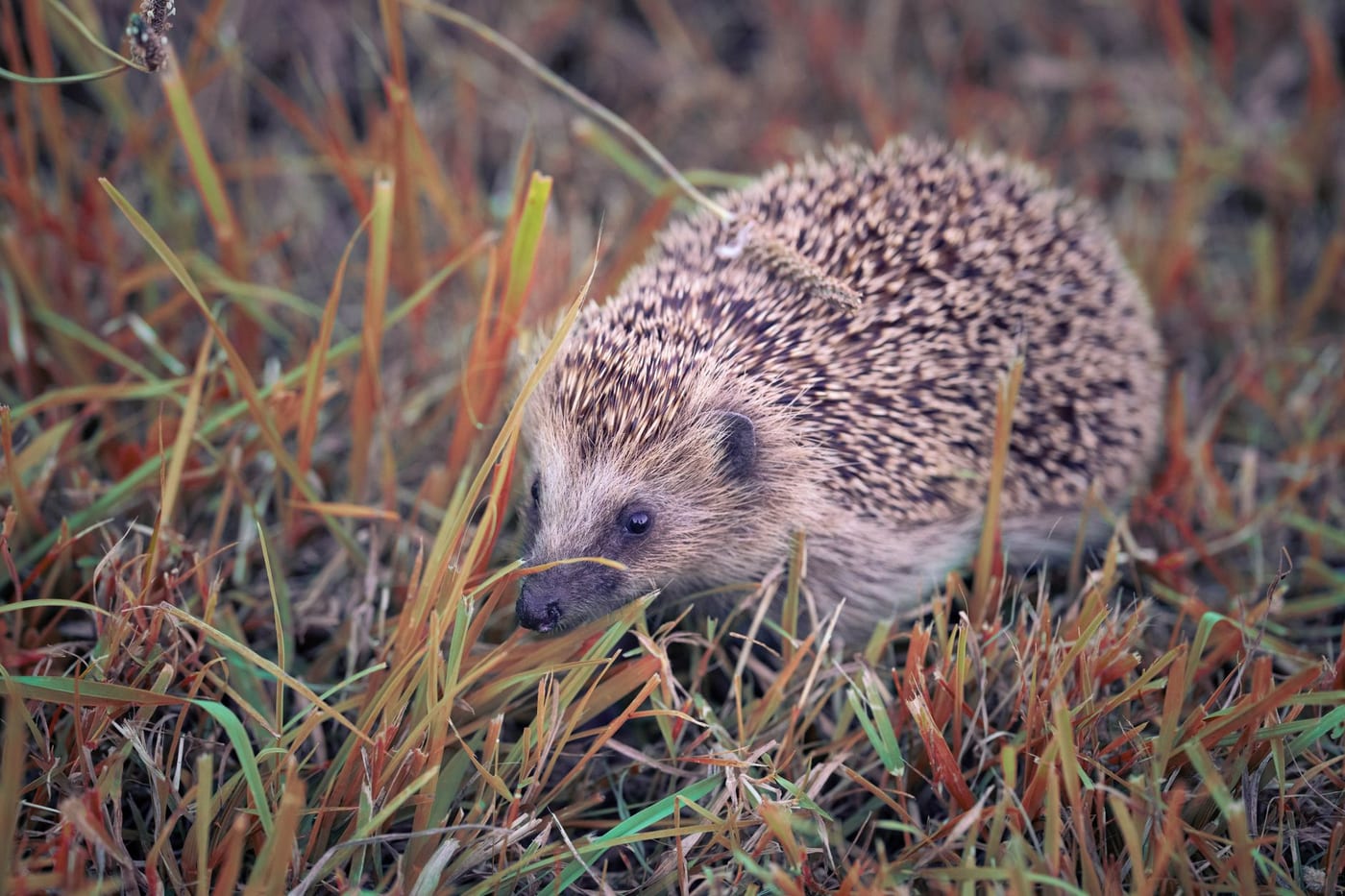
The hedgehog is read today as self-protection, boundaries, and a gentle nature that arms itself. That reading has no single traceable author; it is the animal's own behaviour turned into a lesson. What is documented is stranger: Pliny's claim that hedgehogs carry fallen apples home impaled on their spines, repeated for fifteen centuries and not documented since, and a Greek fragment about knowing one big thing.
Ask what the hedgehog means and you will be told, on page after page, that it stands for self-protection and healthy boundaries. A soft animal that carries its own defence. Gentle, but not available to be trampled.
That reading is fine. It is also not a tradition. Nobody handed it down. It is roughly what anyone arrives at after ten seconds of looking at a hedgehog, which is why it turns up on page after page with no source attached and rarely twice in the same words. On most animals this site has to work backwards through a 1993 paperback to find where the modern meaning came from. Here there is nothing to find, because the animal is doing all the work itself.
The documented material is better anyway, and it is almost entirely about being wrong. A Roman encyclopedist wrote down something hedgehogs do not do. Europe copied it for fifteen hundred years, carved it into churches, and put it on shields. Meanwhile the one genuinely peculiar thing hedgehogs actually do went largely unremarked until the twentieth century, and still has no agreed explanation.
Pliny said hedgehogs carry apples home on their spines
It is in the Natural History, Book 8, chapter 56, in a passage about animals that lay in stores for winter. Hedgehogs, Pliny says, roll on fallen apples so the fruit fixes onto their spines, then carry the load away to hollow trees, with one more apple gripped in the mouth.
Read it again. It is not a vague suggestion. It has a method, a payload, and a destination, and it even accounts for the surplus apple that will not fit on the back.
Hedgehogs do not do this. They are insectivores, working through beetles, caterpillars, earthworms and slugs. They do not cache fruit, they do not carry it on their backs, and the behaviour has not been documented despite the claim being one of the best-known facts about the animal in Europe for most of recorded history. The spines will impale things by accident. That is not the same as a harvest.
What makes it durable is that it sounds plausible if you have never watched a hedgehog and have seen a picture of one. The coat looks like a rack. Somebody, at some point, connected a spiny back to a fallen apple and the connection was too good to check.
How a wrong fact survives fifteen centuries
Isidore of Seville put it into the Etymologies in the seventh century, which was the surest route into the medieval curriculum available. His version swaps the crop: the hedgehog cuts grapes from the vine, rolls on them, and carries them to its young. Isidore’s real interest is the name. He derives ericium from the way the animal stiffens itself with its quills when it is cornered, which is at least an observation about the animal in front of him.
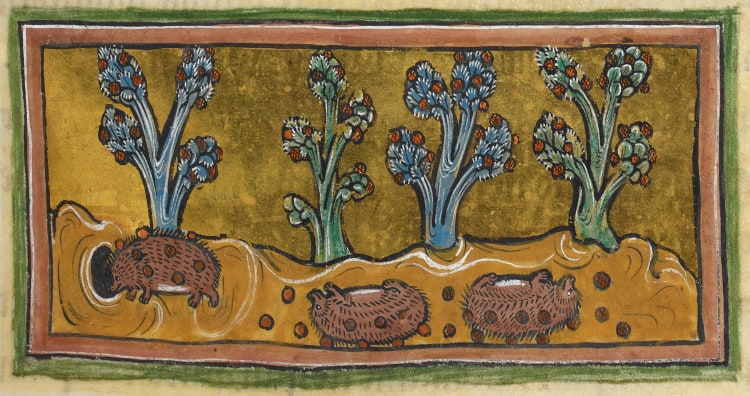
After Isidore the claim stops being anybody’s responsibility. Jacques de Vitry repeats it. Bartholomaeus Anglicus repeats it, calling the animal the Irchin, a beast covered with pricks, hard and sharp. Guillaume le Clerc’s verse bestiary says it is built like a little pig. Illuminators paint it. Masons carve it. Nobody goes outside.
The name survived better than the fact. Urchin turns up in English around 1300 as irchoun, meaning hedgehog, arriving through Old North French from the Latin ericius. It then spread by resemblance: hunchbacks by the 1520s, goblins by the 1580s, ragged children from about 1550, which is the sense that stuck. The spiny thing in the rock pool is named after the land animal and is only recorded from the 1590s. Every time you say sea urchin you are calling it a sea hedgehog.
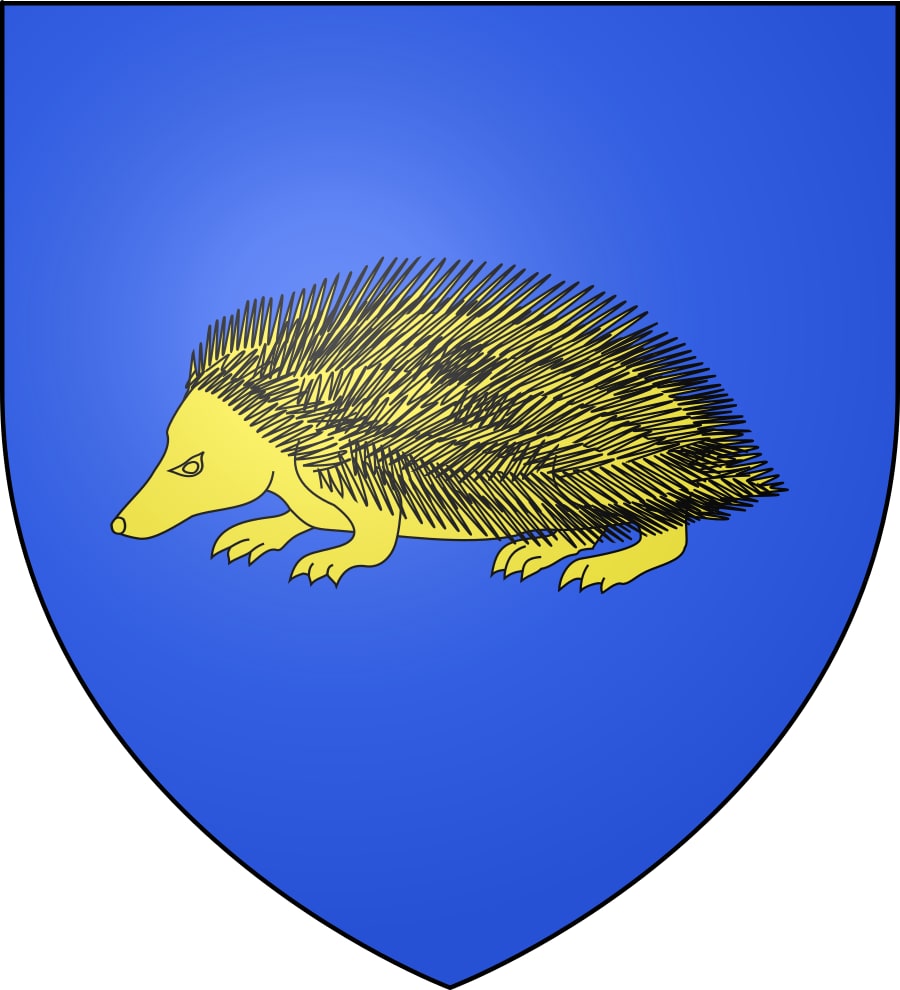
Heraldry kept the oldest form of the word. A hedgehog on a shield is an urcheon, or a herisson in French blazon, and it is very often a pun. Families and towns whose names sounded like the animal put the animal on the shield, which is why the arms of the commune of Herisson in the Allier are exactly what you would guess.
In Egypt the hedgehog was about coming back
Egypt took the animal seriously and left a great deal of evidence. Hedgehogs appear as amulets, as scaraboids, as figurines placed in tombs, as small vessels for cosmetics and perfume, and as heads carved on the prows of boats.
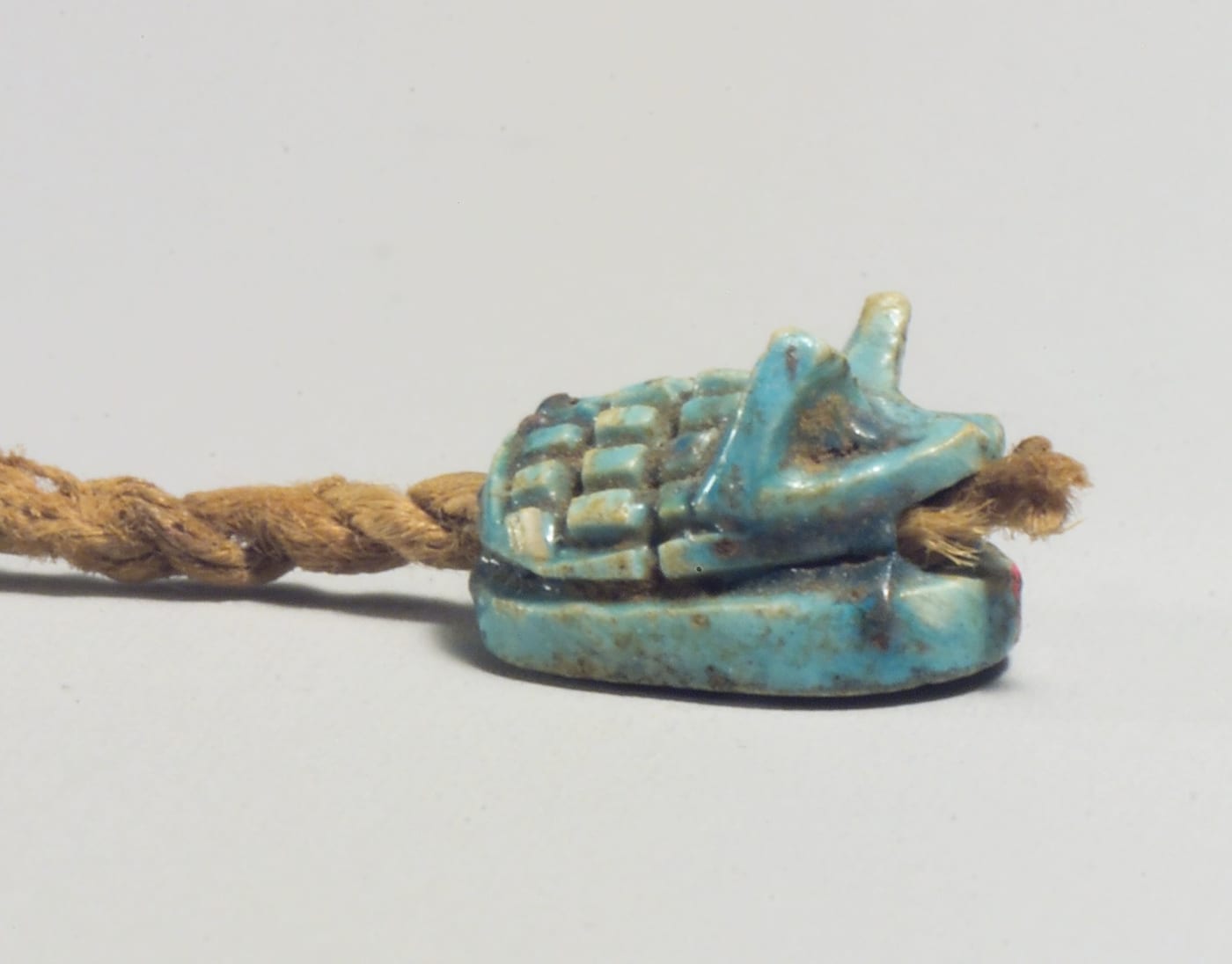
The Metropolitan Museum of Art holds one that survives on its original linen string: a hedgehog in glazed steatite less than a centimetre long, its spines rendered as a raised grid, excavated by the museum’s own expedition in 1921 to 1922 and dated to the middle of Dynasty 13, around 1750 to 1700 BCE. Somebody wore that.
Curators are careful about why, and they should be. The reading offered is that hedgehogs may have been associated with cycles of rebirth, because they go underground and come back. Desert species retreat below the surface through the worst of the summer and re-emerge weeks later, which is a very short step from returning out of the underworld. The Art Institute of Chicago adds the practical half: hedgehogs survive conditions that kill things larger than them, tolerate snake and scorpion venom, and defend themselves by curling into a ball that works. The big ears on many Egyptian examples point to the long-eared hedgehog, Hemiechinus auritus, one of two species native to North Africa. An amulet in that shape is asking for two things at once, protection now and return later.
The best object is not Egyptian at all. In the Louvre there is a small bitumen cart on four wheels, carrying three hedgehogs, with a hole drilled at the front for a pull cord. It came out of the acropolis at Susa, from the temple of Inshushinak, and it is Middle Elamite, somewhere between 1500 and 1100 BCE. It is a toy. Three and a half thousand years ago, in what is now south-western Iran, somebody made a small child a hedgehog on wheels to drag around.
One big thing
The hedgehog’s most quoted appearance is a single line of Greek by a soldier-poet of the seventh century BCE, and it survives only as a fragment: number 201 in West’s edition of Archilochus, 103 in Diehl’s. The fox knows many things, but the hedgehog one big thing.
Erasmus put it into the Adagia in Latin, which kept it alive wherever Latin was taught. Then in 1953 Isaiah Berlin borrowed it for a short book on Tolstoy, and it stopped being a proverb and became a taxonomy. Foxes chase many ends, unconnected and sometimes contradictory. Hedgehogs run everything through one organising idea. Berlin’s actual argument is more interesting than the label: Tolstoy, he says, was a fox by temperament who badly wanted to be a hedgehog, and saw particulars far too clearly to hold the system together.
Berlin got nervous about it almost immediately. He called the division an enjoyable intellectual game that had been taken seriously, while conceding that any classification throws light on something. Too late. The pair now runs loose through strategy writing, forecasting research and management books, most of which never met Archilochus and a fair number of which never read past Berlin’s title.
It is worth noticing what the fragment does and does not say. It does not say the hedgehog is wiser. It says the hedgehog knows one thing, and that the one thing is big. Read against the animal, this is not a compliment about depth. It is a description of a defence. Whatever comes at a hedgehog, the answer is the same answer, and the answer works.
The behaviour nobody has explained
Here is the thing hedgehogs genuinely do that nobody saw coming.
Present a hedgehog with a strong unfamiliar smell or taste and it will lick or chew at the source until it works up a mass of frothy saliva, then twist itself into positions that look anatomically improbable in order to spread the foam across its own spines. A session can last half an hour. The name for it is self-anointing.
Robert Brockie ran the field study in New Zealand, published in Animal Behaviour in 1976. Out of 929 wild hedgehogs examined, nineteen carried the signs of a recent bout. The dried saliva gave off a sharp smell he could pick up several metres downwind. Nestlings did it when lifted out of the nest, which he thought might tell the mother where they had gone. Adults did it only in the breeding season, which suggested a sexual signal.
Later work has not settled it. D’Havé and colleagues published on how the behaviour varies with sex, age and season in Acta Theriologica in 2005 and complicated the neat breeding-season picture. The proposals still in play are chemical defence, scent camouflage and sexual signalling. Hedgehog saliva is not known to carry anything toxic, which weakens the first. Half a century of watching, and the honest answer is that nobody knows.
So what is the hedgehog for
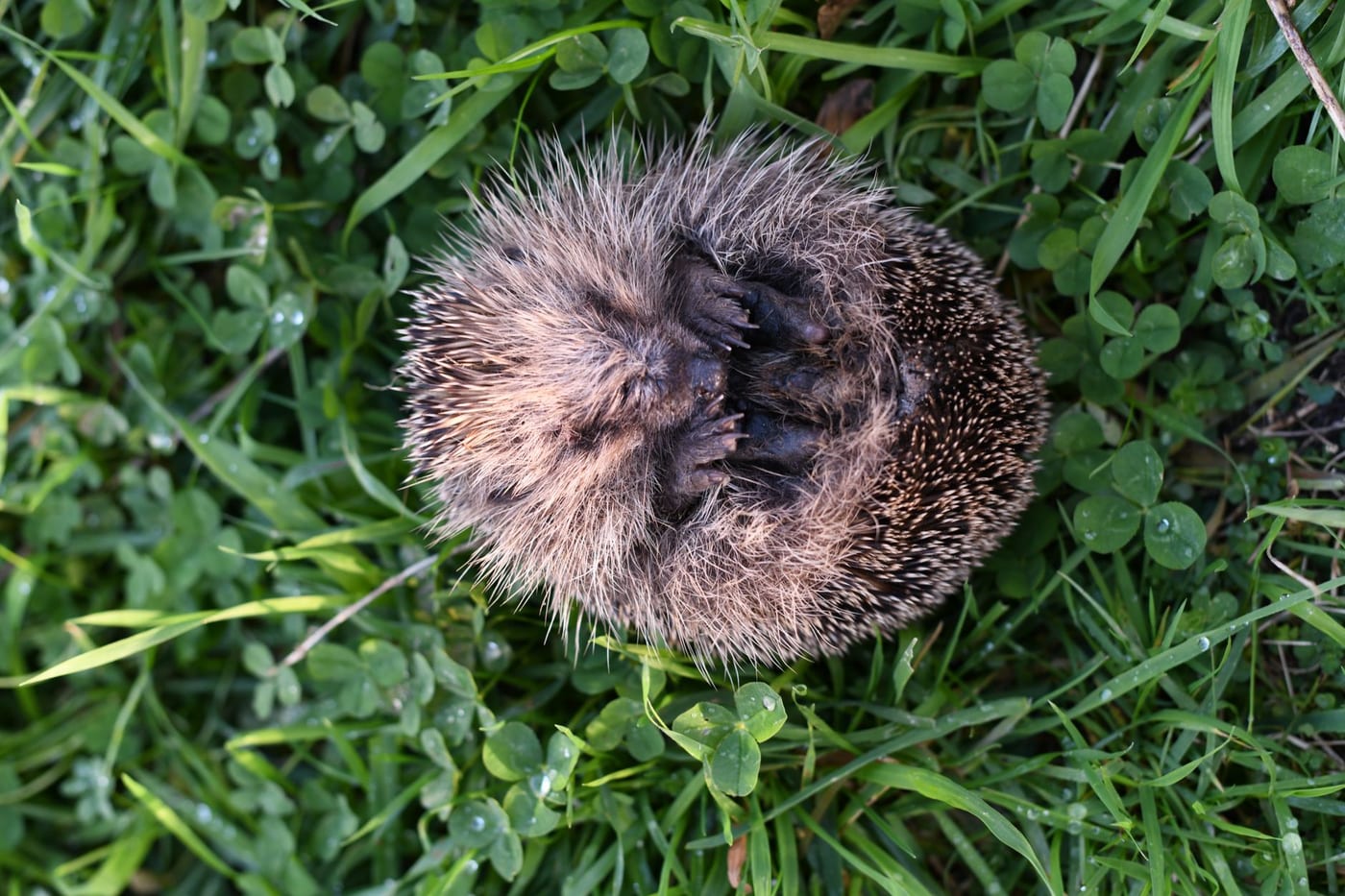
If you want to use the hedgehog, use it for the thing it is unambiguously about, which is a defence that does not require you to become dangerous. Curling up is not an attack. It costs the animal nothing and it ends the conversation. That is a real idea and the modern boundaries reading gets it right, even if it has no pedigree.
What the record adds is two warnings.
The first is Pliny’s, and it is not really about hedgehogs. A plausible claim about a familiar animal ran for fifteen centuries through the best-educated writers in Europe because it fit and because checking it would have meant going outside at dusk in the rain. If you are looking for a reason to distrust the confident paragraph you just read about what an animal means, that is the reason.
The second is Archilochus’s. The hedgehog knows one big thing. Berlin turned that into a compliment about intellectual unity, and a whole management literature turned it into advice. The animal itself suggests something narrower. Knowing one big thing is enough right up until you meet a badger, which knows how to unroll you, or a road, which does not care what you know at all.
Across traditions
Greek and Roman natural history
Aristotle's Historia Animalium treats the hedgehog twice, once on the nature of its spines, which he classes as hair so altered by stiffness that it barely resembles hair, and once on a behaviour he says has been observed repeatedly: when the wind shifts between north and south, hedgehogs living in the ground change which entrance of the burrow they use. The second observation is the kind of thing that made hedgehogs interesting to ancient writers. They were treated as weather-wise, prudent, forward-planning animals.
Pliny the Elder made that reputation concrete in the Natural History, Book 8, chapter 56. Hedgehogs, he says, lay in food for winter by rolling on fallen apples so the fruit fixes onto their spines, then carry the load to hollow trees with one more apple held in the mouth. He also repeats the wind claim.
Aelian follows with the hedgehog as an animal made prudent and experienced by nature in providing for itself. Ambrose, writing on the six days of creation, has hedgehogs sense danger coming and gather themselves behind their shields. That is a Christian bishop, a Roman naturalist and a Greek philosopher all describing an animal that plans.
- PRIMARY Aristotle, Historia Animalium . On the spines as modified hair, and on hedgehogs changing burrow entrances with the wind. Cresswell translation, 1887.
- PRIMARY Pliny the Elder, Natural History, Book 8, chapter 56 . Hedgehogs fix fallen apples on their spines by rolling on them and carry them to hollow trees.
- PRIMARY Aelian, On the Characteristics of Animals, Book 3, chapter 10 . Scholfield translation, Loeb Classical Library.
- PRIMARY Ambrose, Hexameron, Book 6, 4.20 . Savage translation, 1961.
Medieval bestiary and English heraldry
Isidore of Seville put the hedgehog into the Etymologies at Book 12, 3.7, deriving ericium from the way the animal stiffens itself with its quills when cornered. Isidore also passed on the fruit story with the crop changed: in his version the hedgehog cuts grapes from the vine and rolls on them to carry them to its young.
From there the claim is everywhere. Jacques de Vitry, writing on the crusader kingdom, calls the hedgehog clever for exactly this reason. Bartholomaeus Anglicus has the Irchin, a beast covered with pricks, hard and sharp. Guillaume le Clerc says it is shaped like a little pig. The Rochester Bestiary, British Library Royal MS 12 F XIII, paints the whole thing: hedgehogs beneath fruiting vines with the harvest on their backs.
The English word tracks the same animal. Urchin appears around 1300 as irchoun, meaning hedgehog, from Old North French and behind that the Latin ericius. It was applied to hunchbacks by the 1520s, to goblins by the 1580s, and to ragged children from about 1550. The spiny sea creature is named after the hedgehog and is only attested from the 1590s. In heraldry the beast kept the older name: a hedgehog on a shield is an urcheon, or in the French blazon a herisson, and it is usually canting arms, a visual pun on the bearer's name.
- PRIMARY Isidore of Seville, Etymologies, Book 12, 3.7 . Barney, Lewis, Beach and Berghof translation, Cambridge University Press.
- ARCHIVE Rochester Bestiary, British Library Royal MS 12 F XIII, f. 45r . English, late thirteenth century. Hedgehogs collecting grapes on their spines.
- PRIMARY Jacques de Vitry, Historia Hierosolymitana, chapter 92
- PRIMARY Bartholomaeus Anglicus, De proprietatibus rerum, 18.61 to 18.62 . Batman translation, 1582. The Irchin is called Hiricus.
- REFERENCE Urchin, Online Etymology Dictionary . c. 1300 irchoun, hedgehog, from Old North French; sea-urchin attested 1590s.
- REFERENCE A.C. Fox-Davies, A Complete Guide to Heraldry . 1909. Figure 411 is captioned Urcheon.
Ancient Egypt and Elamite Susa
Egyptian craftsmen made hedgehogs in quantity: amulets, scaraboids, figurines left in tombs, small vessels for cosmetics and perfume, and hedgehog heads on the prows of boats. The Metropolitan Museum of Art holds one still on its original linen string, a glazed steatite hedgehog under a centimetre long, excavated by the museum in 1921 to 1922 and dated to the middle of Dynasty 13, roughly 1750 to 1700 BCE.
Museum curators give a consistent reading, carefully hedged. The hedgehog may have been associated with cycles of rebirth because it goes underground and comes back. Desert species retreat below the surface through the worst of the heat and re-emerge weeks later, which reads easily as a return from the underworld. Hedgehogs are also formidable for their size, tolerant of snake and scorpion venom, and equipped with a defence that works, so an amulet transfers something practical as well as something theological. The Art Institute of Chicago notes that the large ears on many Egyptian examples point to the long-eared hedgehog, Hemiechinus auritus, one of the two species native to North Africa.
Further east, the Louvre holds a wheeled hedgehog from Susa, Middle Elamite, 1500 to 1100 BCE, excavated on the acropolis at the temple of Inshushinak: a small bitumen cart carrying three hedgehogs, with a hole at the front for a pull cord. It is a child's toy. Three and a half thousand years ago somebody made a toddler a hedgehog on wheels.
- MUSEUM Hedgehog Amulet on a String, The Metropolitan Museum of Art, 22.1.301 . Glazed steatite and linen string, mid-Dynasty 13, ca. 1750 to 1700 BCE. MMA excavations 1921 to 1922. Rogers Fund and Edward S. Harkness Gift, 1922.
- MUSEUM Animal Amulets: Ancient Egyptian Art and the Natural World, The Art Institute of Chicago . On hedgehog scaraboids, the long-eared hedgehog, and the rebirth association.
- MUSEUM Toy: wheeled hedgehog, Musee du Louvre, SB 2908 . Middle Elamite, 1500 to 1100 BCE. Susa acropolis, temple of Inshushinak. Bitumen and limestone.
Archilochus, Erasmus, and Isaiah Berlin
One line of Greek has done more for the hedgehog's reputation than every bestiary combined. It survives as a fragment of Archilochus, numbered 201 in West's edition and 103 in Diehl's: poll' oid' alopex, all' echinos hen mega. The fox knows many things, but the hedgehog one big thing.
Erasmus carried it into the Adagia as Multa novit vulpes, verum echinus unum magnum, which kept it in circulation across educated Europe. Then in 1953 Isaiah Berlin used it as the frame for an essay on Tolstoy, published as The Hedgehog and the Fox by Weidenfeld and Nicolson. Foxes pursue many ends, unrelated and often contradictory. Hedgehogs relate everything to a single organising vision. Berlin's argument about Tolstoy is that he was a fox by nature who wanted to be a hedgehog, and could not stop seeing particulars clearly enough to sustain the system he longed for.
Berlin was uneasy about what happened next. He described the division as an enjoyable intellectual game that was taken seriously, while allowing that any classification throws light on something. It escaped anyway. The hedgehog and the fox are now standard vocabulary in strategy, forecasting and management writing, most of which has never read Archilochus and some of which has never read Berlin.
- PRIMARY Archilochus, fragment 201 West (103 Diehl) . The fox knows many things, but the hedgehog one big thing.
- PRIMARY Erasmus, Adagia . Multa novit vulpes, verum echinus unum magnum.
- REFERENCE Isaiah Berlin, The Hedgehog and the Fox: An Essay on Tolstoy's View of History . Weidenfeld and Nicolson, 1953. Reprinted in Russian Thinkers and The Proper Study of Mankind.
Self-anointing, a behaviour still unexplained
Hedgehogs do one genuinely strange thing, and unlike the apples it is real, filmed, and still not accounted for. On meeting a strong new smell or taste, a hedgehog will lick or chew the source, work up a quantity of frothy saliva, and then twist itself round to spread the foam across its own spines. The contortion is extreme and the session can run for half an hour. It is called self-anointing.
Robert Brockie's field study of wild hedgehogs in New Zealand, published in Animal Behaviour in 1976, examined 929 animals and found nineteen bearing signs of recent self-anointing. The saliva carried a sharp smell detectable several metres downwind. Nestlings anointed when lifted out of the nest, which Brockie suggested might advertise their position to the mother; among adults he recorded it only in the breeding season, and proposed a sexual signal.
Later work complicated that. D'Havé and colleagues, publishing in Acta Theriologica in 2005, examined how the behaviour varies with sex, age and season and did not simply confirm the breeding-season pattern. Proposals still on the table include chemical defence, scent camouflage and sexual signalling. Hedgehog saliva is not known to carry anything toxic. After half a century of watching, the honest position is that nobody knows what it is for.
- PEER-REVIEWED R.E. Brockie, Self-anointing by wild hedgehogs, Erinaceus europaeus, in New Zealand . Animal Behaviour, volume 24, 1976, pages 68 to 71. 929 animals examined, 19 showing recent self-anointing.
- PEER-REVIEWED H. D'Havé, J. Scheirs, R. Verhagen and W. De Coen, Gender, age and seasonal dependent self-anointing in the European hedgehog Erinaceus europaeus . Acta Theriologica, volume 50, issue 2, 2005, pages 167 to 173.
Working with the Hedgehog
If you want a regular practice rather than a one-time read, an oracle deck is the standard tool: you draw a card and sit with whatever animal comes up. Our ranked guide to spirit animal oracle decks compares the field.
Sources
- PRIMARY Pliny the Elder, Natural History, Book 8, chapter 56
- PRIMARY Aristotle, Historia Animalium
- PRIMARY Isidore of Seville, Etymologies, Book 12, 3.7 . Barney, Lewis, Beach and Berghof translation, Cambridge University Press.
- ARCHIVE Rochester Bestiary, British Library Royal MS 12 F XIII, f. 45r
- MUSEUM Hedgehog Amulet on a String, The Metropolitan Museum of Art, 22.1.301
- MUSEUM Animal Amulets, The Art Institute of Chicago
- MUSEUM Toy: wheeled hedgehog, Musee du Louvre, SB 2908
- PRIMARY Archilochus, fragment 201 West
- REFERENCE Isaiah Berlin, The Hedgehog and the Fox . Weidenfeld and Nicolson, 1953.
- PEER-REVIEWED R.E. Brockie, Animal Behaviour 24 (1976), 68 to 71
- PEER-REVIEWED D'Havé et al., Acta Theriologica 50:2 (2005), 167 to 173
- REFERENCE Urchin, Online Etymology Dictionary