Spirit Animal
Moose Spirit Animal
Moose spirit animal meaning: self-esteem, confidence and groundedness. Traced from the modern self-esteem-and-groundedness reading back through Ted Andrews's Animal Speak to the Anishinaabe Mooz doodem, Mistassini Cree hunting religion, Wabanaki moose-calling craft, and the elk-head staffs of the Mesolithic Baltic.
In modern American "spirit animal" usage, the moose most often stands for self-esteem, groundedness, primal instinct, and the confidence to stand your ground. That reading descends most directly from Ted Andrews's Animal Speak (Llewellyn, 1993). Older traditions are sharper and more specific. The Anishinaabe (Ojibwe) doodem system names Mooz as one of roughly twenty-one hereditary clans recorded by William Warren in 1885. The Cree hunters of the James Bay region hold that a moose gives itself to a hunter who shows correct respect, an economy of reciprocity documented by anthropologist Adrian Tanner among the Mistassini Cree. Wabanaki and Mi'kmaq hunters developed the birchbark moose-calling horn, a precision craft object still made today. And in the Mesolithic Baltic, antler staffs carved as elk heads were placed in burials some 8,000 years ago, long before any Norse saga existed to borrow the animal's name.
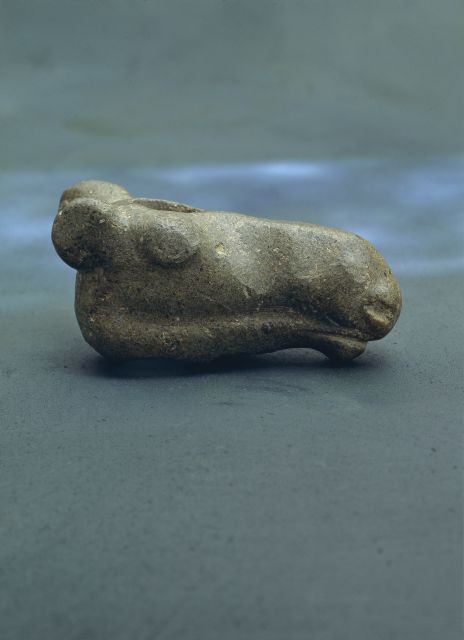
A Finnish potato farmer turned up a strange stone lump in 1903, near the village of Huittinen, and nearly threw it back into the field. What he’d actually found was a soapstone moose head, roughly ten centimeters long, carved about 6,500 years before he was born. It has a hole bored through the neck, so it was likely mounted on a staff and carried, not set on a shelf to be admired. Soapstone doesn’t occur naturally anywhere near where it was dug up, so someone imported the raw material, or the finished object, from the other side of the country. It now sits in the National Museum of Finland’s permanent exhibition, generally regarded as the oldest stone sculpture ever found in the country.
That is what a real moose tradition looks like: an object with a findspot, a material-sourcing puzzle, a plausible ceremonial function, and eighty-five centuries of silence about what it actually meant to the person who carved it. The modern “moose spirit animal” reading is something considerably newer and considerably vaguer.
What the pop reading actually inherited
Ted Andrews’s Animal Speak came out of Llewellyn in September 1993, the same paperback that supplies most of the internet’s bear, wolf, and deer entries too. His moose is built around what he calls “primal contact with the great feminine force and void of life,” an animal whose enormous size and near-total ability to vanish into brush becomes, in his framing, an ancient magic of invisibility and shapeshifting. That reading is where “self-esteem” and “confidence” enter the keyword lists that now blanket spirit-animal search results. It borrows the general atmosphere of northern hunting cultures without naming a single one of them.
Five traditions, each with its own accounting of the animal
The Anishinaabe doodem. William Warren, an Ojibwe and French-descended historian who died in 1853 at twenty-eight, spent his short life collecting oral history from elders across Minnesota and Wisconsin. His book, published by the Minnesota Historical Society more than thirty years after his death, records roughly twenty-one hereditary clans in the Ojibwe doodem system, and Mooz, the Moose, is one of them, alongside two related lesser totems for “little moose” and “little moose-tail.” A doodem is inherited from the father’s line at birth. It governs who you can marry and what social role you fill for life. It is not a personality trait you pick.
Mistassini Cree hunting religion. Anthropologist Adrian Tanner spent a year and a half with Cree hunters in the Mistassini region of Quebec documenting a working religious economy: an animal that is treated correctly, in life and in the disposal of its remains, is understood to make itself available to the hunter again. That’s not metaphor to the people practicing it. It’s the actual logic behind hunting divination, songs sung before a hunt, and careful handling of bones, and it structured whether families ate through the winter. Tanner’s fieldwork remains the standard account.
The Wabanaki moose-calling horn. Among the Mi’kmaq, Maliseet, Penobscot, and neighboring Wabanaki nations, moose knowledge took physical, technical form: a rolled birchbark cone used to imitate a cow moose’s call during the September rut, drawing a bull within range. It rewards precision, not sentiment. Bark selection, timing, and the caller’s own voice all matter, and the craft is still practiced. The Metropolitan Museum of Art holds a Mi’kmaq example acquired in 1889, part of its Crosby Brown Collection of Musical Instruments, and the Canadian Museum of History holds comparable calls from Maliseet, Algonquin, and Innu makers. Ruth Holmes Whitehead’s Elitekey, a 1980 Nova Scotia Museum study of Mi’kmaq material culture, situates the moose call within a much wider record of hide-working and moose-hair embroidery on birchbark.
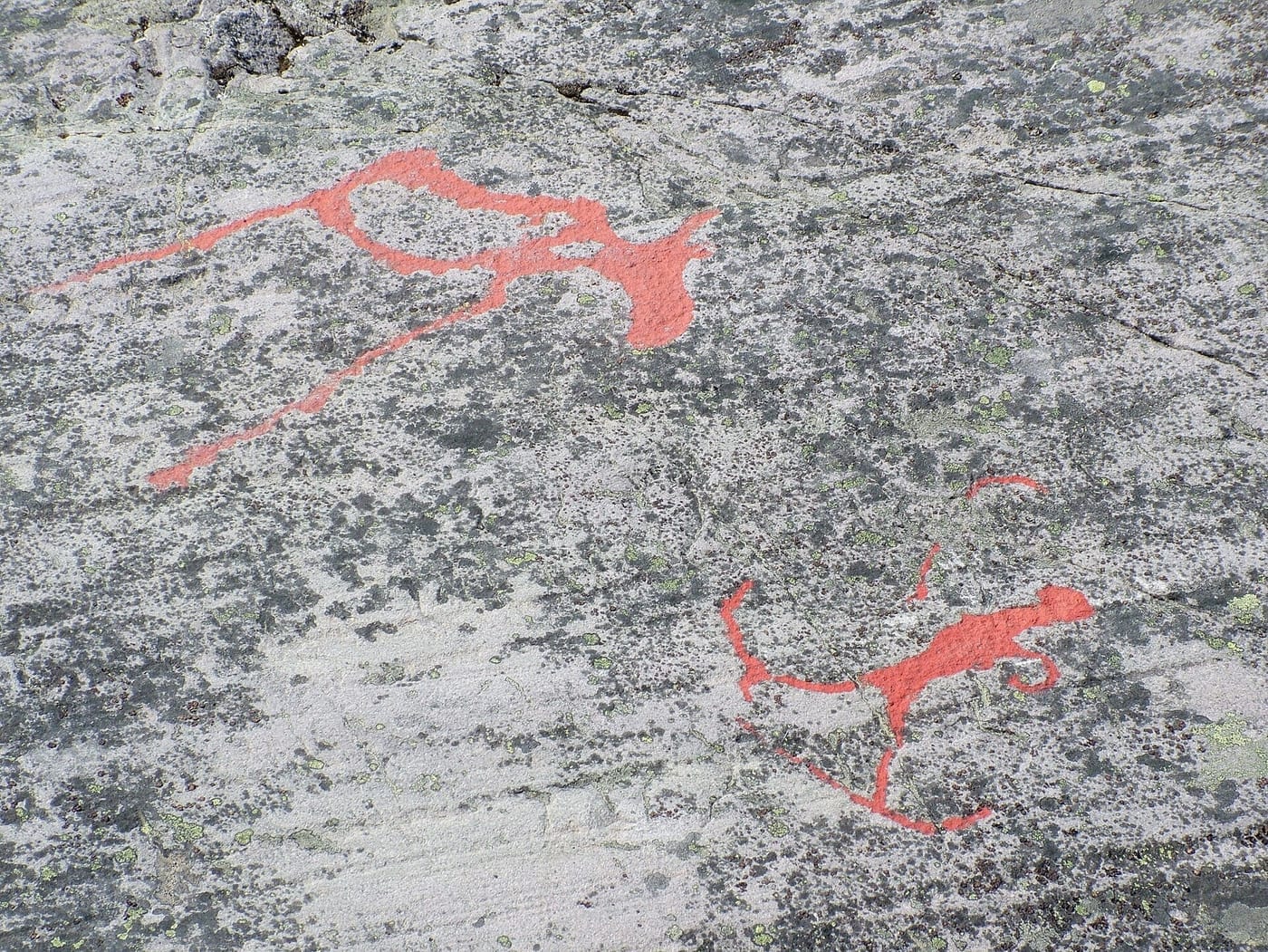
The Mesolithic Baltic elk-head staffs. At Yuzhniy Oleniy Ostrov, a cemetery of more than 170 burials on Lake Onega in Karelia dated to roughly 6200 BCE, the richest single grave held an antler staff carved as an elk’s head, resting near the skull of the person buried with it. Ville Mantere and Ekaterina Kashina’s 2020 survey in the Oxford Journal of Archaeology catalogs some thirty comparable staffs stretching from the Baltic coast to the Ural Mountains, in use across several thousand years, and reads them as markers of status and prestige rather than ordinary hunting gear. Rock art at Alta in Norway and at Besov Nos on Lake Onega, both UNESCO World Heritage sites, carve the same animal into open bedrock across thousands of individual images. None of this is Norse mythology. It predates the Viking Age by six or seven thousand years, and the Eddas themselves never mention the animal.
Sámi drum iconography. In Sámi religious life, the reindeer is the central animal by a wide margin, and the moose is a secondary figure who nonetheless shows up on the noaidi’s painted drum, the goavddis, used for trance and divination. Ernst Manker’s two-volume catalog of the roughly seventy surviving drums, published in 1938 and 1950, remains the foundational inventory. Rolf Kjellström and Håkan Rydving’s 1988 study for the Nordiska museet organizes the recurring drum imagery into categories, reindeer, bears, moose and other mammals, hunting scenes, dwellings, deities, and moose sits inside that catalog as one working hunting symbol among several, never inflated into a singular meaning the way a modern keyword list inflates it.
What they share and what they don’t
What they share is proximity without agreement. Every tradition here comes from people who lived beside actual moose, hunted them, depended on them, and built real knowledge systems (kinship law, hunting divination, craft technique, funerary practice, divinatory iconography) around that dependence. None of the five traditions above treats the moose as a metaphor for a personal quality.
What they don’t share is almost everything else. The Anishinaabe moose is a hereditary kinship marker that governs who you can marry. The Cree moose is a partner in a reciprocal hunting economy with real stakes each winter. The Wabanaki moose is a technical craft problem, solved with rolled bark and a trained voice. The Mesolithic Baltic moose is buried beside the powerful dead, carved onto open rock by the thousand. The Sámi moose is one hunting symbol on a shaman’s working instrument, never the central one. Compress all five into “the moose represents self-esteem,” and every one of those specific, documented relationships disappears.
Across traditions
Anishinaabe / Ojibwe (Great Lakes)
The Anishinaabe doodem (clan, anglicized as "totem") system organizes hereditary, patrilineal kinship groups, each carrying an animal name and a bundle of social obligations: who you could marry, what role you filled in council, what you owed the group. William Warren, an Ojibwe and French-descended historian who collected oral testimony from elders across Minnesota and Wisconsin in the years before his death in 1853, recorded roughly twenty-one such clans in History of the Ojibway People, published posthumously by the Minnesota Historical Society in 1885. Mooz, the Moose, is one of them, grouped by later ethnographers with the hunting-and-scouting branch of the clan system alongside two related lesser totems, Moozoons ("little moose") and Moozwaanowe ("little moose-tail").
A doodem is not a personal spirit-guide chosen by an individual. It is inherited at birth from the father's line, and it structures a person's obligations to the wider community for life. Reducing Mooz to a mood or a virtue erases the entire kinship architecture Warren spent a book describing.
- PRIMARY William W. Warren, History of the Ojibway People, Based Upon Traditions and Oral Statements . Minnesota Historical Society, 1885 (composed 1852).
Cree (James Bay / Mistassini)
For the Cree hunters of the James Bay region of Quebec, the moose has never been a symbol. It has been a partner in a working relationship with real subsistence stakes. Anthropologist Adrian Tanner spent eighteen months among the Mistassini Cree documenting how hunting religion actually functions: a hunter who treats an animal, and its remains, with the correct respect is understood to be rewarded when that animal (or another) subsequently allows itself to be found and taken. Tanner's Bringing Home Animals: Religious Ideology and Mode of Production of the Mistassini Cree Hunters (1979) lays out the hunting divination, the songs, and the treatment of bones that make up this reciprocal economy, moose and caribou both included.
This is not "the moose teaches confidence." It is a functioning system of ecological knowledge and religious obligation that determined whether a family ate that winter, and it survives in the harvesting practices of Cree communities in Eeyou Istchee today.
- PEER-REVIEWED Adrian Tanner, Bringing Home Animals: Religious Ideology and Mode of Production of the Mistassini Cree Hunters . Institute of Social and Economic Research, Memorial University of Newfoundland / C. Hurst & Co. / St. Martin's Press, 1979.
Wabanaki / Mi'kmaq (Maritime Northeast)
Among the Mi'kmaq, Maliseet, Penobscot, and other Wabanaki nations of the northeastern woodlands, moose knowledge took the form of a precision tool: the birchbark moose-calling horn, a rolled cone of bark used by a hunter to reproduce the call of a cow moose during the September rut and draw a bull within range. It is not an abstract emblem. Timing, bark selection, and vocal technique all matter, and the craft is still practiced by Wabanaki hunters today. The Metropolitan Museum of Art holds a Mi'kmaq bark trumpet moose call in its Crosby Brown Collection of Musical Instruments, acquired in 1889, and the Canadian Museum of History holds comparable calls from Maliseet, Algonquin, and Innu makers.
Ruth Holmes Whitehead, longtime ethnologist and curator at the Nova Scotia Museum, situates the moose within the fuller Mi'kmaq material record in Elitekey: Micmac Material Culture from 1600 A.D. to the Present (Nova Scotia Museum, 1980), covering hide-working, moose-hair-and-quill embroidery on birchbark, and the seasonal round that put moose hunting in its proper place among many other subsistence activities.
- PEER-REVIEWED Ruth Holmes Whitehead, Elitekey: Micmac Material Culture from 1600 A.D. to the Present . Nova Scotia Museum, 1980.
- MUSEUM Bark Trumpet / Moose Call (Mi'kmaq), Crosby Brown Collection of Musical Instruments . The Metropolitan Museum of Art, acquired 1889.
Prehistoric Scandinavian and Baltic (rock art and elk-head staffs)
There is no moose or elk deity in the Old Norse literary corpus. The Eddas are silent on the animal by name. The real Scandinavian and Baltic material is thousands of years older than the Viking Age and comes from archaeology, not saga. At Yuzhniy Oleniy Ostrov, a Late Mesolithic cemetery on Lake Onega in Karelia dated to roughly 6200 BCE, the richest of more than 170 burials (grave 56) was found with an antler staff carved as an elk's head resting near the head of the deceased. Ville Mantere and Ekaterina Kashina's 2020 survey in the Oxford Journal of Archaeology catalogs some thirty such elk-head staffs across a range from the Baltic to the Urals, in use from the Late Mesolithic into the Early Metal Period, and reads them as signs of status and prestige rather than ordinary tools.
Rock art tells the same story from a different angle. The UNESCO-listed carvings at Alta in northern Norway, dated from roughly 4200 BCE to 200 CE, depict elk alongside reindeer, bears, and boats across more than six thousand individual images. At Besov Nos and other sites on Lake Onega, another UNESCO-listed complex, elk and moose figures make up roughly a tenth of the several thousand carved images. Whatever these hunter-gatherer societies meant by the animal, they meant it for millennia before anyone wrote a word of Norse mythology.
- PEER-REVIEWED Ville N. Mantere and Ekaterina A. Kashina, Elk-Head Staffs in Prehistoric North-Eastern Europe and North-Western Russia: Signs of Power and Prestige? . Oxford Journal of Archaeology 39 (2020): 2-18.
- PEER-REVIEWED John O'Shea and Marek Zvelebil, Oleneostrovski Mogilnik: Reconstructing the Social and Economic Organization of Prehistoric Foragers in Northern Russia . Journal of Anthropological Archaeology 3 (1984): 1-40.
- ARCHIVE UNESCO World Heritage Centre, Rock Art of Alta . Inscribed 1985.
- ARCHIVE UNESCO World Heritage Centre, Petroglyphs of Lake Onega and the White Sea . Inscribed 2021.
Sámi (northern Fennoscandia)
In Sámi religious life, the reindeer is central and the moose is a secondary figure, present but never dominant, and any honest account has to keep that proportion straight. The noaidi (shaman) used a painted drum, the goavddis, as a working instrument, a tool for divination and trance rather than decoration. Ernst Manker's two-volume catalog Die lappische Zaubertrommel (1938 and 1950) remains the foundational inventory of the roughly seventy surviving drums, documenting their regional styles and painted figures directly from the objects themselves.
Rolf Kjellström and Håkan Rydving's Den samiska trumman (Nordiska museet, 1988) organizes the recurring drum symbols into categories: reindeer, bears, moose and other mammals, hunting and fishing scenes, dwellings, and deities. Moose appears in that catalog as one working symbol among many, tied to hunting rather than to any single overriding meaning, which is the opposite of how a pop-spirituality page tends to isolate one animal and inflate it.
- PRIMARY Ernst Manker, Die lappische Zaubertrommel: Eine ethnologische Monographie . 2 vols., Thule, Stockholm, 1938 and 1950.
- PEER-REVIEWED Rolf Kjellström and Håkan Rydving, Den samiska trumman . Nordiska museet, Sameutställningens småskrifter 2, Stockholm, 1988.
Ted Andrews (1993, the pop-concept's source)
Ted Andrews's Animal Speak (Llewellyn, 1993) gives the moose an entry built around what Andrews calls "primal contact with the great feminine force and void of life," an invitation to explore new depths of awareness and sensitivity. He describes moose as one of the most ancient and unique of the power totems, and links its size-defying knack for disappearing into thick brush to what he frames as an ancient magic of invisibility and shapeshifting. Downstream spirit-animal websites, largely repeating and simplifying Andrews, are where "self-esteem" and "confidence" enter the keyword set.
None of the Anishinaabe, Cree, Wabanaki, Scandinavian, or Sámi material above appears in Andrews's synthesis by name. The moose he describes is a composite drawn from general northern-woods atmosphere, not from any specific documented tradition.
- REFERENCE Ted Andrews, Animal Speak: The Spiritual & Magical Powers of Creatures Great and Small . Llewellyn, September 1993.
Working with the Moose
If you want a regular practice rather than a one-time read, an oracle deck is the standard tool: you draw a card and sit with whatever animal comes up. Our ranked guide to spirit animal oracle decks compares the field.
Sources
- PRIMARY William W. Warren, History of the Ojibway People . Minnesota Historical Society, 1885.
- PEER-REVIEWED Adrian Tanner, Bringing Home Animals: Religious Ideology and Mode of Production of the Mistassini Cree Hunters . Institute of Social and Economic Research / C. Hurst & Co. / St. Martin's Press, 1979.
- PEER-REVIEWED Ruth Holmes Whitehead, Elitekey: Micmac Material Culture from 1600 A.D. to the Present . Nova Scotia Museum, 1980.
- MUSEUM Bark Trumpet / Moose Call (Mi'kmaq), The Metropolitan Museum of Art . Crosby Brown Collection of Musical Instruments, acquired 1889.
- PEER-REVIEWED Ville N. Mantere and Ekaterina A. Kashina, Elk-Head Staffs in Prehistoric North-Eastern Europe and North-Western Russia . Oxford Journal of Archaeology 39 (2020): 2-18.
- PEER-REVIEWED John O'Shea and Marek Zvelebil, Oleneostrovski Mogilnik . Journal of Anthropological Archaeology 3 (1984): 1-40.
- ARCHIVE UNESCO World Heritage Centre, Rock Art of Alta . Inscribed 1985.
- ARCHIVE UNESCO World Heritage Centre, Petroglyphs of Lake Onega and the White Sea . Inscribed 2021.
- PRIMARY Ernst Manker, Die lappische Zaubertrommel . Thule, Stockholm, 1938 and 1950.
- PEER-REVIEWED Rolf Kjellström and Håkan Rydving, Den samiska trumman . Nordiska museet, Stockholm, 1988.
- REFERENCE Ted Andrews, Animal Speak . Llewellyn, September 1993.