Spirit Animal
Pelican Spirit Animal
Pelican spirit animal meaning: sacrifice, provision and motherhood. Traced from the modern self-sacrifice reading back through heraldry, Dante and Aquinas to the Physiologus of about the second century, and to the biological mistake underneath the whole tradition.

The pelican means self-sacrifice, provision, and giving out of your own substance. Unusually, that meaning has a paper trail rather than a modern invention: the Greek Physiologus, around the second century, describes a mother pelican reviving her dead young with blood from her own breast, and the claim ran through the Latin bestiaries into liturgy, poetry and heraldry. Pelicans do not do this.
Most of the animals on this site arrive at their modern meaning by a route that is hard to see and slightly embarrassing once you can. The pelican is the exception. Its meaning has a paper trail, and you can walk the whole thing.
That trail starts with a claim about natural history that is simply false, and the falseness is the interesting part. Pelicans do not open their breasts. They do not feed their young on blood. What they do is press the bill down against the chest to work the pouch, and then let the chicks push their heads inside to take partly digested fish. Some species carry a reddish flush on the bill or the pouch in breeding condition. Watch that from a distance, without knowing what a pouch is for, and you are watching a bird stab itself and feed its children the result.
Somebody did watch it, wrote it down, and Europe believed it for roughly fifteen hundred years.
What the Physiologus actually says
The Physiologus is a Greek book of moralised animal lore, compiled by an unknown author in Alexandria and usually dated to around the second century. Its oldest form runs to about forty-eight chapters. Each one describes a creature and then reads a Christian meaning out of it. It is probably the most influential natural-history book nobody reads any more, because so much downstream of it, the Latin bestiaries, the church carvings, the misericords, the stained glass, is built on its chapters.
The pelican chapter is nastier than its reputation. The young grow up and strike their parents in the face. The parents strike back and kill them. Three days later the mother opens her own side, pours her blood over the bodies, and they come back to life.
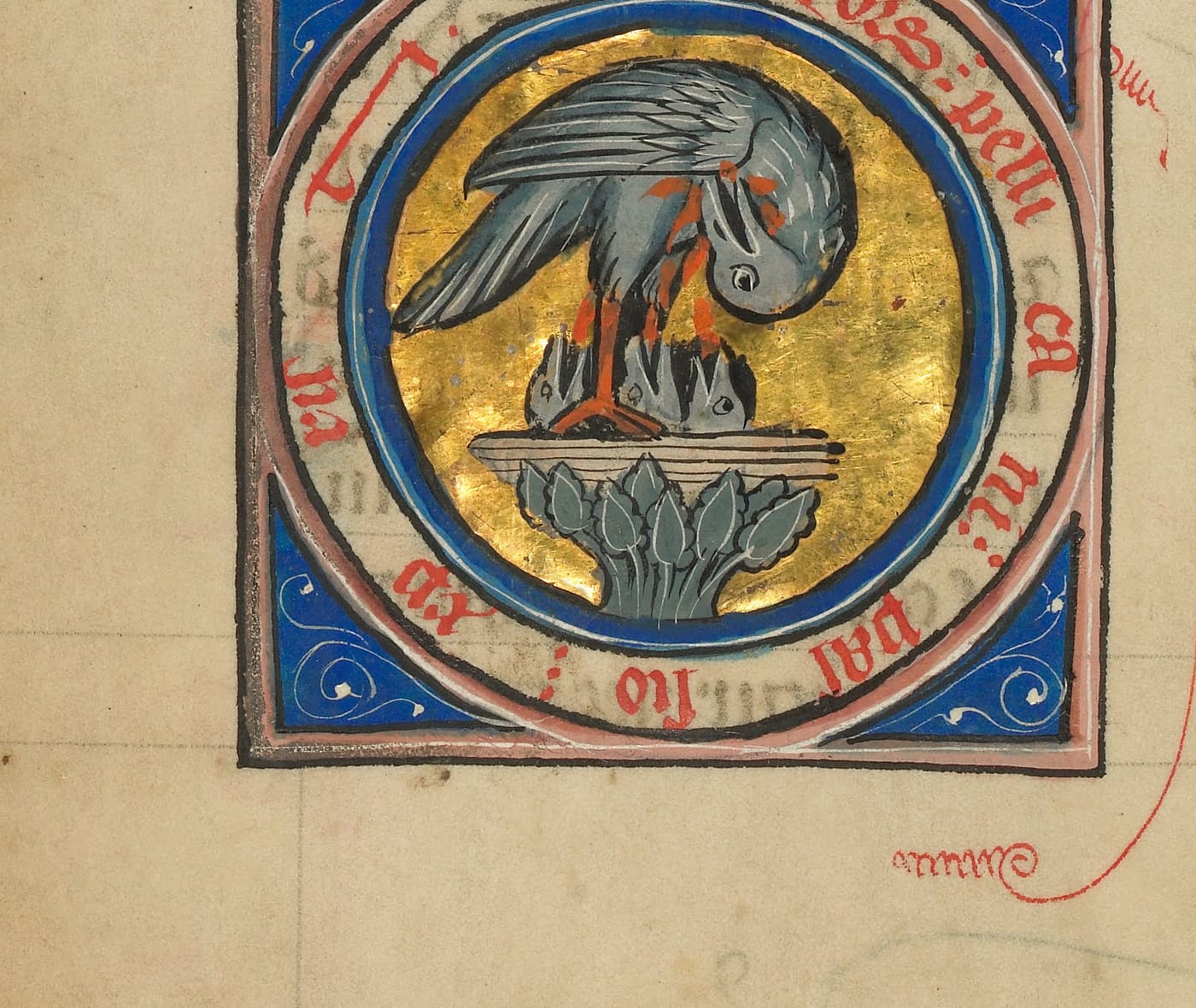
By around 1200 that had become the standard entry in the English bestiaries. The Aberdeen Bestiary, Aberdeen University Library MS 24, gives it in full: the pelican is a bird of Egypt, living in the wilderness of the Nile, from which it takes its name; it is devoted to its young; the young strike, the parents kill, and on the third day the mother opens her side and the dead rise. Then comes the reading. In a mystic sense, the pelican signifies Christ, and Egypt the world.
Note what the sentimental version has lost. In the source, the mother kills them. The blood is not a meal, it is a resurrection, and the third day is not decoration.
Did nobody check?
Somebody did, eventually, and it took until 1646.
Sir Thomas Browne devoted a chapter of Pseudodoxia Epidemica, his catalogue of received beliefs that fall apart on inspection, to this exact image. He opens by noting how completely it had saturated ordinary life: in every place we meet with the picture of the Pelecan, opening her breast with her bill, and feeding her young ones with the blood distilling from her. Not only in devotional art. On inn signs. In the coats of arms of noble families.
Then he makes the argument that should have been made a thousand years earlier. The ancient writers on animals do not mention it. Aristotle does not. Pliny, who was happy to record that hedgehogs carry apples home on their spines, does not. Solinus does not. A behaviour that spectacular, from writers who collected spectacular behaviours, and none of them noticed.
Browne then explains what the bill and the pouch are actually for. The pouch, which he calls the chowle or crop adhering unto the lower side of the bill, is a container. The bird uses it to hold shellfish it cannot break open, keeping them until they open on their own. He is fair about the residual possibility, allowing that the pointed tip of the bill could open the breast and that a bird might nibble at itself, but not for the purpose the pictures claim. His verdict on the picture is that it disagrees almost in all things from the true and proper description of the animal.
It changed nothing. The emblem was by then load-bearing in liturgy, heraldry and civic identity, and none of those depend on the bird. Browne knew it. He notes that among religious writers the pelican stands allegorically for Christ, and an allegory does not stop working because the animal declines to cooperate.
The bird gets into the Mass
A story in a book about animals is one thing. Getting sung at is another.
The Eucharistic hymn Adoro te devote addresses Christ as Pie pellicane, Iesu Domine, merciful pelican, Lord Jesus, and asks to be washed clean by his blood, one drop of which would be enough for the whole world. It is traditionally ascribed to Thomas Aquinas and connected with the institution of Corpus Christi in 1264. That ascription was doubted through much of the twentieth century, and has been argued back in more recent work. The hymn is medieval either way, and it moved the pelican out of the reference shelf and into the mouths of people at Mass.
Dante treats it as a name you would not need explained. In Paradiso XXV, Beatrice points out John the Evangelist as the one who laid his head on the breast of nostro pellicano, our pelican. That is the whole gloss. The reader is assumed to know.
Three centuries later it is available for a furious young man in a play. Laertes, in Hamlet 4.5, swears he will open his arms to his father’s friends and, like the kind life-rendering pelican, feed them with his blood. The line is not devotional. Laertes is not thinking about the Eucharist. He is reaching for the most extravagant image of self-giving in general circulation, and this is the one he finds.
Vulning, and the queen who wore it
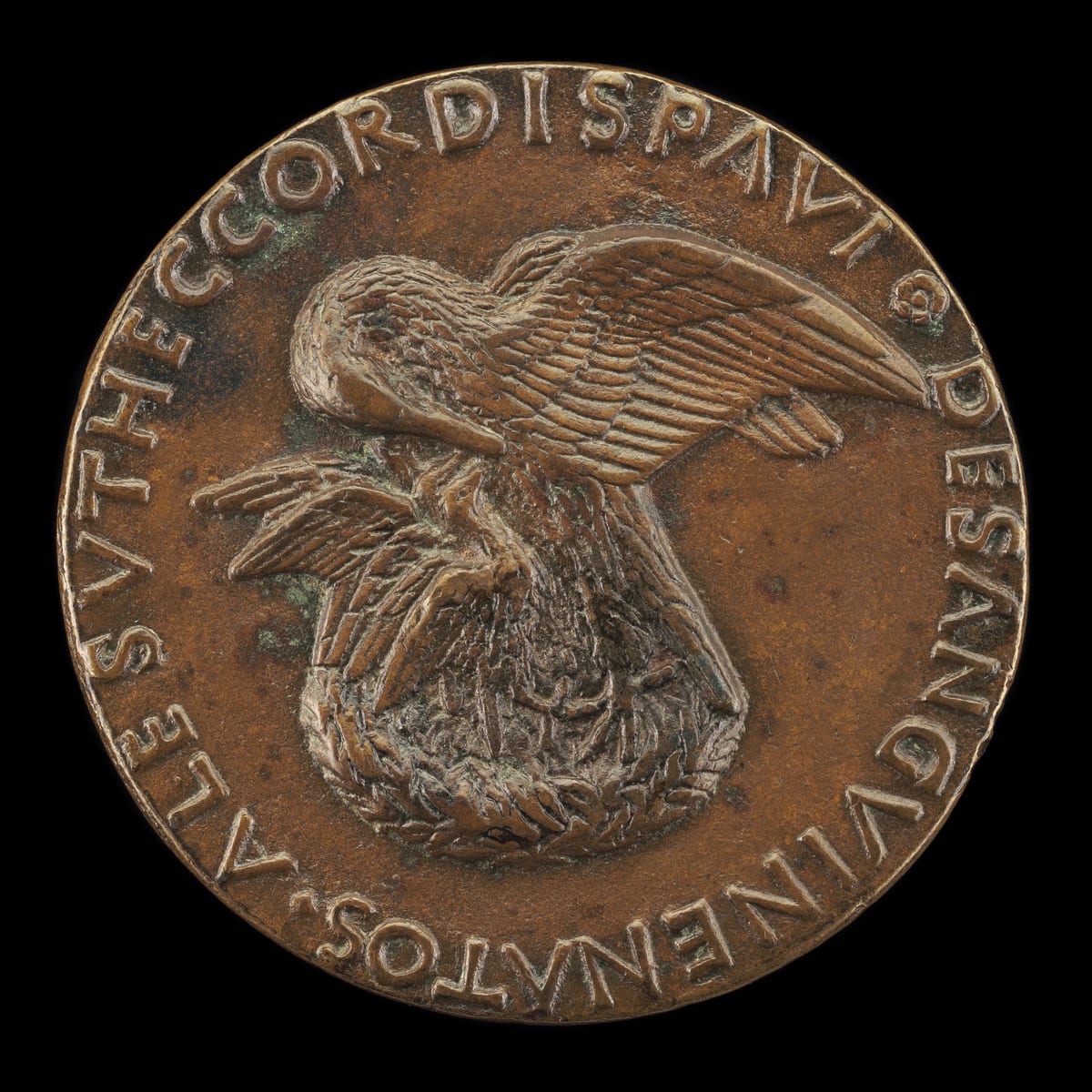
Heraldry is the only tradition that gave this act its own technical verb. A bird shown wounding its own breast is vulning herself, from the Latin for a wound, and the full device is a pelican in her piety. Piety there is the Roman word, the duty owed to your own family, not anything about being devout.
Richard Foxe, Bishop of Winchester, used it as his personal arms: azure, a pelican with wings endorsed vulning herself or. In 1517 he founded a college at Oxford and named it Corpus Christi, the body of Christ, and the bird went up with the buildings. It is still there.
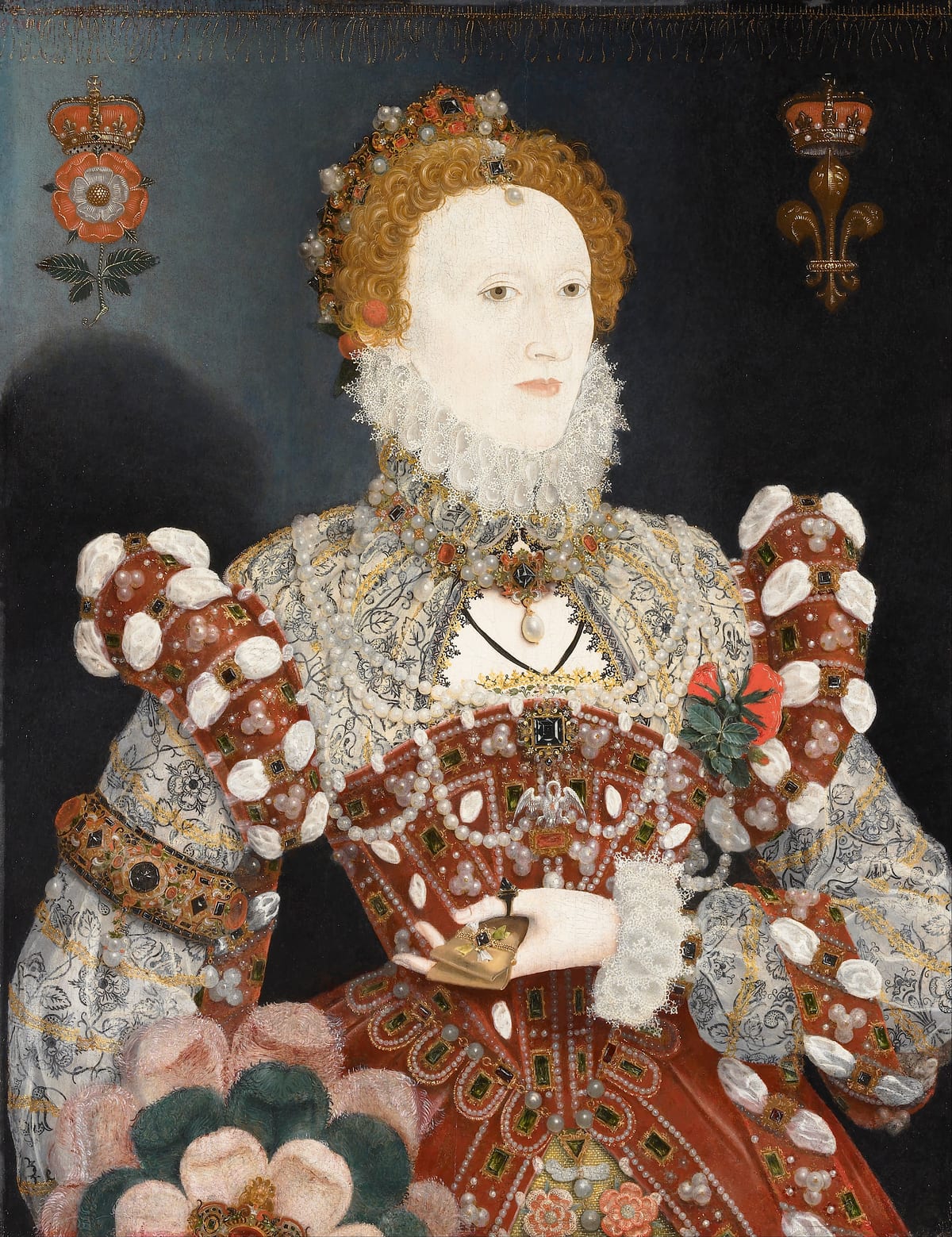
Elizabeth I wore it. In the portrait at the Walker Art Gallery in Liverpool, attributed to Nicholas Hilliard and painted around 1575, a pelican pendant hangs at her breast, and the picture has been called the Pelican Portrait ever since. The argument the jewel makes is not subtle and was not meant to be. Here is a queen with no children, presenting herself as the mother who feeds a nation out of her own body. A second panel of almost identical size and composition, reversed because both were laid out from the same pattern, swaps the pelican for a phoenix. Two birds, two arguments, one queen.
A sundial, and a state that legislated the wound
Two things keep the emblem visible in ordinary life rather than in a museum.
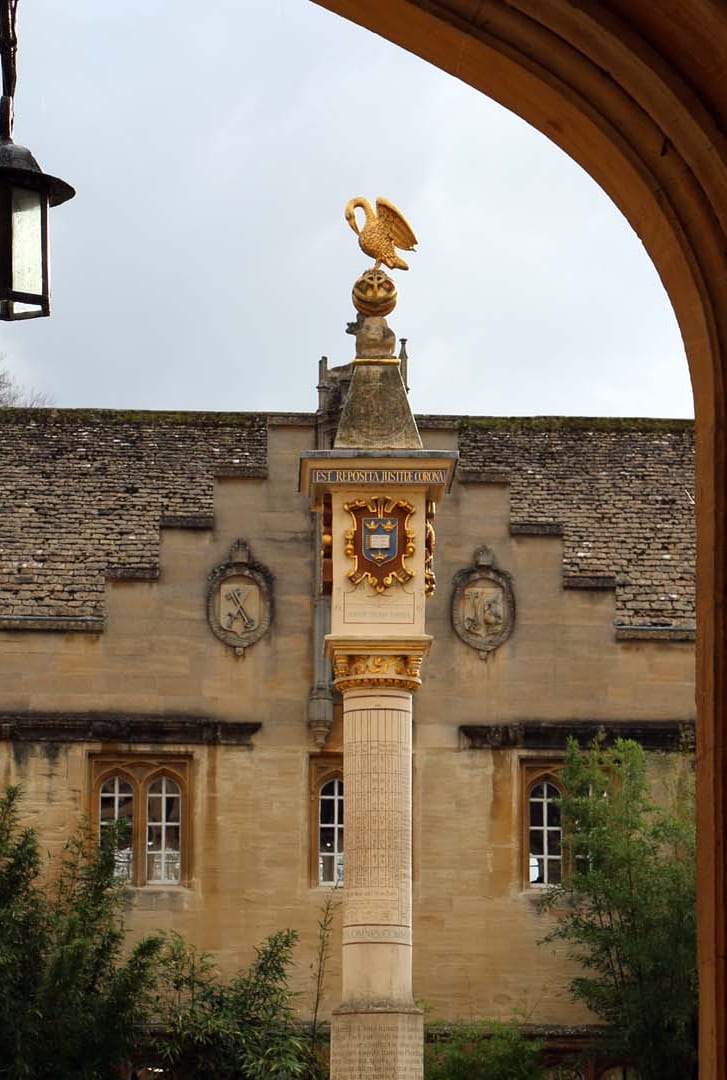
The first is in Oxford. In the front quad of Corpus Christi stands a pillar of sundials put up by Charles Turnbull in 1579, and on top of it, on a gilded armillary sphere, is Foxe’s pelican. It has been telling the time above a college named for the body of Christ for well over four centuries.
The second is Louisiana. A pelican in her piety has been on the state’s emblems since about 1812, and through the nineteenth century the bird conventionally showed three drops of blood on her breast. Somewhere along the way manufacturers stopped bothering. An eighth-grader in Houma noticed that the flag he owned, which had flown over the capitol, had the drops, while flags currently flying outside did not. He told his state legislator. In 2006 the legislature passed Act 92, which requires an appropriate display of three drops of blood on the pelican used on the state flag and seal.
A state government wrote the wound back into law because a teenager complained. That is the afterlife of a second-century zoological error, and it is a much better story than any keyword list.
Is the pelican even in the Bible?
Here is the loose thread. Every bestiary pelican entry opens by quoting a psalm, and the psalm may not be about a pelican.
The Hebrew word is qa’at. It shows up among the unclean birds at Leviticus 11:18 and Deuteronomy 14:17, among ruins at Isaiah 34:11 and Zephaniah 2:14, and in the lament of Psalm 102:6 that the bestiaries put at the head of the chapter. The Greek translators of the Septuagint rendered it pelekan. The Latin followed with pellicanus. From there it was fixed.
Modern translators do not agree, and they say so on the page. The King James Version, the New American Standard Bible and the 1917 Jewish Publication Society text read pelican. The New International Version and the English Standard Version read desert owl. The New Revised Standard Version and the New English Translation read owl. The Christian Standard Bible reads eagle owl. The disagreement is not about theology, it is about ornithology and a rare word, and the passages themselves lean away from a fish-eating waterbird: they keep putting the creature in dry ruins and empty places.
So the chain has a mistake at the top and possibly a mistranslation at the bottom, and it produced Aquinas, Dante, a queen’s jewellery, an Oxford sundial and an American state flag.
That is worth being clear about, because it cuts both ways. If you have read that the pelican is an ancient symbol of self-sacrifice, that is true, and unusually well documented. If you have read that it is an ancient symbol of nurturing abundance, or that it teaches you to stay buoyant and not be overcome by emotion, that is a twentieth-century keyword list, and the version circulating on spirit-animal pages is generally credited to Ted Andrews without anybody checking the book. This page has not been able to check it either, which is why it is flagged rather than repeated.
The older meaning is narrower and harder. It is not about giving generously. It is about giving out of your own substance until there is a wound, and it is about a mother who kills her children and then buys them back. Foxe put that on a college. Elizabeth wore it as a claim to be a mother without having been one. Louisiana legislated three drops of blood back onto a flag because a schoolboy noticed they had gone missing.
Use it for that. Just do not tell anyone the bird does it.
Across traditions
Physiologus and the Latin bestiaries
The story begins in the Physiologus, a Greek compilation of moralised animal lore assembled by an unknown author in Alexandria, conventionally dated to about the second century. Its oldest recension runs to roughly forty-eight chapters, each pairing a creature with a Christian reading. The pelican chapter says that the young strike their parents in the face, that the parents strike back and kill them, and that on the third day the mother opens her own side and pours her blood over the bodies, and they live.
That text passed into Latin and then into the great English bestiaries of around 1200. The Aberdeen Bestiary, Aberdeen University Library MS 24, opens its pelican entry by quoting the psalm, then gives the Egyptian etymology and the three-day narrative, and closes with the reading that made the bird famous: in a mystic sense the pelican signifies Christ, and Egypt the world. The manuscript's own illustration divides the story into three scenes, the young attacking, the parents killing them, and the mother piercing her side. Hugh of Fouilloy's De avibus, an independent twelfth-century bird book that circulated widely alongside the bestiaries, carries the pelican too.
Two details are worth holding onto. The third day is not incidental; it is doing theological work. And the killing is in the source. The sentimental modern version, in which a devoted mother simply feeds hungry chicks, has quietly dropped the part where she kills them first.
- PRIMARY Aberdeen Bestiary, Aberdeen University Library MS 24, ff. 34v to 35r . De pellicano, with transcription and English translation. Circa 1200.
- EDITION Physiologus, trans. Michael J. Curley . University of Chicago Press. Standard English translation of the Greek text.
- MUSEUM J. Paul Getty Museum, Ms. Ludwig XV 4, De natura avium of Hugh of Fouilloy . Franco-Flemish, 1277 or after. Leaf 23.3 by 16.4 cm.
- PRIMARY Sir Thomas Browne, Pseudodoxia Epidemica V.i, Of the Picture of the Pelecan . First published 1646. An early sustained argument that the ancient writers on animals do not report the behaviour.
Latin liturgy, Dante, and Shakespeare
The bestiary bird did not stay in the bestiary. The Eucharistic hymn Adoro te devote, traditionally ascribed to Thomas Aquinas and associated with the institution of Corpus Christi in 1264, addresses Christ directly as Pie pellicane, Iesu Domine, merciful pelican, Lord Jesus, and asks to be cleansed by his blood. The ascription to Aquinas was doubted through much of the twentieth century and has been defended in more recent scholarship; what is not in doubt is that the verse is medieval and that it put the pelican into devotional Latin sung by ordinary people.
Dante uses it as a byname. In Paradiso XXV, Beatrice identifies John the Evangelist as the one who laid his head on the breast of nostro pellicano, our pelican. No explanation is offered, because none was needed.
By 1600 the image had travelled far enough from the altar to be available for revenge. Laertes, working himself up over his father's death in Hamlet 4.5, promises to open his arms to his father's friends and, like the kind life-rendering pelican, feed them with his blood. The bestiary had become common property.
- PRIMARY Adoro te devote, stanza beginning Pie pellicane, Iesu Domine . Traditionally ascribed to Thomas Aquinas, associated with Corpus Christi, 1264. Ascription contested in the twentieth century.
- PRIMARY Dante, Paradiso XXV . John the Evangelist described as resting on the breast of nostro pellicano.
- PRIMARY Shakespeare, Hamlet 4.5, Folger Shakespeare Library edition . Laertes: and, like the kind life-rendring pelican, repast them with my blood.
Heraldry: Foxe, Elizabeth I, and Louisiana
Heraldry gave the act its own verb. A pelican shown wounding its breast is vulning herself, and the whole device is a pelican in her piety, the word piety carrying its older Roman sense of duty owed to family rather than anything to do with devoutness.
Richard Foxe, Bishop of Winchester, took the pelican as his personal arms: azure, a pelican with wings endorsed vulning herself or. When he founded Corpus Christi College, Oxford, in 1517, the bird came with him, which is why a gilded pelican still stands on an armillary sphere above the sundial in the front quad, a pillar of dials put up by Charles Turnbull in 1579. The joke, if it is one, is exact. A college named for the body of Christ is watched over by the animal that stood for it.
Elizabeth I wore the same idea as jewellery. In the portrait at the Walker Art Gallery attributed to Nicholas Hilliard, painted around 1575 and known ever since as the Pelican Portrait, a pelican pendant hangs at her breast, presenting a childless queen as the mother who feeds the nation out of herself. A near-identical panel, reversed from the same pattern, gives her a phoenix instead.
The device also crossed the Atlantic and stayed. A pelican in her piety has appeared on Louisiana emblems since about 1812. Through the nineteenth century the bird conventionally showed three drops of blood at her breast, then flag manufacturers began leaving them off. A schoolboy in Houma noticed, told his legislator, and in 2006 the state passed Act 92 requiring the drops back. Louisiana legislated the wound.
- REFERENCE Corpus Christi College, Oxford: arms of Richard Foxe and the Pelican Sundial . College founded 1517. Blazon: azure, a pelican with wings endorsed vulning herself or. Sundial by Charles Turnbull, 1579; the year 1581 also appears in some accounts.
- MUSEUM Elizabeth I, The Pelican Portrait, Walker Art Gallery, Liverpool . Attributed to Nicholas Hilliard, circa 1573 to 1575. Paired by pattern with the Phoenix Portrait.
- MUSEUM Andrea Guacialoti, medal of Pope Pius II, reverse: Pelican in Her Piety . Bronze, 5.4 cm. National Gallery of Art, Washington, Samuel H. Kress Collection, 1957.14.1285.b.
- REFERENCE Louisiana Act 92 of 2006, three drops of blood on the state flag and seal . Enacted 25 May 2006 after the omission was reported by a Houma schoolboy. Standardised design adopted 2010.
The Hebrew Bible, and a bird nobody can identify
Every bestiary pelican entry opens by quoting a psalm, and the psalm may not be about a pelican at all. The Hebrew word is qa'at, which appears in the list of unclean birds at Leviticus 11:18 and Deuteronomy 14:17, among the ruins in Isaiah 34:11 and Zephaniah 2:14, and in the lament of Psalm 102:6.
The Septuagint rendered it pelekan, the Latin followed with pellicanus, and the whole medieval tradition inherited a pelican from that decision. Modern translators disagree openly. The King James Version, the New American Standard Bible and the 1917 Jewish Publication Society text keep the pelican. The New International Version and the English Standard Version have desert owl; the New Revised Standard Version and the New English Translation have owl; the Christian Standard Bible has eagle owl. The identification rests partly on the bird's cry and partly on where the passages place it, and the passages place it in dry ruins, which suits an owl better than a fish-eating waterbird.
None of this dislodges the symbol. It just relocates the origin. What the psalmist meant is genuinely unsettled; what a Greek translator chose is what Europe went on to paint for the next fifteen hundred years.
- PRIMARY Psalm 102:6, parallel English translations . KJV, NASB and JPS 1917 read pelican; NIV and ESV read desert owl; NRSV and NET read owl; CSB reads eagle owl.
- PRIMARY Leviticus 11:18 and Deuteronomy 14:17 . qa'at listed among birds not to be eaten.
Working with the Pelican
If you want a regular practice rather than a one-time read, an oracle deck is the standard tool: you draw a card and sit with whatever animal comes up. Our ranked guide to spirit animal oracle decks compares the field.
Sources
- PRIMARY Aberdeen Bestiary, Aberdeen University Library MS 24, ff. 34v to 35r
- EDITION Physiologus, trans. Michael J. Curley . University of Chicago Press.
- MUSEUM J. Paul Getty Museum, Ms. Ludwig XV 4, De natura avium of Hugh of Fouilloy
- PRIMARY Shakespeare, Hamlet 4.5, Folger Shakespeare Library
- PRIMARY Dante, Paradiso XXV
- PRIMARY Adoro te devote . Traditionally ascribed to Thomas Aquinas.
- MUSEUM Elizabeth I, The Pelican Portrait, Walker Art Gallery, Liverpool
- MUSEUM Andrea Guacialoti, medal of Pope Pius II, National Gallery of Art 1957.14.1285.b
- PRIMARY Psalm 102:6, parallel English translations
- PRIMARY Sir Thomas Browne, Pseudodoxia Epidemica V.i . 1646.
- REFERENCE Louisiana Act 92 of 2006