Spirit Animal
Rooster Spirit Animal
Rooster spirit animal meaning traced to real sources: the bird Parodars who wakes the world in Vendidad 18, the cock crow in the Gospel accounts of Peter's denial, the oldest surviving weathercock of about 820, and the Latin pun on gallus behind the French emblem.
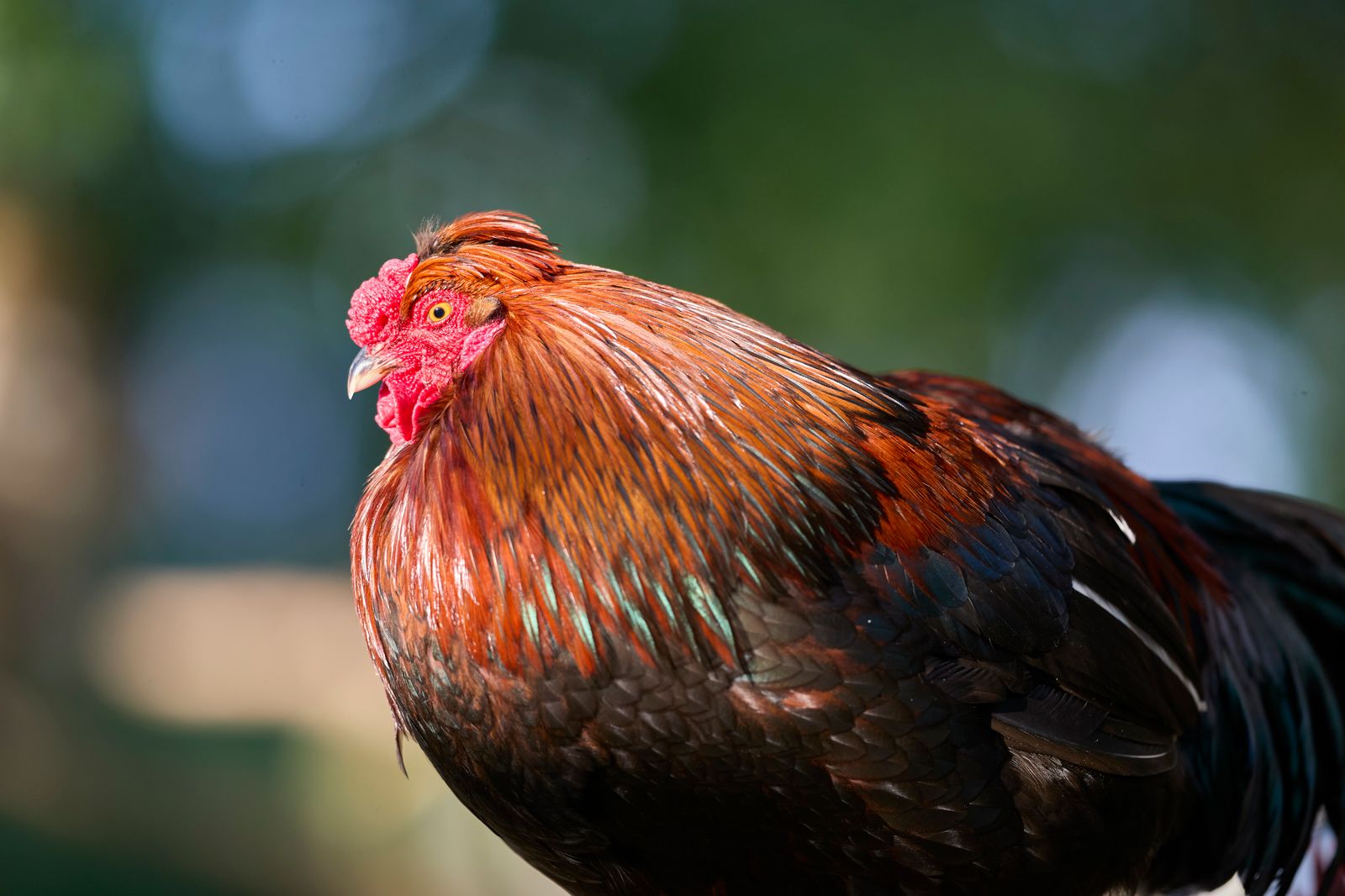
The rooster is read as vigilance, courage and the announcement of a new day, and that reading is genuinely ancient rather than recycled. Zoroastrian scripture assigns the bird a named role waking the world against the demon of sloth. The Gospels make its call the moment Peter learns what he has done. The rooster on European church spires and the rooster on French shirts descend from those two ideas.
Of all the animals covered here, the rooster is the one whose meaning has changed least. Vigilance, the announcement of morning, courage that is mostly noise: those readings are in texts from three separate traditions, none of them talking to each other, and all of them older than any book with the words “spirit animal” on the cover.
That consistency has an obvious cause. A rooster does one striking thing, loudly, at a time of day when everybody is listening. There was never much room for interpretation to drift.
What does the Chinese zodiac rooster stand for?
The tenth Earthly Branch, you, and nothing more mystical than that to begin with. The twelve-animal cycle in its complete form is Han-dynasty, and the earliest full listing pairing the animals with the branches is in Wang Chong’s Lunheng in the first century CE.
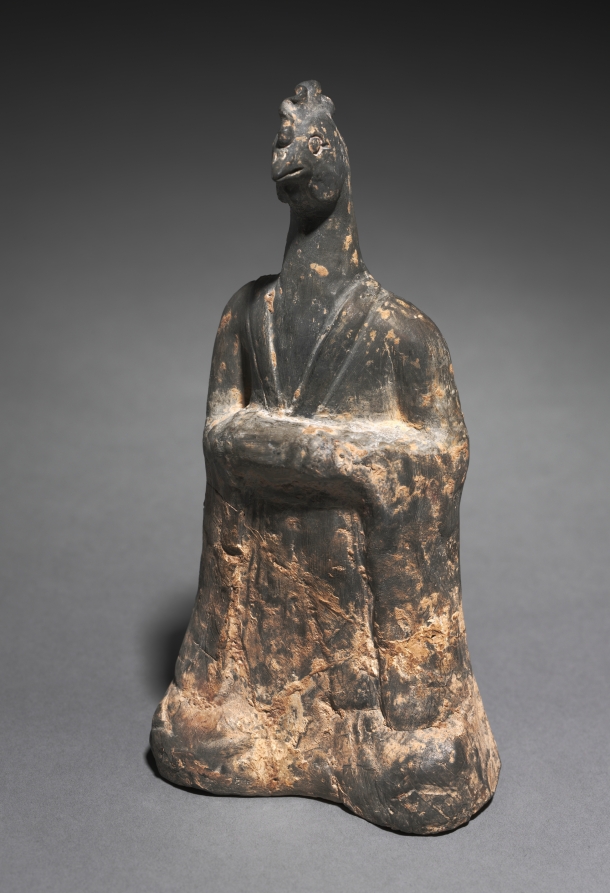
Where the character content comes from is a separate question with a much shorter answer. The English-language personality profile, punctual, blunt to the point of rudeness, immaculately turned out, hard-working and inclined to crow, is a twentieth-century genre, and the book most of it descends from is Theodora Lau’s The Handbook of Chinese Horoscopes, published in 1979 and reissued for four decades. A Chinese almanac tradition sits behind that, older and more complicated, but it is not what the English internet is copying from.
Why does a rooster wake the world in Zoroastrian scripture?
Because it was given the job by name, and given an opponent to do it against.
Fargard 18 of the Vendidad names the bird Parodars, he who foresees the coming dawn, adding that ill-speaking people call it Kahrkatas. The divinity Sraosha wakes it, and it lifts its voice against the dawn. Then the text supplies the words of the call: rise, recite the prayer that smites the demons, because Bushyasta the long-handed is coming for you, the one who lulls the waking world back to sleep.
Bushyasta is sloth. Her entire function is making people miss the hour of prayer by rolling over. Against her, the rooster is not a general symbol of alertness but a specific instrument of religious discipline, whose crowing is the counter-move.
That is a considerably harder-edged idea than “new beginnings”, which is what most modern pages offer. The Zoroastrian rooster is not celebrating a new day. It is preventing you from wasting one.
Why does the cock crow at Peter’s denial?
Because a clock was needed, and the bird is the only clock a first-century night has.
All four Gospels carry it. Jesus predicts that Peter will deny him three times before the cock crows. Peter, warming himself in the high priest’s courtyard, is recognised three times and denies it three times. The cock crows. Peter remembers the words and goes out and weeps. Mark’s version specifies the cock crowing twice, which is one of the small textual differences between the accounts that translators have been managing for centuries.
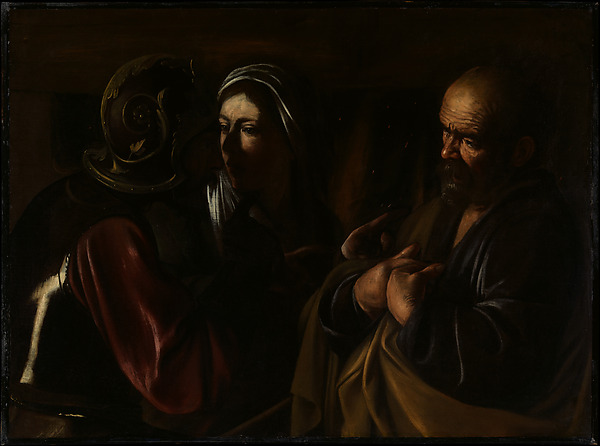
The animal’s role is tiny and load-bearing. It has no character, takes no action and is spoken to by nobody. It makes a noise at a predictable hour, and the noise converts a man’s cowardice into his knowledge of his cowardice. That is the whole of it, and it is why the Christian rooster ends up standing for conscience and watchfulness rather than for the swagger it means almost everywhere else.
Where does the rooster’s reputation for courage come from?
From the fighting pit, and from a story that is almost certainly explaining a custom rather than recording its origin.
Cockfighting was ordinary in the Greek world, and the birds turn up constantly in Attic vase painting: given as courtship presents, held under the arm, set against each other. Aelian preserves the founding anecdote. Themistocles, marching against the Persians, sees two cocks fighting, halts the army, and points to the birds as an example of stubbornness worth copying. After the victory, an annual cockfight is instituted at Athens, initially with patriotic and religious weight and later as plain entertainment.
Treat that as an aetiology. It has the classic shape of a story invented to account for a practice that already existed, and Aelian is writing some six centuries after the event. What it does record accurately is what Athenians thought the bird meant: not cleverness, not vigilance, but a willingness to keep going past the point of sense.
That reading and the Christian one sit oddly together. In one, the rooster is a fighter held up to soldiers. In the other, it is a sound that makes a man cry. The modern composite, brave and watchful and a bit vain, is both of them laid on top of each other with the edges sanded off.
Why is there a rooster on top of European churches?
Not because a pope said so, whatever the guidebook told you.
The claim in circulation is that Pope Nicholas I decreed in the ninth century that every church in Christendom must carry a cock on its tower, in memory of Peter. It appears in reference works, on church noticeboards and across the internet. No text of any such decree has been produced. It is a tidy explanation attached after the fact to a practice that already existed, which is a pattern worth recognising: a real custom, a plausible authority, and no document.
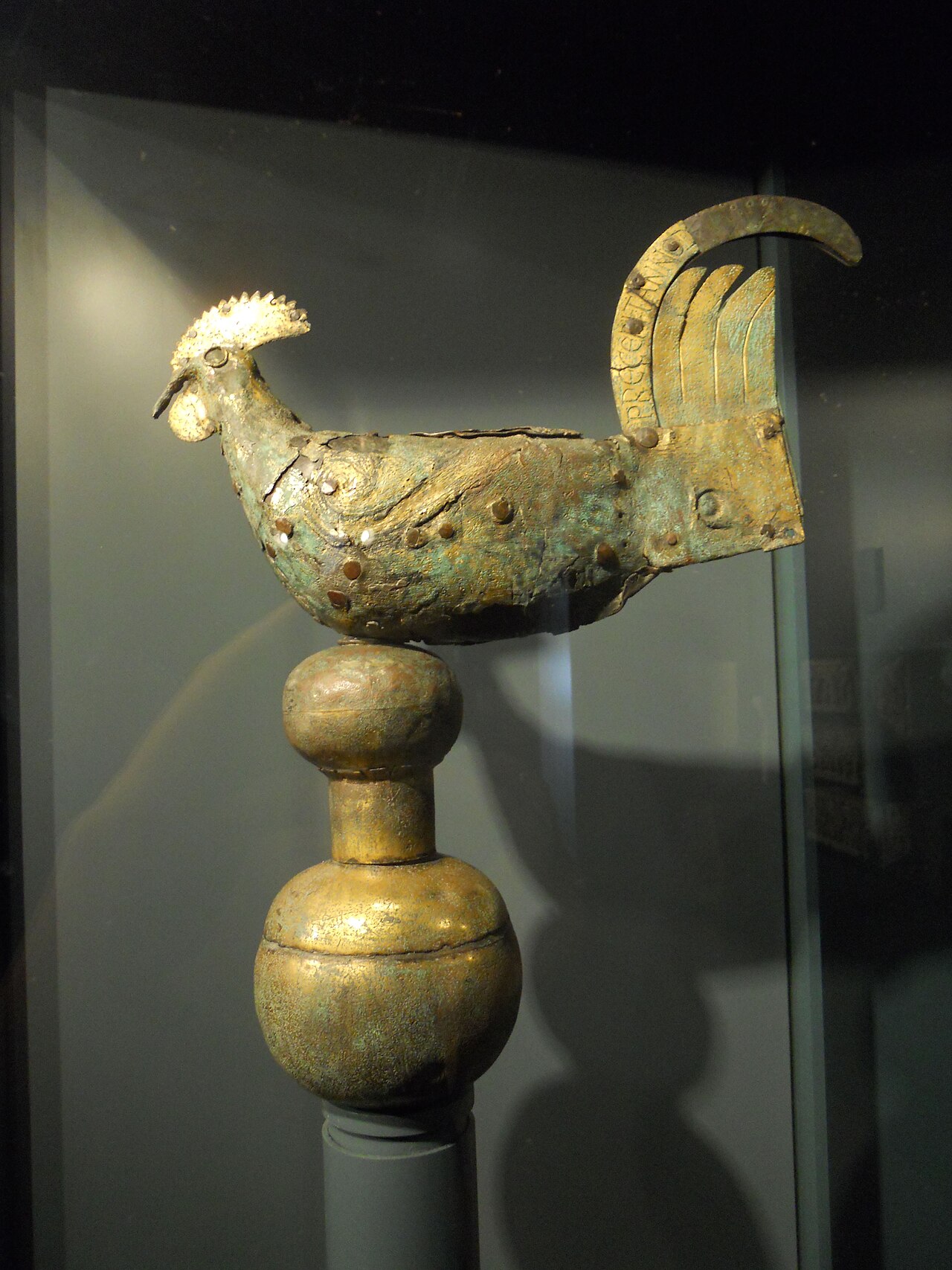
The physical evidence is better than the legal evidence. The Gallo di Ramperto, made around 820 for a bell tower in Brescia and now in the Museo di Santa Giulia, is the oldest surviving weathercock in the world. Two and a half centuries later, the Bayeux Tapestry shows a workman fixing a vane to the roof of Westminster Abbey, in what is the only surviving contemporary picture of Edward the Confessor’s church.
So the custom is early medieval and well attested by objects. Why a cock is not hard to see. You are putting a weather vane on the highest point of a building whose business is the coming of the light, and there is one animal that already does that job.
How did a Latin pun become the emblem of France?
Slowly, and originally as an insult.
Gallus in Latin means a cock. Gallus also means a Gaul. Roman writers noticed and used it, and the point of the joke was that it was cheap. There is no evidence that the Gauls themselves used the bird as an emblem, which makes the modern French cockerel a symbol imposed from outside and then claimed.
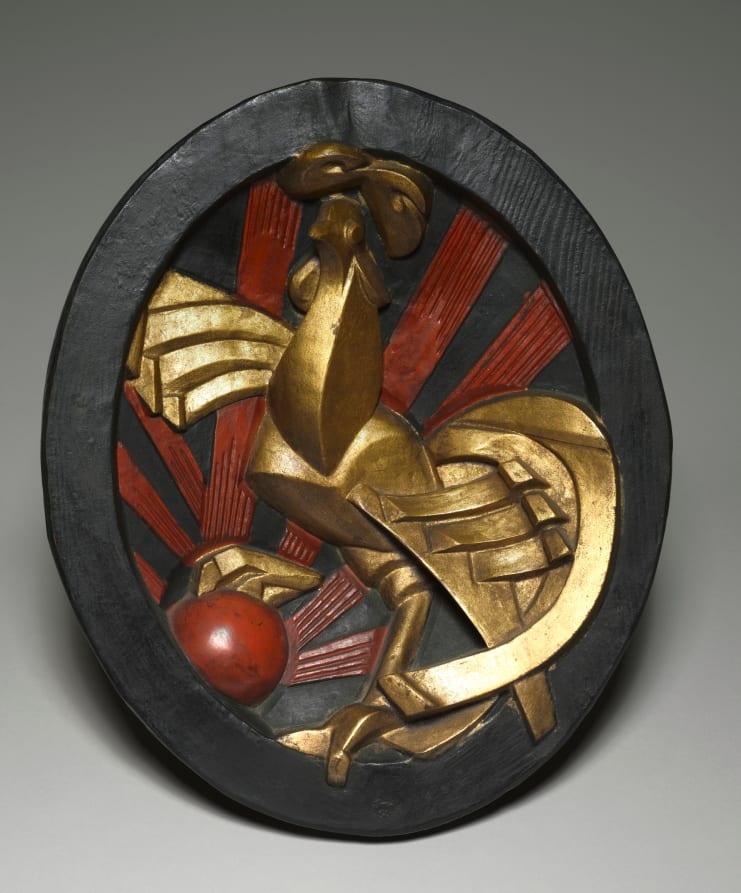
The pun was revived in the Middle Ages, still mockingly. Renaissance kings then put the cock on coins and arms and read it as courage and fighting spirit. The Revolution made it a national emblem in earnest, sometimes wearing a Phrygian cap, and it has stayed on French coinage, monuments and, most visibly now, the shirts of national sports teams.
An animal chosen because of a coincidence in Latin vocabulary, adopted out of defiance, and still going after two thousand years. Symbols are rarely appointed for good reasons and it does not appear to matter.
Is there an Akan or Ashanti rooster symbol?
There is a documented Akan bird symbol, and it is the hen.
Adinkra, the Akan symbol repertoire of what is now Ghana, was first recorded systematically by R. S. Rattray, whose Religion and Art in Ashanti was published by the Clarendon Press in 1927. Among the symbols he collected is akoko nan, the hen’s foot, carrying the proverb he transcribes as Akoko nan tia ’ba, na nkum ’ba: a hen treads on her chicks but does not kill them. The reading is about authority exercised without harm, and it is usually applied to parenthood and to governing.
That is a real, named, citable source, which is more than can be said for the loose “in African tradition the rooster means…” lines that circulate. It is also, precisely, not about a rooster. Anyone repeating it as cockerel symbolism has substituted the wrong bird for the one in the record.
Rattray’s own position is worth naming: he was a colonial administrator as well as an ethnographer, and his books are documents of that relationship as much as of Akan thought. That does not make the transcription wrong. It does mean the reading is his, taken down at a particular moment, and later Ghanaian scholarship on adinkra is the place to check him against.
Where does the modern rooster meaning come from?
Nowhere new, which is the unusual finding here.
I looked for a rooster keynote in Ted Andrews’s Animal Speak and could not verify one, and Medicine Cards has no rooster on its roster. The two books that supply most of the internet’s animal keywords do not appear to be the source, and there is no need for them to be. Vigilance, the announcement of morning, conscience, noisy courage: those were all fixed in writing by texts that are still read, in Persia, in the Gospels, in Athens.
What the modern era added is the zodiac personality profile, from Theodora Lau’s 1979 handbook and its many descendants, and one persistent piece of invented history in the papal decree. Otherwise the rooster arrives roughly intact, which makes it a useful control case. When a claim about it does not check out, it is usually not a compiler’s invention. It is a legend that grew where a document should have been.
Does a rooster actually crow at dawn?
Not exactly, and the difference is worth having.
Roosters do not wait for light. They anticipate it, which is why they call in the dark before sunrise rather than at the moment the sun appears. Tsuyoshi Shimmura and Takashi Yoshimura tested this at Nagoya University and published the result in Current Biology in 2013: birds held under constant dim light for two weeks carried on crowing at what they took to be dawn, running free on a cycle of roughly 23.8 hours. The call is generated by an internal clock, not triggered by the sun.
A bird that merely responded to light would arrive late, and the whole symbolic career described above depends on the bird arriving early.
Every tradition on this page is built on that timing. The Zoroastrian bird calls against the dawn, before it. Peter’s cock crows while it is still night. The weathercock sits above a building waiting for a morning that has not come yet. Announcing something that has already happened would not have been worth the metalwork.
Across traditions
Zoroastrian (Parodars, the bird of Sraosha)
The most explicit ancient statement about what a rooster is for sits in Fargard 18 of the Vendidad. The text names the bird Parodars, glossed as he who foresees the coming dawn, and notes that ill-speaking people call it Kahrkatas. The divinity Sraosha, obedience and attentive piety personified, wakes the bird, and the bird lifts up his voice against the mighty Ushah
, the dawn.
What it says when it calls is given verbatim: Arise, O men! recite the Ashem yad vahistem that smites down the Daevas. Lo! here is Bushyasta, the long-handed, coming upon you, who lulls to sleep again the whole living world, as soon as it has awoke.
Bushyasta is the demon of sloth, whose fixed epithet is the long-handed, and whose work is making the faithful miss the hour of prayer by going back to sleep.
This is a fully worked-out symbolic role, not a passing simile: the rooster is a religious functionary whose crowing is a summons to prayer and whose adversary is named. The English word vigilance covers it, but flattens it. The bird is not merely alert, it is on duty.
- PRIMARY Vendidad, Fargard 18 (Avesta) . James Darmesteter translation, Sacred Books of the East vol. 4. Sections 15, 16 and 23; the footnote identifies Parodars as the cock.
Christian (the cock crow at Peter's denial)
All four Gospels carry the prediction and the fulfilment. Jesus tells Peter that before the cock crows he will deny him three times; Peter does; the cock crows; Peter remembers and weeps. Mark's version is the most specific, having the cock crow twice.
The bird's part is small and structurally enormous. It is not a character, it does nothing, and it is not addressed. It is a sound arriving at a fixed hour and turning a man's night into knowledge. That is why the rooster ends up as the emblem of conscience and of watchfulness in Christian art rather than as an emblem of courage, which is what it means in most other places.
Worth noting because painters kept doing it: the cock is frequently absent from major treatments of the scene. Caravaggio's The Denial of Saint Peter of 1610 has three figures, an accusing servant, a soldier and Peter's hands rising to his own chest, and no bird at all. The sound is the subject; the animal is optional.
- PRIMARY Matthew 26:34 and 26:69-75; Mark 14:30 and 14:66-72; Luke 22:34 and 22:54-62; John 13:38 and 18:15-27 . The prediction and the denial. Mark alone specifies that the cock crows twice.
- MUSEUM Caravaggio, The Denial of Saint Peter, 1610 . Metropolitan Museum of Art 1997.167. Oil on canvas, 94 x 125.4 cm. No cock is depicted.
Medieval and later Europe (the weathercock)
A cock on a church spire is so ordinary in Europe that people assume a rule produced it. The rule usually cited is a ninth-century decree of Pope Nicholas I requiring a cock on every church tower, in memory of Peter's denial. No text of any such decree has been found. It circulates as fact in reference works and tourist signage and the primary document does not exist, which puts it in the same category as several other claims this site flags.
What does exist is the object. The oldest surviving weathercock is the Gallo di Ramperto, made of copper sheet, originally gilded and silvered, commissioned by Bishop Ramperto for the bell tower of Santi Faustino e Giovita in Brescia around 820. It is now in the Museo di Santa Giulia there. The Bayeux Tapestry, worked in the 1070s, shows a man fixing a vane to the roof of the newly finished Westminster Abbey, which is the only surviving image of that building.
So the practice is genuinely early medieval, documented by surviving metalwork and by embroidery rather than by canon law. The rooster's suitability is obvious enough not to need a decree: it is the animal that announces the light, mounted on the highest point of the building, turning to face whatever is coming.
- MUSEUM Gallo di Ramperto, c. 820 . Copper sheet, originally gilded and silvered. Commissioned by Bishop Ramperto for the bell tower of Santi Faustino e Giovita, Brescia; now Museo di Santa Giulia. The oldest surviving weathercock.
- PRIMARY Bayeux Tapestry, Westminster Abbey scene . Worked in the 1070s. Shows a workman fixing a vane to the roof of the abbey consecrated 28 December 1065; the only surviving contemporary depiction of the building.
France (the Latin pun that became a national emblem)
Latin gallus means a cock. Latin Gallus means an inhabitant of Gaul. The coincidence is a plain homonym and there is no evidence the Gauls themselves used the bird as an emblem.
The joke was made at their expense. Roman writers used the pun to needle them, and it was revived in the Middle Ages, again by outsiders, again unkindly. The French then did the thing that makes this history interesting: they adopted it. Renaissance kings put the cock on coinage and arms, reading it as courage and combativeness, and the Revolution made it a national emblem outright, sometimes in a Phrygian cap, alongside the allegorical figures of the Republic.
It survives now mostly in sport, on shirts and crests. What began as a Latin insult about the sound of a word is one of the more durable national symbols in Europe, which is a reasonable summary of how emblems usually work.
- MUSEUM Raymond Duchamp-Villon, Rooster (Gallic Cock) . Plaster 1916, cast 1919, painted bronze. Cleveland Museum of Art 1972.227, Bequest of Lucia McCurdy McBride. CC0.
Working with the Rooster
If you want a regular practice rather than a one-time read, an oracle deck is the standard tool: you draw a card and sit with whatever animal comes up. Our ranked guide to spirit animal oracle decks compares the field.
Sources
- PRIMARY Vendidad, Fargard 18 . Darmesteter translation, Sacred Books of the East vol. 4.
- PRIMARY The Gospel accounts of Peter's denial . Matthew 26, Mark 14, Luke 22, John 18.
- PRIMARY Wang Chong, Lunheng . First century CE. Earliest complete listing of the twelve zodiac animals; the rooster is you, the tenth branch.
- MUSEUM Caravaggio, The Denial of Saint Peter, 1610 . Metropolitan Museum of Art 1997.167.
- MUSEUM Mortuary Figure of the Zodiac Sign: Cock, Northern Wei, 500s . Cleveland Museum of Art 1972.76.10, The Norweb Collection. CC0.
- MUSEUM Raymond Duchamp-Villon, Rooster (Gallic Cock), 1916/1919 . Cleveland Museum of Art 1972.227. CC0.
- REFERENCE Theodora Lau, The Handbook of Chinese Horoscopes . First published 1979.
- PRIMARY R. S. Rattray, Religion and Art in Ashanti . Clarendon Press, Oxford, 1927. The first systematic record of adinkra symbols, including akoko nan and the proverb 'Akoko nan tia 'ba, na nkum 'ba' (a hen treads on her chicks but does not kill them).
- PRIMARY Aelian, Varia Historia 2.28 . The Themistocles anecdote and the annual Athenian cockfight. Written c. 200 CE about events of 480 BCE, and best read as an aetiology.
- PEER-REVIEWED T. Shimmura and T. Yoshimura, 'Circadian clock determines the timing of rooster crowing' . Current Biology 23(6), R231-R233, 2013. Roosters held under constant dim light kept crowing on a free-running cycle of about 23.8 hours, so the predawn call is driven by an internal clock rather than by light.