Spirit Animal
Monkey Spirit Animal
Monkey spirit animal meaning traced to real sources: Sun Wukong in a novel published anonymously in 1592, Hanuman in Valmiki's Ramayana, the Japanese wordplay behind the three wise monkeys at Nikko, Thoth in baboon form, and Churchill's 1944 order about the apes of Gibraltar.
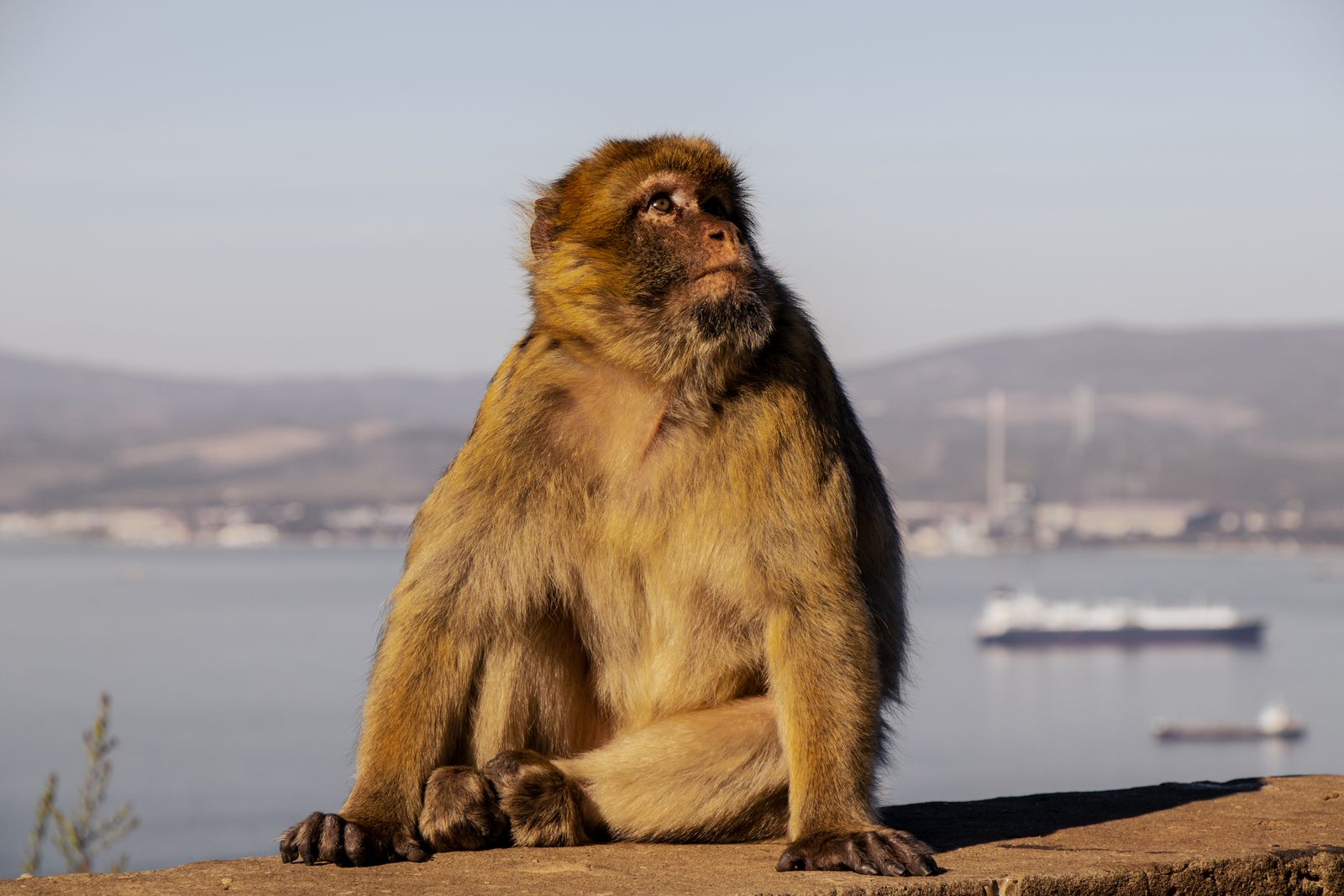
The monkey is read as cleverness, mischief and a mind that will not sit still, and that reading is unusually well grounded: it comes from actual literature rather than from twentieth-century compilers. Sun Wukong in Journey to the West and Hanuman in the Ramayana are both monkeys defined by an intelligence that outruns their discipline, and both texts long predate the spirit-animal genre.
The monkey is one of the few animals on this site whose modern meaning did not have to be invented for it. Cleverness, mischief, a mind that will not hold still: that is what the two great monkey characters of world literature are actually about, and both of them predate the spirit-animal shelf by centuries.
Which makes the monkey unusual here. Most of these pages involve tracing a confident claim back to a twentieth-century compiler and finding that the ancient tradition underneath is thinner than advertised. With the monkey the opposite happens. The literature is enormous, it is specific, and the popular summaries are the part that has gone thin.
Who is Sun Wukong, and did Wu Cheng’en write him?
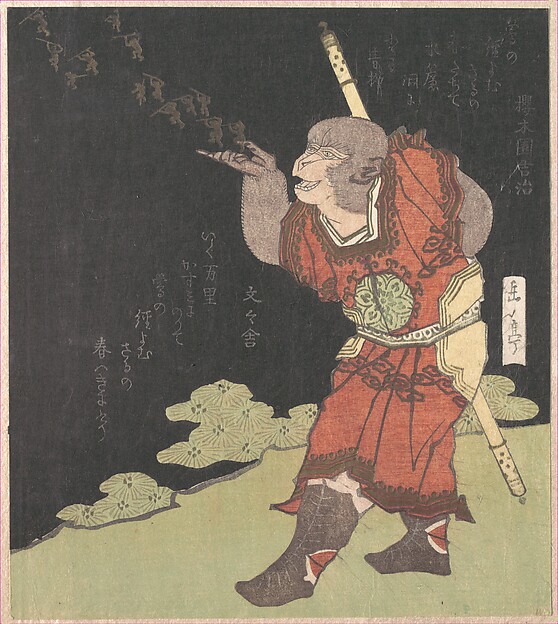
Journey to the West was printed anonymously in 1592. Its monkey is born out of a stone egg, learns immortality and shapeshifting, eats the peaches of the Queen Mother of the West, declares himself Great Sage Equal of Heaven, and fights the celestial bureaucracy until the Buddha traps him under a mountain for five hundred years. He is then paroled into service escorting the monk Xuanzang to India for scriptures.
The detail worth keeping is the headband. Sun Wukong is not restrained by force, because force does not work on him. He is restrained by a golden circlet that tightens on his skull whenever the monk recites a particular spell. A mind that cannot be beaten and can only be given a headache is a sharp piece of writing about intelligence without discipline, and it is the actual content of the monkey symbol.
As for the author, the byline is a convention rather than a finding. The 1592 title page is blank. The attribution to Wu Cheng’en rests mainly on a line in a Huai’an prefectural gazetteer compiled in the 1620s recording that he wrote something called The Journey to the West, which could describe several things. Wu died around 1582. No preface, colophon or surviving text of his claims the novel. Anthony C. Yu, whose translation is the standard English one, wrote in 2012 that the dispute had gone back and forth for nearly a century without resolution. It is fine to keep using the name. It is not fine to state it as fact.
What does the Year of the Monkey actually refer to?
A calendar position, not a character. The monkey is the ninth of the twelve Earthly Branches, shen, and the branch is the older thing: the complete twelve-animal list appears in Wang Chong’s Lunheng in the first century CE, some fifteen hundred years before anyone wrote Sun Wukong.
The two get merged constantly. Pages describing the zodiac monkey slide into describing the Monkey King, borrowing his rebellion and his shapeshifting for people born in 1968 or 1980 or 1992. They are separate systems that happen to share an animal, in the same way that Aries and a sheep farm share one.
The personality profile itself, quick-witted, sociable, unreliable with money, is a modern English genre with a traceable centre of gravity. Theodora Lau’s The Handbook of Chinese Horoscopes, published in 1979 and reissued for forty years, is the book most later English writing on the twelve signs is downstream of. Chinese-language almanac tradition is older and larger, but it is not what the English internet is copying.
Why is Hanuman a monkey and not a symbol of one?
Because the Sanskrit says so. Valmiki’s Ramayana calls Hanuman and his people kapi, monkey, without hedging, and the fifth book of the epic, the Sundara Kanda, is given over to him almost entirely.
He is the son of the wind. Told that only he can cross the ocean to Lanka, he swells to enormous size and leaps it, dealing with two sea monsters on the way. He finds Sita in the ashoka grove, allows himself to be captured, and when the demons set his tail alight he uses it to burn the city. Later, sent for a specific healing herb and unable to tell which plant it is, he brings the entire mountain.
That last story is the tell. Hanuman’s defining trait in devotional practice is not cunning at all, it is bhakti: service offered without calculation and without ego. He is one of the most actively worshipped figures in India today, and Tulsidas, writing in the sixteenth century, gave that devotion its most-recited text in the forty verses of the Hanuman Chalisa.
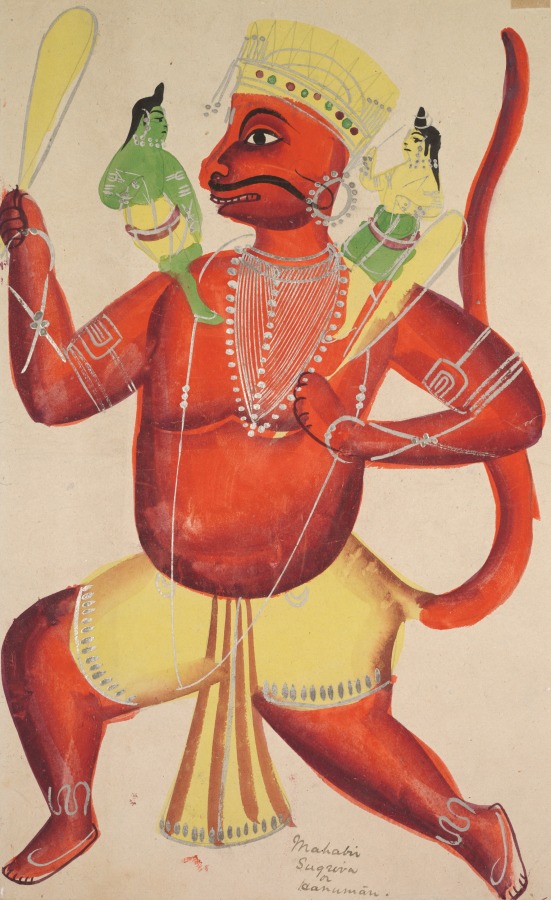
Filing him under monkey mischief, as a good deal of English-language spirit-animal writing does, means having read about him instead of reading him.
What do the three wise monkeys actually say in Japanese?
They make a pun that English cannot carry, and the pun is the reason the idea is carved as monkeys in the first place.
The three are mizaru, kikazaru and iwazaru: see-not, hear-not, speak-not. The classical negative ending -zaru sounds exactly like saru, monkey. Each name is at once a prohibition and the name of the animal delivering it. “See no evil, hear no evil, speak no evil” translates the sense and throws away the machinery, which is why the English version feels like a slightly prim proverb while the Japanese is a joke.
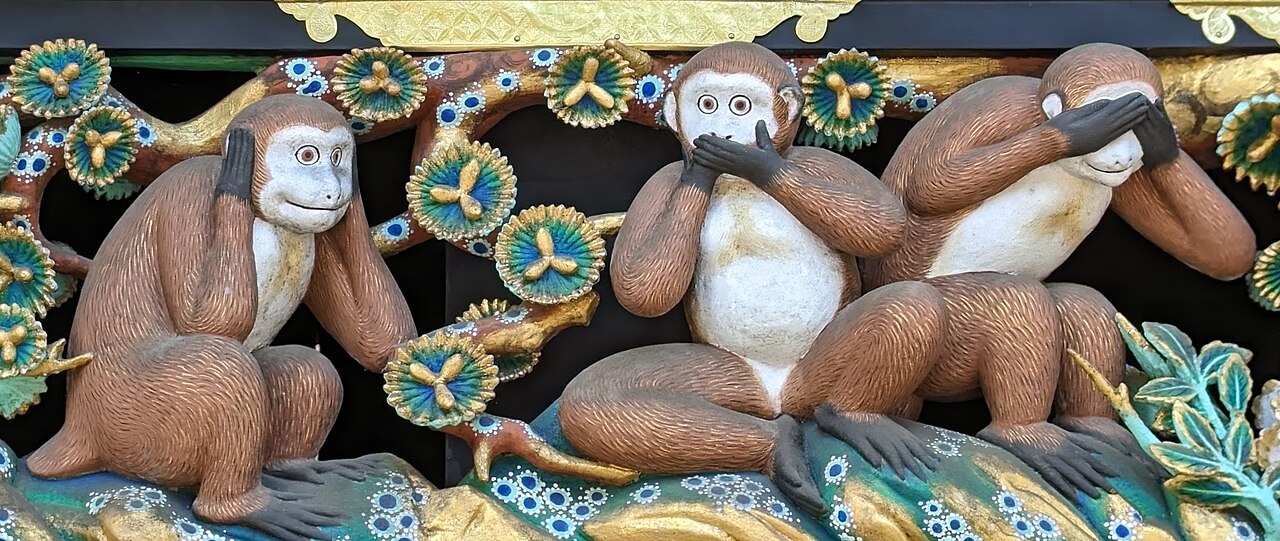
The carving belongs to the 1636 rebuilding of Nikko Tosho-gu, the shrine complex for Tokugawa Ieyasu, and tradition attributes it to Hidari Jingoro. It is worth knowing that it is panel two of eight. The full run tracks a human life, and the three monkeys are the child being kept from bad influences, not a general instruction to adults to keep quiet.
Two claims about origins get repeated. The Confucian one has substance: Analects 12.1 records Confucius telling Yan Yuan to look not, listen not, speak not and move not contrary to propriety. Four prohibitions, not three, and the resemblance is real without amounting to proof of descent. The nearer context is Koshin, a Japanese folk observance derived from Daoist ideas about spirits that report your misdeeds upward on a fixed night, in which the three monkeys appear as attendants. That association is well documented in Japan and sits much closer to the carving than Confucius does.
Why did the Egyptians make Thoth a baboon?
Because of what baboons do at dawn, and they were watching carefully.
Thoth is the god of writing, calculation and the moon, and he appears both as an ibis and as a hamadryas baboon. The baboon side has its own ancestry: a baboon deity called Hedj-wer, the Great White One, is attested from the Early Dynastic period and was folded into Thoth.
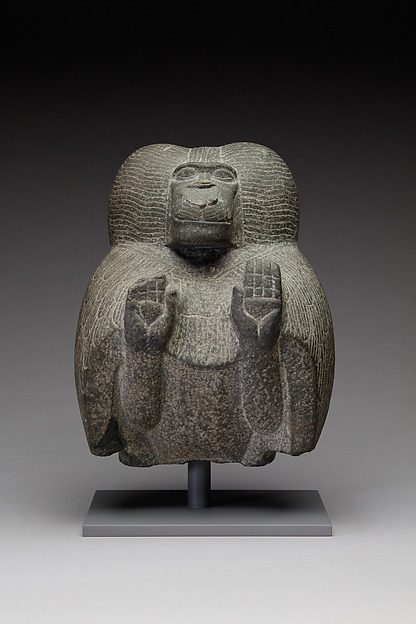
Hamadryas baboons become loudly vocal at first light, and they sit upright with their forelimbs raised. Egyptian sculptors took that posture and made it worship of the rising sun, producing squatting baboons with hands lifted in reliefs, amulets and freestanding statuettes. The behaviour is real. The reading is theirs, and it is a good deal better observed than most ancient animal symbolism.
Why does Britain keep monkeys on the Rock of Gibraltar?
Because of a superstition that a Prime Minister decided not to test.
The Barbary macaques on Gibraltar are the only free-living monkey population in Europe. Local belief holds that British rule lasts exactly as long as they do. In 1913 the population had fallen to about ten. During the Second World War it dropped to roughly seven, and on 2 September 1944 Churchill sent a directive to the Colonial Secretary: “The establishment of the apes on Gibraltar should be twenty-four, and every effort should be made to reach this number as soon as possible and maintain it thereafter.” Animals were brought across from Morocco to make up the number.
Whether he believed the legend is beside the point and probably unanswerable. What he clearly understood is that a visibly dwindling colony of monkeys, on a rock the enemy was watching, would read as a sign. The population today runs to a few hundred.
They are also, pedantically, not apes. Macaca sylvanus is a macaque, and it looks apelike only because it has almost no tail.
So where does the modern monkey meaning come from?
Not from where you would expect. I could not verify a monkey entry in Ted Andrews’s Animal Speak, and Medicine Cards, the other book that supplies half the internet’s animal keywords, works from a North American roster with no monkey in it.
What is left is better sourced than either. The mischief reading is Sun Wukong, a character from a novel printed in 1592 that has never been out of circulation in East Asia and has been continuously adapted into opera, film, television and games. The loyalty reading is Hanuman, from an epic older still and worshipped daily. The Chinese zodiac profile supplies the rest, and its most-copied English source is Theodora Lau’s The Handbook of Chinese Horoscopes of 1979.
None of that needed a compiler to assemble it, which is why the monkey’s popular meaning holds up better than most. The failure mode here is different. It is not invention, it is compression: two of the richest characters in world literature, flattened into the word “playful”.
Across traditions
Chinese literature (Sun Wukong and Journey to the West)
Journey to the West was published anonymously in 1592, in the Shidetang edition, and it is the source of nearly everything the modern world thinks a mythic monkey is. Sun Wukong is born from a stone egg, masters immortality, steals the peaches of the Queen Mother, fights heaven to a standstill, and is pinned under a mountain for five hundred years before being enlisted to escort the monk Xuanzang to India. His weapon is a compressible iron staff. His restraint is a headband that tightens when the monk recites a spell, which is as clear a piece of symbolism about an ungovernable mind as any tradition offers.
The attribution to Wu Cheng'en is conventional rather than settled, and honest sources say so. The 1592 title page carries no author. The attribution rests chiefly on an entry in a Huai'an prefectural gazetteer of the Tianqi era, 1621 to 1627, recording that Wu wrote something called The Journey to the West, which need not have been a novel. Wu died around 1582, a decade before publication, and no preface, colophon or surviving writing of his claims the book. Anthony C. Yu, whose complete translation is the standard English one, described the dispute in 2012 as having see-sawed for nearly a century without resolution. Use the name if you like, but do not treat it as established.
The ninth zodiac branch, shen 申, is the monkey, and the two are often conflated online. They are separate: the branch is Han-dynasty calendrical machinery, and Sun Wukong is a sixteenth-century literary character.
- PRIMARY Journey to the West (Xiyouji), Shidetang edition . Published anonymously, 1592. Standard complete English translation: Anthony C. Yu, University of Chicago Press, 1977-83, revised 2012.
- PRIMARY Huai'an prefectural gazetteer, Tianqi era (1621-1627) . The sole early basis for attributing the novel to Wu Cheng'en, and it records only a title, not a novel.
- PRIMARY Wang Chong, Lunheng . First century CE. Earliest complete listing of the twelve zodiac animals against the Earthly Branches; the monkey is shen, the ninth.
- REFERENCE Theodora Lau, The Handbook of Chinese Horoscopes . First published 1979. The most-copied English source for zodiac personality descriptions.
Hindu epic (Hanuman in the Ramayana)
Hanuman is a vanara, son of the wind god Vayu, and the fifth book of Valmiki's Ramayana, the Sundara Kanda, is largely his. He crosses the ocean to Lanka in a single leap to find the abducted Sita, is captured, has his tail set alight, and burns the city with it. Later he carries an entire mountain back from the Himalaya because he cannot identify the one healing herb growing on it, which is a joke about literal-mindedness that has been funny for two thousand years.
The Sanskrit uses kapi, unambiguously monkey, throughout. Hanuman is not a symbolic monkey or a metaphorical one; the text means a monkey.
What he is read for is not cleverness but devotion. He is the model of bhakti, service given without calculation, and his cult is enormous and living rather than antiquarian. Tulsidas, writing in Awadhi in the sixteenth century, composed the Ramcharitmanas and is credited by tradition with the forty-verse Hanuman Chalisa, which is recited daily by millions. Any page that files Hanuman under monkey mischief has read about him rather than read him.
- PRIMARY Valmiki, Ramayana, Sundara Kanda . Sanskrit epic; the fifth book is devoted to Hanuman's journey to Lanka. Critical edition: Oriental Institute, Baroda, 1960-75.
- PRIMARY Tulsidas, Ramcharitmanas . Awadhi, composed c. 1574-76. The Hanuman Chalisa is traditionally attributed to the same author.
Japan (the three monkeys at Nikko Tosho-gu)
The carving is on the sacred stable at Nikko Tosho-gu, the shrine complex built for Tokugawa Ieyasu, and dates to the 1636 rebuilding. It is attributed to the sculptor Hidari Jingoro. It is not a standalone image: it is the second of eight panels running the length of the stable, a sequence about a human life from infancy onward, and the three monkeys belong to the childhood panel.
The English name loses the joke. In Japanese the three are mizaru, kikazaru and iwazaru: see-not, hear-not, speak-not. The classical negative suffix -zaru is a homophone of saru, monkey. The names simultaneously state the prohibition and name the animal making it, which is why the idea is carved as monkeys at all. See no evil, hear no evil, speak no evil is a translation of the meaning with the entire mechanism removed.
Two things frequently claimed about it deserve care. The Confucian parallel is real: Analects 12.1 has Confucius tell Yan Yuan to look not at what is contrary to propriety, listen not, speak not, and make no movement contrary to it. That is four prohibitions rather than three, and the resemblance is strong enough to be worth noting without being proof of descent. The other context is the Koshin folk observance, a vigil derived from Daoist belief about spirits that report a person's misdeeds to heaven, in which the three monkeys appear as attendants. That association is well attested in Japanese material and is the more immediate setting for the carving.
- PRIMARY Three monkeys carving, sacred stable, Nikko Tosho-gu . 1636 rebuilding; attributed to Hidari Jingoro. Second of eight panels depicting stages of a human life.
- PRIMARY Confucius, Analects 12.1 (Yan Yuan) . The four prohibitions: look not, listen not, speak not, move not, contrary to propriety. James Legge translation.
Ancient Egypt (Thoth in baboon form, and the dawn baboons)
Thoth, the god of writing, reckoning and the moon, is shown as an ibis and as a hamadryas baboon, Papio hamadryas. The baboon form is not a late curiosity: a baboon deity called Hedj-wer, the Great White One, is attested from the Early Dynastic period and was absorbed into Thoth's identity.
The reason is behavioural and it is correct. Hamadryas baboons are noisy at first light and sit upright with their forelimbs raised as the sun comes up. Egyptian art turned that into worship, and statuettes and reliefs show squatting baboons with hands lifted, greeting the rising sun. The observation is accurate; the interpretation is theirs.
One caution. The baboon-headed figure that appears among the four sons of Horus on canopic jars is Hapy, guarding the lungs, and is not Thoth. Both are baboons in Egyptian art and pages routinely merge them.
- MUSEUM Statuette depicting a worshipping baboon, Dynasty 19, reign of Ramesses II . Metropolitan Museum of Art 66.99.55, ca. 1290-1224 BCE. Meta-siltstone, 17.8 cm.
- REFERENCE Richard H. Wilkinson, The Complete Gods and Goddesses of Ancient Egypt . Thames and Hudson, 2003. Standard reference for Thoth's forms and for Hedj-wer.
Working with the Monkey
If you want a regular practice rather than a one-time read, an oracle deck is the standard tool: you draw a card and sit with whatever animal comes up. Our ranked guide to spirit animal oracle decks compares the field.
Sources
- PRIMARY Journey to the West (Xiyouji), Shidetang edition, 1592 . Published anonymously; the Wu Cheng'en attribution is contested.
- PRIMARY Valmiki, Ramayana, Sundara Kanda . Hanuman's leap to Lanka.
- PRIMARY Confucius, Analects 12.1 . The four prohibitions, a likely antecedent of the three-monkey formula.
- MUSEUM The Monkey King Songoku, from the Chinese novel Journey to the West . Yashima Gakutei, probably 1824. Metropolitan Museum of Art JP2047, H. O. Havemeyer Collection.
- MUSEUM Hanuman with Rama and Lakshmana on his shoulders, Kalighat, c. 1890 . Cleveland Museum of Art 2003.120. CC0.
- ARCHIVE Fred Glueckstein, 'Churchill and the Barbary Macaques' . Finest Hour 161, International Churchill Society. Quotes the directive of 2 September 1944.