Spirit Animal
Black Cat Spirit Animal
Black cat symbolism and superstition, checked against the sources: what the 1233 papal decretal Vox in Rama actually says, who started the claim that cat-killing worsened the Black Death, why England's most famous witch cat was white, and what shelter adoption data really shows.
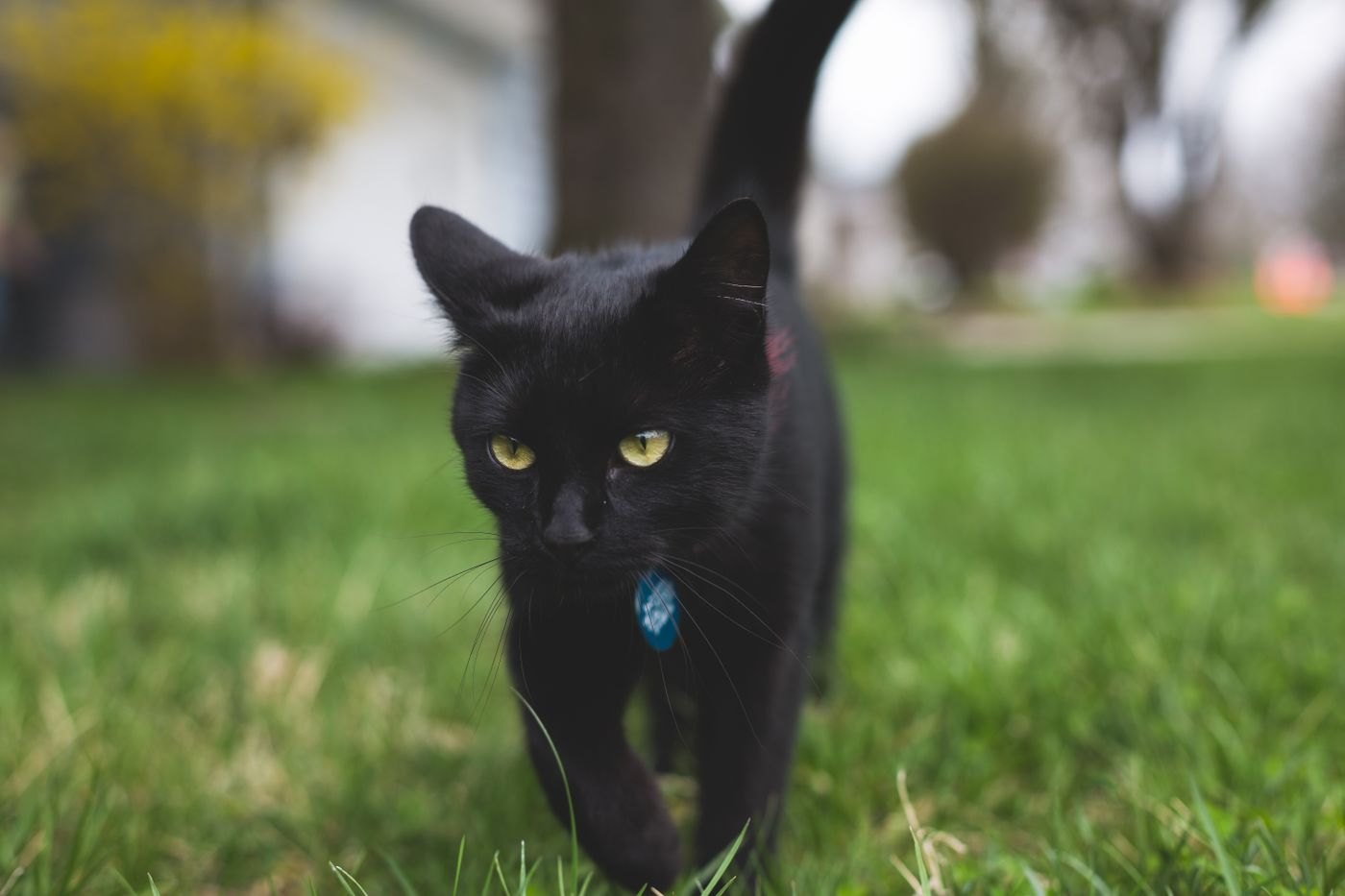
The black cat means bad luck in the United States and good luck across most of Britain, and the split is old and unexplained. The origin story told everywhere online, that a papal decretal of 1233 triggered mass cat-killing that worsened the Black Death, is traceable to a single 1999 book and is not supported by the decretal's text, by archaeology, or by plague epidemiology.
The story goes like this. In 1233 a pope declared black cats to be servants of the Devil. Medieval Europe obeyed, killed its cats in enormous numbers, and the rat population exploded. A century later the rats brought the Black Death, and Europe died of its own superstition.
It is a wonderful story. It is on hundreds of pages, in documentaries, in pub quizzes. Nearly every part of it is wrong, and the wrongness is checkable in an afternoon.
What the decretal of 1233 actually says
Vox in Rama is real. Gregory IX issued it in June 1233 to Emperor Frederick II, to King Henry, to two German bishops and to Konrad von Marburg, the inquisitor whose interrogations in Mainz had produced the account it repeats. A papal official named Bernard complained at the time that Konrad was extracting confessions from innocent people by threatening to burn them. Konrad was assassinated the following year.
The cat is there. The decretal describes an initiation rite in which a statue of a black cat comes alive, walks backwards with its tail up, and is kissed on the hindquarters by the initiate and the presiding master. Later a man appears from a dark corner, shining like the sun above the waist and shaggy like a cat below it.
That is the extent of it. There is no statement that cats in general are diabolical. There is no instruction to kill any. It is a description of an alleged heretical ceremony in one part of Germany, drawn from confessions obtained under threat of the stake, and the animal in it is a prop in a story the inquisitor had already decided was true.
The plague story has an author, and a date
The extermination-and-plague claim is not medieval. It comes from Donald Engels’s Classical Cats: The Rise and Fall of the Sacred Cat, published by Routledge in 1999, which reads the decretal as a papal proclamation against cats and blames the resulting crusade of extermination for the severity of the Black Death.
Four things sit badly with it.
The gap. The decretal is from 1233. Plague reached Europe in 1347. That is 114 years, which is a long time for a cause to wait.
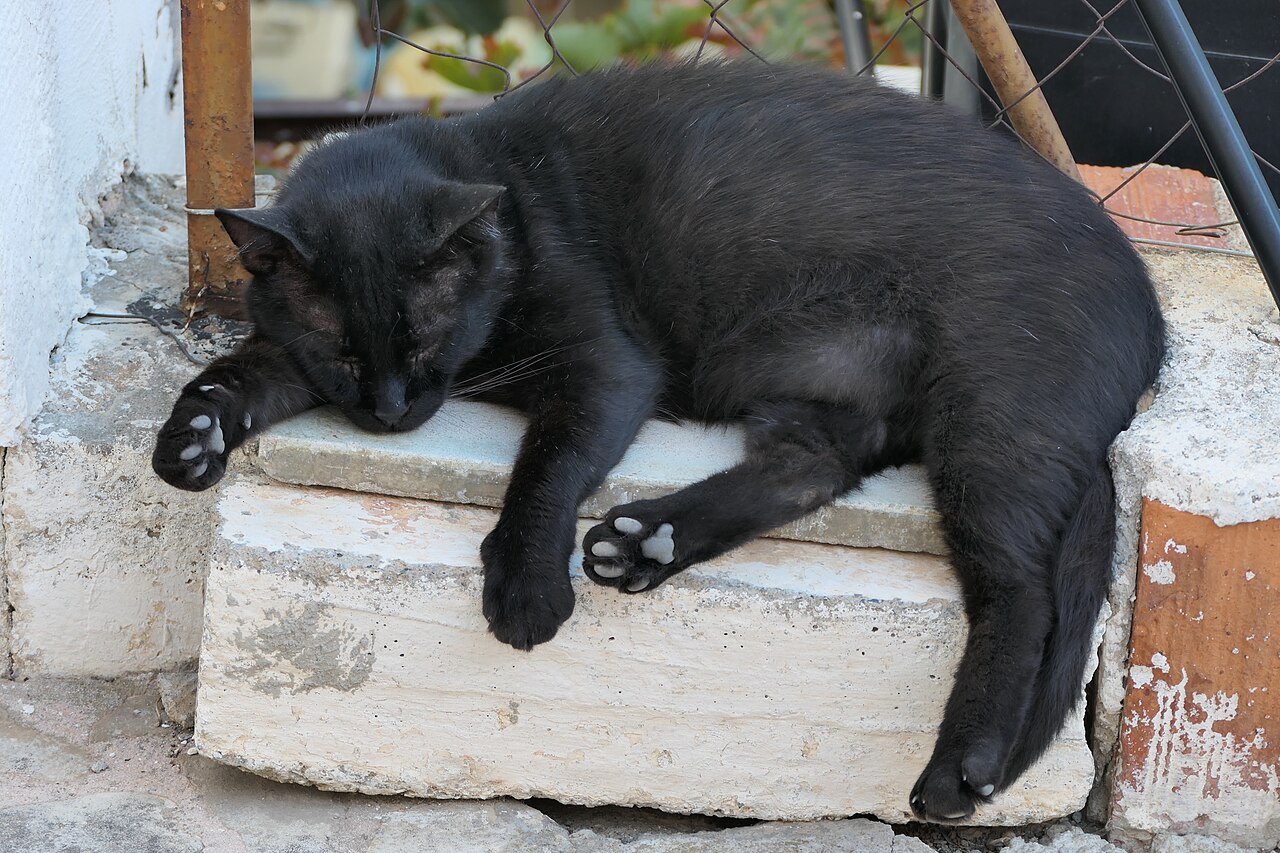
The archaeology. Where medieval cat remains turn up in quantity, they show butchery and skinning rather than ritual killing. Rosemary Luff and Marta Moreno García published seventy cats from a Cambridge well in Archaeofauna in 1995: throats cut, then skinned and dismembered. That is a fur and meat trade, an unlovely one, but a trade. It is not a religious purge, and it produced no documentary record of the kind Engels’s claim requires. Excavators in Portugal reported a comparable assemblage in 2024, thirteen cats from twelfth and thirteenth century storage pits, cut-marked in the pattern skinning leaves. Cat pelts lined collars and cuffs across medieval Europe. The animals died for the same reason rabbits did.
The church, meanwhile, was busy permitting cats. The Ancrene Wisse, a rule for anchoresses written in England in the early thirteenth century and therefore within a generation of the decretal, tells its three sisters that unless necessity requires it and their director agrees, they should keep no animal except one cat. That is a religious instruction manual, contemporary with Gregory IX, and its position on cats is that a woman walled into a church may have exactly one. And where civic authorities did order stray animals killed in numbers, it was during plague outbreaks and as a response to them, with no known examples before the fifteenth century. The killing follows the disease. It does not precede it by a century.
The epidemiology. The rat-and-flea route is not the only candidate for how the Second Pandemic moved. Katharine Dean and colleagues, in PNAS in 2018, tested a human-ectoparasite model against mortality curves from nine European outbreaks and found it fitted better than rodent or pneumonic models in seven of them. That paper drew a rebuttal in the same journal the same year, so treat it as a live argument rather than a settled answer. Either way, a Europe-wide cat shortage is not the pivot the story needs it to be.
The cats themselves. Cats catch plague. They are highly susceptible to Yersinia pestis, and a cat that eats an infected rodent becomes a hazard to whoever handles it. That is not a medieval inference. Kenneth Gage and colleagues at the CDC counted 23 cat-associated human plague cases in the western United States between 1977 and 1998, five of them fatal.
England’s most famous witch cat was white
Skip forward three centuries to where the black cat and the witch actually meet in the record, and the record has a joke in it.

England’s first printed witch-trial pamphlet covers the Chelmsford assizes of 26 and 27 July 1566. Elizabeth Frauncis confessed that her grandmother had taught her witchcraft at the age of twelve and had given her a familiar in the likeness of a cat. She fed it bread and milk. She kept it fifteen or sixteen years. She handed it on to her neighbour Agnes Waterhouse, who used it to kill livestock and was hanged for it, the first woman executed under the 1562 Witchcraft Act. The cat’s name was Sathan, and later, on a spoken formula, it was turned into a toad.
The pamphlet says Sathan was a white spotted cat.
Familiars in this literature are a menagerie: dogs, toads, ferrets, mice, rats, cats of assorted colours. The single-minded association with black is not what the trial documents show. It thickens afterwards, in print rather than in court, and by the time the Victorians got hold of it the black cat had become the default and the white spotted one had been quietly forgotten.
Lucky in Britain, unlucky in America, unverified in Japan
The single most interesting thing about black cat superstition is that it does not agree with itself.
In most of Britain a black cat crossing your path is good luck, and one turning up on your doorstep is better. Cross the Atlantic and the identical event is a warning. Both readings are recorded in the standard collections. Iona Opie and Moira Tatem’s A Dictionary of Superstitions, published by Oxford in 1989, is the reference work that runs British superstitions back to their earliest printed appearances, and it is where the British half belongs.
What no source produced was an explanation for the inversion. Plenty of pages offer one, usually Puritan settlers carrying a harder line across the Atlantic, and it is a plausible story. I could not find a document behind it, so it is not stated here as a cause. The honest position is that two neighbouring cultures, sharing a language and most of their folklore, read the same animal in opposite directions, and that nobody has produced the paperwork.
A third claim travels with these two: that black cats are lucky in Japan and that a single woman who keeps one will attract suitors. It appears in nearly every English-language article on the subject, always without a source. Everything found for it traced back to other articles making the same claim. It may be perfectly true. It is recorded here as unverified, because that is what it is.
How the black cat became a five-cent trademark
By the end of the nineteenth century the black cat in America was no longer really an omen. It was a brand.
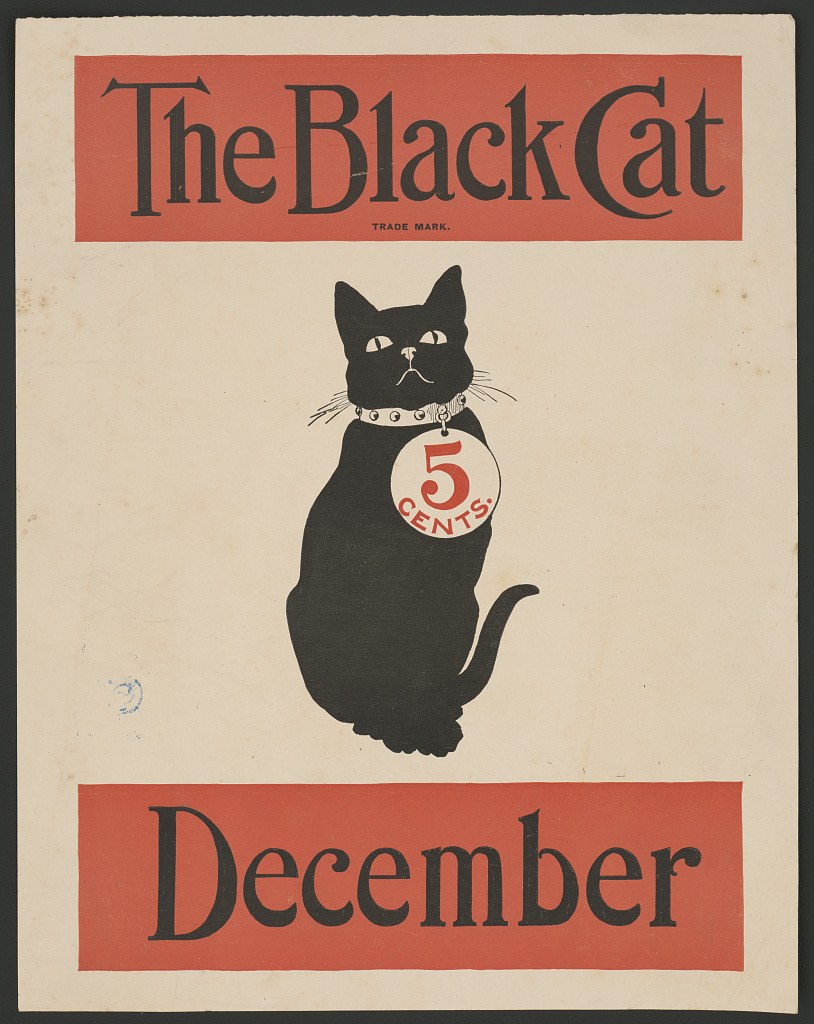
The Black Cat was a Boston fiction monthly, five cents an issue, and its covers put the animal on the newsstand as a trademark rather than a warning. Poe had published his story of that title in 1843. The Chat Noir cabaret opened in Montmartre in 1881. Halloween cards, cigarette packets and pulp magazines followed. The superstition survived, but by 1900 it was mostly being sold back to people as atmosphere, which is a different thing from being believed.
What the shelter numbers actually show
Every October, campaigns run on the claim that black cats languish in shelters and die there. The research is more equivocal than the posters.
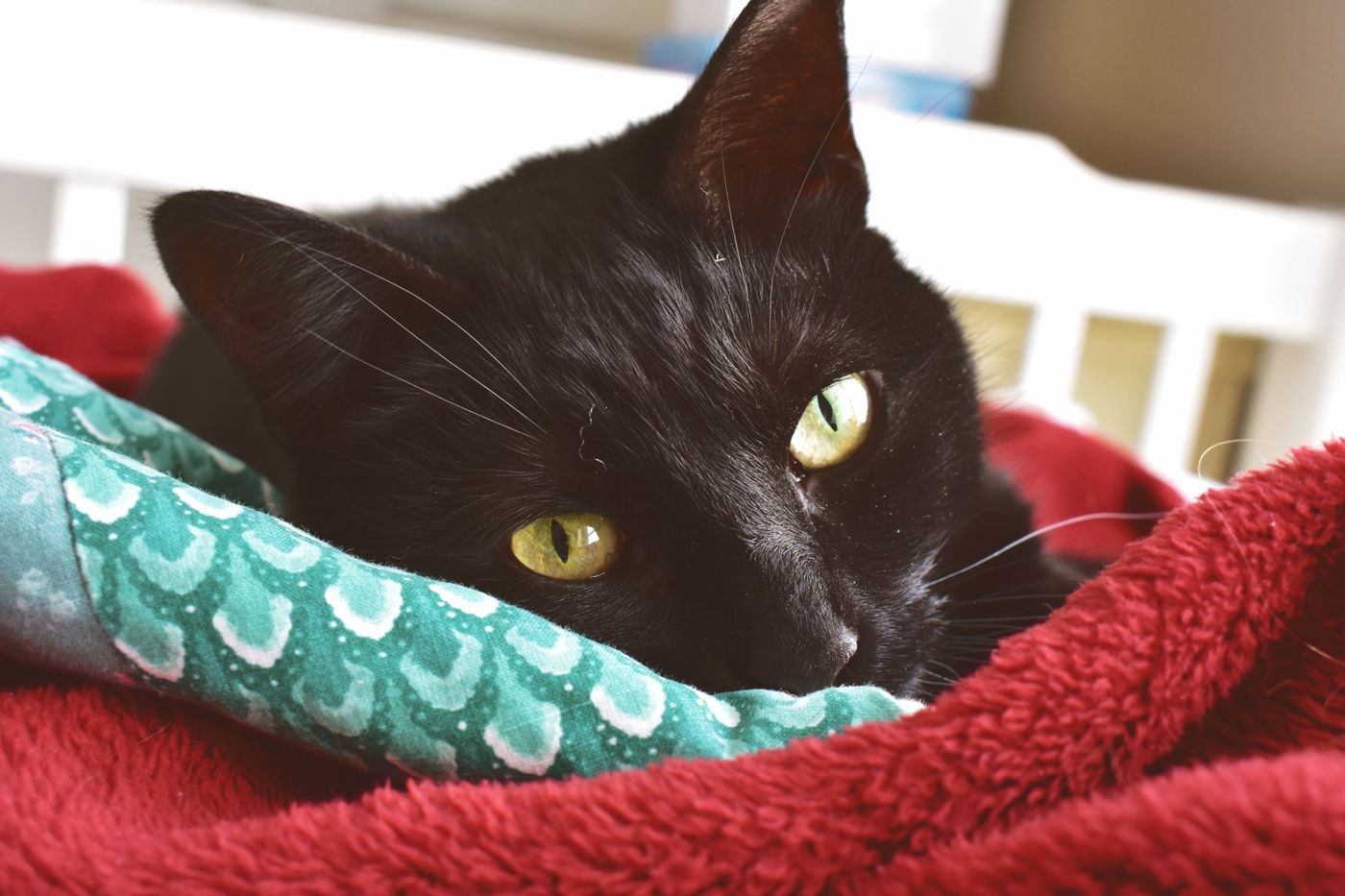
Kogan, Schoenfeld-Tacher and Hellyer found the effect in two Colorado shelters: black cats waited longest, mostly-black cats next, across ages and both sexes. Other datasets do not reproduce it. At one Sydney shelter white cats waited longer than black ones. Where the gap does appear it tends to be measured in days against waits measured in weeks, which is a real welfare cost and a poor headline.
The 2020 attitude study is the one worth reading. Jones and Hart found two predictors of bias: superstitious belief, and a person’s confidence in reading feline facial expression. The second has nothing to do with 1233. It is a photograph problem. Dark fur under fluorescent light in a small thumbnail gives an adopter almost nothing to read, and people do not choose animals whose faces they cannot see.
Where the modern reading comes from
Spirit-animal writing on the black cat mostly inherits the general cat keynote from Ted Andrews’s Animal Speak (Llewellyn, 1993), independence and mystery and intuition, then darkens it a shade and adds the pope.
The correction is not that the black cat has no history. It has a long and specific one: a coerced confession in Mainz, a white spotted cat in an Essex courtroom, seventy skinned cats in a Cambridge well, a Boston magazine at five cents, and an argument among epidemiologists that is still running. What it does not have is the single tidy origin the internet gave it in 1999, and anyone who tells you a pope caused the Black Death is quoting a book, not a bull.
Across traditions
Vox in Rama (papal decretal, June 1233)
Gregory IX issued Vox in Rama in June 1233, addressed to Emperor Frederick II, King Henry, Archbishop Siegfried III of Mainz, Bishop Conrad II of Hildesheim and the inquisitor Konrad von Marburg. It responded to Konrad's inquisition in Mainz, which had produced, through what a contemporary papal official described as coerced confessions, an account of a satanic cult.
The document does contain a black cat. In the initiation rite it describes, a statue of a black cat comes to life, walks backwards with its tail raised, and is kissed on the hindquarters by the initiate and the sect's master. Later a figure appears whose upper body shines like the sun and whose lower half is shaggy like a cat's. The decretal also alleges that members carry the consecrated host home in their mouths and throw it into a latrine.
What the text does not do is declare cats satanic in general or order anyone to kill one. It describes an alleged heretical rite in one region of Germany. Everything built on top of that, the Europe-wide extermination campaign, the rat population boom, the aggravated plague, is a later construction and belongs to its author rather than to Gregory IX.
- PRIMARY Gregory IX, Vox in Rama (June 1233) . Papal decretal issued to Frederick II, Henry, Siegfried III of Mainz, Conrad II of Hildesheim and Konrad von Marburg. Contains no instruction to kill cats.
- REFERENCE Donald Engels, Classical Cats: The Rise and Fall of the Sacred Cat . Routledge, 1999. The source of the modern claim that the decretal launched a cat extermination that worsened the Black Death.
English witch trials (Chelmsford, 1566)
The first English witchcraft pamphlet, The Examination and Confession of Certain Witches at Chelmsford in the County of Essex (London, 1566), reports the trial of Elizabeth Frauncis, Agnes Waterhouse and Waterhouse's daughter Joan, held on 26 and 27 July 1566. Frauncis testified that she had been taught witchcraft at twelve by her grandmother, who delivered to her a familiar in the likeness of a cat. She fed it bread and milk, kept it fifteen or sixteen years, and passed it to her neighbour Agnes Waterhouse. Waterhouse used it, by her own confession, to kill livestock, and was hanged. The familiar's name was Sathan.
The detail that matters here is its colour. The pamphlet describes Sathan as a white spotted cat, and later says the cat was kept in wool in a pot and, on a spoken formula, turned into a toad. The most famous cat in the English witch-trial record is neither black nor, by the end, a cat.
Familiars in the English pamphlet literature come in many forms and colours: cats, dogs, toads, ferrets, mice, rats. The specific fixation on black is not a feature of the trial documents themselves. It hardens later, and by the nineteenth century it has become the default.
- PRIMARY The Examination and Confession of Certain Witches at Chelmsford in the County of Essex (London, 1566) . England's first witch-trial pamphlet. Describes the familiar Sathan as a white spotted cat, later turned into a toad.
British and American folk superstition (a split with no paper trail)
In most of Britain, a black cat crossing your path is lucky, and a black cat arriving at your door is luckier still. In most of the United States, the identical event is a bad omen. Both readings are recorded in the standard collections, and the divergence is real rather than an internet artefact.
What is missing is an explanation. Iona Opie and Moira Tatem's A Dictionary of Superstitions (Oxford University Press, 1989) is the reference work that traces British superstitions to their earliest printed attestations, and it is the right place to look for the British half. This page has not located a document that explains why the two traditions inverted, and pages that confidently name a cause are supplying one.
A parallel claim, that black cats are considered lucky in Japan and bring suitors to unmarried women, is repeated in almost every English-language article on the subject. No scholarly source for it was found. It is recorded here as unverified rather than repeated as fact.
- REFERENCE Iona Opie and Moira Tatem, A Dictionary of Superstitions . Oxford University Press, 1989. The standard reference tracing British superstitions to earliest printed attestation.
Modern shelter research (the black cat bias question)
The Halloween adoption campaigns rest on a claim that shelter research supports only in part. Lori Kogan, Regina Schoenfeld-Tacher and Peter Hellyer, analysing data from two Colorado shelters, reported in The Open Veterinary Science Journal in 2013 that black cats took the longest to adopt regardless of age or sex, with mostly-black cats next. Other datasets disagree. In one Sydney shelter the effect ran the other way and white cats waited longer.
Where the effect appears, it is small. Reported gaps run to roughly two days at one shelter and closer to six for black adult cats at another, against a background in which cats of every colour wait weeks. Haylie Jones and Christian Hart, publishing in Psychological Reports in 2020, tested attitudes rather than outcomes and found black cat bias predicted by two things: superstitious belief, and how well people thought they could read a cat's face. The second is the more interesting finding, because a black cat's expression is genuinely harder to see in a photograph.
- PEER-REVIEWED Kogan, Schoenfeld-Tacher and Hellyer, Cats in Animal Shelters: Exploring the Common Perception that Black Cats Take Longer to Adopt . The Open Veterinary Science Journal 7 (2013), pp. 18-22.
- PEER-REVIEWED Haylie D. Jones and Christian L. Hart, Black Cat Bias: Prevalence and Predictors . Psychological Reports 123, no. 4 (2020), pp. 1198-1206.
Working with the Black Cat
If you want a regular practice rather than a one-time read, an oracle deck is the standard tool: you draw a card and sit with whatever animal comes up. Our ranked guide to spirit animal oracle decks compares the field.
Sources
- PRIMARY Gregory IX, Vox in Rama (1233)
- PRIMARY The Examination and Confession of Certain Witches at Chelmsford (London, 1566)
- PEER-REVIEWED Rosemary M. Luff and Marta Moreno García, Killing Cats in the Medieval Period: An Unusual Episode in the History of Cambridge, England . Archaeofauna 4 (1995), pp. 93-114. Seventy cats from a Cambridge well, throats cut, skinned and dismembered.
- PEER-REVIEWED Pets or Pelts: Cat Fur Exploitation in Medieval Portugal . Journal of Archaeological Science: Reports, 2024. Thirteen cats from 12th to 13th century storage pits with skinning cutmarks.
- PRIMARY Ancrene Wisse (early 13th century) . Rule for anchoresses. Permits no animal except one cat.
- PEER-REVIEWED Katharine R. Dean et al., Human Ectoparasites and the Spread of Plague in Europe during the Second Pandemic . PNAS 115, no. 6 (2018), pp. 1304-1309. Contested by Park et al. in the same journal later that year.
- PEER-REVIEWED Kenneth L. Gage et al., Cases of Cat-Associated Human Plague in the Western US, 1977-1998 . Clinical Infectious Diseases 30, no. 6 (2000), pp. 893-900.
- PEER-REVIEWED Kogan, Schoenfeld-Tacher and Hellyer, Cats in Animal Shelters . The Open Veterinary Science Journal 7 (2013).
- PEER-REVIEWED Jones and Hart, Black Cat Bias: Prevalence and Predictors . Psychological Reports 123 (2020).
- REFERENCE Donald Engels, Classical Cats: The Rise and Fall of the Sacred Cat . Routledge, 1999.
- REFERENCE Iona Opie and Moira Tatem, A Dictionary of Superstitions . Oxford University Press, 1989.