Spirit Animal
Ox Spirit Animal
Ox spirit animal meaning: endurance, patience and labour. Traced to sources that exist: the ox as second animal of the Chinese zodiac, Laozi's departure west in Sima Qian's Shiji and the ox that is not in it, Kuoan Shiyuan's ten ox-herding pictures, the aurochs behind every domestic cow, and why the ox at the manger comes from Isaiah rather than Luke.
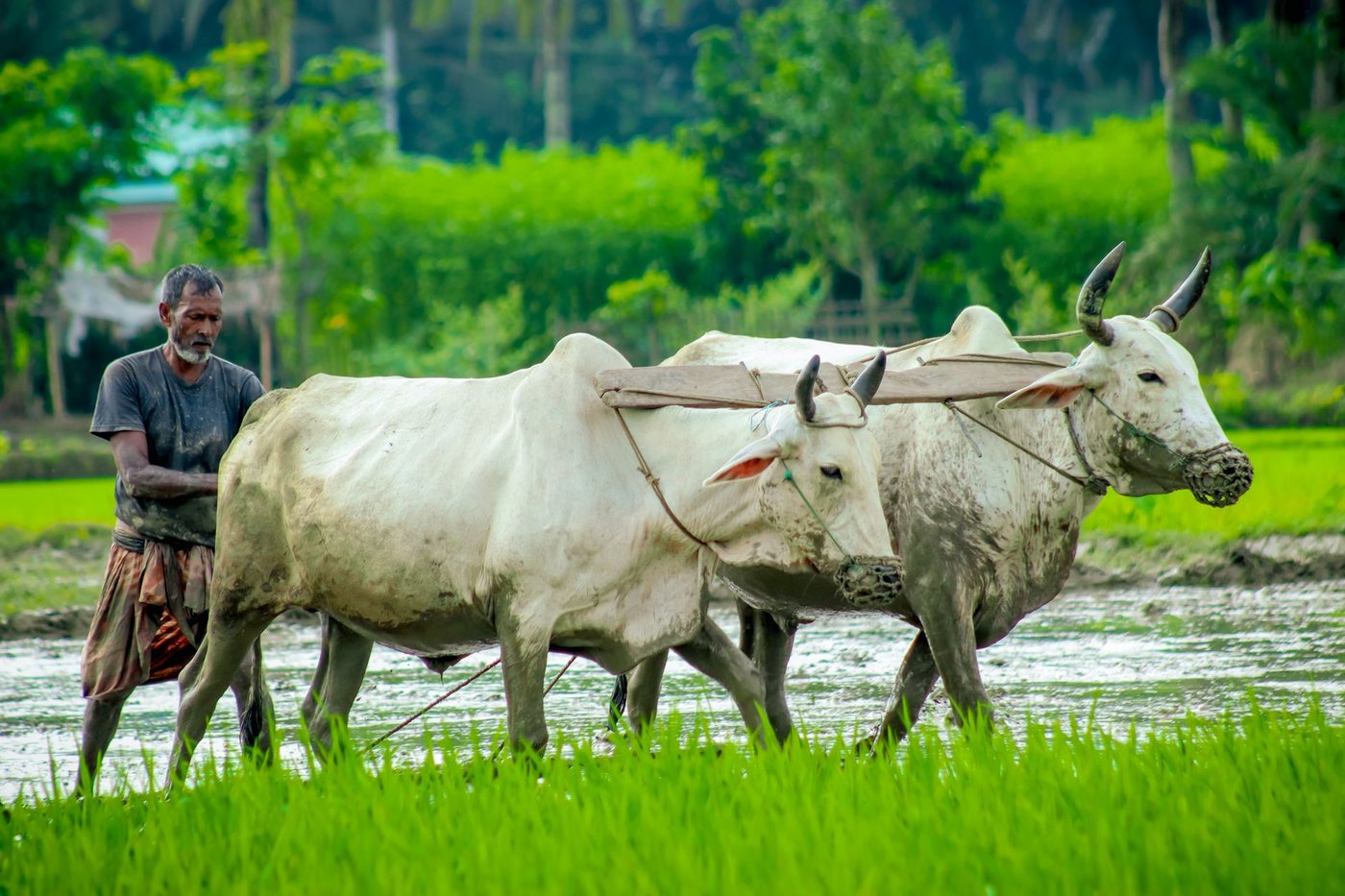
The ox is read as endurance, patience and steady work, and that reading is unusually well founded: an ox is by definition a bovine trained to pull, so the symbolism describes the job rather than a projection onto the animal. It is second in the Chinese zodiac, it carries Laozi west out of China in the later legend, and it is the quarry in the Chan Buddhist ten ox-herding pictures, where the ox is the practitioner's own mind.
An ox is not a species. It is a job.
The word describes a bovine, usually a castrated male, trained to draught work: pulling a plough, a cart, a sledge, a mill. Left uncastrated he is a bull, and a bull is a different symbol doing different work in every tradition that keeps both. So when a page tells you the ox stands for patience and steady effort, it is not projecting a virtue onto an animal. It is describing what the animal was made to do, by people who made it do that for six thousand years.
That is rarer than it sounds on this site. Most of the meanings we take apart here turn out to be inventions with a date on them. This one is close to a description.
Why is the ox second in the Chinese zodiac?
For the same reason the rat is first: the branch was already there.
The twelve earthly branches are a counting sequence attested in Shang oracle-bone record-keeping around 1200 BCE, and chou, the ox’s branch, was in second place long before anybody attached an animal to it. The mapping of animals onto branches is documented by 217 BCE on the daybook slips from a Qin tomb at Shuihudi, and Wang Chong’s Lunheng gives the first complete list in the first century CE. The race in which the rat rides on the ox’s back and jumps off at the finish is a later explanation for an order the early texts simply take as given. The rat entry follows that thread.
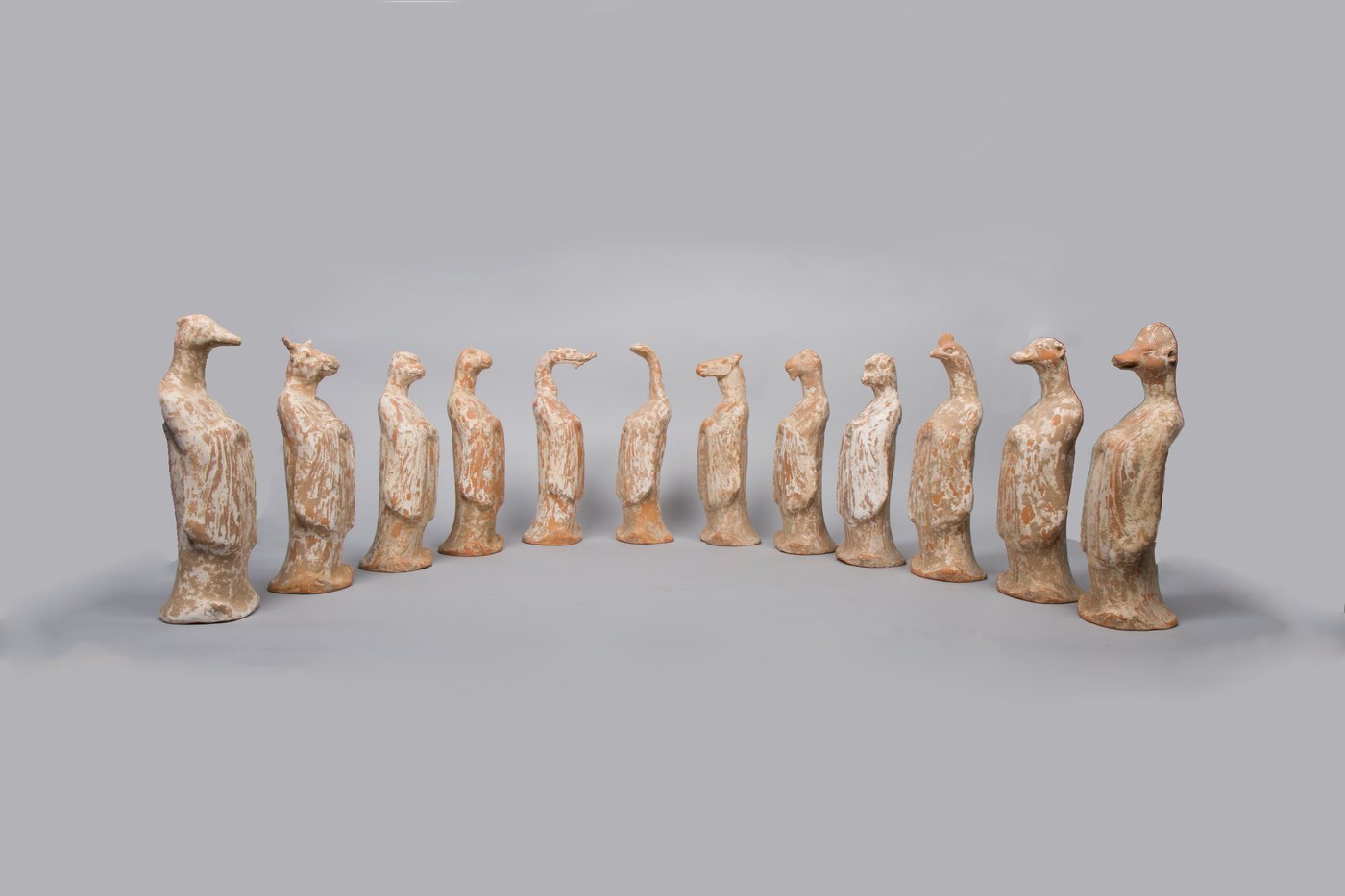
One translation note that matters. The Chinese word is niu 牛, which means cattle generally, not specifically a castrated draught male, and the Vietnamese cycle, otherwise near-identical, reads the second animal as the water buffalo, trâu. English calls it an ox because English needed a word. Across most of the region, in practice, it is whichever bovine is on the end of the yoke.
Did Laozi really ride an ox out of China?
Sima Qian says he went west. Sima Qian does not say he rode.
The oldest surviving account of Laozi sits in the Shiji, compiled around 104 to 91 BCE, and it is unusually honest about its own thinness: the historian is working four centuries after the fact with very little to go on. The story is short. The archivist of Zhou, seeing the dynasty in decline, heads west. At the pass, the keeper Yin Xi recognises him and asks him to write his teaching down before he goes. He produces a book in two parts, on the Way and its power, and vanishes.
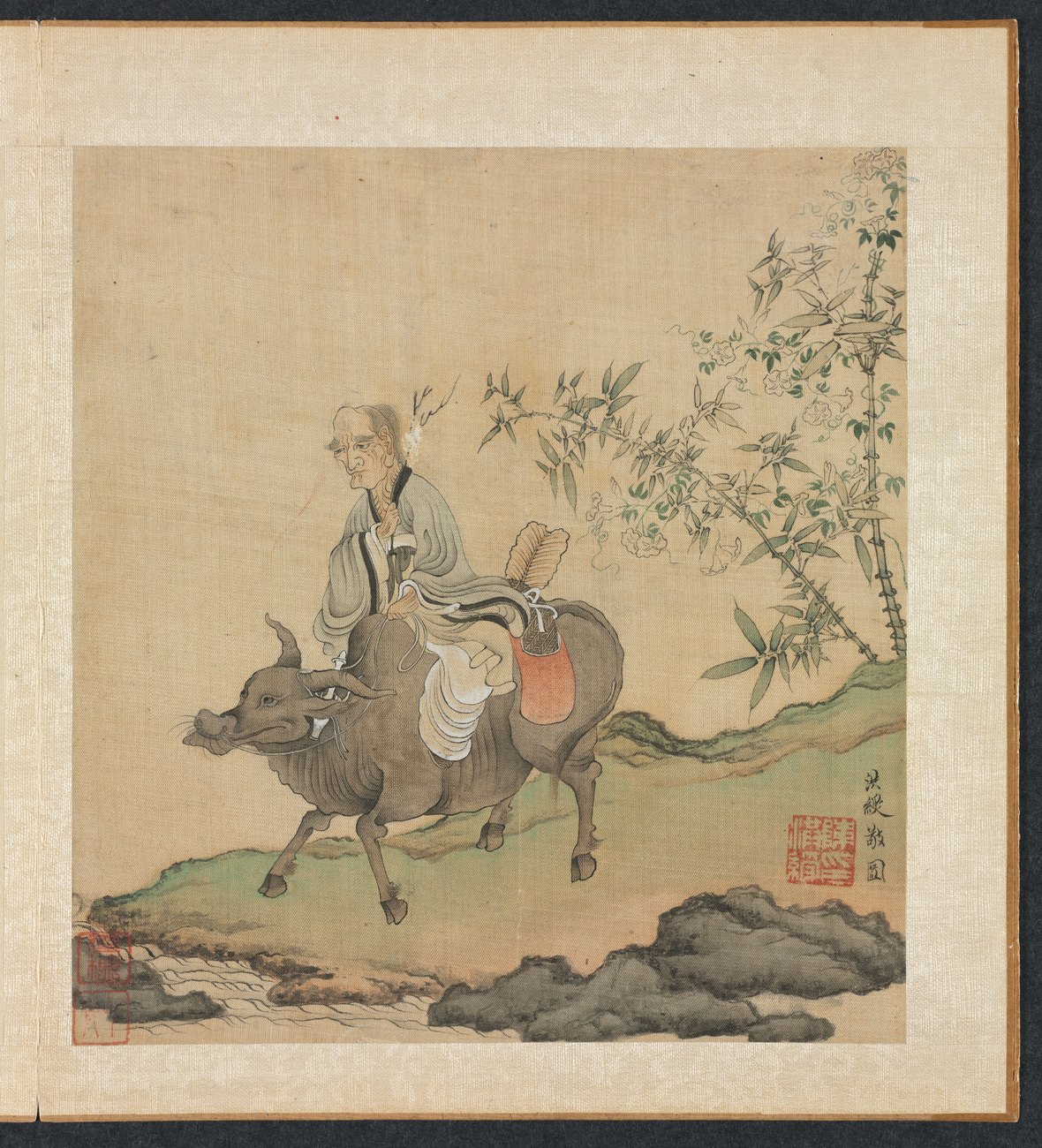
The ox belongs to the pictures. Painters put him on one, and in the version that stuck it is a green water buffalo, the qingniu, with a boy servant leading. It is an image with a good argument inside it: the man walking out on civilisation leaves on the animal civilisation was built with. That is worth appreciating as art. It is not worth citing as biography, and A. C. Graham’s case that even Sima Qian’s Laozi is a composite of separate legends is the standard reason to hold the whole account loosely.
What is the ox in the Zen ox-herding pictures?
You. That is the entire point of the sequence, and it is why these pictures are the most substantial ox tradition in the record.
The ten ox-herding pictures, with verses and prose introductions, are attributed to Kuoan Shiyuan, a twelfth-century Chan master of the Linji line. The stages run: looking for the ox, finding its tracks, catching sight of it, catching it, taming it, riding it home, ox forgotten and self alone, both forgotten, returning to the source, and entering the marketplace with open hands.
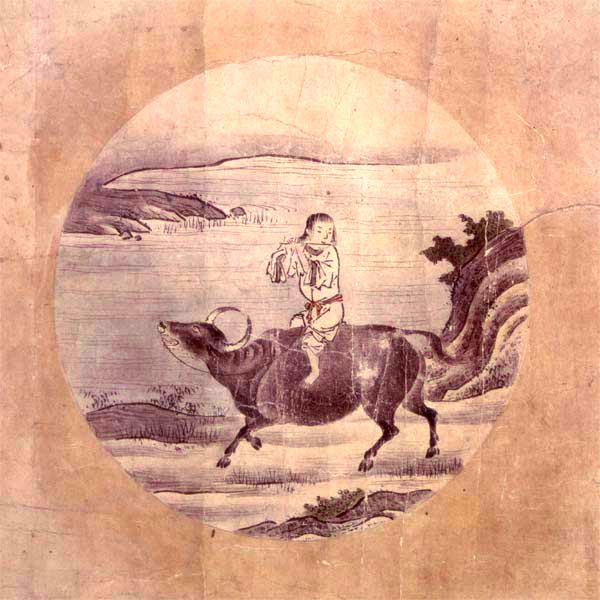
Two features separate this from ordinary animal symbolism. The first is that the ox is not an external guide, messenger or helper, the roles animals almost always take in this genre. The ox is the practitioner’s own mind, and the sequence is about getting hold of it. The second is where it ends. The eighth picture is an empty circle, and the tenth deposits you back in an ordinary street among ordinary people, which is a deliberate refusal of the arrival-at-enlightenment shape the earlier frames could be read as offering.
Kuoan’s is not the only version. An earlier five-picture set attributed to Qingju has the ox whiten in stages as it is tamed, and Puming’s sequence circulated widely with its own poems. English-language readers mostly meet the ten through D. T. Suzuki, and through the Nyogen Senzaki and Paul Reps translation.
The one animal Hebrew law protects by name
Before the ox reaches the manger it appears in the Torah as a legal subject, and the rulings are specific enough to be worth reading directly.
Deuteronomy 25:4: you shall not muzzle an ox while it is threshing. The animal walking the grain out is entitled to eat some of it, and a farmer who ties its mouth shut is breaking the law. Deuteronomy 22:10: you shall not plough with an ox and a donkey together, which reads as a rule about mismatched pace and strength, the stronger animal dragging the weaker one along. And the sabbath commandment names the ox in its own clause. Deuteronomy 5:14 lists who rests: you, your son, your daughter, your slaves, your ox, your donkey, the rest of your cattle, and the stranger in your settlements. Exodus 23:12 puts the ox’s rest as the reason for the day rather than an afterthought to it, so that your ox and your donkey may rest.
Set that against every other animal in the same law code, most of which appear as clean, unclean, or an offering. The ox appears as a worker with entitlements, and the entitlements are the ordinary ones: food while working, a workload matched to its strength, a day off. The muzzling verse is quoted twice in the New Testament letters, at 1 Corinthians 9:9 and 1 Timothy 5:18, both times in an argument about paying the people who do the work. That is a fair reading of what it was already doing.
Where does every ox come from?
From an animal that no longer exists.
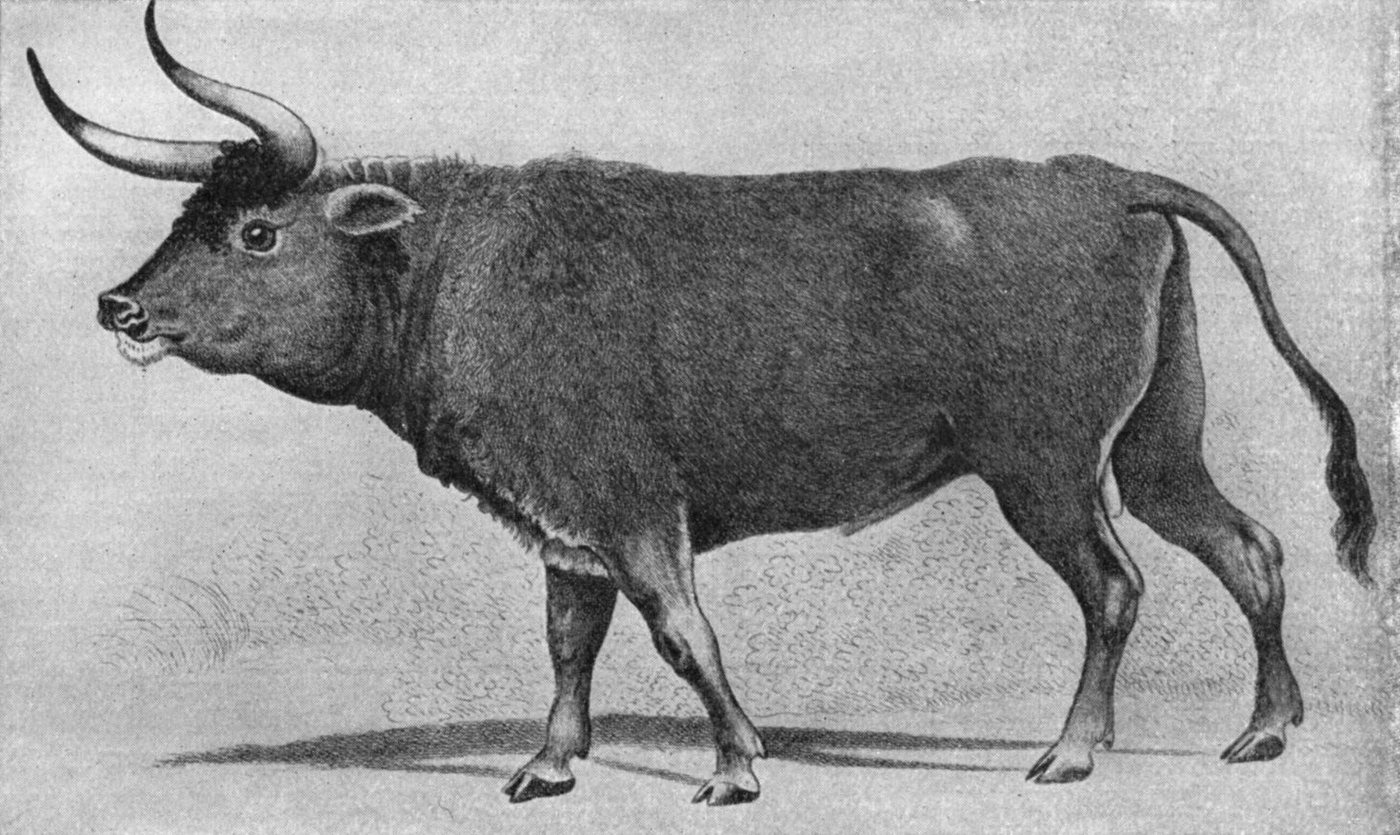
The aurochs, Bos primigenius, stood around 1.8 metres at the shoulder in northern European bulls, substantially larger than the cattle descended from it. Taurine cattle were domesticated in the Fertile Crescent about 10,500 years ago, and the genetic evidence points to a founding population of roughly eighty wild animals in southeastern Anatolia and northern Syria. The last recorded aurochs cow died in 1627 in the Jaktorów Forest in Poland, of natural causes, in a herd the Polish crown had been protecting.
Eighty animals, ten thousand years, and the result is the ox in the photograph at the top of this page. That is the actual story of patient work, and nobody had to invent it.
Why is there an ox at the manger?
Because of Isaiah, not Luke.
Neither nativity account has one. Matthew has no manger scene at all. Luke has the manger and the lack of room and mentions no animals. The ox and the ass come in through two verses read across into the story by early commentators. Isaiah 1:3: the ox knows its owner and the ass its master’s crib, but Israel has not known me. And the Septuagint text of Habakkuk 3:2, read in Greek as saying that God is made manifest between two living creatures, a sense the Hebrew does not carry.
The Gospel of Pseudo-Matthew, a Latin infancy text usually placed in the seventh or eighth century, is the first known narrative that actually puts the animals at the birth and has them bow, and its chapter 14 quotes both verses while doing it. But the picture got there first: the ox and the ass are already carved on fourth-century Roman sarcophagi. On the sarcophagus in Sant’Ambrogio in Milan associated with Stilicho, of about 385, the infant lies between the two animals with neither Mary nor Joseph in the scene.
Exegesis, then art, then narrative, in that order. It is a real tradition, sixteen centuries deep and older than most of what surrounds it in a modern nativity set. It is just not a Gospel one, and the ox has been standing there on the strength of a line about how a working animal knows who feeds it.
Across traditions
Chinese (the second earthly branch)
The ox is the second animal of the twelve-year cycle, paired with chou 丑, the second earthly branch. The branch sequence is the older layer: the twelve branches appear as an ordered set in Shang oracle-bone record-keeping around 1200 BCE, long before any animal was mapped onto them. The mapping itself is attested by 217 BCE on the bamboo daybook slips from Shuihudi in Hubei, and the first complete twelve-animal listing survives in Wang Chong's Lunheng in the first century CE.
The animal name is worth reading carefully. Chinese niu 牛 covers cattle in general rather than a castrated draught male specifically, and the Vietnamese cycle, which otherwise tracks the Chinese one closely, takes the second animal as the water buffalo, trâu. So the second sign is an ox in English by translators' convention. In the field it is whichever bovine actually pulls the plough.
- PRIMARY Shuihudi Qin bamboo slips, Rishu (Daybook) . Tomb sealed 217 BCE, Yunmeng, Hubei. Pairs the twelve earthly branches with animals.
- PRIMARY Wang Chong, Lunheng, chapter 14 . 1st century CE. Earliest complete twelve-animal listing paired with the earthly branches. Alfred Forke trans., Kelly and Walsh, 1907 to 1911; revised Paragon, 1962.
- MUSEUM Set of twelve zodiac animals, Metropolitan Museum of Art 2000.662.7a to l . Earthenware with white slip, 8th century, China. Gift of Charlotte C. Weber, 2000.
Daoist (Laozi at Hangu Pass)
The oldest account of Laozi is in Sima Qian's Shiji, compiled around 104 to 91 BCE, and Sima Qian is candid that he has very little to work with. The narrative he gives is spare: the old archivist of Zhou, seeing the state in decline, goes west, is stopped at the pass by the keeper Yin Xi, who asks him to set down his teaching before he disappears, and leaves behind a book in two parts on the Way and its power.
The ox is not the load-bearing part of that account. It belongs to the iconography, which is where it became inseparable from the story: Laozi crossing west on the back of an ox, or in the later and more common form a green water buffalo, the qingniu, with a servant walking ahead. That image is what Chinese and Japanese painters returned to for centuries, and it is doing something the text does not. A man abandoning civilisation rides out on the animal that civilisation was built with.
A. C. Graham's argument that the Laozi of the Shiji is itself a conflation of separate legends is the standard caution here. Sima Qian was reconstructing a figure four centuries after the fact, and the mount is a further layer on top of that.
- PRIMARY Sima Qian, Shiji, chapter 63 (biography of Laozi) . Compiled c. 104 to 91 BCE. Laozi goes west, is stopped by the keeper of the pass, and writes the text in two parts. Nienhauser, ed., The Grand Scribe's Records, Indiana University Press, 1994 onward.
- MUSEUM Chen Hongshou, Paintings after Ancient Masters: Laozi Riding an Ox, Cleveland Museum of Art 1979.27.1.2 . Ming dynasty, artist 1598/99 to 1652. Album leaf.
- PEER-REVIEWED Laozi (Stanford Encyclopedia of Philosophy) . On the Shiji account, its date, and A. C. Graham's conflation argument.
Chan and Zen Buddhist (the ten ox-herding pictures)
The best-documented ox tradition anywhere is a training sequence. The ten ox-herding pictures, with verses and prose introductions, are attributed to Kuoan Shiyuan, a twelfth-century Chan master of the Linji line, and they set out ten stages: searching for the ox, finding its tracks, glimpsing it, catching it, taming it, riding it home, ox forgotten and self alone, both forgotten, returning to the source, and entering the marketplace.
The ox is the practitioner's own mind, and that is what makes the sequence unusual as animal symbolism: the animal is not an external helper, a guide, or a message. It is the thing doing the reading. The pictures do not end at mastery either. The eighth is an empty circle, and the tenth returns the practitioner to an ordinary street with ordinary people, which is a deliberate refusal of the enlightenment-as-arrival structure the earlier images could be read as promising.
Kuoan's is not the only version. An earlier five-picture sequence attributed to Qingju has the ox gradually whiten as it is tamed, and Puming's set circulated widely in China with its own poems. D. T. Suzuki's discussion, and the Nyogen Senzaki and Paul Reps translation, are the route by which the ten pictures reached English.
- PRIMARY Kuoan Shiyuan (廓庵師遠), Ten Ox-Herding Pictures with verses . 12th-century Chan (Linji) master, Song dynasty. Ten stages with accompanying verses and prose introductions.
- REFERENCE D. T. Suzuki, Manual of Zen Buddhism . Contains the ten pictures with translated verses; the principal route by which the sequence entered English, alongside the Nyogen Senzaki and Paul Reps translation.
- MUSEUM Tenshō Shūbun, Ox-herding pictures, Shōkoku-ji, Kyoto . 15th century, after lost 12th-century originals. The most reproduced painted set.
Christian (the ox at the manger, which is not in the Gospels)
The ox standing over the crib is one of the most familiar images in European art and it does not appear in either nativity account. Matthew has no manger scene at all; Luke has the manger and the absence of room, and mentions no animals. The ox and the ass arrive from elsewhere.
Two verses did the work. Isaiah 1:3, in the Vulgate and in English after it, reads that the ox knows its owner and the ass its master's crib, but Israel has not known me; early Christian commentators read the manger of that verse into the manger of Luke. The Septuagint text of Habakkuk 3:2 was read as saying that God is made manifest between two living creatures, a reading that arises from the Greek and not the Hebrew, and it supplied the pairing.
The Gospel of Pseudo-Matthew, a Latin infancy text usually dated to the seventh or eighth century, is the first known narrative in which the ox and the ass are actually present at the birth and bow to the child, and its chapter 14 cites Isaiah and Habakkuk while doing it. The picture ran ahead of the text: the animals are already on fourth-century Roman sarcophagi, among them the sarcophagus in Sant'Ambrogio in Milan associated with Stilicho, of about 385, where the infant lies between the ox and the ass with no Mary and no Joseph in the scene at all.
So the sequence is exegesis first, then art, then narrative. It is a genuine and very old Christian tradition. It is simply not a Gospel one, and the distinction is worth stating precisely rather than quietly.
- PRIMARY Isaiah 1:3 . "The ox knoweth his owner, and the ass his master's crib: but Israel doth not know, my people doth not consider." The verse behind the pairing.
- PRIMARY Habakkuk 3:2 (Septuagint) . The Greek was read as "between two living creatures thou shalt be made known"; the Hebrew does not carry this sense.
- PRIMARY Gospel of Pseudo-Matthew, chapter 14 . Latin infancy gospel, usually dated 7th to 8th century. First known narrative placing the ox and the ass at the nativity, citing Isaiah and Habakkuk.
- MUSEUM Sarcophagus of Stilicho, Basilica of Sant'Ambrogio, Milan . Roman, c. 385. The infant between ox and ass, without Mary or Joseph, among the earliest surviving nativity images.
Working with the Ox
If you want a regular practice rather than a one-time read, an oracle deck is the standard tool: you draw a card and sit with whatever animal comes up. Our ranked guide to spirit animal oracle decks compares the field.
Sources
- PRIMARY Sima Qian, Shiji, chapter 63 . Compiled c. 104 to 91 BCE. The earliest account of Laozi's departure west.
- PRIMARY Shuihudi Qin bamboo slips, Rishu (Daybook) . Tomb sealed 217 BCE. Branch-animal pairings.
- PRIMARY Wang Chong, Lunheng, chapter 14 . 1st century CE. Earliest complete twelve-animal listing.
- PRIMARY Kuoan Shiyuan, Ten Ox-Herding Pictures with verses . 12th-century Chan master of the Linji line.
- PRIMARY Gospel of Pseudo-Matthew, chapter 14 . 7th to 8th century Latin infancy gospel; first narrative placing the ox at the nativity.
- PRIMARY Deuteronomy 25:4; 22:10; 5:14, and Exodus 23:12 . "You shall not muzzle an ox while it is threshing"; "You shall not plow with an ox and a donkey together"; the ox named in the sabbath rest. Sefaria, JPS translation.
- PRIMARY Isaiah 1:3 . The ox knows its owner and the ass its master's crib. The verse that put both animals at the manger.
- MUSEUM Chen Hongshou, Laozi Riding an Ox, Cleveland Museum of Art 1979.27.1.2 . Ming dynasty album leaf.
- MUSEUM Set of twelve zodiac animals, Metropolitan Museum of Art 2000.662.7a to l . Tang dynasty earthenware, 8th century.
- REFERENCE Aurochs (Bos primigenius) . The last recorded aurochs cow died in 1627 in the Jaktorów Forest, Poland; taurine cattle were domesticated in the Fertile Crescent roughly 10,500 years ago from a founding population of about eighty wild animals.