Spirit Animal
Praying Mantis Spirit Animal
Praying mantis spirit animal meaning: stillness, patience and prophecy. Traced from the modern stillness-and-patience reading back through Ted Andrews's Animal Speak to ǀKaggen of the ǀXam San, the Greek word for a prophet that gave the insect its name, and the Chinese martial art built on its strike.
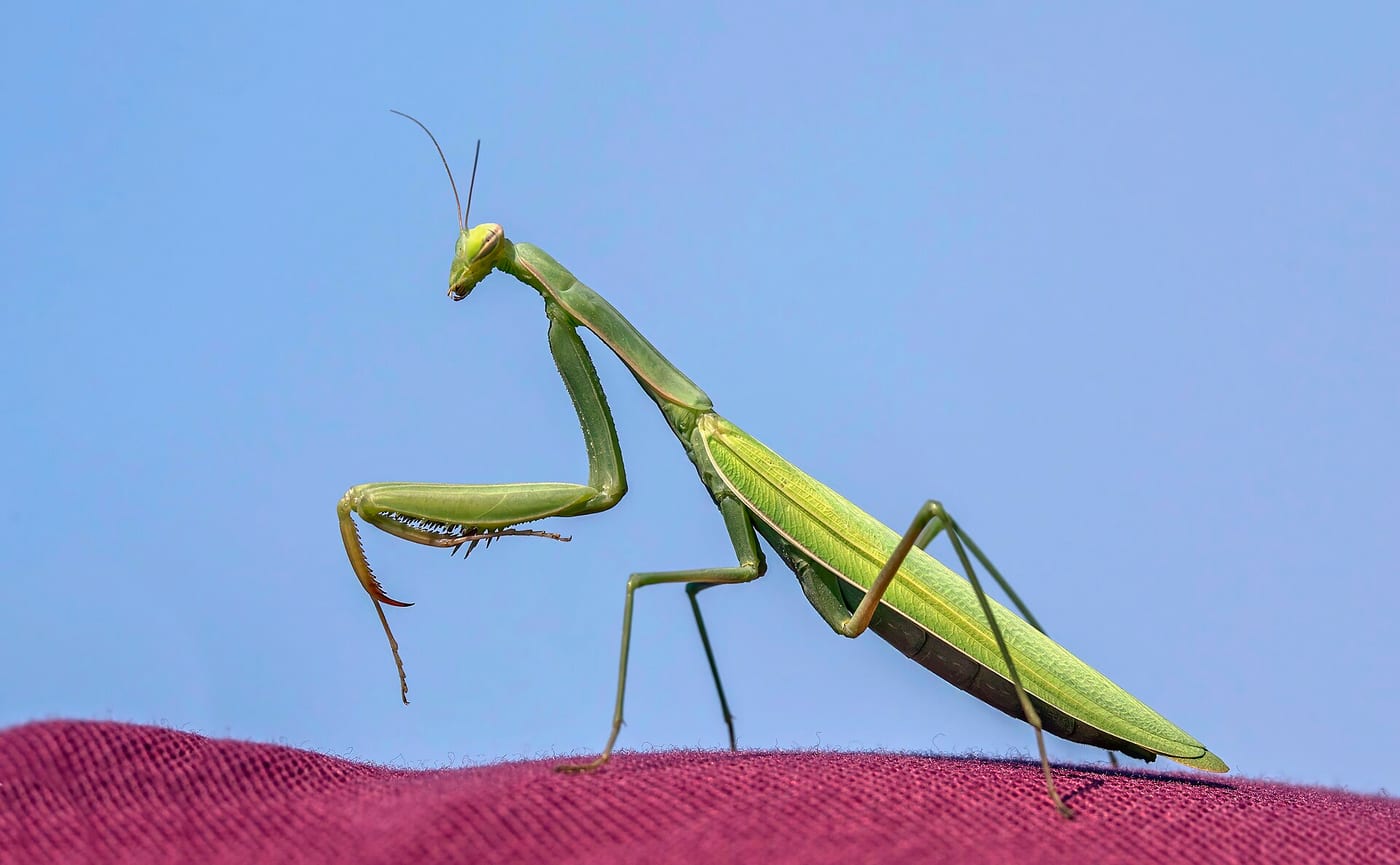
In modern usage the praying mantis signals stillness, patience, and the answer that arrives when you stop chasing it, a reading that traces most directly to Ted Andrews's Animal Speak (Llewellyn, 1993), whose keynote for the insect is the power of stillness. The older record is more specific and more interesting: ǀKaggen, the trickster-creator of the ǀXam San of southern Africa, appears in the 1870s Bleek and Lloyd narratives as a being who can take mantis form and who solves his troubles by sleeping on them. The prophetic association most sites assert for ancient Greece is a fact about a word, not a documented cult.
The praying mantis is one of the clearest cases on this site of a symbol built almost entirely out of a name.
Two separate acts of interpretation are already baked into the label before anyone reaches for its meaning. A naturalist borrowed the Greek word for a prophet, and a second naturalist added a species name that reads the insect’s folded forelimbs as devotion. Neither is a description. The mantis holds its forelimbs that way because they are raptorial, folded into the loaded position a strike is released from, and the whole posture is about eating rather than praying.
That is worth saying plainly, because the two most common claims made about this insect online both overstate the record. The first is that the ancient Greeks regarded the mantis as prophetic. The word is genuinely ancient and genuinely means seer; the application of it to this insect is a much later naming convention, and a real cult is a different claim requiring different evidence. The second is that the San of southern Africa worshipped the praying mantis as a god. What the record actually shows is more particular and more worth reading.
What ǀKaggen actually is
The ǀXam narratives collected by Bleek and Lloyd in the 1870s are among the best-documented bodies of southern African oral literature, and they exist because of a grim circumstance: the narrators were prisoners. Their names are known, which matters. ǁKabbo, ǀHanǂkasso and the others are not an anonymous source pool but individuals whose particular tellings the notebooks preserve.
ǀKaggen, the figure at the centre of them, is a trickster and a creator. He makes the eland. He is repeatedly outwitted, injured, and put back together. And he changes shape, appearing as a mantis but equally as an eland, a hartebeest, a snake, or a man.
The English habit of calling him simply “the Mantis” is the problem. It converts a being whose defining trait is that he will not stay in one form into an insect god, which is roughly the opposite of what the narratives describe. The identification with the praying mantis in particular is a translation decision rather than something self-evident in the ǀXam.
What does survive the compression, and what later writers picked up, is the sleeping. ǀKaggen in difficulty withdraws, sleeps, and finds his answer in the dream. That is a genuinely distinctive idea and it is the one thread connecting the oldest layer here to the newest.
The martial art reads it the other way round
Northern Praying Mantis is a living style built on the insect’s mechanics: the hooked hand that traps and redirects, and the close-range strike released from a held position. Its origin story, a swordsman named Wang Lang studying the insect after a defeat, is not securely dated. Some versions place him in the Song dynasty, most in the late Ming. Those are centuries apart, and the lineages disagree among themselves.
The symbolism is what makes it worth including. Here the stillness is not devotional and it is not contemplative. It is the wind-up. The same posture Europe read as prayer, this tradition read as a fighter waiting, and both readings are looking at the same set of forelimbs.
Where the modern meaning comes from
If you have read that the mantis means patient stillness, that good things come to those who wait, and that the Bushmen revered it and the Chinese built a kung fu style from it, you have read Ted Andrews, whether the page credited him or not.
Animal Speak (1993) gives the mantis a keynote of stillness, arguing that quieting the outer mind is what makes the inner one reachable. Andrews also relays both older traditions, including the detail that the Mantis in trouble would sleep and dream his solution. That is a real thread from the ǀXam material, arriving several removes downstream and with the shapeshifting removed.
The reading is not baseless. It is a synthesis, assembled in 1993 from the insect’s genuine motionlessness plus a compressed gesture at two much older traditions, and it has been recopied so widely since that its origin has become invisible. Knowing where it came from does not make it less usable. It just means you can go back to the ǀXam notebooks, which are online, and read what the people who actually told these stories said.
Across traditions
ǀXam San (ǀKaggen)
The richest documented tradition around the mantis belongs to the ǀXam San of the northern Cape, and it survives because of an unusual and uncomfortable piece of colonial history. In the 1870s the philologist Wilhelm Bleek and his sister-in-law Lucy Lloyd interviewed ǀXam men who were serving sentences in the Cape Town Breakwater Prison, recording their language, natural history and narratives in phonetic transcription alongside English translation. The named narrators, ǀA!kunta, ǁKabbo, Diäǃkwain, !Kweiten-ta-ǀǀKen and ǀHanǂkasso, are not anonymous folk-sources; they are identifiable people whose individual voices the notebooks preserve. Lloyd published eighty-seven of the narratives as Specimens of Bushman Folklore (G. Allen, 1911), sixteen years after Bleek's death in 1875. The full archive is digitised as The Digital Bleek and Lloyd at the University of Cape Town.
ǀKaggen, the central figure of these narratives, is a trickster and a creator: he makes the eland, he is repeatedly outwitted and injured, and he shapeshifts. Two things are routinely got wrong about him. First, he is not simply an insect deity. He appears as a mantis, but also as an eland, a hartebeest, a snake and a man, and the English convention of calling him "the Mantis" flattens a being whose whole character is that he does not hold one form. Second, the identification with the praying mantis specifically is a translation decision, not a self-evident fact of the ǀXam text. What is well attested is the pattern Andrews later picked up and simplified: when ǀKaggen is in trouble he withdraws, sleeps, and finds his answer in a dream.
- PRIMARY W.H.I. Bleek and L.C. Lloyd, Specimens of Bushman Folklore . G. Allen, London, 1911. Eighty-seven ǀXam narratives with facing transcription.
- PRIMARY The Digital Bleek and Lloyd, University of Cape Town . Digitised notebooks and artwork from the 1870s collection.
Greek (the name, not a cult)
The insect carries a Greek word for a prophet. Mantis (μάντις) means a seer or diviner, from mainesthai, to be inspired, related to menos, passion or spirit. That is the same root behind mania and behind the -mancy in necromancy. Linnaeus fixed it into the scientific record in the tenth edition of Systema Naturae (1758) as Mantis religiosa, adding a species name that reads the folded forelimbs as devotion.
It is worth being precise about what this does and does not show, because a great many pages overstate it. The English use of mantis for the insect dates to the 1650s. The word is genuinely ancient and genuinely means prophet; the application of it to this insect is a naturalist's naming convention layered on top. That is a fact about vocabulary. It is not the same as evidence that ancient Greeks kept a mantis cult, treated the insect as an oracle, or read its appearance as an omen, and this page does not claim they did. The posture that produced both halves of the binomial is a raptorial one: the forelimbs are folded because that is the loaded position from which the strike is released.
- PRIMARY Carl Linnaeus, Systema Naturae, 10th edition . Stockholm, 1758. Original description of Mantis religiosa.
- REFERENCE Online Etymology Dictionary, mantis . Greek mantis, one who divines, a seer, prophet; from mainesthai, be inspired. English insect sense from the 1650s.
Chinese martial arts (Northern Praying Mantis)
Northern Praying Mantis, tanglangquan, is a real and continuously practised style whose techniques are explicitly modelled on the insect: the hooked hand that traps and redirects, and the sudden close-range strike from a held position. Its origin story credits a swordsman named Wang Lang, said to have studied the mantis after losing a contest and to have built the system from what he saw.
The dating of that story is not settled, and treating it as history would be a mistake. One version places Wang Lang in the Song dynasty among masters gathered at Shaolin; most place him in the late Ming, roughly four hundred years ago. The two accounts are centuries apart and the style's own lineages disagree, which is the ordinary condition of martial-arts origin narratives rather than a scandal. What matters for symbolism is the reading itself, and it runs directly against the devotional one Europe baked into the name: here the mantis is not at prayer, it is a fighter whose stillness is the wind-up.
- REFERENCE Northern Praying Mantis (tanglangquan), style-lineage accounts . Origin attributed to Wang Lang; dating contested between Song-dynasty and late-Ming versions.
Ted Andrews (1993, the pop-concept's source)
The modern reading, stillness, patience, and the answer that comes once you stop pursuing it, is Ted Andrews's Animal Speak (Llewellyn, 1993). His keynote for the mantis is the power of stillness: the argument is that quieting the outer mind is what makes the inner one available, and the insect's motionless waiting is offered as the emblem of it.
Andrews is also the point where the older material enters English-language pop usage, which is why so many pages repeat the same two examples in the same order. He mentions the Chinese martial art, and he relays the Kalahari material with the detail that the Mantis, in trouble, would go off, sleep, and dream his way to a solution. That is a recognisable compression of the ǀKaggen narratives above, several removes from the ǀXam notebooks and without the shapeshifting that makes ǀKaggen who he is. If a page tells you the mantis means patient stillness and then mentions Bushmen and kung fu, it is repeating Andrews, whether or not it says so.
- REFERENCE Ted Andrews, Animal Speak: The Spiritual & Magical Powers of Creatures Great and Small . Llewellyn, 1993. Keynote for the mantis: the power of stillness.
Working with the Praying Mantis
If you want a regular practice rather than a one-time read, an oracle deck is the standard tool: you draw a card and sit with whatever animal comes up. Our ranked guide to spirit animal oracle decks compares the field.
Sources
- PRIMARY W.H.I. Bleek and L.C. Lloyd, Specimens of Bushman Folklore . G. Allen, London, 1911.
- PRIMARY The Digital Bleek and Lloyd, University of Cape Town . Digitised 1870s ǀXam notebooks.
- PRIMARY Carl Linnaeus, Systema Naturae, 10th edition . Stockholm, 1758.
- REFERENCE Ted Andrews, Animal Speak . Llewellyn, 1993.
- REFERENCE Online Etymology Dictionary, mantis . Greek mantis, seer or prophet; English insect sense from the 1650s.